
Table of Contents
Table of Contents
Serverless managed Kafka is attractive for the same reason most serverless infrastructure is attractive: a team can start a production-looking service without sizing brokers, planning disks, or owning every upgrade window. That matters. Development teams want a Kafka API quickly, platform teams want fewer clusters to babysit, and FinOps teams like the idea of usage-based spend instead of idle capacity. The pricing question starts after that first good impression.
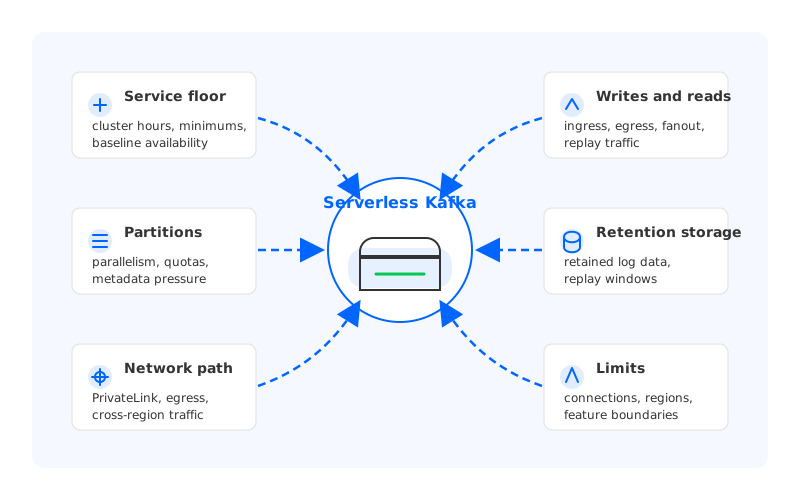
Serverless Kafka pricing does not automatically mean the lowest Kafka cost. It means the vendor has converted infrastructure, operations, scaling policy, storage behavior, and guardrails into service meters. Those meters can be excellent for bursty workloads, early-stage products, low-ops environments, and teams that value speed over low-level control. They can become less comfortable when the workload turns into sustained high throughput, long retention, large partition counts, heavy private networking, or a platform-wide event backbone with predictable demand.
The commitment mistake is to compare one advertised unit against one broker instance. A Kafka bill is the result of data movement, log retention, client fanout, partitions, network placement, and operational boundaries. Serverless changes how those costs are packaged; it does not remove them.
1Why Serverless Kafka Looks Attractive
Traditional Kafka capacity planning is not gentle to a new team. You need a broker count, disk size, replication factor, availability-zone layout, partition strategy, upgrade plan, monitoring baseline, and enough spare headroom for a failure or a launch spike. Managed Kafka reduces part of that burden, but many provisioned managed services still ask teams to pick cluster size or capacity units.
Serverless managed Kafka moves the buying experience closer to an application service. Amazon MSK Serverless, for example, presents a cluster model where capacity is handled by the service and pricing is tied to cluster hours plus dimensions such as partitions, storage, and data written or read. Confluent Cloud has evolved around cloud-native cluster types and pricing units, while its public pricing and cluster documentation separate concerns such as cluster type, networking, storage, and enterprise features. Upstash Kafka historically pushed the idea even further with a per-request serverless Kafka experience, although Upstash announced that Kafka was deprecated and stopped accepting new Kafka users in 2024.
For a team evaluating serverless managed Kafka, the operational value is real:
- Faster environment creation for application teams that need a Kafka-compatible endpoint.
- Less day-two work around broker replacement, storage sizing, and patch cadence.
- Smaller initial commitment when traffic is uncertain.
- A billing model that can scale down better than an always-on dedicated cluster.
- A clean way to separate low-volume product experiments from the main streaming platform.
Those benefits are why serverless deserves a serious look. The next question is whether the billing surface matches the workload's shape.
2The Pricing Dimensions Behind Serverless Kafka
A credible serverless Kafka pricing review should map the workload to every service meter that can move. Vendor pages change, and negotiated contracts differ, so the safest planning method is not to memorize a single price. The safer method is to identify which technical behaviors trigger billable units.
| Pricing dimension | What to verify before commit | Why it matters |
|---|---|---|
| Cluster or service hours | Is there a base hourly charge, minimum spend, or always-on resource? | Some serverless services still have a steady floor even when traffic is low. |
| Data ingress and egress | Are writes, reads, or throughput capacity billed separately? | Kafka fanout can make read traffic larger than producer traffic. |
| Partitions | Are partitions a quota, a billed dimension, or both? | Kafka applications often scale by partition count before data volume becomes large. |
| Storage and retention | Is retained data billed by logical storage, physical storage, tier, or included allowance? | Retention turns traffic spikes into persistent cost. |
| Network path | Are PrivateLink, public egress, cross-zone, or cross-region paths billed outside the Kafka line item? | The cloud network bill may not sit on the managed Kafka invoice. |
| Connections and clients | Are there limits on client connections, request rate, or throughput per connection? | Many small services can stress connection limits before total GB looks high. |
| Operational limits | What are the ceilings for throughput, partitions, retention, regions, and features? | A workload can be affordable and still not fit the product envelope. |
A partition can be a cost dimension, a quota dimension, and a performance dimension at the same time. A private endpoint can be a security requirement, a networking limit, and a cost line. Serverless simplifies cluster operation, but it makes workload modeling more important because you have fewer low-level levers after purchase.
2.1Throughput and Request Units
Kafka is rarely priced by a single stream of bytes. Producers write records, brokers replicate them, consumers read them, connectors move them again, and stream processors may reread retained data during recovery. A serverless service can hide brokers, but it still has to provision network, CPU, memory, and storage work somewhere.
This is where serverless Kafka cost can diverge from first impressions. A 20 MiB/s write workload with one consumer group is different from a 20 MiB/s write workload with eight independent consumer groups, two sink connectors, and a replay-heavy analytics team. The producer number is the same; the read-side pressure is not.
When reviewing Amazon MSK Serverless or another serverless Kafka service, separate the following:
- Sustained write throughput during normal operation.
- Peak write throughput during launches, batch loads, or incident catch-up.
- Read fanout across independent consumer groups.
- Reprocessing traffic during backfills and disaster recovery drills.
- Per-partition throughput limits and aggregate service limits.
Do not treat serverless as infinite burst capacity. Official quota pages exist because every managed service has boundaries, so production designs should check default quotas and quota-increase paths.
2.2Storage Retention
Retention is the quiet budget multiplier. Kafka teams often start with short retention because they are thinking about event delivery, then extend retention because replay, audit, analytics, and operational recovery become valuable. In provisioned Kafka, retention pushes teams toward larger disks, tiered storage, or more frequent capacity work. In serverless Kafka, retention is often converted into a storage meter or a quota boundary.
A useful model is to compute logical retained data before looking at any vendor price. If a workload writes 10 MiB/s continuously, it produces roughly 864 GiB per day before compression effects and protocol overhead. Seven days is roughly 6 TiB of logical data. Thirty days is roughly 25 TiB. The exact bill depends on service pricing, compression, compaction, reads, and storage implementation, but the architectural fact remains: long retention makes Kafka behave less like a transient pipe and more like a replayable data store.
That distinction should drive the buying decision. Serverless Kafka is often appealing when retention is modest and operational simplicity is the priority. Long retention with frequent replay may favor a design that makes storage economics explicit, especially if object storage can hold durable log data without binding all retained bytes to broker-local capacity.
2.3Networking and Private Access
Network cost is where serverless Kafka buyers can get surprised because the managed Kafka service may not be the only bill. A production Kafka deployment may need private connectivity, traffic from multiple VPCs, cross-zone access, cross-region replication, connector traffic, and egress to analytics systems. Some of those charges can appear on the cloud provider bill rather than the Kafka vendor invoice.
Before committing, trace the paths:
- Producers to the Kafka endpoint.
- Broker-side replication or service-internal movement, where visible.
- Kafka to every consumer group.
- Kafka Connect or managed connectors to source and sink systems.
- Disaster recovery replication across regions.
- PrivateLink, VPC peering, NAT gateways, or internet egress.
This is not a reason to avoid serverless. It is a reason to avoid a narrow quote. FinOps needs to model the whole data path, not only the line called "Kafka." Architects should also verify whether private networking changes available regions, cluster types, throughput ceilings, or enterprise feature requirements.
3Serverless vs Dedicated Managed Kafka Cost
Serverless and dedicated managed Kafka are not stages on a maturity ladder where one is always better. They are different cost-control models. Serverless is strongest when demand is uncertain, spiky, or operationally small. Dedicated or BYOC models often become more attractive when the workload is predictable, high-volume, or strategically central.
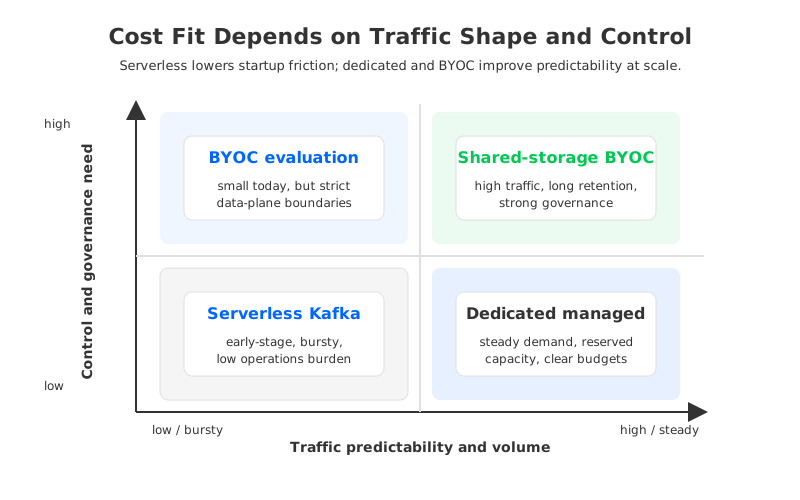
Use the following decision frame:
| Workload shape | Serverless managed Kafka fit | Dedicated managed Kafka fit | BYOC or shared-storage fit |
|---|---|---|---|
| Early-stage product with uncertain traffic | Strong fit because startup friction and idle capacity are low | Usually premature unless compliance demands it | Possible, but may be more platform work than needed |
| Bursty application events | Strong if quotas and burst behavior match | Good when peaks are predictable and reserved capacity is acceptable | Good when burst elasticity must stay inside customer cloud boundaries |
| High sustained throughput | Can fit, but watch aggregate meters and limits | Often easier to forecast with reserved capacity | Often attractive when storage and compute can scale independently |
| Long retention and frequent replay | Watch storage and read-side meters carefully | Better if tiering and capacity planning are favorable | Strong when object storage economics are central to the design |
| Strict data-plane control | Depends on vendor networking and compliance model | Better in private or dedicated offerings | Strong fit when data remains in the customer's cloud account |
The practical takeaway is that serverless Kafka lowers the cost of being wrong early. If the product succeeds, revisit the model before the workload quietly crosses into a different cost regime.
4Where Serverless Kafka Pricing Becomes Hard to Forecast
Serverless pricing becomes hard when workload behavior is not captured in the first sizing worksheet. This usually happens in four places.
Partition count can grow for parallelism, tenant isolation, ordering domains, or future headroom before GB volume looks large. Read fanout can multiply after Kafka becomes a shared integration layer. Retention can shift from a convenience setting into a recovery and compliance requirement. Private networking can arrive late, changing both product tier and cloud network cost.
A good pricing review asks for a future-state model: 10x topic count, more consumer groups, longer retention, and mandatory private access. Those questions prevent a pleasant launch experience from becoming an uncomfortable renewal.
5When BYOC Kafka Is a Better Fit
Bring-your-own-cloud Kafka is not the opposite of managed Kafka. It is a different boundary: the control plane and operational automation can be managed, while the data plane, networking, and storage live in the customer's cloud environment. For regulated teams, platform teams with strong cloud standards, or companies with committed cloud spend, that boundary can matter as much as the headline service price.
BYOC is often worth evaluating when:
- Data residency, VPC boundaries, or private networking rules are non-negotiable.
- Kafka traffic is high enough that per-usage serverless meters need careful scrutiny.
- Long retention makes storage architecture a first-order cost driver.
- The team wants Kafka protocol compatibility without ceding all data-plane control to a multi-tenant SaaS model.
- Procurement wants a clearer separation between vendor software cost and cloud infrastructure cost.
This is where AutoMQ enters the discussion naturally. AutoMQ represents an elastic Kafka-compatible path built around a shared-storage architecture: brokers can be treated more like compute, while durable log data is placed on object storage in the customer's environment. That does not make it a universal replacement for every serverless Kafka use case. A small team with a low-volume prototype may still prefer a fully serverless SaaS experience. But for teams that want elasticity, Kafka compatibility, BYOC control, and more explicit storage economics, the architecture gives them another option besides accepting every serverless billing meter as a black box.
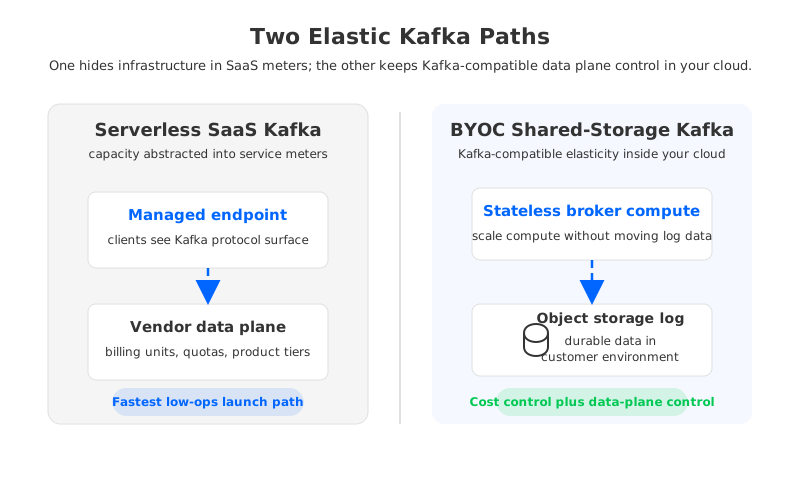
Serverless SaaS optimizes the user experience by hiding infrastructure. Shared-storage BYOC optimizes the operating model by changing where state lives and who controls the data plane.
6A Pre-Commit Checklist for Serverless Managed Kafka
Before signing a contract or standardizing on a serverless managed Kafka service, ask the vendor and your internal platform team the same concrete questions.
- What are the default and maximum quotas for partitions, throughput, retention, connections, and regions?
- Which meters apply to writes, reads, retained data, partitions, private networking, and cross-region traffic?
- Which costs appear on the vendor invoice and which appear on the cloud provider bill?
- How does the service behave during a sudden traffic burst, a consumer replay, or a regional failover test?
- What happens when the workload moves from seven-day retention to thirty-day retention?
- Can the team export, migrate, or mirror data without changing client semantics?
- Are Kafka APIs, clients, transactions, Connect, Schema Registry, and ecosystem tools supported at the level your applications require?
- What is the migration path if serverless stops being the right economic model?
The last question is the one teams skip most often. Serverless is a good starting point when it buys speed and reduces idle commitment. It is a risky endpoint if the team has no plan for the moment when usage, retention, or governance requirements exceed the model.
7References
- Amazon MSK pricing
- Amazon MSK Serverless
- Amazon MSK quotas
- Confluent Cloud pricing
- Confluent Cloud cluster types
- Upstash product updates, Q1 2024
- AutoMQ architecture overview
- What is AutoMQ Cloud
8FAQ
8.1Is serverless Kafka always lower cost than dedicated Kafka?
No. Serverless Kafka can reduce idle capacity and startup friction, especially for bursty or uncertain workloads. Dedicated managed Kafka, BYOC Kafka, or shared-storage Kafka can be more predictable for high sustained throughput, long retention, heavy fanout, or strict data-plane control.
8.2What should I model first for serverless Kafka pricing?
Start with logical write volume, read fanout, retention, partition count, private networking, and replay behavior. Then map those workload traits to the vendor's current pricing units and quotas.
8.3Why do partitions matter in serverless managed Kafka pricing?
Partitions are not only a Kafka design detail. They affect parallelism, metadata, broker work, quotas, and sometimes pricing. A low-GB workload with many topics and partitions can still hit a serverless service boundary.
8.4When is serverless managed Kafka a good fit?
It is a strong fit for early-stage applications, bursty workloads, low-operations teams, development environments, and products where fast launch and low idle commitment matter more than deep infrastructure control.
8.5When should a team evaluate AutoMQ instead?
Evaluate AutoMQ when the team wants Kafka compatibility, elastic scaling, BYOC-style data-plane control, and an architecture where durable log data can live on object storage rather than being tightly coupled to broker-local disks or opaque serverless SaaS meters.


