
Table of Contents
Table of Contents
The hardest Kafka decision often arrives after the proof of concept succeeds. A product team starts with a small managed Kafka cluster or a serverless Kafka endpoint, developers like the reduced setup work, and then the workload becomes important enough for real SLOs, security review, budget ownership, and incident response. At that point, the question changes from "Can we get Kafka quickly?" to "Which operating model will survive production growth?"
Serverless managed Kafka and dedicated Kafka can both be valid production choices. Serverless is not a toy category, and dedicated is not automatically the enterprise answer. The right choice depends on workload shape: throughput steadiness, partition growth, retention, latency sensitivity, consumer fanout, isolation requirements, private networking, and how much operational control the platform team wants to keep.
For architects and SRE teams, the useful comparison is a boundary analysis: which resources are shared, which limits are explicit, how costs scale, where data flows, and who owns the performance envelope.
1Quick recommendation by workload
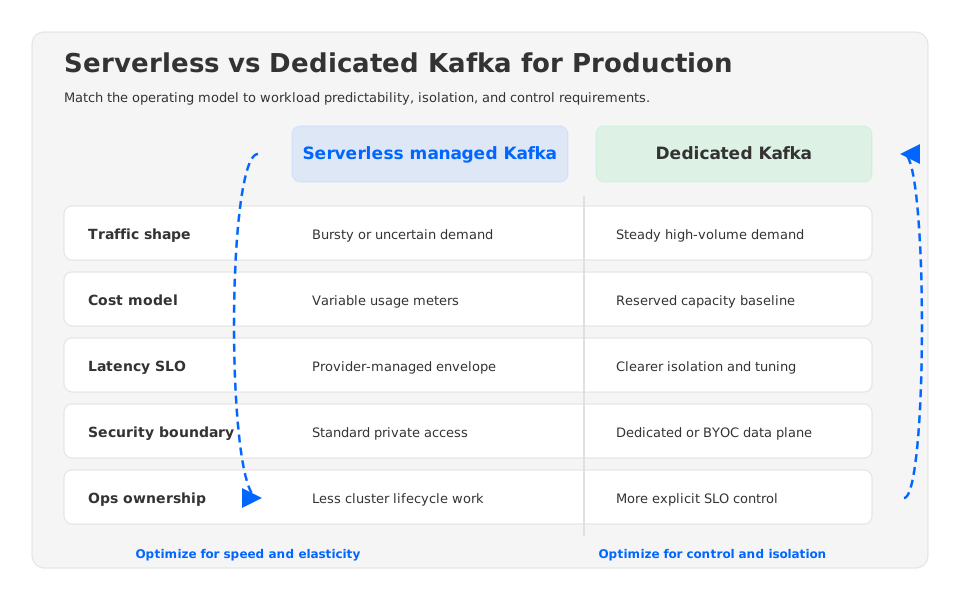
Choose serverless managed Kafka when the workload is uncertain, spiky, moderate in scale, and the team values fast provisioning more than low-level control. It is especially compelling for development-to-production transitions where the first production objective is to remove broker operations from the team's critical path. Amazon MSK Serverless, for example, documents a model where AWS handles capacity management while users still configure networking, authentication, topics, producers, and consumers. Confluent Cloud also offers cloud-native cluster types where buyers can choose different operating envelopes instead of starting with raw VMs.
Choose dedicated Kafka when the workload is steady, high-throughput, latency-sensitive, tightly governed, or expected to become a shared enterprise data backbone. Dedicated capacity gives teams clearer resource boundaries, stronger isolation, and more predictable performance tuning. It also gives procurement and FinOps teams a simpler base for committed spend, because a dedicated managed Kafka service usually has known capacity units, instance boundaries, or contract dimensions.
A practical first pass looks like this:
| Production condition | Serverless managed Kafka usually fits when... | Dedicated Kafka usually fits when... |
|---|---|---|
| Traffic pattern | Traffic is bursty, early-stage, or hard to forecast | Traffic is sustained, large, or capacity planning is stable |
| Latency SLO | The application can tolerate provider-managed placement and guardrails | Tail latency and noisy-neighbor isolation need tighter control |
| Partition growth | Topic and partition counts stay within published service quotas | Partition count is a core scaling dimension |
| Retention | Retention is short or moderate | Long replay windows and backfills are strategic |
| Security | Standard encryption, IAM, and private access are enough | Network isolation, audit boundaries, and private data plane control matter |
| Operations | The team wants minimal cluster lifecycle work | The platform team wants explicit capacity, SLO, and incident boundaries |
| Budget | Usage-based variability is acceptable | Predictable committed capacity is more important |
This is not a maturity ladder. Many production workloads should begin serverless. Others should move to dedicated before the event stream becomes a dependency for payments, fraud detection, inventory, observability, or customer-facing analytics.
2Serverless managed Kafka strengths and limits
The main strength of serverless managed Kafka is that it reduces the infrastructure design required before the first production event flows. The provider abstracts broker sizing, capacity expansion, and much of the service lifecycle. That is valuable because Kafka capacity planning is not only about broker count. Teams normally reason about partitions, replica placement, disk throughput, network bandwidth, retention, upgrades, controller behavior, and recovery.
Serverless changes the interface. Instead of asking "How many brokers and how much disk?", the buyer asks "What are the service quotas, pricing meters, and feature boundaries?" That is a cleaner starting point, but it does not remove workload physics. Kafka still needs CPU, memory, network, and durable storage. A provider can automate the supply side; the application still creates demand.
Before using serverless for production, verify these official limits and behaviors:
- Maximum partitions per cluster and per topic.
- Maximum ingress and egress throughput, including per-partition or per-connection limits.
- Retention limits and storage billing behavior.
- Supported Kafka protocol versions, APIs, authentication methods, and client configuration.
- Private connectivity options, VPC/VNet attachment model, and cross-account access.
- Region availability and disaster recovery options.
- SLA terms, support response paths, and operational visibility.
Amazon MSK Serverless quotas are a useful example of why this matters. AWS publishes service limits for serverless clusters, including limits around partitions, throughput, client connections, and request rates. Those limits are not flaws; they are the product envelope. They tell an architect where serverless capacity management stops being invisible and starts becoming a design constraint.
The cost profile also changes. Serverless can reduce waste when traffic is low or unpredictable, but production Kafka often grows beyond producer throughput. A single producer workload can become quota-sensitive when many consumer groups read the same data, processors replay topics, connectors export records, and retention turns spikes into stored bytes.
3Dedicated Kafka strengths and limits
Dedicated Kafka is attractive because it creates a clearer resource boundary. The service may still be managed by a provider, but the cluster, capacity pool, or data plane is dedicated to the customer or environment. That isolation matters when Kafka becomes an internal platform.
The production advantages are concrete:
- More predictable throughput planning because capacity is explicitly reserved.
- Stronger isolation for noisy-neighbor concerns.
- More room for enterprise networking patterns such as private links, peering, transit routing, and controlled egress.
- Better fit for regulated environments where data plane location and access model are reviewed.
- Clearer SLO conversations because platform teams can map demand to reserved capacity.
- Better alignment with committed-use economics when traffic is steady.
Dedicated Kafka has a cost problem of its own: over-provisioning. Kafka teams commonly reserve capacity for peak traffic, broker failure, maintenance windows, partition skew, consumer replay, and future product launches. That headroom is necessary, but it can leave compute and storage idle for long periods. Traditional dedicated Kafka also couples compute and storage closely. When retention grows, brokers need more local disk; when throughput grows, brokers need more compute and network. The scaling unit is not always the same as the bottleneck.
That coupling is why "dedicated" should not automatically mean "fixed and wasteful." A dedicated managed Kafka service can still be elastic if its architecture separates the parts that scale differently.
4Cost predictability and scaling behavior
Cost predictability is where the serverless vs dedicated Kafka debate becomes nuanced. Serverless gives teams a lower-friction path to usage-based spend, but it can make monthly bills harder to forecast when workload growth is nonlinear. Dedicated capacity gives teams a clearer baseline, but the baseline may include idle headroom.
For production planning, model Kafka demand with engineering metrics rather than invoice labels:
| Metric | Why it changes the decision |
|---|---|
| Write throughput | Determines ingestion pressure, storage growth, and replication work |
| Read fanout | Multiplies egress and broker-side work across consumer groups |
| Partition count | Drives metadata, leader distribution, open files, and quota pressure |
| Retention window | Converts event rate into stored data and replay capability |
| Peak-to-average ratio | Indicates whether usage-based serverless economics may help |
| Backfill frequency | Exposes read-side and retention cost that steady-state charts hide |
| Latency SLO | Determines how much isolation and placement control you need |
The inflection point is often the peak-to-average ratio. If average traffic is low but occasional bursts are real, serverless may avoid idle dedicated capacity. If traffic is high and steady, dedicated capacity may be easier to forecast and negotiate. If traffic is high, steady, and retention-heavy, the architecture of the dedicated service becomes more important than the word "dedicated."
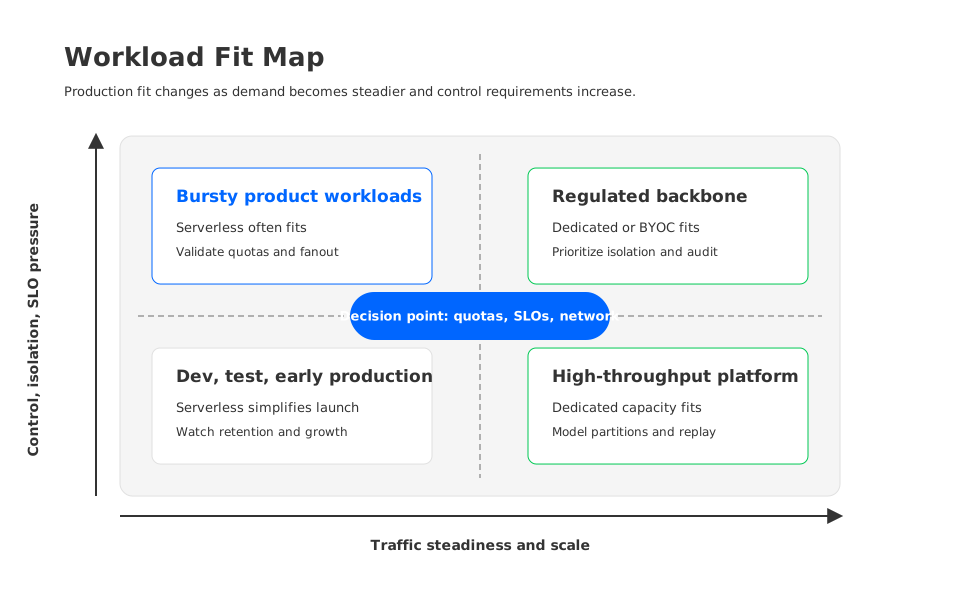
Platform teams should also watch the ratio between throughput growth and partition growth. A microservices estate with many teams, topics, and consumer groups may hit service quotas, connection pressure, or governance complexity before raw MiB/s looks large.
5Latency, isolation, and SLOs
Latency-sensitive Kafka workloads need more than an average latency number. They need tail-latency behavior during broker maintenance, consumer group rebalances, partition leadership changes, compaction, storage pressure, and client retries. Serverless managed Kafka can still serve production latency needs, but the team must accept that the provider controls more of the placement and capacity-management behavior.
Dedicated Kafka gives SREs a cleaner model for SLO ownership. The capacity boundary is clearer, blast radius is easier to explain, and incident response can be tied to a specific cluster or environment. When a payment stream or fraud pipeline needs predictable behavior under sustained load, that clarity is often worth the planning work.
The tradeoff is operational ownership. Dedicated managed Kafka still leaves teams responsible for application-level design: topic naming, partition strategy, producer batching, consumer lag handling, schema governance, ACLs, quotas, and replay processes.
Apache Kafka's own operational documentation points teams toward metrics such as request latency, under-replicated partitions, broker throughput, consumer lag, and controller behavior. Those metrics remain relevant in both serverless and dedicated models. The difference is how much of the underlying remediation path is available to the customer.
6Security, isolation, and enterprise networking
Security is not simply a checkbox for encryption. Production Kafka security includes authentication, authorization, network reachability, auditability, secret handling, data residency, private connectivity, and who can access the data plane during support events.
Serverless managed Kafka is often strong for standard security controls. AWS documents MSK Serverless support for IAM access control and VPC-based access patterns. Confluent Cloud documents multiple networking options across cluster types, including public internet, private networking, and cloud-provider-specific private connectivity depending on plan and environment. Those are real enterprise capabilities.
Dedicated Kafka becomes more attractive when the security review asks for stronger boundaries:
- Single-tenant or customer-dedicated capacity.
- Private endpoints with controlled routing.
- Data plane placement in a customer-approved cloud account, VPC, VNet, or Kubernetes environment.
- Network policies that align with existing firewalls, transit gateways, DNS, and observability tooling.
- Clear support access rules and audit trails.
- Separation between vendor control plane and customer data plane.
This is where BYOC and private dedicated models enter the conversation. They are not only procurement labels. They answer a specific enterprise architecture question: can the organization get a managed Kafka experience while keeping the data plane closer to its own cloud governance model?
7Where AutoMQ fits
AutoMQ is relevant when the team likes the production boundaries of dedicated Kafka or BYOC Kafka, but not the over-provisioning pressure of traditional broker-local storage. Its architecture keeps Kafka compatibility while using stateless brokers and shared object storage as the durable storage layer. That targets the part of dedicated Kafka that often becomes rigid: brokers carrying both compute responsibility and long-lived local data.
In a dedicated or BYOC environment, this architecture can change the scaling discussion. Broker compute can be adjusted with less dependence on moving retained log data between local disks, while object storage handles durable capacity. Teams still size throughput, partitions, client fanout, and networking, but the penalty for broker over-provisioning can be lower.
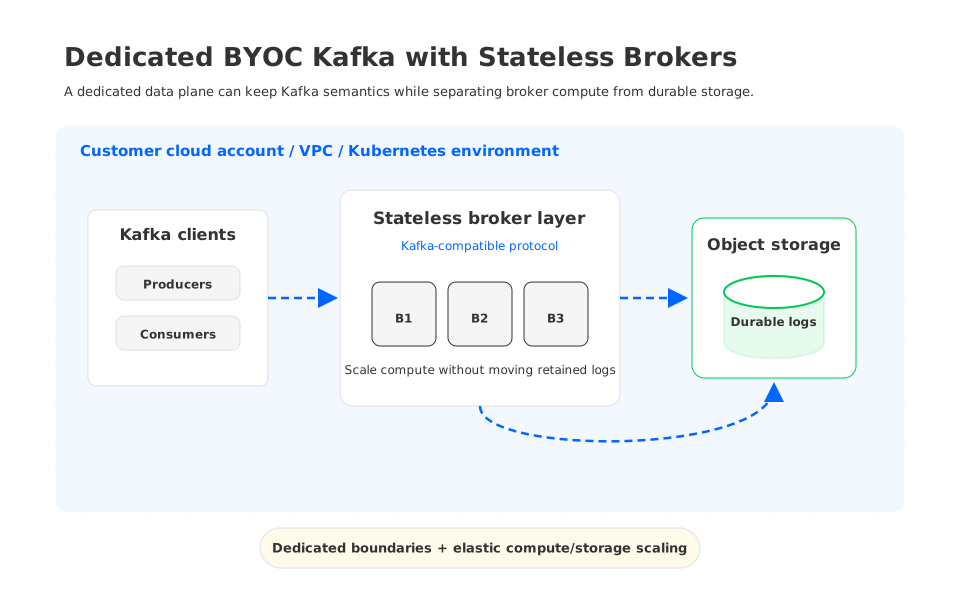
The natural fit is not "serverless is bad, choose AutoMQ." A better framing is this: if your workload needs dedicated isolation, private networking, or customer-controlled data placement, but you also want elasticity closer to a cloud-native service, then a Kafka-compatible, object-storage-backed architecture is worth evaluating. AutoMQ's BYOC and software deployment models are designed for teams that want Kafka semantics inside controlled environments rather than a fully external SaaS data plane.
That makes AutoMQ part of the dedicated side of the map, but with a different scaling assumption. Dedicated does not have to mean broker-local storage forever, and BYOC does not have to mean self-managed operations from scratch.
8A production decision checklist
Score the workload before selecting the service category. Use serverless managed Kafka when the score favors speed, variable demand, and managed guardrails. Use dedicated Kafka when the score favors isolation, predictable SLOs, private networking, and explicit capacity control.
Ask these questions before committing:
- What is the normal, peak, and failure-mode write throughput?
- How many independent consumer groups read the same topics?
- How many partitions will exist after two years of team and topic growth?
- Is the retention window for operational convenience, compliance, replay, or analytics?
- Which workloads require low tail latency, and what happens when they miss it?
- Does the service need private connectivity, customer-controlled routing, or data plane isolation?
- Are published service quotas comfortably above the projected workload?
- Is the budget owner more sensitive to idle capacity or variable usage?
- Can the team observe the right Kafka metrics and act when SLOs drift?
- Is the future migration path acceptable if the first choice stops fitting?
The best production choice is the one whose limits are boring. If serverless quotas, networking, and billing meters leave plenty of room, serverless managed Kafka may be the most efficient operating model. If the event backbone is becoming strategic infrastructure, dedicated Kafka may give the organization a better control plane for reliability, security, and cost predictability.
9References
- Amazon MSK Serverless
- Amazon MSK service quotas
- Confluent Cloud cluster types
- Confluent Cloud service quotas
- Confluent Cloud networking overview
- Apache Kafka operations and monitoring
- AutoMQ overview
- AutoMQ deployment overview
- AutoMQ Cloud BYOC Kubernetes overview
10FAQ
10.1Is serverless managed Kafka good enough for production?
Yes, for the right workload. Serverless managed Kafka can be a strong production choice when traffic is moderate or bursty, published quotas fit the application, and the team values low operational overhead. The mistake is not using serverless; the mistake is using it without checking throughput, partition, retention, networking, and SLA boundaries.
10.2When should a team choose dedicated Kafka instead?
Choose dedicated Kafka when the workload has sustained high throughput, strict tail-latency SLOs, large partition growth, long retention, enterprise private networking, or a need for stronger isolation. Dedicated capacity also fits organizations that prefer predictable committed spend over variable usage-based billing.
10.3Does dedicated Kafka always cost more than serverless Kafka?
No. Dedicated Kafka can cost more when capacity sits idle, but it can become more predictable for steady high-volume workloads. Serverless can cost less for variable demand, yet usage-based meters may surprise teams when read fanout, retention, partitions, or private networking grow.
10.4What is the difference between dedicated Kafka and BYOC Kafka?
Dedicated Kafka usually means reserved or isolated Kafka capacity. BYOC Kafka means the data plane runs in the customer's cloud account, VPC, VNet, or Kubernetes environment while the provider may still manage lifecycle operations. A BYOC deployment can also be dedicated, but the key distinction is data plane ownership and placement.
10.5Where does AutoMQ fit in a serverless vs dedicated decision?
AutoMQ fits when teams want Kafka compatibility in dedicated, BYOC, or private environments, but want to reduce the rigidity of broker-local storage. Its stateless broker and object-storage architecture can reduce over-provisioning pressure while preserving Kafka-facing application semantics.


