
Table of Contents
Table of Contents
The search for governed self service kafka clusters usually starts after the platform team has already lost control of the request queue. Application teams want Kafka topics, credentials, connectors, quotas, retention changes, and cluster capacity without waiting through a ticket chain. Security teams want every environment to keep private networking, encryption, access review, audit records, and data residency boundaries intact. Finance wants the cloud bill to stay predictable while usage expands across more product teams.
Those goals are not in conflict at the policy level. They collide because Kafka access is rarely a single object. A "cluster request" touches network placement, broker capacity, ACLs, client compatibility, topic lifecycle, consumer group behavior, schema and connector paths, monitoring, and incident ownership. If the service catalog exposes the wrong abstraction, self service becomes a faster way to create production risk.
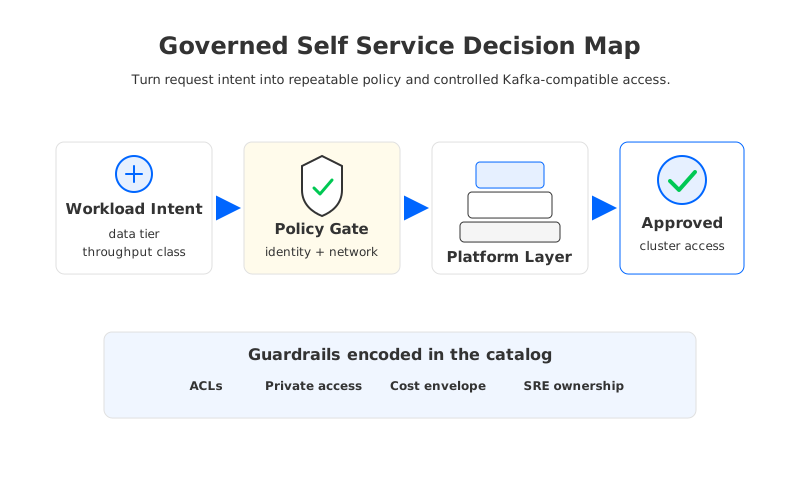
The useful pattern is controlled access, not unrestricted access. A platform team can give internal teams a catalog entry for Kafka-compatible streaming only when the entry encodes guardrails that used to live in tribal knowledge: what data may enter the cluster, which identities can read it, how retention is set, where traffic flows, who owns rollback, and what operational limits apply before the service is approved.
1Why teams search for governed self service kafka clusters
Kafka becomes a platform bottleneck when every request requires a human to translate intent into infrastructure changes. A team asks for "a Kafka cluster for payments events," but the real request includes a production VPC, private connectivity, topic naming, retention policy, ACLs, secrets, client settings, monitoring routes, and sometimes a connector runtime. The platform team can fulfill that once by hand. At scale, the same process becomes a queue of partial decisions.
The opposite failure mode is worse. Some organizations automate cluster creation before they automate governance. Teams create environments quickly, then discover inconsistent authentication, unclear ownership, and a cost profile nobody approved. The speed is real, but it is distributed infrastructure drift with a friendly UI.
A governed service catalog should turn recurring decisions into typed choices. A requestor chooses workload class, data sensitivity tier, connectivity model, retention profile, and availability target. The catalog maps those choices to approved Kafka-compatible infrastructure, network placement, identity integration, cost limits, and observability defaults.
Kafka often sits upstream of critical systems. A bad access decision can leak sensitive data, break downstream consumers, or create a cluster that cannot be scaled without a migration. The catalog should make the approved path faster than workarounds.
2The production constraint behind the problem
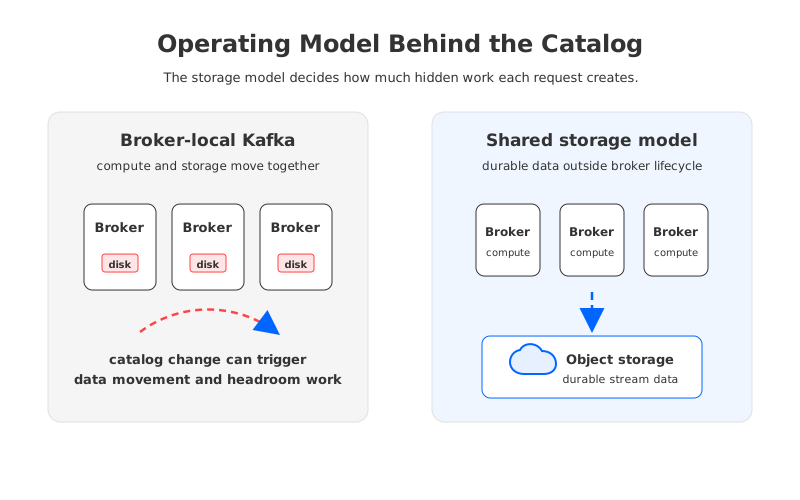
Traditional Kafka was designed around brokers that own local storage. That shared-nothing model is powerful and proven, but it creates operational coupling that a service catalog has to hide or expose deliberately. A broker is not only compute. It is also the local home for partitions, replicas, retained data, and recovery work. When a cluster grows, shrinks, or replaces failed capacity, data placement and broker lifecycle move together.
That coupling affects governance because catalog users do not ask for partition reassignment, broker-local storage headroom, or recovery traffic. They ask for a streaming environment. The platform team still has to reserve capacity, design availability zones, choose retention limits, and decide whether a request belongs in a shared cluster, a dedicated cluster, or a separate account and VPC.
Cloud networking makes the constraint more visible. A self-service request can create additional producer paths, consumer fan-out, connector traffic, cross-zone replication, and private endpoint dependencies. For regulated workloads, the catalog must also preserve region boundaries and private access paths rather than assuming public endpoints are acceptable.
The service catalog therefore needs an operating model underneath it. If the platform cannot explain how capacity, placement, identity, and recovery behave after a request is approved, the catalog is only an intake form. Controlled self service depends on a streaming architecture that makes the approved defaults repeatable.
3Architecture options and trade-offs
There are three common patterns for governed Kafka access. The first is the central shared cluster. It is efficient when many teams have similar sensitivity, throughput, retention, and availability requirements. It also concentrates blast radius because unrelated teams share brokers, metadata, and operational events.
The second pattern is the dedicated cluster per domain or environment. This gives stronger ownership and cleaner cost allocation, but it can create capacity fragmentation. If the underlying platform uses broker-local storage, every dedicated environment also carries storage planning and recovery complexity.
The third pattern is a service catalog backed by a standardized Kafka-compatible platform layer. In this model, the catalog exposes approved workload templates, while the platform abstracts the repeated cluster mechanics. The important detail is that the catalog is not a thin wrapper around a cloud console. It is an opinionated contract between requestors, platform engineers, security, and finance.
| Catalog decision | What it controls | Why it matters |
|---|---|---|
| Workload class | Shared cluster, dedicated cluster, or isolated environment | Prevents small workloads from receiving excessive infrastructure while high-risk workloads get real boundaries. |
| Data tier | Encryption, network route, region, retention, and audit policy | Keeps access control tied to the sensitivity of the stream, not to whoever opened the request. |
| Compatibility profile | Kafka client version, APIs, connectors, and protocol expectations | Reduces migration risk by keeping application contracts explicit. |
| Cost envelope | Throughput, retention, fan-out, and scaling limits | Gives FinOps a control point before cloud usage expands. |
| Operations owner | Alert routing, runbook, SLO, and escalation path | Makes production ownership visible before the first incident. |
The table exposes an uncomfortable point: a service catalog does not remove decisions. It moves decisions from ad hoc tickets into reusable policy. That is the right trade when the policy can be tested, versioned, and audited.
4Evaluation checklist for platform teams
Before choosing tooling, evaluate the platform boundary that the service catalog will automate. Kafka compatibility comes first because application teams should not rewrite producers, consumers, or connector logic for every environment. Apache Kafka's public documentation remains the reference point for client behavior, consumer groups, offsets, Kafka Connect, and KRaft operations. If a catalog option claims Kafka compatibility, test the actual client and connector estate, not only a hello-world producer.
The second dimension is elasticity. A catalog request often starts small and grows unevenly. A team may need a short validation environment, a larger production cluster, or a temporary capacity increase during migration. If every change requires broker-local storage movement, self service will still depend on a specialist queue. If compute and durable storage can scale with less coupling, the catalog can offer more precise workload shapes.
Governance is the third dimension, and it has to be concrete. "Secure by default" is not a control. A catalog entry should declare how identities map to Kafka ACLs, how TLS and private networking are enforced, where audit evidence lives, and which environment boundaries cannot be crossed. Cloud primitives such as AWS PrivateLink, Google Cloud service perimeters, and Azure private networking patterns are useful only when the catalog encodes when to use them.
Cost is the fourth dimension. Platform teams should model producer traffic, replication or durability traffic, consumer fan-out, connector throughput, retention storage, cross-zone movement, and monitoring overhead. The model does not need false precision, but it must identify which knobs are user-controlled and which are platform-controlled. A catalog that lets teams request unlimited retention without a cost envelope will eventually become a budget incident.
Use this evaluation frame before approving the platform design:
- Can the catalog produce the same Kafka access pattern twice without a human reinterpreting policy?
- Can security review the request from typed metadata rather than reading infrastructure diffs by hand?
- Can the platform scale a workload without turning every request into a broker placement project?
- Can finance trace cost to workload, data tier, retention, and traffic shape?
- Can SREs see ownership, SLOs, alerts, and rollback paths before the service enters production?
These questions are intentionally cross-functional. Governed self service fails when the platform team optimizes only for provisioning speed.
5How AutoMQ changes the operating model
Once the evaluation framework is clear, the architecture question becomes sharper: can the platform keep Kafka-compatible behavior while reducing the broker-local state that makes every catalog request operationally heavy? AutoMQ fits this category as a Kafka-compatible cloud-native streaming system that separates compute from storage and uses shared object storage as the durable data layer.
In a shared-storage design, brokers are closer to stateless compute nodes. Durable stream data is not bound to the lifecycle of a specific broker disk. Capacity requests can focus more on throughput, retention, availability, and governance profile instead of manual data placement. The catalog still needs policy, but it exposes fewer storage mechanics to each workload owner.
AutoMQ documentation describes this architecture around object-storage-backed durability, independent compute and storage scaling, and Kafka protocol compatibility. For teams building internal service catalogs, those properties matter less as feature names and more as operating-model changes. A developer asking for a governed Kafka-compatible environment should not need to understand broker disk replacement. A platform engineer should still be able to define where the workload runs, how identities are enforced, how private access is configured, and how capacity is bounded.
The BYOC deployment model is also relevant for regulated organizations. A customer-controlled deployment boundary lets the platform team keep infrastructure in its own cloud account or VPC pattern while consuming a standardized control experience. That is different from treating all self service as a public managed service request. The catalog can preserve data sovereignty, private routing, and internal approval flows while still giving teams a repeatable path to streaming infrastructure.
AutoMQ's fit is strongest when the organization has already decided that Kafka-compatible APIs matter, but the traditional operating model is slowing down governed access. The goal is not to remove platform engineering. The goal is to let platform engineering encode policy once, then reuse it across teams without dragging broker-local storage, cross-zone traffic, and capacity headroom into every request discussion.
6A service catalog pattern that works in production
The production pattern starts with a small set of opinionated catalog products. Avoid a catalog entry called "Kafka cluster" if it forces requestors to make infrastructure decisions they are not qualified to own. A better catalog offers workload templates such as "internal event stream," "regulated event stream," "analytics fan-out stream," and "migration landing zone." Each template has an approved boundary, default retention, observability profile, cost envelope, and escalation route.
The request form should collect intent, not implementation trivia. Ask for data sensitivity, producer systems, expected fan-out, retention class, availability target, region, connectivity needs, and business owner. The platform layer should translate that into cluster placement, topic policy, ACL structure, private access, quotas, and monitoring.
The approval workflow should be short when the request stays inside a known policy. It should become stricter when the request crosses a boundary: sensitive data, external connectivity, unusually long retention, multi-region access, high throughput, or shared consumer access by multiple domains. The catalog accelerates normal work while making exceptional work visible.
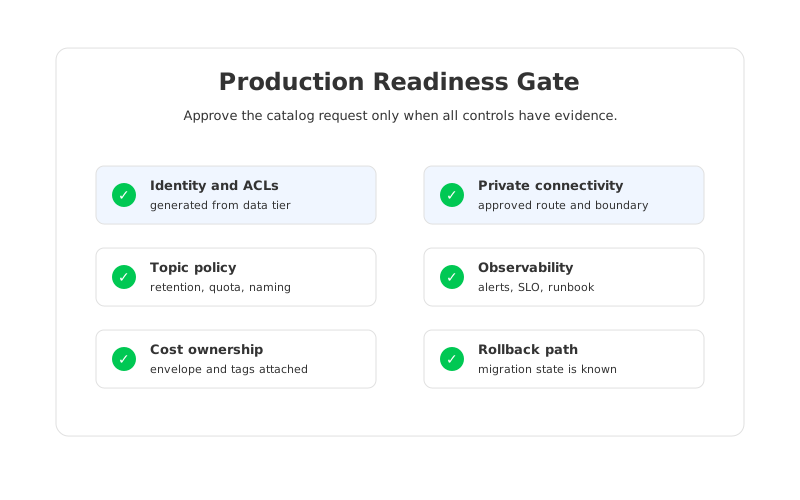
The final gate should check readiness before the service is handed over:
- Identity and access controls are generated from the data tier and reviewed by the right owner.
- Network paths use approved private connectivity for the selected environment.
- Topic retention, partitions, quotas, and naming are created from policy, not free-form text.
- Monitoring, alert routing, and runbooks are attached before production traffic starts.
- Cost ownership is mapped to workload metadata and reviewed against the selected envelope.
- Rollback and migration paths are documented for any workload moving from an existing Kafka estate.
This is the difference between a platform catalog and a request portal. The portal collects demand. The catalog turns demand into a governed production object.
7The practical decision
Controlled Kafka cluster access is not a UI problem. The UI is the visible part of a deeper contract between teams that want speed and teams that are accountable for risk. If the catalog exposes too much raw infrastructure, application teams inherit decisions they should not own. If it hides every decision, platform teams become the manual control plane.
The right abstraction is a governed workload product: Kafka-compatible access with known boundaries, typed policy, elastic behavior, cost visibility, and clear ownership. Traditional Kafka can support parts of that model, but broker-local storage and coupled capacity planning make the platform team carry hidden work. Shared-storage Kafka-compatible systems reduce that work by moving durable data out of broker-local lifecycle decisions.
If your team is designing governed self service for Kafka-compatible streaming, use one high-value workload as the test case. Model the catalog request, policy mapping, identity, private access, capacity envelope, cost ownership, and rollback path before expanding the service. To evaluate whether AutoMQ's shared-storage operating model fits that design, start with the verified product entry point: talk to AutoMQ about a governed Kafka-compatible deployment.
8References
- Apache Kafka Documentation
- Apache Kafka Connect
- Apache Kafka consumer position and offsets
- Apache Kafka KRaft documentation
- AutoMQ: What is AutoMQ
- AutoMQ Cloud overview
- AutoMQ BYOC installation on AWS
- AutoMQ role-based access control
- AutoMQ inter-zone traffic documentation
- AWS PrivateLink documentation
- AWS Availability Zones fault isolation
- Google Cloud VPC Service Controls
- Azure Storage overview
9FAQ
9.1What are governed self service Kafka clusters?
Governed self service Kafka clusters are Kafka or Kafka-compatible streaming environments that application teams can request through an approved catalog while platform, security, and finance controls are enforced automatically. The catalog usually encodes workload class, data tier, identity, private networking, quotas, retention, cost ownership, monitoring, and support boundaries.
9.2Is a service catalog enough to govern Kafka access?
No. A catalog is useful only when it is backed by repeatable infrastructure and policy automation. A form that creates clusters without identity, network, cost, observability, and ownership controls is provisioning automation, not governance.
9.3Should every team get a dedicated Kafka cluster?
Not always. Dedicated clusters improve ownership and isolation, but they can increase operational overhead and capacity fragmentation. Shared clusters can work for similar workloads with strong quotas and ACL discipline. Regulated, high-throughput, or high-blast-radius workloads often need stronger boundaries.
9.4Where does AutoMQ fit in this pattern?
AutoMQ is relevant when teams need Kafka-compatible behavior but want a cloud-native operating model with shared storage, stateless broker operation, and customer-controlled deployment boundaries. It does not replace governance design, but it can reduce the broker-local storage and capacity mechanics behind each catalog request.
9.5What should platform teams test first?
Test one production-like workload template end to end. Include identity, ACLs, private networking, topic policy, retention, observability, cost tagging, scaling behavior, and rollback. A service catalog pattern is ready to expand only when the same request can be reproduced without a human translating policy by hand.


