
Table of Contents
Table of Contents
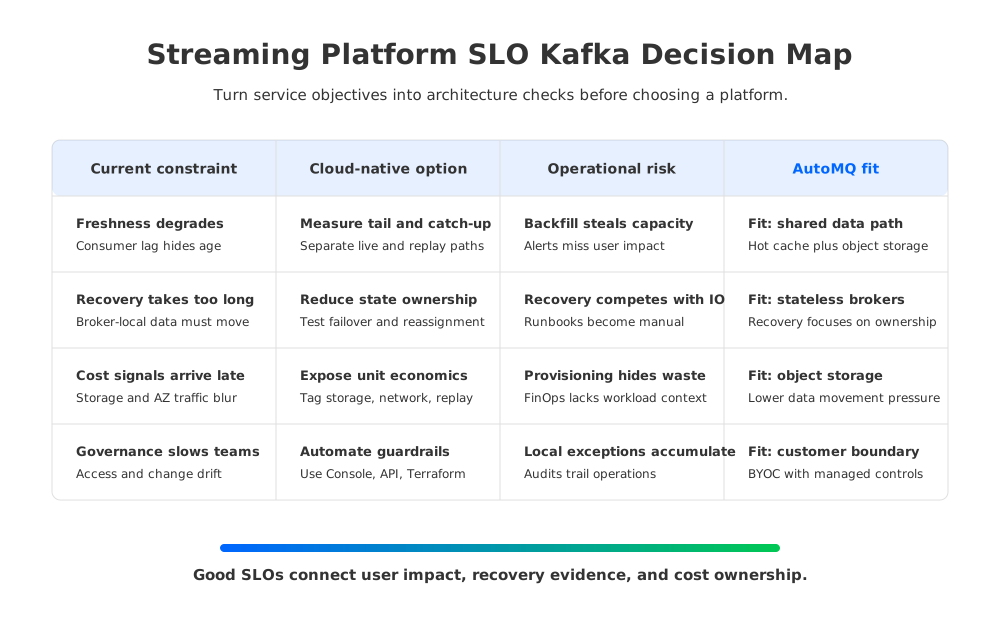
Teams usually search for streaming platform slo kafka after the obvious Kafka dashboards have stopped answering the operational question. Broker CPU looks acceptable, producer latency is within the old alert threshold, and storage has not filled up. Yet application owners still report stale personalization, delayed fraud decisions, or recovery drills that take long enough to become a release risk. The missing layer is not another broker metric. It is a set of service objectives that connects Kafka behavior to user-visible freshness, recovery evidence, and cost ownership.
That shift matters because event streaming platforms sit between application teams and platform teams. Application teams care whether data arrives before a decision window closes, whether offsets can be replayed safely after a bad deployment, and whether a burst can be absorbed without breaking customer workflows. Platform teams care whether capacity, storage, network, upgrades, and access controls can be managed repeatedly. A useful SLO framework must speak both languages without pretending that Kafka is only a latency system.
1Why teams search for streaming platform slo kafka
The search intent is practical. Nobody wakes up wanting a philosophical definition of service level objectives for streams. They want to know which measurements belong in an operating contract before a cluster becomes the shared backbone for payments, AI agents, CDC, analytics, mobile telemetry, or operational automation. Through that lens, a Kafka platform SLO is not a single number. It is a contract that says which failure modes the platform can absorb, which workloads get priority under pressure, and which trade-offs are acceptable.
Three signals tend to expose whether that contract is real.
- Freshness: Consumer lag is useful, but it is only a proxy. Freshness asks how old the information is when it reaches the application, model, dashboard, or downstream workflow. A small offset lag can still be unacceptable when a low-volume topic is blocked.
- Recovery: Recovery is not only broker restart time. It includes leader election, controller availability, offset correctness, replay capacity, transaction behavior, connector state, schema compatibility, and the time needed to return to the desired placement after a failure.
- Cost signals: Kafka cost is not only broker count. Storage retention, replication, cross-zone movement, catch-up reads, backfills, idle headroom, private connectivity, and operational labor all belong in the platform contract.
These signals are uncomfortable because they cross team boundaries. Freshness may fail in an application consumer while the broker remains healthy. Recovery may depend on whether a connector, consumer group, or transactional producer can resume without duplicate side effects. Cost may spike during a backfill that the platform team sees as normal recovery traffic and the finance team sees as unexplained network spend.
2The production constraint behind the problem
Apache Kafka's core model is powerful because it gives applications durable, ordered logs with partitions, offsets, consumer groups, and replay. The same model also makes production operations deeply stateful. In a traditional Shared Nothing architecture, each broker owns local storage for the partitions assigned to it, and replication keeps follower copies in sync. That design is coherent: it keeps the log close to the broker that serves reads and writes, and it provides durability through multiple replicas.
The production constraint appears when that local ownership meets elastic cloud operations. If a broker fails, the cluster must elect leaders, preserve in-sync replicas, and eventually restore the desired replica layout. If the platform scales out, new compute is not fully useful until partitions and their data placement are rebalanced. If retention grows, broker-local storage grows with it. If the cluster spans multiple Availability Zones, replicated traffic and recovery movement become part of the bill, not only part of the architecture diagram.
This is why an SLO such as "broker available" is too thin for event streaming. A platform can be technically available while applications miss freshness targets because catch-up reads are fighting live tail traffic. It can pass a steady-state latency alert while a broker replacement creates hours of background movement. It can fit a storage budget during normal traffic and still surprise the team during replay, reassignment, or disaster recovery drills.
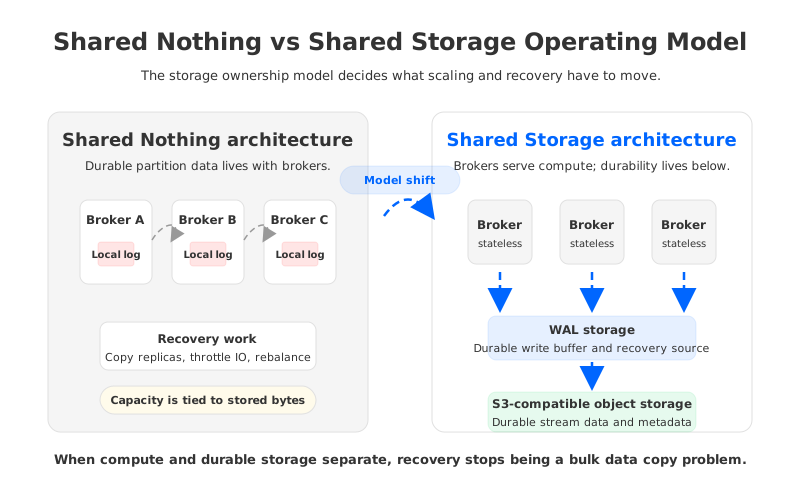
The key question is therefore not whether Kafka has metrics. It has many. The question is whether the platform architecture turns operational events into bounded, testable service behavior. Traditional Kafka can be operated well, but it asks teams to manage the coupling between compute and broker-local durable state. That coupling is where many freshness, recovery, and cost SLOs become harder to defend.
3Architecture options and trade-offs
The first option is to keep the traditional Kafka model and invest in excellent operations. This can be the right answer for teams with stable workloads, experienced Kafka operators, strong capacity planning, and clear ownership of replica movement, upgrades, and recovery drills. It preserves familiar tooling and direct control. The trade-off is that elasticity remains constrained by broker-local data, and platform teams must keep enough headroom for both live traffic and the operational work that appears during incidents.
The second option is Tiered Storage. Apache Kafka's Tiered Storage separates older completed log segments from local broker storage by moving remote segments to external storage while keeping the active write path and hot data broker-local. This can improve retention economics and reduce pressure on local disks for historical data. It does not, by itself, make brokers stateless. The platform still has to reason about the active segment, local storage, leader/follower replication, metadata, and the operational behavior of reads that span local and remote tiers.
The third option is a Shared Storage architecture, where durable stream data lives in shared object storage and brokers primarily serve compute, protocol handling, caching, and ownership. This model changes the operating question. Scaling no longer has to mean copying large amounts of partition history before compute becomes useful. Broker replacement focuses more on metadata, ownership, WAL (Write-Ahead Log) recovery, cache warmup, and traffic routing than on inheriting a failed node's local log.
None of these options removes trade-offs. Shared Storage architecture depends on object storage behavior, WAL design, metadata correctness, cache strategy, and observability. Tiered Storage can be a good fit when the main pain is long retention rather than compute elasticity. Traditional Kafka remains a proven choice when workload shape and operations maturity are stable. The point of a platform SLO is to make those trade-offs explicit before an incident writes them into the postmortem.
| Decision area | Question to ask | What a weak answer looks like |
|---|---|---|
| Freshness | Can the platform measure end-to-end event age, not only broker latency? | Alerts focus on broker health while application state is stale. |
| Recovery | Can the team rehearse broker loss, zone loss, bad producer deploys, and consumer replay? | Recovery plans assume a happy path and skip offset behavior. |
| Cost | Can storage, network, replay, and idle headroom be attributed by workload? | Monthly cost is visible only after shared operations have already run. |
| Governance | Can access, topic changes, connector changes, and audit trails be managed consistently? | Local exceptions accumulate until the platform becomes hard to reason about. |
| Migration | Can producers, consumers, offsets, and rollback paths be tested before cutover? | The migration plan says "compatible" but has no consumer progress drill. |
4Evaluation checklist for platform teams
A useful evaluation starts with compatibility because Kafka is an ecosystem contract, not only a broker API. Producers and consumers depend on topic semantics, partition ordering, offsets, consumer group coordination, idempotent writes, transactions, ACLs, and client behavior. Kafka Connect jobs add source and sink offsets, connector-specific state, and operational assumptions. A platform that claims Kafka compatibility should be tested against the versions, clients, serializers, and security mechanisms the organization actually uses.
The second check is workload shape. Some topics are tail-heavy and care about low write-to-read delay. Others are replay-heavy and need predictable catch-up while live traffic continues. CDC workloads have different correctness risks than AI context pipelines or financial event logs. Treating all topics as the same service class usually leads to vague SLOs. A better model defines service classes around decision windows, replay windows, retention, duplicate tolerance, and recovery priority.
Cost belongs in the same checklist, not in a procurement spreadsheet after architecture is chosen. Ask which parts of the design scale with retained bytes, produced bytes, consumed bytes, cross-zone movement, connector traffic, and recovery operations. Cloud pricing pages can explain the unit prices, but the platform team still has to decide which architecture creates those units. The cost objective should be observable during normal traffic and during drills, because recovery traffic is still traffic.
Security and governance need the same precision. A Kafka-compatible platform may run in a vendor-managed service, a self-managed cloud account, a customer-owned VPC, or a private data center. Each boundary changes who controls IAM, network routing, keys, audit logs, private connectivity, and operational access. The right SLO language does not say "secure" in the abstract. It says which data path, control path, metadata path, and observability path are allowed to cross which boundary.
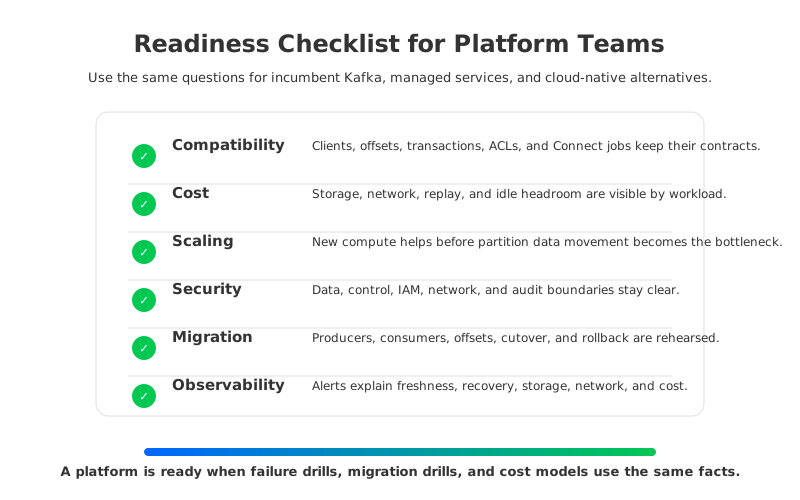
The final check is migration readiness. Compatibility is necessary, but it is not sufficient. A migration plan needs a repeatable answer for topic creation, producer cutover, consumer group progress, offset preservation, connector restart, rollback, and verification. For stateful streaming jobs, the platform team should test how checkpoints or saved positions interact with the target cluster before the production cutover window.
5How AutoMQ changes the operating model
After the neutral evaluation, the architectural direction becomes clearer: if the hard part is the coupling between broker compute and broker-local durable state, the strongest answer is to reduce that coupling. AutoMQ is a Kafka-compatible cloud-native streaming platform built around Shared Storage architecture. It keeps Kafka protocol and API compatibility while moving durable stream data into S3-compatible object storage through S3Stream, with WAL storage providing the durable write buffer used for low-latency writes and recovery.
That design changes the service objective discussion in several concrete ways. Stateless brokers make scaling and replacement less dependent on moving historical partition data. Object-storage-backed durability changes the cost profile of long retention and replay. Self-Balancing can focus on traffic and ownership rather than treating every rebalance as a large data movement project. Self-healing can isolate unhealthy nodes and let the cluster recover around shared durable data instead of requiring the failed broker's local disks to be the center of the recovery plan.
For platform teams, the daily friction is often outside the broker process. AutoMQ Console, Terraform-based workflows, monitoring, and BYOC deployment boundaries help translate architecture into operations. In AutoMQ BYOC, the control plane and data plane run in the customer's cloud account and VPC, so teams can keep customer data inside their own environment while using managed lifecycle controls. For private environments, AutoMQ Software follows the same principle inside customer-controlled infrastructure.
The migration story also matters for SLOs because service objectives have to survive the path from old to new. AutoMQ Kafka Linking is designed to migrate Kafka workloads while preserving message data and consumer progress, which gives platform teams a clearer way to test cutover and rollback behavior. Table Topic and managed Kafka Connect can then extend the same platform boundary into lakehouse and integration workloads, but they should be evaluated as part of the service contract, not as decorative features.
6A scorecard you can use before the next incident
Before changing platforms, write the SLO as an operations scorecard and run it against your current Kafka estate. The scorecard should be short enough to survive a design review and specific enough to drive a drill.
- Define freshness in user terms. For each critical stream, record the maximum acceptable event age at the consuming application, not only broker-side latency.
- Separate tail reads from catch-up reads. Measure whether replay or backfill changes the tail freshness of high-priority workloads.
- Rehearse recovery as a workflow. Include broker loss, controller events, connector restart, bad producer deployment, consumer replay, and rollback.
- Attribute cost to behavior. Tag retained bytes, produced bytes, consumed bytes, network movement, replay traffic, and idle headroom.
- Test compatibility with real clients. Include client versions, authentication, ACLs, transactions, idempotent producers, Connect jobs, and stream processors.
- Verify governance boundaries. Confirm who controls IAM, network paths, encryption keys, audit logs, platform changes, and operational access.
- Make migration reversible. A cutover plan without a practiced rollback path is an availability assumption, not an SLO.
The strongest platform choice is the one that makes these checks boring. It should not require heroic interpretation of dashboards during a backfill, nor should it require every application team to understand the broker placement plan. When freshness, recovery, and cost signals are designed into the operating model, Kafka-compatible streaming becomes easier to run as a shared product rather than a collection of clusters.
If your team is using this framework to evaluate a cloud-native Kafka-compatible architecture, review the AutoMQ deployment model and run a focused proof of concept against one freshness-sensitive workload and one replay-heavy workload: start with AutoMQ.
7FAQ
7.1Is a Kafka platform SLO the same as broker uptime?
No. Broker uptime is one input, but a streaming platform SLO should also cover event freshness, consumer progress, recovery workflows, replay capacity, storage behavior, network movement, and cost visibility.
7.2Should consumer lag be the main freshness metric?
Consumer lag is useful, but it is not enough. Freshness should measure event age at the point where the application, model, or workflow uses the data. Lag and freshness can diverge, especially on low-volume topics or during blocked processing.
7.3Does Tiered Storage make Kafka brokers stateless?
No. Tiered Storage can move older completed log segments to remote storage, but brokers still manage the active write path, local hot data, leader/follower behavior, metadata, and serving responsibilities.
7.4Where should AutoMQ enter the evaluation?
AutoMQ should enter after the team has defined the service objectives and tested the constraints of the current operating model. It is most relevant when broker-local storage ownership is a major blocker for elasticity, recovery, retention cost, or operational simplicity.
8References
- Apache Kafka Documentation
- Apache Kafka KRaft Documentation
- Apache Kafka Connect Documentation
- Apache Kafka Tiered Storage Documentation
- AutoMQ Architecture Overview
- AutoMQ Compatibility with Apache Kafka
- AutoMQ S3Stream Shared Streaming Storage
- AutoMQ WAL Storage
- AutoMQ Kafka Linking Migration Overview
- AWS Data Transfer Pricing


