
Table of Contents
Table of Contents
Searches for shared storage kafka broker operations usually come from teams that already know how to run Kafka. They are not trying to learn what a broker is. They are asking why broker operations still feel heavy after years of automation, managed disks, Terraform modules, and dashboards. The pressure usually appears during change: adding capacity, replacing brokers, recovering from failure, expanding retention, or explaining why a cloud networking line item moved in the wrong direction.
Traditional Kafka made a practical trade-off. Brokers own local log replicas, followers replicate from leaders, and partition reassignment moves data when placement changes. That model is clear and proven, but it makes the broker both a compute process and a durable storage owner. Once Kafka runs across cloud availability zones with elastic workloads, that ownership becomes the root of many operational tasks. A broker is no longer only a process to restart; it is also a location where important bytes live.
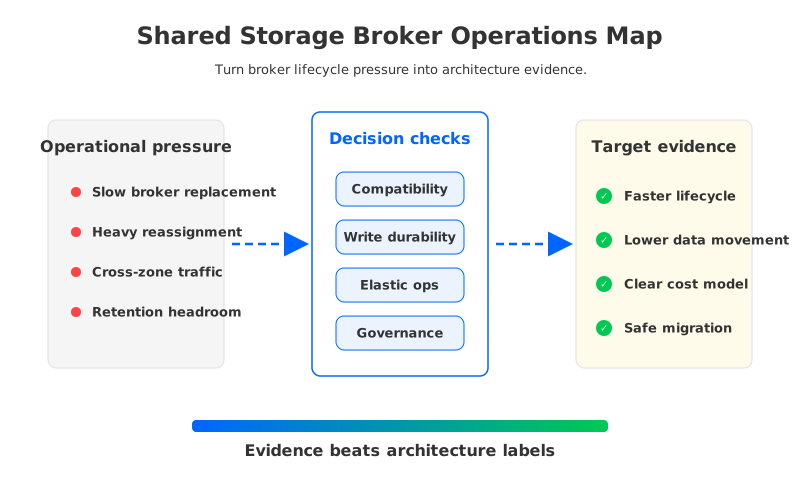
Shared storage changes the question. Instead of asking how to make broker-local storage movement faster, platform teams can ask whether brokers should own durable stream data in the first place. That does not make operations disappear. It changes what operators control: compatibility, write durability, metadata, cache behavior, object storage, network boundaries, and migration safety.
1Why Teams Search for shared storage kafka broker operations
The operational pain rarely starts with a single dramatic outage. It starts with repeated small moments where Kafka behaves correctly but the operating model resists the business. A broker replacement takes longer than expected because data must catch up. A scaling event adds compute but also triggers reassignment work. A retention increase forces another disk review. None of these are bugs in Kafka. They are consequences of the storage model.
That distinction matters because teams often respond to storage-model pressure with local optimizations. They tune partition counts, increase disk throughput, adjust replica placement, improve Cruise Control workflows, expand cache, or move older data into tiered storage. Those changes can be worthwhile. They do not fully remove the fact that the retained log is operationally attached to brokers.
The same pattern shows up in day-two runbooks:
- Capacity planning is tied to broker disk as much as broker CPU.
- Broker replacement is a data-placement event, even when automation provisions nodes quickly.
- Rebalancing has a data cost when replicas and retained segments live on broker storage.
- Cross-zone durability can create network traffic, depending on placement and configuration.
- Migration risk extends beyond endpoints into offsets, transactions, Connect jobs, ACLs, and dashboards.
The useful search intent is not "shared storage is always better." It is "which broker responsibilities should remain local, and which should move into a shared durable layer?"
2The Storage Constraint Behind Cloud Kafka
Kafka's shared-nothing architecture fits the environment where it was born. Brokers own local data, replication creates durability, and adding brokers expands both compute and storage. In a fixed-capacity data center, that is a reasonable mental model. The machines are the cluster, and the cluster's durability is built from copies across those machines.
Cloud infrastructure separates those costs more visibly. Compute instances, block storage, object storage, private connectivity, and cross-zone data transfer are billed and governed separately. When Kafka keeps durable data on brokers, each operational decision touches several surfaces at once. Scaling out adds compute, but it may also require moving data. Increasing retention changes storage. Spreading replicas across zones improves availability, but it may add network cost.
Tiered storage addresses one important part of this constraint. Apache Kafka's tiered storage design moves completed log segments to remote storage while brokers retain local responsibility for active log operations. That can reduce the local-disk pressure of long retention, especially when older data is kept mainly for replay, compliance, or backfill.
Shared storage goes further by moving the durable center of gravity away from broker-local disks. In a Kafka-compatible shared-storage design, brokers still handle protocol requests, partition leadership, caching, request scheduling, and coordination. The difference is that durable stream data is stored in a shared layer, often object storage with a write-ahead path in front of it. Broker lifecycle then becomes less about protecting the local home of retained data and more about managing compute, metadata, cache, and traffic.
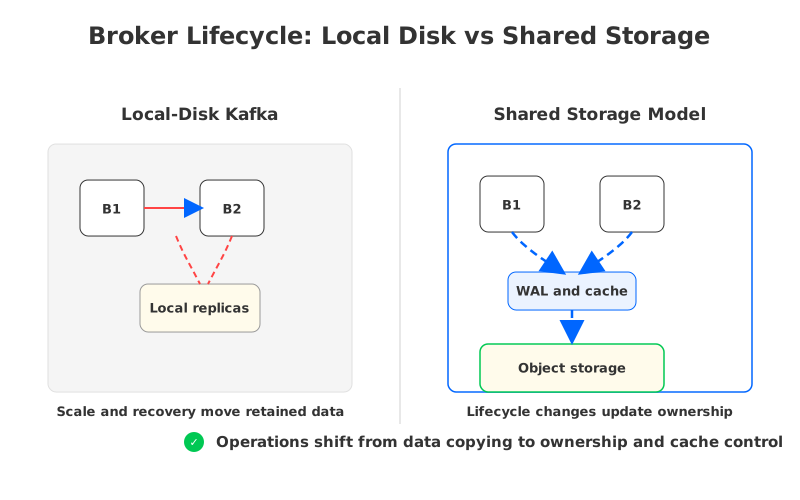
The shift is operational. A local-disk broker replacement asks, "How do we restore this broker's share of the log?" A shared-storage broker replacement asks, "How do we safely reassign ownership and warm the serving path when the durable data is already outside the broker?" Those questions lead to different runbooks, metrics, and failure drills.
3Architecture Options: Local Disk, Tiered Storage, and Shared Storage
Broker operations should be evaluated by workload pressure, not by architecture fashion. Local-disk Kafka remains a strong choice for stable, latency-sensitive workloads where the team values operational familiarity and can plan capacity ahead of demand. Tiered storage is a strong fit when retention is the main cost driver and active-log behavior remains acceptable. Shared storage becomes relevant when the painful part of operations is tying durable data to broker lifecycle.
| Operating model | Broker responsibility | Operational strength | Main risk to validate |
|---|---|---|---|
| Local-disk Kafka | Protocol handling, leadership, local log storage, replication, recovery | Familiar semantics and mature operational tooling | Scaling and recovery can require large broker-to-broker data movement |
| Kafka tiered storage | Active local log plus remote storage for completed segments | Better retention economics without changing the whole model | Active segment, cache, and recovery behavior still depend on broker design |
| Kafka-compatible shared storage | Protocol handling, leadership, cache, metadata, and shared durable storage integration | Broker lifecycle can become more elastic because retained data is externalized | Write path, read path, object storage behavior, and compatibility must be proven |
The table is not a maturity ladder. If your largest problem is long retention on otherwise stable clusters, tiered storage may be enough. If your largest problem is frequent capacity change, slow broker replacement, or cross-zone replication traffic, shared storage deserves a deeper look. If your largest problem is ultra-low tail latency for a narrow workload class, local-disk Kafka may still be the right operating model.
The hard part is that broker operations span several teams. SREs care about recovery and alert quality. Platform engineers care about automation and tenant isolation. FinOps cares about storage and network paths. Security cares about encryption, access, and audit boundaries. Application teams care about whether producers, consumers, transactions, offsets, and stream processors behave the same way after the platform changes.
That is why an architecture review should define the broker contract explicitly:
- Which data is durable when a produce request is acknowledged?
- Where does active data live during normal operation, failure, and recovery?
- What happens when the storage backend has elevated latency?
- How are consumer lag, catch-up reads, and hot reads served?
- How does the platform preserve idempotence, transactions, offsets, and consumer groups?
- Which team owns the bucket, IAM policy, encryption key, network path, and observability pipeline?
These questions are intentionally operational. A shared-storage diagram is not enough. The implementation has to explain how acknowledged writes survive, how reads stay predictable, and how operators identify whether a problem is in brokers, cache, WAL, object storage, metadata, clients, or network.
4Evaluation Checklist for Platform Teams
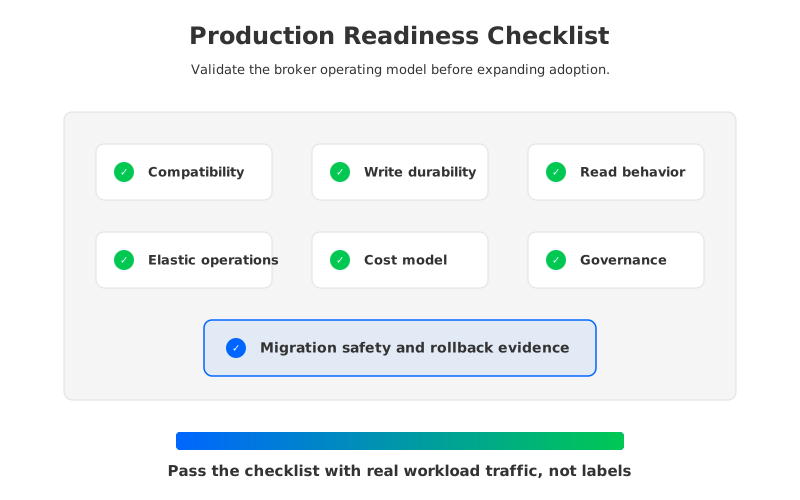
A good checklist turns shared storage from an abstract architecture into a production decision. The goal is to identify which workload class is painful enough to test and what evidence would prove that the operating model is better.
| Review area | What to check | Why it matters |
|---|---|---|
| Kafka compatibility | Producer, consumer, admin, transactions, idempotence, offsets, consumer groups, Kafka Connect, and monitoring tools | Endpoint compatibility is not enough if application semantics or ecosystem tools change |
| Write durability | WAL design, acknowledgment point, fencing, flush behavior, and broker-loss recovery | Shared storage still needs a trusted hot write path |
| Read behavior | Tail reads, catch-up reads, cache warm-up, remote fetches, replay, and consumer lag under failure | Object storage economics help only if read behavior stays acceptable |
| Elastic operations | Scale-out, scale-in, broker replacement, partition reassignment, and traffic balancing | The main benefit should show up during change, not only steady state |
| Cost model | Compute, block or file storage, object storage, object requests, cross-zone traffic, and private connectivity | Moving bytes changes the cost surface rather than making it vanish |
| Governance | VPC boundary, IAM, encryption, audit logs, data residency, private endpoints, and telemetry scope | Many enterprise decisions fail on control boundaries, not throughput |
| Migration safety | Linking or mirroring strategy, offset preservation, producer cutover, consumer cutover, rollback, and runbook ownership | A better target architecture still needs a low-drama adoption path |
This checklist should drive a proof of concept with real traffic shape. Synthetic throughput tests are useful, but they miss the operational questions that started the search. Use a representative topic class: high retention, high ingress, bursty load, replay-heavy consumers, expensive cross-zone traffic, or frequent scaling. Then test broker loss, scale-out, scale-in, consumer catch-up, backfill, and rollback.
The most important metric may not be a single latency number. It may be how much manual coordination disappears from the runbook. If scaling still requires long data movement or broker replacement still creates unclear recovery states, the architecture has not solved the original problem.
5How AutoMQ Changes the Operating Model
After the neutral evaluation is clear, AutoMQ becomes relevant as a Kafka-compatible streaming platform built around Shared Storage architecture. It keeps Kafka protocol and ecosystem compatibility while replacing broker-local persistent log storage with S3Stream, WAL storage, caching, and S3-compatible object storage. Brokers still serve Kafka clients, lead partitions, and participate in coordination, but durable stream data is not planned as data permanently owned by a broker disk.
The WAL layer is central to the operating model. Object storage is durable and elastic, but direct small synchronous writes to object storage are not the right shape for every Kafka workload. AutoMQ uses WAL storage as a durable write path before data is organized into object storage. That distinction keeps the architecture honest: shared storage is not a claim that object storage latency disappears; it is a design that separates write protection, cache behavior, and long-term durable storage.
This changes broker operations in several practical ways. Broker replacement can focus more on metadata, ownership, and cache warm-up because retained stream data is already in shared storage. Scaling can focus more on compute and traffic balance rather than copying large retained logs between broker disks. Long retention is planned around object storage capacity and lifecycle rather than per-broker disk headroom. In supported deployment patterns, AutoMQ's zero cross-AZ traffic design can also reduce broker-to-broker replica traffic by using shared storage and zone-aware access paths.
The deployment boundary matters as much as the storage mechanism. AutoMQ BYOC and AutoMQ Software are designed for customer-controlled environments, where the data plane runs in the customer's cloud account, VPC, or private infrastructure. Teams can inspect the data path, control path, object storage bucket, WAL option, IAM scope, network path, encryption posture, and telemetry boundary before moving production workloads.
AutoMQ is still something to validate, not something to assume. Platform teams should test the clients they actually run, the Kafka features they depend on, the Connect jobs they operate, the consumer lag behavior they alert on, and the failure scenarios they fear. The benefit is that the proof of concept can focus on whether broker operations become more elastic and governable, not only whether a benchmark produces a large number.
6Migration and Day-Two Operations
The safest migration starts with workload selection. Begin with the topic class where broker-local storage is clearly causing pain and where success criteria can be measured: long retention with predictable replay, bursty telemetry, high-ingress topics with visible cross-zone cost, or workloads that force frequent capacity changes.
A practical migration plan has four gates: compatibility validation, linking or mirroring, controlled cutover, and failure drills. The cutover should compare lag, throughput, errors, cost signals, and operator actions before the pattern expands.
Day-two operations should also change on purpose. Dashboards need to separate broker compute, WAL, cache, object storage, metadata, and client behavior. Alerts should tell operators whether the issue is a Kafka-facing problem, a storage-path problem, or a network/governance problem. Runbooks should document who owns the object storage bucket, who can rotate credentials, who can change retention, and who approves scaling policy. Shared storage reduces one class of broker-local data movement, but it introduces a shared durable layer that must be operated with the same discipline as any critical infrastructure.
If your search for shared storage kafka broker operations started with recurring broker lifecycle pain, turn that pain into an evaluation plan. Pick one workload class, measure the current runbook, then test whether a Kafka-compatible shared-storage model changes the operational burden without changing application semantics. To evaluate AutoMQ in that process, start with the AutoMQ Cloud Console and validate the checklist against representative production traffic before widening adoption.
7References
- Apache Kafka documentation: https://kafka.apache.org/documentation/
- Apache Kafka consumer documentation: https://kafka.apache.org/documentation/#consumerapi
- Apache Kafka message delivery semantics: https://kafka.apache.org/documentation/#semantics
- Apache Kafka KRaft documentation: https://kafka.apache.org/documentation/#kraft
- Apache Kafka tiered storage documentation: https://kafka.apache.org/41/operations/tiered-storage/
- Apache Kafka KIP-405: Kafka Tiered Storage: https://cwiki.apache.org/confluence/display/KAFKA/KIP-405%3A+Kafka+Tiered+Storage
- Apache Kafka KIP-1150: Diskless Topics: https://cwiki.apache.org/confluence/display/KAFKA/KIP-1150%3A+Diskless+Topics
- AutoMQ architecture overview: https://docs.automq.com/automq/architecture/overview?utm_source=blog&utm_medium=reference&utm_campaign=aivk-0009
- AutoMQ native Kafka compatibility: https://docs.automq.com/automq/architecture/technical-advantage/native-compatible-with-apache-kafka?utm_source=blog&utm_medium=reference&utm_campaign=aivk-0009
- AutoMQ cross-AZ traffic cost guidance: https://docs.automq.com/automq-cloud/best-practice/save-cross-az-traffic-costs-with-automq?utm_source=blog&utm_medium=reference&utm_campaign=aivk-0009
- AutoMQ migration prerequisites: https://docs.automq.com/automq-cloud/migrate-to-automq/prerequisites?utm_source=blog&utm_medium=reference&utm_campaign=aivk-0009
8FAQ
8.1Is shared storage the same as Kafka tiered storage?
No. Kafka tiered storage moves completed log segments to remote storage while brokers still keep active-log responsibilities. Shared storage moves the durable center of gravity away from broker-local disks, which changes broker replacement, scaling, and recovery operations.
8.2Does shared storage make Kafka brokers stateless?
It depends on the implementation and the meaning of stateless. In AutoMQ's model, brokers are stateless with respect to durable stream data because retained records are not permanently attached to broker-local disks. Brokers still handle protocol requests, leadership, cache, metadata interaction, and operational state.
8.3What should SRE teams test first?
Test broker loss, scale-out, scale-in, consumer catch-up, backfill, object storage latency, WAL behavior, alert clarity, and rollback. These scenarios reveal whether shared storage improves operations or only changes the architecture diagram.
8.4When should AutoMQ be evaluated?
Evaluate AutoMQ when Kafka compatibility is required but broker-local storage creates scaling friction, slow replacement, retention pressure, cross-zone traffic cost, or governance complexity. Use real clients, real topic patterns, and a documented rollback plan.


