
Table of Contents
Table of Contents
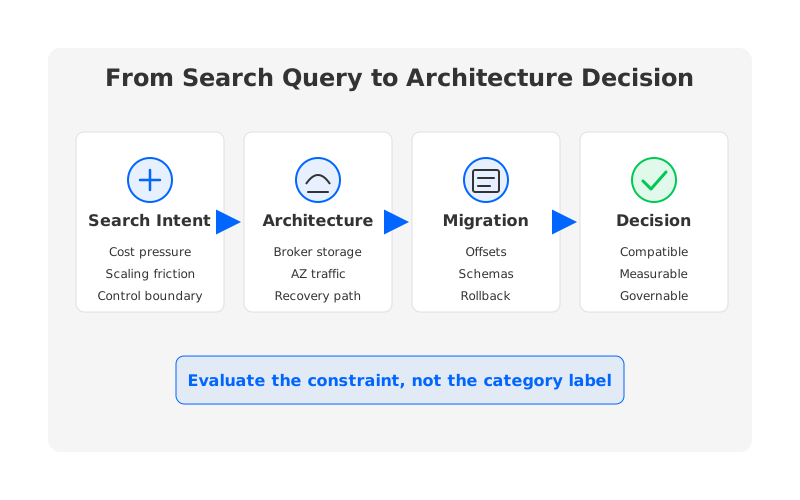
Teams rarely search for msk alternatives because Amazon MSK has failed them in a simple way. More often, MSK has done the first job well enough: it gave them managed Apache Kafka inside AWS, kept applications close to familiar VPC and IAM patterns, and reduced the amount of undifferentiated cluster administration. The search starts when the second job becomes harder. Storage grows faster than expected, cross-zone traffic appears in cost reviews, recovery exercises expose data movement, or platform teams discover that "managed Kafka" still leaves them owning a set of architectural decisions.
That is why an MSK alternative evaluation should not begin as a vendor list. It should begin as a storage and ownership review. The useful question is not "Which service is better than MSK?" The useful question is: what part of the Kafka operating model are you trying to change while preserving the Kafka behavior your applications already depend on?
1Why teams search for msk alternatives
Amazon MSK is a managed service for running applications that use Apache Kafka. AWS manages control-plane operations such as creating, updating, and deleting clusters, while applications continue to use Kafka data-plane operations such as producing and consuming records. That is a strong fit for many AWS-centered teams because it keeps the Kafka ecosystem intact and places the service under familiar AWS procurement, networking, and security models.
The search for alternatives usually appears after the team has enough production history to see the workload. A stable event bus with moderate retention may fit MSK cleanly. A platform with high partition counts, long retention, bursty replay, strict multi-AZ availability, and frequent scaling reviews experiences Kafka differently. In that environment, the important costs extend beyond broker instance hours. They include storage, replicated data movement, recovery headroom, operational time, and slow cluster changes.
Four triggers tend to move the conversation from service selection to architecture:
- Storage is no longer a local capacity detail. Retention, replay, and audit requirements can turn broker storage into the dominant planning unit. When durable data is tied to broker-local disks, scaling compute and scaling retained data remain coupled.
- Network cost becomes visible. Multi-AZ designs are often required for resilience, but replication and client traffic can cross availability-zone boundaries. The bill may not say "Kafka architecture," but the traffic pattern often points back to it.
- Recovery exercises reveal hidden state. Replacing a broker, changing capacity, or rebalancing partitions is harder when durable data has to move with the broker ownership model.
- Governance demands a clearer boundary. Security, FinOps, and platform teams need to know where data lives, who controls the control plane, which account pays for infrastructure, and how support access is constrained.
These are signs to inspect the storage model underneath each option.
2The architecture criteria behind the shortlist
An MSK alternative shortlist can include managed Apache Kafka services, Kafka-compatible engines, BYOC platforms, self-managed Kafka, and sometimes a different streaming system entirely. Those categories solve different problems. A fully managed service can reduce operational work but may not change the underlying cost mechanics of stateful brokers. A Kafka-compatible engine can change the broker or storage model, but it must prove compatibility rather than assume it. Self-managed Kafka gives control, but it returns more operational responsibility to the platform team.
The first pass should separate product convenience from architectural change. A managed console, automatic upgrades, and integrated monitoring are valuable, but they do not answer whether retained data remains bound to broker disks. Tiered storage can reduce local pressure by moving older log segments to remote storage, and Apache Kafka's KIP-405 describes that direction in Kafka itself. That is different from a shared-storage architecture where durable stream data is designed around object storage and brokers are less tied to local ownership.
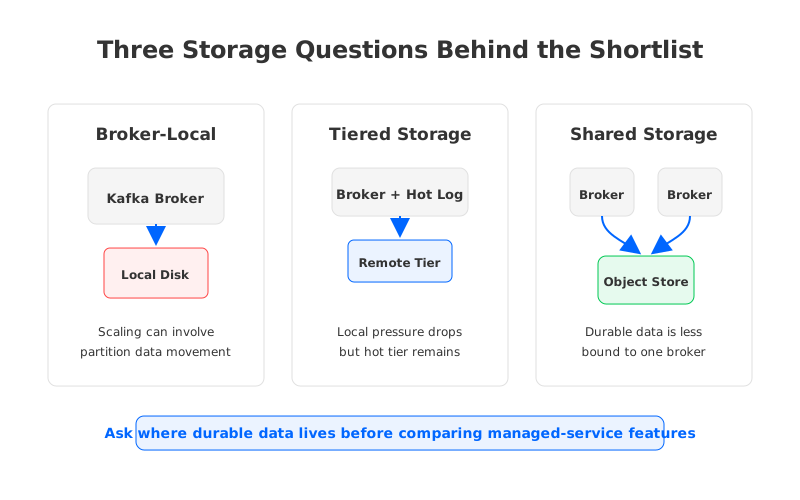
The distinction matters because the evaluation criteria change:
| Evaluation area | What to ask | Why it changes the decision |
|---|---|---|
| Kafka behavior | Which clients, APIs, security features, transactions, offsets, and admin operations must keep working? | Compatibility is not a slogan. It is an inventory of application and tooling behavior. |
| Storage model | Is durable data broker-local, tiered from local storage, or primarily shared through object storage? | Storage placement shapes scaling, recovery, and cost visibility. |
| Network path | Which produce, consume, replication, and catch-up reads cross AZ or VPC boundaries? | Data movement often becomes a recurring cost line before it becomes an outage. |
| Ownership boundary | Does the control plane, data plane, or both run in the customer's account? | Security and procurement teams care who can access infrastructure and where logs, metrics, and data reside. |
| Migration path | How are topics, offsets, ACLs, schemas, clients, and rollback handled? | A platform that looks attractive on a diagram can fail if cutover risk is not controlled. |
This table should be filled with evidence, not adjectives. If a provider says it is Kafka-compatible, map that claim against the actual clients and broker features your estate uses. If a service says storage scales automatically, ask whether compute, storage, and recovery scale independently. If a deployment is described as BYOC, inspect whether the control plane and data plane both stay inside your cloud account or whether some metadata path leaves your boundary.
3Shared storage is the question behind many cost reviews
Kafka's traditional shared-nothing model is not an accident. It was a sensible design for durable logs running on machines that owned local disks. Brokers store partition data locally, replicas are distributed for resilience, and the cluster coordinates leadership and replication. In cloud environments, that model meets a different set of economics. Storage is metered, cross-AZ traffic is metered, and overprovisioned headroom is visible to FinOps teams every month.
That is why shared storage keeps entering MSK alternative research. The phrase can mean different things, so it needs precision. Tiered storage keeps a local log tier and offloads older segments to remote storage. Object-storage-backed shared storage makes remote durable storage a primary part of the architecture and treats brokers more like compute nodes serving the Kafka protocol. Both can be useful, but they do not create the same operating model.
The practical test is to follow a record through the system:
- On write, where is the durable acknowledgement anchored, and what path protects low-latency produce traffic?
- During retention growth, does the team add broker-local disk, tune tiering, or rely on object storage capacity?
- During catch-up reads, does replay contend with hot traffic on the same broker resources?
- During broker replacement or scaling, does durable data have to be copied, reassigned, or rehydrated before capacity is useful?
- Across AZs, which bytes move because of Kafka replication, client routing, or storage access patterns?
Those questions are more useful than a generic comparison of "managed Kafka" options. They expose whether the alternative changes the cost and recovery surface or mainly changes who operates the same surface.
4Migration risk is the gate, not a footnote
Platform teams often underestimate migration work because Kafka's client protocol makes connectivity look familiar. A producer can point to a different bootstrap endpoint, and a consumer group can connect to a different cluster. That is not a migration plan. The hard parts live around correctness: ordering expectations, offset continuity, schema compatibility, ACLs, quotas, transactional producers, connector state, consumer lag, observability, and rollback.
The migration review starts with a workload inventory. Separate workloads by blast radius and behavior, not by team name. A low-retention telemetry topic can move differently from an order-events topic with strict replay requirements. A connector-heavy estate has risks distinct from custom consumers. A platform that looks like one Kafka cluster from a procurement view may be five migration classes from an engineering view.
A good proof of concept uses one low-risk workload and one demanding workload. The low-risk workload validates basic operations. The demanding workload reveals whether the target architecture can handle the behavior that made the current platform expensive or slow to operate. Measure producer latency, consumer lag recovery, catch-up reads, controller operations, rebalance behavior, failure recovery, and cloud traffic. Also test the negative path: pause migration, roll back clients, restore the old consumer position, and explain who owns each action.
A migration is ready when the rollback plan is as specific as the cutover plan.
This is where some MSK alternative evaluations become clearer. If the main pain is administrative convenience, another managed Kafka service may be enough. If the main pain is broker-local storage, cross-zone replication cost, or slow recovery from data movement, the evaluation should include architectures that change the storage boundary.
5How AutoMQ fits the evaluation
After the neutral architecture review, AutoMQ belongs in the category of Kafka-compatible cloud-native streaming systems built around shared storage. It is not a request for teams to abandon Kafka clients or rewrite event-driven applications. The relevant claim is narrower: keep Kafka protocol and ecosystem compatibility while moving the durable storage model away from broker-local disks and toward object-storage-backed shared storage.
AutoMQ's architecture documentation describes S3Stream as the storage layer that offloads Kafka log storage to cloud storage, with a write-ahead log path, cache design, and object storage as the durable storage foundation. In that model, brokers handle Kafka-facing compute work while durable stream data is not trapped on a specific broker's local disk. For an MSK alternatives review, that matters because the team can evaluate compute scaling, retention growth, recovery, and cloud cost as separate questions rather than treating every issue as broker sizing.
AutoMQ is most relevant when the pain points are architectural:
- You want Kafka-compatible clients and ecosystem behavior, but you do not want durable retention tied tightly to broker-local storage.
- You need to model storage growth, replay, and broker replacement without turning each change into a large data movement project.
- You care about customer-controlled cloud boundaries. AutoMQ BYOC is designed for deployment in the customer's cloud environment, which makes infrastructure ownership, networking, and data placement part of the evaluation rather than an afterthought.
- You are reviewing multi-AZ cost. AutoMQ documents an inter-zone traffic design that uses shared storage and routing patterns to reduce cross-zone data movement for supported deployments.
This does not remove the need for testing. Shared storage changes the system's constraints; it does not exempt the platform team from compatibility checks, workload modeling, failure drills, or observability design. The right way to evaluate AutoMQ is to use the same scorecard you use for every MSK alternative: Kafka behavior, storage path, latency envelope, cloud traffic, migration plan, control boundary, and operational runbook.
6A practical decision framework
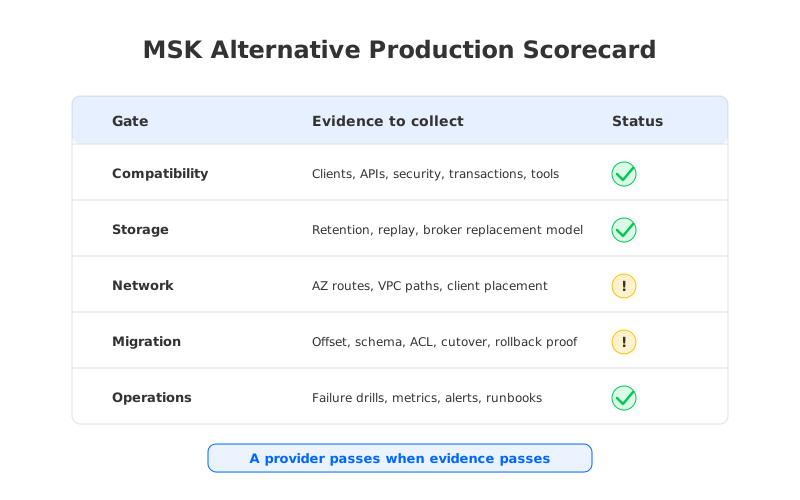
Treat the MSK alternative decision as a sequence of gates. The first gate is compatibility: if your clients, connectors, security model, and operational tooling cannot pass, cost advantages do not matter. The second gate is ownership: if the deployment boundary cannot pass security and procurement review, performance claims do not matter. The third gate is architecture: if the alternative does not change the constraint that caused the search, it is not really an alternative; it is a different operating wrapper.
The final gate is economic evidence. Avoid estimating savings from a single service price page. Model write throughput, read fanout, retention, partitions, replication, catch-up reads, inter-zone traffic, and operational headroom. AWS publishes MSK pricing and EC2 data transfer pricing separately because compute, storage, and network are different meters. Your Kafka platform model should keep them separate too.
A useful internal worksheet has six rows:
| Gate | Pass evidence | Stop signal |
|---|---|---|
| Compatibility | Representative clients and admin tools pass tests | Unsupported API or security behavior blocks a critical workload |
| Storage | Retention and replay have a clear cost and recovery model | Durable data movement remains the scaling bottleneck |
| Network | AZ, VPC, PrivateLink, and client routes are mapped | Cross-zone paths are unknown or unmeasured |
| Migration | Cutover and rollback are rehearsed | Offset or schema recovery depends on manual guesswork |
| Operations | Failure drills, metrics, and alerts are documented | Runbook relies on vendor claims without local evidence |
| Governance | Data plane, control plane, IAM, and support access are approved | Boundary cannot pass security review |
This framing also keeps the team respectful of existing platforms. MSK can be the right answer when managed Apache Kafka inside AWS is the primary requirement. Confluent, Aiven, Redpanda, self-managed Kafka, and other platforms can be right answers under different constraints. Choose by the constraint you can measure.
The search that began with msk alternatives should end with a sharper architecture question: which parts of Kafka do you need to preserve, and which parts of the operating model must change? If your evidence points to Kafka compatibility, shared storage, customer-controlled deployment, and lower exposure to broker-local data movement, evaluate AutoMQ against one representative workload through the AutoMQ Cloud Console and compare the results against the same scorecard.
7References
- Amazon MSK Developer Guide: What is Amazon MSK?
- Amazon MSK pricing
- Amazon MSK Express brokers
- Amazon MSK tiered storage
- Apache Kafka documentation
- Apache Kafka KIP-405: Kafka Tiered Storage
- AutoMQ architecture overview
- AutoMQ S3Stream shared streaming storage
- AutoMQ inter-zone traffic overview
8FAQ
8.1What is the main reason teams evaluate MSK alternatives?
The strongest reason is usually not basic Kafka functionality. It is the operating model around storage, scaling, recovery, network cost, governance, or migration risk. MSK remains a strong managed Apache Kafka option for AWS teams, but some workloads need a different storage and ownership model.
8.2Is tiered storage the same as shared storage?
No. Tiered storage generally keeps a local log tier and moves older segments to remote storage. Shared-storage architectures make object storage a primary durable layer and reduce the degree to which brokers own durable data locally. Both patterns can reduce local storage pressure, but they affect scaling and recovery differently.
8.3Can a Kafka-compatible platform replace MSK without application changes?
It depends on the exact clients, APIs, security settings, transactions, connectors, schemas, and operational tooling in use. Treat compatibility as a test matrix tied to your workload inventory, not as a generic product claim.
8.4When should AutoMQ be part of an MSK alternative review?
AutoMQ is worth evaluating when the goal is to keep Kafka-facing behavior while changing the storage and elasticity model. It is especially relevant for teams reviewing object-storage-backed shared storage, stateless brokers, BYOC deployment boundaries, retention growth, replay, and multi-AZ traffic cost.
8.5What should a proof of concept measure?
Measure producer latency, consumer lag recovery, catch-up reads, throughput, failure recovery, broker scaling, cloud traffic, observability, security controls, and rollback. Use at least one workload that reflects the constraint that made you search for an alternative in the first place.


