
Table of Contents
Table of Contents
Many Kafka teams already know the awkward shape of a "real-time" data platform that is not quite real time. Applications emit events into Kafka. Stream processors enrich or filter some of them. Sink jobs copy the same records into object storage. A lakehouse table format then makes the copied files queryable. The architecture works, but every stage after the source adds infrastructure whose main job is to move bytes that already existed somewhere else.
Shift Left Architecture is a useful name for the counter-pressure: push data quality, transformation, routing, and product contracts closer to where events are created. That does not mean every service should run a miniature data warehouse. It means the platform should stop treating raw event movement as the default path and start asking which work can happen before data is replicated, persisted again, and interpreted downstream.
For Kafka, that question has a second layer. You can shift processing left and still keep a disk-heavy broker fleet in the middle, followed by another lakehouse ingestion path. The result is a cleaner logical architecture running on the same duplicated storage foundation. The next step is to shift the storage foundation left as well: make object storage the durable substrate for the streaming layer, then serve operational consumers and analytical systems from that foundation with the right semantics for each.
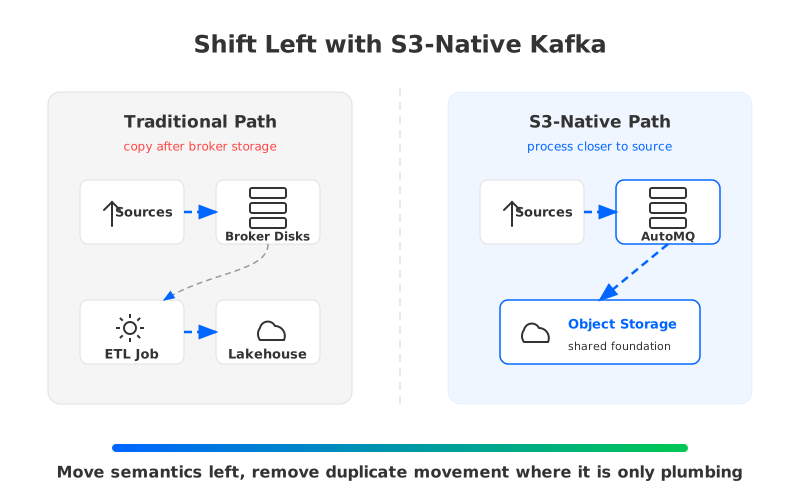
That is where S3-native Kafka becomes interesting. It does not turn a Kafka topic into an analytical table by wishful thinking, and it does not remove the need for schemas, compaction, table maintenance, or query governance. It changes the economics of the middle layer. If the event log already lands in object storage through a Kafka-compatible platform, the lakehouse pipeline no longer starts from broker-attached disks as the source of truth.
1What Shift Left Means In Data Streaming
"Shift left" originally became popular in software delivery because teams learned that catching defects earlier is less expensive than finding them after release. In streaming architecture, the same instinct applies to data: catch structural problems, apply lightweight enrichment, route events, and define contracts while the event is still close to the application, device, or operational system that produced it.
The useful version is practical, not ideological. A payment event may need idempotency keys, schema validation, account-level enrichment, and PII tagging before ten downstream teams consume it. A telemetry stream may need noise filtering at the edge before every vibration reading crosses a WAN link. A CDC stream may need delete semantics normalized before it becomes a table. These are not "analytics" problems in the warehouse sense; they are source-adjacent responsibilities that determine whether the rest of the platform can trust the stream.
Three kinds of work usually belong further left:
- Contract work: schema validation, event versioning, ownership metadata, and compatibility rules. If the producer contract is vague, downstream systems turn ambiguity into permanent pipeline code.
- Lossless normalization: timestamp correction, key selection, CDC operation mapping, and metadata enrichment. This work changes representation without throwing away business meaning.
- Selective reduction: filtering noise, dropping invalid events, sampling high-volume diagnostics, or splitting hot and cold paths. This is where infrastructure savings become visible, because data that never needs to move is the lowest-cost data.
The risk is overcorrecting. If every source team implements its own bespoke transformation logic, the platform may lower the infrastructure bill while raising the coordination cost. The better pattern is a shared streaming layer that gives source teams strong contracts and reusable processing primitives without making the central lakehouse the first place where events become intelligible.
2Why Traditional Kafka Still Duplicates Data Movement
Traditional Kafka gives teams a durable, ordered, replayable event log. Its replication model is deliberately simple: each partition has a leader, followers replicate from the leader, and the replication factor determines how many broker replicas exist for that partition. That design is one reason Kafka became the default infrastructure for event-driven systems. It also means Kafka durability is tied to broker-managed log storage.
In a cloud deployment, the storage path often looks like this: producers write to a leader broker, followers replicate the log, brokers retain data on local or attached disks, sink jobs read the log, and a lakehouse writer stores a second representation in object storage. Tiered storage improves long-retention economics by moving completed segments to remote storage, but the hot path still starts with broker-local storage and a later copy to the remote tier. A Kafka-to-Iceberg path then adds table files and metadata on top.
That movement is easy to ignore because each step has a reasonable owner. The Kafka team owns broker availability. The data platform team owns object storage and tables. The analytics team owns query freshness. The problem is that the bill does not care about org charts. It sees duplicate retention, network movement, sink compute, operational headroom, and incident surfaces.
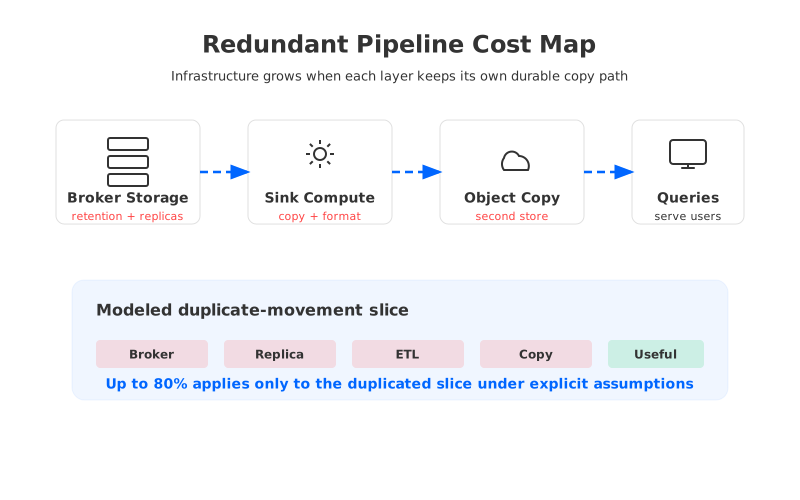
Consider a narrow but common slice: a high-volume Kafka topic whose primary downstream destination is a lakehouse table, while operational consumers still need Kafka semantics for a short replay window. A conventional design may allocate infrastructure to five separate jobs:
| Pipeline Job | Why It Exists | What Can Become Waste |
|---|---|---|
| Broker retention | Keep Kafka replayable and fault tolerant | Long local retention for data that will be stored again |
| Replica movement | Keep broker failures survivable | Cross-zone and disk writes for every replica |
| Sink compute | Move records into lake files | Dedicated workers that mostly copy and format |
| Object-storage copy | Make data queryable later | A second durable copy with its own lifecycle |
| Operational headroom | Survive rebalances, catch-up reads, and backfills | Idle capacity held for stateful operations |
This is the context behind the "save 80%" claim. It is not a promise that every Kafka bill falls by 80%. It is a model for the duplicate-movement slice of the architecture: if four of the five infrastructure jobs above exist mostly because Kafka and the lakehouse have separate durable storage foundations, moving the Kafka log to object storage can remove up to 80% of that slice under the stated assumptions. Your full platform savings will be lower or higher depending on retention, fanout, write rate, table freshness, cloud network pricing, and how much processing still belongs between the stream and the table.
That caveat matters. Architecture slogans get dangerous when they skip scope. Shift left is not a coupon; it is a way to find which parts of the pipeline are doing real semantic work and which parts are doing compensating work for an older storage model.
3S3-Native Kafka And The Store-Once Pattern
S3-native Kafka starts from a different assumption: object storage can be more than the place where analytics eventually lands. It can be the durable foundation of the streaming platform itself, while brokers remain compatible with Kafka clients and focus on protocol handling, caching, coordination, and low-latency access.
AutoMQ is one implementation of that idea. Its documentation describes a Kafka-compatible streaming platform built on S3-compatible object storage, with storage and compute separated through S3Stream. In AutoMQ's architecture, the WAL path handles write acceleration and recovery, while S3 is the actual persistent storage location for stream data. Brokers become more stateless because partition data is no longer bound to broker-local disks.
That is not the same as Apache Kafka tiered storage. Tiered storage keeps a local tier for recent data and copies rolled log segments to a remote tier for longer retention. It helps with storage scaling, and for many teams it is the right evolutionary step. S3-native Kafka is a stronger architectural move: the object store becomes the primary repository rather than a colder extension of broker disks.
The practical consequence is a store-once pattern:
- Streaming clients keep the Kafka contract. Producers, consumers, Kafka Connect jobs, and stream processors continue to use Kafka APIs where compatibility is maintained.
- Durable bytes live on object storage. The platform can rely on the cloud storage layer for elastic capacity instead of sizing broker disks as the long-term source of truth.
- Analytical systems get closer to the source. Iceberg writers, table topics, or Flink jobs can materialize queryable tables from an object-storage-backed stream without treating broker disks as the durable starting point.
- Scaling becomes less stateful. When broker compute is less tied to partition data, scaling and recovery involve less partition copying between brokers.
The phrase "store once" needs discipline. A Kafka log is not an Iceberg table. Iceberg adds snapshots, table metadata, schema evolution, partition planning, and query semantics that a log does not provide by itself. The goal is not to pretend one abstraction replaces the other; the goal is to stop building the lakehouse ingestion path as a second storage universe detached from the streaming foundation.
4AutoMQ + Iceberg As A Practical Architecture
A strong Shift Left Architecture for Kafka has four layers that should stay separate in your mental model even if the implementation shares storage underneath. First, the source contract defines event names, keys, schemas, ownership, and evolution rules. Second, the Kafka-compatible stream gives operational systems a replayable, ordered interface. Third, the object-storage foundation provides durable capacity. Fourth, table formats such as Apache Iceberg expose analytical views with snapshots, metadata, and query-engine interoperability.
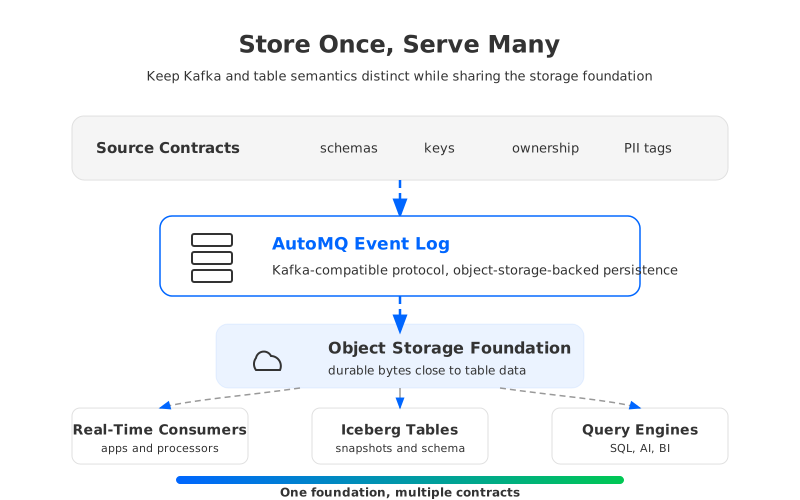
AutoMQ fits in the second and third layers. It keeps Kafka compatibility while moving persistent stream data to object storage through S3Stream. Its Table Topic capability points toward the fourth layer by using schema information and Iceberg configuration to synchronize topic data with table structures. Teams can also use established open paths such as the Apache Iceberg Kafka Connect sink or Flink's Iceberg sink when they want explicit pipeline control.
This gives platform teams several implementation options:
- Kafka Connect to Iceberg: Best when events are already close to table-ready and the team wants a connector-driven path. The Apache Iceberg sink for Kafka Connect is designed for writing Kafka records into Iceberg tables and relies on Kafka Connect exactly-once support.
- Flink to Iceberg: Best when the pipeline needs joins, deduplication, stateful enrichment, CDC normalization, or event-time handling before data becomes a table. Iceberg's Flink sink supports streaming writes and exactly-once semantics.
- AutoMQ Table Topic: Worth evaluating when the platform wants to reduce ETL friction and keep Kafka-compatible ingestion closer to Iceberg table output. Treat it as an architecture feature to test against your schemas, catalog, compaction, and governance requirements, while keeping table design as a first-class responsibility.
The sober version of this architecture is more credible than the magical one. You still need table compaction, catalog credentials, data retention policies, schema compatibility rules, and recovery drills. You still need to decide which events should become analytical tables and which should remain operational streams. AutoMQ's value is not that it deletes every downstream responsibility; it removes the assumption that the streaming layer must be a separate disk estate in front of object storage.
That distinction is why AutoMQ can be introduced without turning the article into an ad. If your Kafka estate is small, stable, and inexpensive, a storage-engine migration may not be the best use of time. If your Kafka estate is high-volume, cloud-hosted, lakehouse-bound, and constantly fighting disk, rebalance, and duplicate-copy pressure, the architecture deserves a serious look.
5Adoption Checklist
The fastest way to misuse Shift Left Architecture is to apply it everywhere. Some transformations belong near the source; some belong in a shared stream processor; some belong in the warehouse because they are exploratory, expensive, or analytical by nature. The design work is deciding where each responsibility creates the least coupling.
Use this checklist before changing the platform:
| Question | Good Signal | Warning Signal |
|---|---|---|
| Is the data product contract known at the source? | Producers own schema, keys, and event meaning | Downstream teams infer meaning from raw payloads |
| Is duplicate movement visible in cost or reliability? | Sink compute, broker storage, and backfills dominate incidents | Kafka cost is small compared with query or application cost |
| Does the stream need operational replay and analytical history? | Kafka consumers and Iceberg users both need the same events | The lakehouse is the only real consumer |
| Can reduction happen without losing future value? | Filtering removes noise, invalid events, or redundant diagnostics | Teams want to drop raw facts before governance agrees |
| Is object storage acceptable as the durable foundation? | Workload tolerates an architecture with WAL, cache, and object-store persistence | Ultra-low-latency local reads dominate and object-store access patterns are untested |
| Can the team operate table semantics? | Catalog, compaction, schema evolution, and recovery owners are clear | Everyone assumes "Kafka to Iceberg" is a connector checkbox |
Start with one pipeline slice rather than a platform-wide rewrite. Pick a topic with high volume, clear ownership, a known analytical destination, and a measurable duplicate-copy path. Define the event contract, then model the current infrastructure jobs. If most of the cost sits in broker retention, replica movement, sink workers, and repeated object-storage writes, an S3-native Kafka foundation may be a better fit than another optimization pass on the sink layer.
Then test the hard parts. Measure tail-read latency, consumer catch-up behavior, table freshness, compaction cost, failure recovery, and backfill isolation. Validate Kafka client compatibility with the applications that matter, rather than only with a benchmark producer. Check cloud network billing in your region and account structure. Confirm who owns the object-storage buckets, IAM policies, encryption, and catalog metadata.
The best outcome is not a diagram with fewer boxes. The best outcome is a platform where source teams publish trustworthy events once, operational consumers keep Kafka semantics, analytical users get governed tables, and the infrastructure no longer spends most of its effort copying the same stream into its next resting place.
6FAQ
6.1What is Shift Left Architecture for Kafka?
Shift Left Architecture for Kafka means moving data contracts, validation, enrichment, routing, and selective reduction closer to the event source instead of postponing all work until the lakehouse or warehouse. The goal is to reduce duplicate movement and make events more useful before many downstream systems depend on them.
6.2Does Shift Left mean replacing the lakehouse with Kafka?
No. Kafka and the lakehouse solve different problems. Kafka provides a replayable operational stream for applications and processors. A lakehouse table format such as Iceberg provides queryable analytical history with snapshots, schemas, metadata, and table maintenance. Shift left makes the path between them cleaner; it does not collapse every abstraction into Kafka.
6.3How can S3-native Kafka reduce infrastructure cost?
S3-native Kafka can reduce cost when a large part of the pipeline exists to copy data from broker disks into object storage and then operate both storage foundations. By making object storage the durable foundation for the Kafka-compatible stream, the platform can reduce broker-local storage pressure, stateful scaling overhead, and some duplicate movement. The exact savings depend on workload shape and cloud pricing.
6.4Is the 80% savings number guaranteed?
No. In this article, 80% refers to a scoped model of the duplicate-movement slice: broker retention, replica movement, sink compute, duplicate object-storage copy, and operational headroom. If an S3-native design removes four of those five jobs for a specific lakehouse-bound pipeline, that slice can shrink by up to 80% under the stated assumptions. It is not a universal reduction across the entire Kafka estate.
6.5Is AutoMQ the same as Kafka tiered storage?
No. Kafka tiered storage keeps a local hot tier on brokers and copies completed log segments to remote storage for longer retention. AutoMQ's documented architecture uses S3Stream to move Kafka log storage to object storage as the primary persistent foundation, with WAL and cache components for write and read performance. Both patterns use object storage, but the source-of-truth model is different.
6.6When is this architecture a bad fit?
It is a bad fit when Kafka cost is not a material problem, when source contracts are weak, when table governance is immature, or when workloads require latency and access patterns that have not been validated on an object-storage-backed design. It is also a poor fit if the team expects architecture to replace ownership: schemas, catalogs, retention, compaction, and recovery still need clear owners.


