
Table of Contents
Table of Contents
Teams usually search for sink connector idempotency kafka after a sink has already betrayed their expectations. The connector was configured correctly. The Kafka topic had data. The downstream database, warehouse, object store, or search index accepted writes. Then a task restarted, a network call timed out, or a consumer group rebalance interrupted a batch, and the team had to answer a harder question: did the target receive each event once, more than once, or not at all?
That question is not solved by labeling a connector "idempotent." Idempotency is a property of an operation under a specific retry pattern, key model, offset boundary, and target commit protocol. A sink that is harmless for upserts into a keyed table can be dangerous when writing append-only files. A sink that handles task restarts cleanly can still duplicate records after a partial target commit. A sink that works for one topic can fail under schema evolution, partition reassignment, or replay.
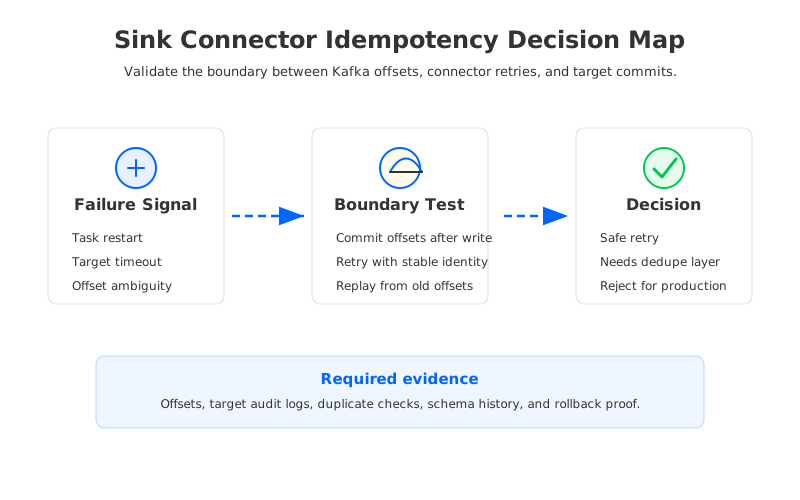
The practical goal is to make failure semantics testable before the platform becomes critical. Kafka gives teams offsets, consumer groups, transactions, and replayable logs, but a sink connector turns those primitives into writes against another system. The platform team must validate Kafka read progress, connector task state, target write behavior, retry policy, and recovery evidence as one boundary.
1Why teams search for sink connector idempotency kafka
The search query sounds narrow, but it usually hides a production design review. Data engineers want to know whether a Kafka sink connector can retry safely. SREs want alerts that distinguish duplicate writes from missing writes. Architects want to know whether a connector-heavy platform can preserve correctness when downstream systems fail independently.
The complication is that Kafka and the target system define progress differently. Kafka progress is expressed through offsets, consumer group coordination, and topic retention. A target system may express progress through primary keys, file names, table snapshots, object manifests, sequence numbers, or external transactions. The connector sits between the two and has to decide when a Kafka offset is safe to commit relative to a target write.
The dangerous window is usually small. A task reads records from Kafka, transforms them, sends a write request to the target, and then records progress. If the task crashes after the target accepts data but before the Kafka offset is committed, the same records may be read again. If the offset is committed before the target write is durable, records may be lost. Most real incidents are variations of that timing problem, made harder by batching, parallel tasks, schema changes, and target-side throttling.
A useful review starts by separating four kinds of guarantees:
- Producer-side idempotence: Kafka producers can avoid duplicate records caused by producer retries when configured for idempotent delivery. That does not automatically make a downstream sink idempotent.
- Kafka transactions: Transactions can coordinate writes across Kafka topics and offsets inside Kafka. They do not automatically make an external database, lake, or API participate in the same transaction.
- Connector offset management: Kafka Connect tracks source and sink progress, but each connector implementation decides how target writes and offset commits are ordered.
- Target write semantics: Upsert tables, append-only files, search indexes, and REST APIs all respond differently to retries.
Once those boundaries are visible, idempotency becomes a validation topic, not a checkbox in a connector catalog.
2The operational constraint behind connector-heavy platforms
Connector-heavy platforms tend to standardize the interface first and the failure model later. Kafka Connect gives teams a common way to run integrations, distribute tasks, configure converters, and monitor worker status. It is a strong operational abstraction compared with hand-built ingestion services, but it does not eliminate the need to understand what each sink does when work is interrupted.
The most expensive assumption is that replay is always safe. Kafka makes replay possible, which is one of its greatest strengths. Safe replay depends on the sink. A keyed upsert into a table may tolerate replay if the key is stable and the operation is deterministic. An append-only object store sink may need deterministic file names, transactional table commits, or a compaction and deduplication layer. A target API may need request IDs, idempotency keys, or an outbox-style reconciliation process.
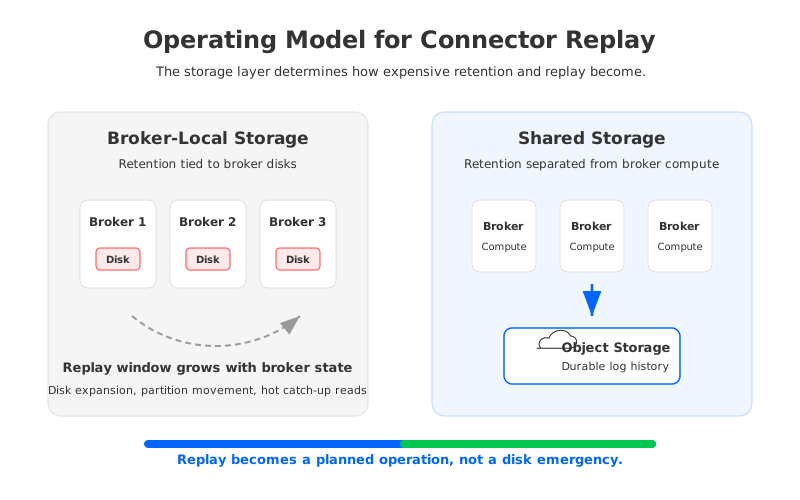
Traditional Kafka infrastructure can add another operational constraint. Broker-local storage ties retained history, catch-up reads, and broker capacity together. When sink teams ask for longer retention because replays are part of their recovery plan, the streaming platform must size broker disks, replication traffic, partition movement, and hot catch-up reads around that requirement. The connector's correctness plan becomes a cluster capacity plan.
This is where sink idempotency stops being only a connector property. A platform that cannot keep enough replay history forces teams to recover from snapshots, backups, or target-side patches. Correctness requires both: a replayable log and a target write model that can survive replay.
3Failure handling, schema, and replay trade-offs
The right test suite for a Kafka sink connector is built from failure timing, not from happy-path throughput. Throughput matters, but a fast connector that duplicates records during a restart is not production-ready for financial events, customer profiles, inventory movement, or operational telemetry. Teams should test the exact points where control moves from Kafka to the sink.
Start with the offset boundary. Offsets represent records read from Kafka, but the business effect happens in the target system. The connector must decide whether to commit offsets before or after target writes, how to handle retries, and how to recover when a batch outcome is ambiguous. A timeout does not prove the target rejected the request; it only proves the connector did not receive a usable response.
Then test the target's duplicate behavior. Some targets make idempotency natural because each event has a stable key and the write replaces or merges state. Other targets are append-first systems where duplicates become visible unless the connector creates deterministic output paths or the table layer can commit atomically. Search sinks may overwrite documents by ID. Relational sinks may use upserts, unique constraints, or transaction boundaries. The connector's documentation may describe the intended behavior, but the platform team still needs evidence from its own schema, keys, and retry configuration.
Schema changes add a second failure surface. A target write can fail because a field changed type, a required column disappeared, or a payload format changed. If the connector retries a poison batch forever, lag grows and retention becomes the recovery budget. If the connector skips records without a governed dead-letter path, correctness becomes invisible.
The strongest validation plan is concrete:
| Failure case | Validation question | Evidence to capture |
|---|---|---|
| Task crash after target write | Are records duplicated after the task restarts and reads the same offsets again? | Target row/file/document counts, Kafka offsets before and after restart, connector logs |
| Target timeout | Does retry create duplicate writes or does the target collapse them by key? | Request identifiers, target audit log, retry count, final target state |
| Consumer group rebalance | Do parallel tasks preserve partition ownership and batch boundaries? | Task assignment history, partition offsets, target write ordering |
| Schema incompatibility | Does the pipeline stop, route bad records, or partially write a batch? | Dead-letter records, schema registry history, target commit evidence |
| Replay from old offsets | Is replay deterministic under the current target schema and key rules? | Replay runbook, duplicate check, target reconciliation report |
The point is not to demand an impossible universal guarantee. It is to know exactly where the guarantee ends. A connector may be at-least-once at the Kafka boundary and effectively exactly-once for a specific target table because the target operation is idempotent. Another connector may be correct only when downstream compaction removes duplicates.
4Evaluation checklist for platform teams
A sink connector idempotency review should happen before procurement, migration, or platform standardization decisions are final. It needs to force teams to write down the failure semantics that would otherwise appear only during incidents.
Compatibility comes first. Existing Kafka clients, topics, ACLs, schemas, consumer groups, and Kafka Connect workers should behave predictably on the chosen Kafka-compatible infrastructure. Basic produce-consume tests are not enough because sink connectors depend on consumer group behavior, offset commits, partition assignment, backpressure, and monitoring signals.
Cost is the next dimension because idempotency often relies on replay. Longer retention, larger batches, slower downstream targets, and repeated backfills all consume infrastructure. In a broker-local Kafka deployment, that usually means more disk, more broker capacity, more replication traffic, and more operational planning around partition movement. A cloud cost model should separate broker compute, durable storage, cross-zone traffic, connector workers, object storage operations, private connectivity, and observability volume.
Governance deserves equal attention. Sink connectors often move regulated or business-critical data into systems with different access models. A platform should define which topics can be replayed, who can reset offsets, how dead-letter records are protected, how schema changes are approved, and how target reconciliation is audited.
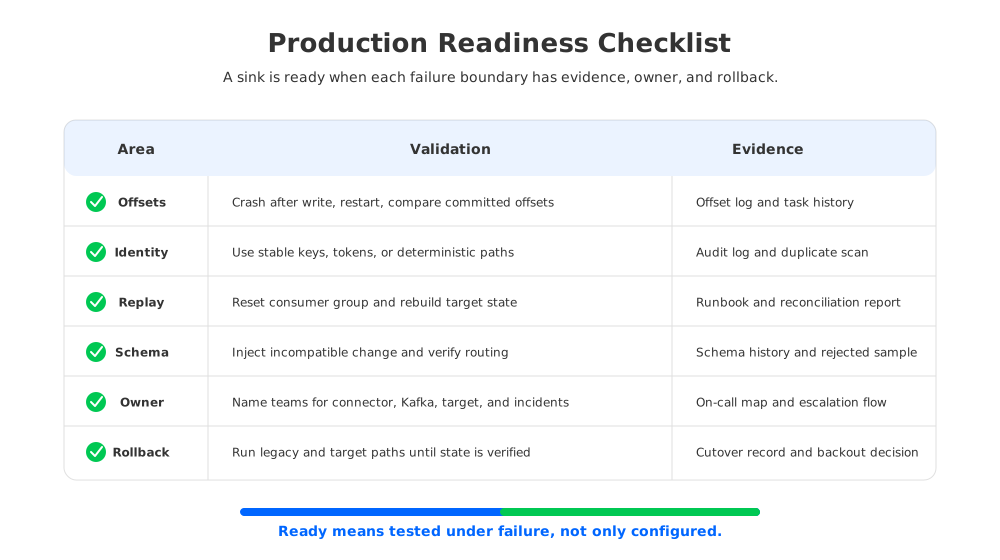
The checklist should be short enough to use in an architecture review:
- Offset and write boundary: Can the team explain when offsets are committed relative to target writes, and what happens when that boundary is interrupted?
- Stable identity: Does every record have a deterministic key, idempotency token, file path, or target identity that survives retries and replay?
- Replay window: Is Kafka retention long enough for the largest realistic recovery, schema migration, or downstream rebuild?
- Target reconciliation: Can the team prove target state after replay through counts, checksums, table snapshots, audit logs, or business keys?
- Operational ownership: Are connector workers, Kafka infrastructure, schemas, target systems, and incident runbooks owned by named teams?
- Rollback path: Can the legacy and target sink paths coexist until offsets and target state are verified?
5How AutoMQ changes the operating model
If the evaluation points toward Kafka compatibility but away from broker-local storage as the long-term bottleneck, a shared-storage Kafka-compatible architecture becomes relevant. AutoMQ fits that category: it keeps the Kafka API and ecosystem contract while redesigning the storage layer around object storage and stateless brokers. For sink connector platforms, that changes the operating question from "How much broker-local disk do we need for every replay plan?" to "How should we separate active compute, durable log history, and connector worker capacity?"
AutoMQ's Shared Storage architecture moves Kafka log storage into object storage through its S3Stream layer, with WAL options used for low-latency writes before data is persisted to object storage. Broker nodes are largely stateless, so scaling broker compute is less tied to moving retained data between brokers. That matters for sink idempotency because replay is part of testing schema changes, recovering ambiguous target writes, rebuilding lake tables, and reconciling downstream state.
The benefit is operational discipline. A connector team can continue to use Kafka-compatible topics, offsets, and consumer groups. The platform team can size broker compute around active traffic, retain durable history on object storage, and treat connector workers as the layer that owns target-specific write semantics. That separation does not make a non-idempotent sink correct, but it gives teams a better substrate for proving correctness.
AutoMQ's deployment model is also relevant for teams with strict boundaries. BYOC and private deployment options let organizations keep streaming infrastructure in customer-controlled cloud accounts or private environments, while Kafka compatibility keeps the client and connector ecosystem familiar.
There is a limit to what infrastructure should claim. AutoMQ does not remove the need for stable record keys, target-side idempotency, schema governance, dead-letter handling, or reconciliation. What changes is the cost and complexity of keeping enough Kafka history to test and recover those responsibilities in production.
6Migration scorecard
A migration scorecard turns sink semantics into a decision the organization can defend. Give each row a status of green, yellow, or red, and require a written remediation plan for every red item before production cutover.
| Area | Green signal | Red signal |
|---|---|---|
| Connector semantics | Restart, timeout, rebalance, and replay tests are documented | The design relies on "idempotent" without failure evidence |
| Kafka layer | Retention, offsets, ACLs, monitoring, and consumer groups match production needs | The platform validates only basic produce-consume behavior |
| Target writes | Keys, upserts, file commits, or table snapshots make duplicate handling explicit | Target correctness depends on manual cleanup after retries |
| Cost model | Compute, storage, networking, connector workers, and replay windows are modeled separately | Capacity is planned from average throughput only |
| Rollback | Legacy and target paths can coexist until target reconciliation is complete | Cutover assumes a one-way switch |
This scorecard is practical. Sinks succeed when target state stays correct after restarts, retries, and replay.
If your current sink connector idempotency kafka review is stuck at connector feature comparison, move the discussion to failure semantics. Test offset commits, retries, rebalances, replay, and target reconciliation with real data. AutoMQ's Kafka-compatible shared-storage architecture is one option worth evaluating when replay history, elastic broker compute, and cloud operating cost are central to that review. A practical next step is to review the AutoMQ compatibility documentation and run a PoC that includes connector restarts and target reconciliation, not only a throughput benchmark.
7References
- Apache Kafka Documentation
- Kafka Connect Documentation
- Kafka Message Delivery Semantics
- Kafka Producer Configuration: enable.idempotence
- Confluent Kafka Connectors Overview
- AutoMQ Compatibility with Apache Kafka
- AutoMQ Shared Storage Architecture Overview
- AutoMQ S3Stream Shared Streaming Storage
- AutoMQ Inter-Zone Traffic Overview
8FAQ
8.1Does Kafka producer idempotence make sink connector writes idempotent?
No. Kafka producer idempotence protects producer retries into Kafka. A sink connector writes from Kafka into another system, so idempotency depends on the connector's offset handling, retry behavior, record identity, and the target system's write semantics.
8.2Is exactly-once possible for Kafka sink connectors?
It depends on the target. Kafka transactions can coordinate Kafka writes and offsets, but an external system must provide compatible commit or idempotency behavior for end-to-end exactly-once effects. Many production pipelines use at-least-once delivery plus target-side upserts, deterministic file commits, table transactions, or reconciliation.
8.3What is the most important sink connector failure test?
Crash the task after the target has accepted a write but before the connector has committed the corresponding Kafka offsets. Then restart the task and verify whether the target receives duplicates, collapses them by key, or loses records.
8.4How long should Kafka retain data for sink replay?
Retention should be based on the largest realistic recovery or rebuild, not only on average lag. Include target outages, schema migrations, lake table redesigns, replay validation, and operational approval time in the retention window.
8.5Does shared storage make connectors idempotent?
No. Shared storage changes how the Kafka-compatible streaming layer stores and scales log data. It can make retention and replay easier to operate, but connector idempotency still depends on keys, offsets, retries, target commits, and reconciliation.


