
Table of Contents
Table of Contents
A Kafka SLO discussion often starts with p99 latency because p99 is visible, easy to chart, and painful when it moves in the wrong direction. Yet the incidents that hurt the business rarely fit into one latency graph. A broker replacement drags on because partition movement is still running. A consumer group is healthy but serving stale features to a model. A retention increase looks harmless until storage cost and recovery time expand together.
That is why kafka slo latency durability freshness is a better search phrase than it first appears. It describes the problem platform teams actually have: Kafka SLOs are coupled. Latency, durability, freshness, replay recovery, and cost all compete for the same architecture budget. Optimizing one in isolation can move risk into another area, where it becomes harder to notice and more expensive to fix.
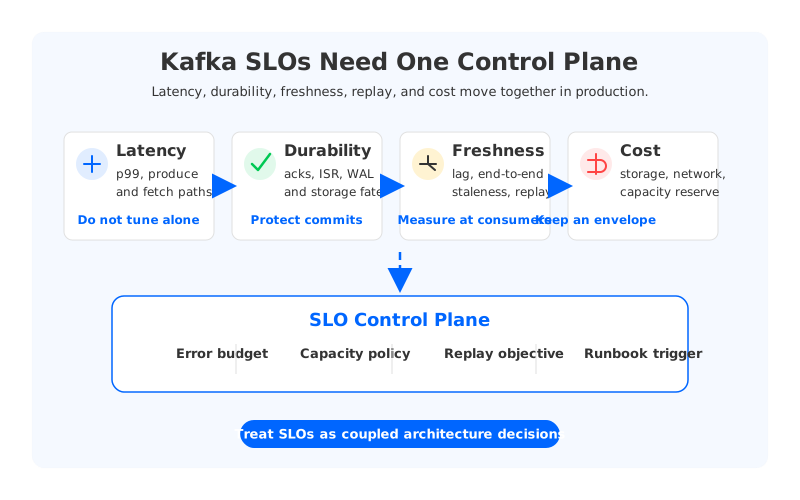
The practical goal is not to create more dashboards. It is to define an operating model where every SLO has an owner, a measurement point, a runbook trigger, and a cost envelope. Once Kafka carries event sourcing, fraud features, stream processing, AI context, and operational workflows, the platform needs one control plane for reliability and economics.
1Start With The Workload, Not The Broker
The first mistake is to define a Kafka SLO at the broker boundary only. Broker metrics are necessary, but they do not show whether the application received fresh data, committed records are safe, or replay can finish inside the recovery window.
A better starting point is the workload contract. For each critical topic or application family, ask what promise the platform must keep when traffic is normal, when traffic spikes, and when infrastructure fails. The answer usually has four dimensions:
- Latency: How long can produce, fetch, and end-to-end processing take at normal and peak load?
- Durability: Which acknowledged writes must survive broker, disk, zone, or storage failure?
- Freshness: How stale can downstream state become before the application is wrong, not just slow?
- Cost: How much storage, network transfer, and reserved capacity can the service consume as data grows?
These dimensions should be written as SLOs, not vibes. The exact thresholds differ by domain, but the relationship among them matters. A fraud detection stream and a daily analytics export should not inherit the same latency target, retention period, and replica policy just because they share a Kafka cluster.
2Latency Is A Symptom, Not The Whole Contract
Kafka latency is not one thing. Producer request latency includes batching, compression, network time, broker queueing, commit time, and replication acknowledgment. Consumer latency includes fetch wait time, processing time, offset commits, and downstream backpressure. End-to-end latency includes all of that plus application scheduling and stream-processing state.
That is why p99 latency needs context. A produce spike caused by broker CPU saturation calls for a different response than a spike caused by replication pressure or storage commit latency. One may need capacity or partition balancing; the other may require revisiting durability settings, placement, or the storage architecture.
For production teams, the useful latency SLO is tied to an action:
| SLO signal | Where to measure | Why it matters |
|---|---|---|
| Producer acknowledgment latency | Client and broker request metrics | Shows whether writes are being accepted within the application budget. |
| Fetch latency | Consumer client and broker fetch metrics | Shows whether consumers can read fast enough without masking broker pressure. |
| End-to-end freshness | Event timestamp to application-visible state | Shows whether the business outcome is still using current data. |
| Replay recovery time | Restore from retained log to target offset | Shows whether the platform can recover after failures, deploys, or backfills. |
The table explains why "low latency" is too vague for a platform SLO. A cluster can have good broker-side latency and still fail freshness after a deployment. It can also preserve p99 latency by under-replicating, shortening retention, or overprovisioning capacity. Those choices may pass a chart review and fail an architecture review.
3Durability Is A Promise About Acknowledged Data
Durability in Kafka starts with the producer acknowledgment path. Settings such as acks, replication factor, and minimum in-sync replicas control when a write can be treated as committed. The operating question is not whether the cluster has replicas. It is whether an acknowledged record remains available through the failures the business cares about.
Traditional Kafka uses broker-local log storage. That design is well understood and widely deployed, but it couples durability to broker health, placement, and capacity. Replication protects data by writing copies across brokers. In multi-AZ deployments, that can improve availability, but it can also increase network traffic and make storage growth a broker-level capacity concern. When partitions move, data moves with them.
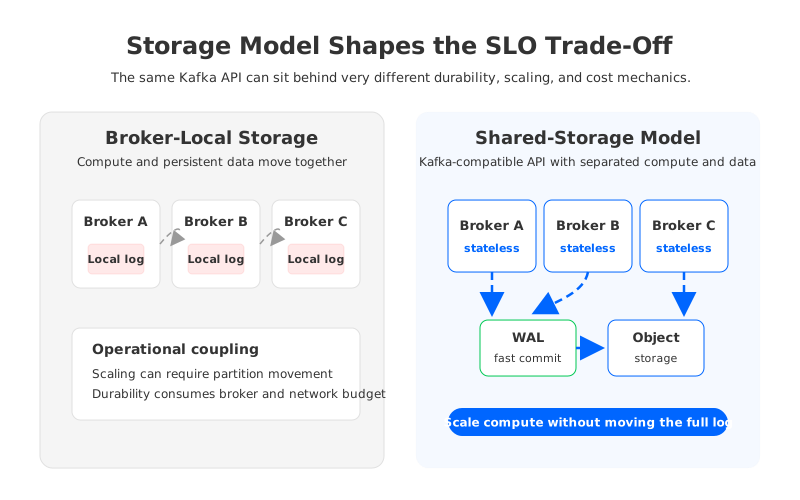
This coupling is not a flaw in the abstract. It is a trade-off. Broker-local storage gives operators direct control over log placement and performance. The problem appears when the same design must serve fast elasticity, long retention, frequent replay, and bounded multi-AZ cost at the same time.
Platform teams should make the durability target explicit: which topics require acks=all, which workloads can replay from another source, which retained data is needed for audit or recovery, and which failure drills prove the promise. A durability SLO that has never been tested during broker loss, zone impairment, or storage pressure is only a configuration preference.
4Freshness Belongs At The Consumer Edge
Consumer lag is useful, but freshness is the metric users feel. Lag counts offsets. Freshness measures how old the consumed information is when it reaches the application, model, dashboard, or workflow. A high-rate topic can show intimidating lag that recovers quickly, while a low-volume topic can have small lag and unacceptable staleness if processing is blocked.
Freshness also changes the meaning of cost optimization. It is tempting to reduce Kafka cost by lowering capacity, compressing more aggressively, moving data to a colder tier, or increasing batching. Those moves may be correct, but each can affect how quickly consumers observe new data or replay old data.
For AI and real-time product workloads, freshness becomes part of correctness. A recommendation feature that is 15 minutes stale may be available and still degrade the product. A fraud model that reads late account events may produce decisions that look fast but use the wrong state.
That pushes platform teams toward two separate objectives:
- Steady-state freshness: how quickly new events become visible to the consumers that matter.
- Catch-up freshness: how quickly those consumers recover after deploys, incidents, rebalances, or backfills.
The second objective is often ignored until the first major incident. Catch-up behavior is where retention, replay throughput, consumer parallelism, and storage design meet. If the platform cannot replay fast enough, the durability of old data does not translate into recovery.
5Cost Is Part Of The SLO, Not A Finance Add-On
Kafka cost optimization is often treated as a separate exercise: look at instance size, disk, network transfer, service fees, and utilization. That is useful, but it becomes more powerful when cost is attached to SLO design. More replicas, longer retention, higher peak headroom, larger local disks, and cross-zone replication all buy something. They should also be named in the budget.
The most common hidden cost is architectural coupling. In a broker-local model, storage capacity, compute capacity, and data movement are hard to separate. If retention grows, brokers need more storage. If brokers change, partitions may need to move. If data is replicated across zones, network movement can become material.
None of these costs are automatically wrong. They become wrong when nobody can trace them to an SLO. A topic with strict write durability, high freshness, and long replay retention deserves a larger budget than a low-priority analytics stream.
A practical cost envelope should include baseline compute and storage, peak headroom, replication and network movement, retention and replay capacity, and operational cost from rebalancing or incident response.
When cost is expressed this way, the discussion becomes clearer. Platform teams are not asking application teams to give up reliability. They are asking which reliability promise is worth which architecture cost.
6Shared Storage Changes The Operating Model
Once the coupled nature of Kafka SLOs is visible, shared-storage Kafka-compatible architectures become easier to evaluate. The point is not that every workload must move away from broker-local storage. The point is that separating compute from persistent data can change which trade-offs are unavoidable.
AutoMQ is one example of this category: a Kafka-compatible streaming platform that uses stateless brokers with shared storage on object storage. The Kafka API remains the application-facing contract, while broker compute and durable log data are no longer bound to the same local disks. AutoMQ also supports customer-controlled deployment models such as BYOC, which matters for teams that need cloud-account, network, and data-boundary control.
The architectural question is precise: can the platform preserve the Kafka semantics your applications depend on while reducing operational coupling among durability, elasticity, and cost? That requires validation, not slogans. A serious evaluation should test producer behavior, consumer groups, transactions if used, ACLs, client libraries, observability, failure handling, migration paths, and workload-specific cost.
Shared storage can help when it is implemented carefully. Stateless brokers can make compute scaling less dependent on moving the full log. Object storage can provide a durable, elastic persistence layer for retained data. A WAL path can protect the commit path without forcing every durability decision into broker-local disk. Reduced cross-zone traffic patterns can also matter in cloud deployments where network movement is material. Each claim should be mapped to a workload SLO and tested under failure, scale-out, and replay conditions.
The important distinction is between tiered storage and a separated operating model. Tiered storage can offload older segments, but the broker may still own the hot log and much of the operational coupling. A shared-storage design changes the question from "Where do older segments live?" to "Which parts of the Kafka data plane must be stateful on the broker?"
7A Practical Decision Table
The evaluation should end with a decision, not an endless platform debate. This table helps decide whether to tune the current cluster, redesign the operating model, or evaluate a Kafka-compatible shared-storage option.
| Situation | Likely action | Reason |
|---|---|---|
| Latency is unstable, but retention and replay needs are modest | Tune clients, partitions, quotas, and broker capacity first | The bottleneck may be operational rather than architectural. |
| Freshness fails after deploys or incidents | Add catch-up SLOs and replay drills | The platform needs recovery evidence, not only steady-state charts. |
| Retention growth forces broker storage expansion | Revisit storage architecture | The cost and recovery window are becoming coupled to local disks. |
| Multi-AZ durability creates material network cost | Model placement and replication traffic explicitly | Durability policy should be tied to a cost envelope. |
| Scaling brokers requires long data movement windows | Evaluate compute-storage separation | Elasticity is constrained by where the log physically lives. |
| Migration risk is higher than platform pain | Run a compatibility and rollback pilot | The right first step is evidence, not a big-bang replacement. |
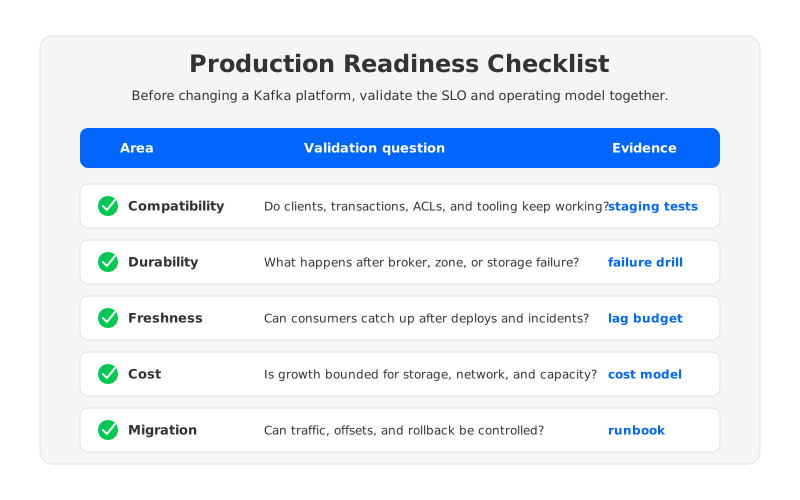
The checklist is intentionally operational. Before a platform change, teams need proof that clients work, committed data survives failures, consumers recover within budget, cost growth is bounded, and rollback is possible.
8Building The Runbook
The runbook should connect each SLO to an observable symptom and a bounded response. If producer acknowledgment latency breaches the objective, the team should know whether to inspect client batching, broker queues, replication health, WAL behavior, or storage commit pressure. If freshness breaches, the first question should be whether the issue is consumer capacity, downstream processing, broker fetch performance, or replay throughput.
This is where error budgets become useful. A freshness budget tells teams how much catch-up delay is acceptable after planned maintenance. A durability budget defines which failure drills are mandatory before a cluster is trusted for critical topics. A cost budget sets the point where growth triggers architecture review instead of another round of instance resizing.
For teams evaluating AutoMQ or any Kafka-compatible shared-storage platform, the runbook should include a pilot that mirrors production behavior:
- Use real client libraries and representative message sizes.
- Test normal writes, burst writes, consumer group rebalances, and replay.
- Simulate broker loss and zone-level impairment where the environment allows it.
- Compare storage, network, and capacity cost under the same retention policy.
- Document rollback steps before moving critical traffic.
If your Kafka SLO review shows that storage growth, replay recovery, and broker scaling are tied to the same constraint, study the shared-storage operating model in the AutoMQ architecture documentation and validate it against one workload before changing the platform broadly.
9References
- Apache Kafka Documentation
- Apache Kafka Design
- AutoMQ Architecture Overview
- AutoMQ and Tiered Storage
- AutoMQ Zero Inter-Zone Traffic
- Amazon S3 FAQs
- Amazon EC2 On-Demand Pricing
10FAQ
10.1What is a good Kafka SLO?
A good Kafka SLO is tied to a workload promise, not only to broker health. It should define producer acknowledgment latency, consumer freshness, durability for acknowledged writes, replay recovery time, and a cost envelope for the workload class.
10.2Is p99 latency enough for Kafka reliability?
No. p99 latency is important, but it does not prove that consumers are fresh, retained data can be replayed in time, or durability is cost-effective. It should be one signal inside a broader SLO model.
10.3How should teams measure Kafka freshness?
Measure freshness from event time or produce time to the point where the consuming application, model, or workflow uses the data. Consumer lag is useful, but freshness is closer to the business outcome.
10.4How does Kafka durability affect cost?
Durability choices affect replication, storage, network movement, and reserved capacity. Stronger durability is often worth the cost for critical workloads, but it should be explicitly connected to the SLO it protects.
10.5When should a team evaluate shared-storage Kafka-compatible architecture?
Evaluate it when local broker storage makes retention, replay, scaling, or multi-AZ cost hard to control. The evaluation should include compatibility, failure drills, replay tests, and rollback planning before production migration.


