
Table of Contents
Table of Contents
Smart meter event ingestion looks simple until the utility starts treating the stream as production infrastructure rather than a nightly batch feed. Millions of meters send interval reads, outage signals, voltage anomalies, firmware events, and reconnection messages. Some events arrive on schedule; others arrive late after a mesh network recovers or a cellular gateway drains its backlog. The search query smart meter event ingestion kafka usually appears when a team has already learned that the hard part is not accepting messages. The hard part is keeping the pipeline predictable when device behavior, regulatory retention, and cloud costs all move at different speeds.
Apache Kafka is a natural fit because it gives architects a shared abstraction for producers, topics, partitions, offsets, and consumer groups. Meter head-end systems can publish events into topics, validation services can process them independently, billing systems can replay from a known offset, and analytics teams can consume the same stream without owning ingestion. That does not make the platform choice automatic. The closer the workload gets to grid operations or customer billing, the more the architecture has to answer questions outside Kafka client code: where data lives, how failures recover, who owns security boundaries, and how much capacity is paid for during low-traffic hours.
The useful question is not whether Kafka can ingest smart meter events. It can. The question is whether the chosen Kafka-compatible platform keeps the operating model proportional to the utility workload.
1Why Smart Meter Event Ingestion Stresses Kafka Platforms
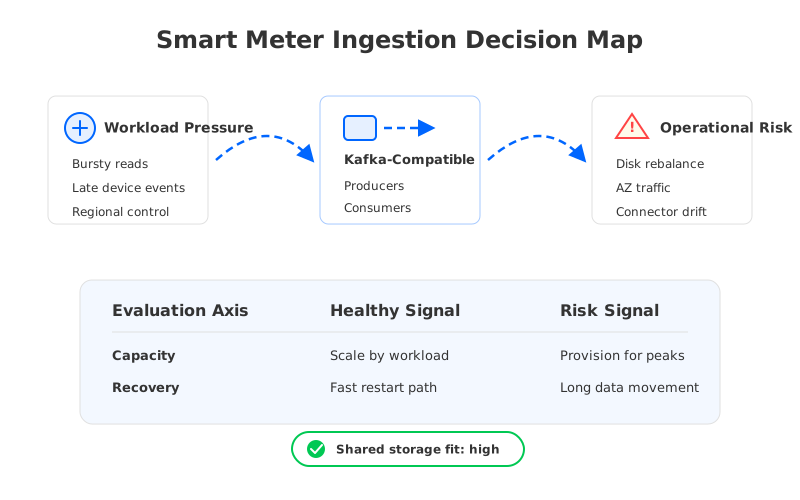
Smart meter traffic is easy to underestimate in a lab. A residential meter may publish a routine interval read on a predictable cadence, but a utility platform also has to absorb reconnect storms, outage restoration signals, firmware rollouts, and delayed backfill from disconnected devices. Those bursts often arrive with business deadlines attached: billing windows close, outage dashboards need fresh status, and regulatory retention policies require raw events to remain auditable.
The first architectural pressure is partitioning. Meter events are usually keyed by meter ID, premise ID, feeder, or service territory, and the key choice affects ordering, hot partitions, downstream joins, and backfill behavior. Kafka does not remove that trade-off. It makes the trade-off explicit, which is useful only when the platform team can observe skew and change capacity without turning every adjustment into a storage migration.
The second pressure is retention. Utilities rarely keep only the latest reading. They need raw events for dispute resolution, settlement processes, customer analytics, outage investigation, and model training. Longer retention increases storage pressure, and storage pressure changes the meaning of broker sizing. A broker is no longer sized only for CPU and network throughput; it is sized for a local disk footprint that may grow for business reasons the platform team does not control.
The third pressure is isolation. A utility data platform may serve billing, outage management, customer apps, demand response, and analytics teams from the same ingestion backbone. Each team wants stable contracts and independent scaling. If one consumer group falls behind during a release, the ingestion path should not become fragile for everyone else.
2The Production Constraint Behind the Problem
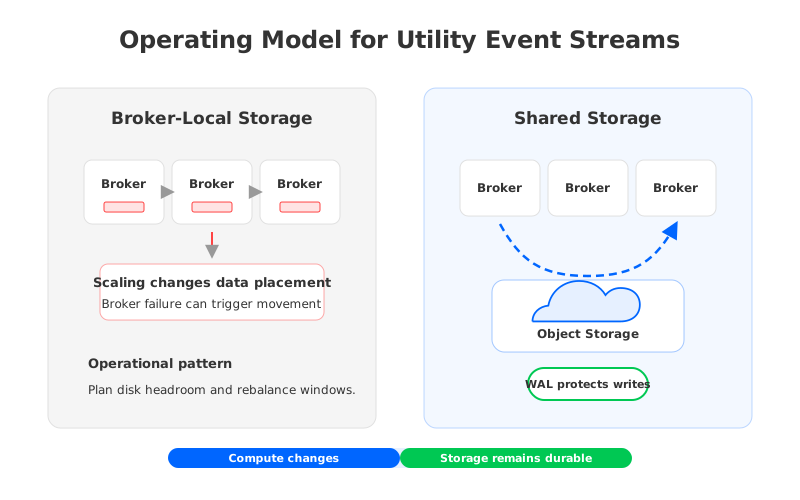
Traditional Kafka follows a Shared Nothing architecture. Each broker owns local storage for the partitions assigned to it, and replication keeps additional copies on other brokers. That model is mature, familiar, and effective for many workloads. It also means the broker is not merely a compute process. It is a compute process, a storage owner, a replication participant, and a capacity boundary at the same time.
That coupling matters for smart meter event ingestion because utility workloads force capacity changes at inconvenient times. If the platform team adds brokers to handle a seasonal peak or a planned meter rollout, partitions have to move to make use of the added capacity. If a broker fails, recovery can involve leader movement, replica catch-up, and disk pressure on the remaining brokers. If retention expands from weeks to months, the platform may need larger disks even when CPU is not the bottleneck.
The cost model follows the same coupling. Broker-local storage encourages capacity planning around peaks, not averages. Replication increases write amplification. In multi-Availability Zone deployments, inter-zone traffic can become a large part of the bill because replication and cross-zone client paths both move data across network boundaries. The exact cost depends on cloud pricing, topology, replication factor, and client placement, so calculate it with the utility's own traffic model.
Tiered Storage changes part of this equation by moving historical log segments to remote storage. It is useful when older data dominates the footprint. It does not make brokers stateless or remove the need to manage local hot data, broker placement, or recovery behavior.
3Architecture Options and Trade-Offs
Teams usually arrive at one of four patterns. None is wrong in every case, but each one puts the operating burden in a different place.
| Option | Fit for smart meter ingestion | Main trade-off |
|---|---|---|
| Self-managed Kafka on virtual machines | Maximum control over topology, storage, upgrades, and security boundaries. | The team owns broker lifecycle, storage planning, rebalancing, and incident response. |
| Managed Kafka service | Faster procurement and less infrastructure maintenance for standard workloads. | Less control over placement, cost structure, feature timing, and migration mechanics. |
| Kafka with Tiered Storage | Good when long retention is the main pain point and hot data still fits broker-local storage. | Brokers remain stateful, and operational recovery still depends on local storage behavior. |
| Kafka-compatible Shared Storage architecture | Better fit when elasticity, long retention, and cloud cost predictability matter together. | Requires validating implementation details, write path latency, and deployment boundaries. |
This table is a decision aid, not a ranking. A utility with a small service area and a stable billing-only workload may be well served by a straightforward managed Kafka cluster. A national provider that ingests events across regions, keeps raw data for analytics, and needs frequent capacity changes has a different problem. The platform choice should follow the operating model.
4Evaluation Checklist for Platform Teams
A neutral evaluation framework keeps the discussion from turning into a feature comparison. The platform has to satisfy Kafka client expectations first, then prove that it can operate under the utility's data shape. Start with compatibility because it protects application teams: producers, consumers, AdminClient usage, serializers, schema tooling, Kafka Connect, and security configuration all need to be tested with the utility's actual client versions.
Cost comes next because smart meter streams have high retention pressure and uneven traffic. A credible cost model separates broker compute, storage, inter-zone traffic, connector infrastructure, observability, backups, and operational labor. It also models traffic bursts rather than only daily averages. If the architecture needs overprovisioned disks for rare peaks, that cost should be visible before the platform becomes a dependency for billing.
Governance and security deserve the same treatment. Meter data can contain customer-linked information and operational signals, so the architecture should make network boundaries, identity management, encryption, audit logs, and regional control explicit. Private connectivity options such as AWS PrivateLink may matter when ingestion is split across internal systems, partner networks, and cloud services.
Migration risk is the final gating item. The migration plan has to cover topic creation, ACLs, quotas, consumer offsets, producer cutover, schema compatibility, connector state, replay windows, and rollback. A smart meter pipeline cannot treat rollback as a vague safety promise. If the target path accepts writes for 6 hours and the team rolls back, the plan must say what happens to those records and which system is authoritative.
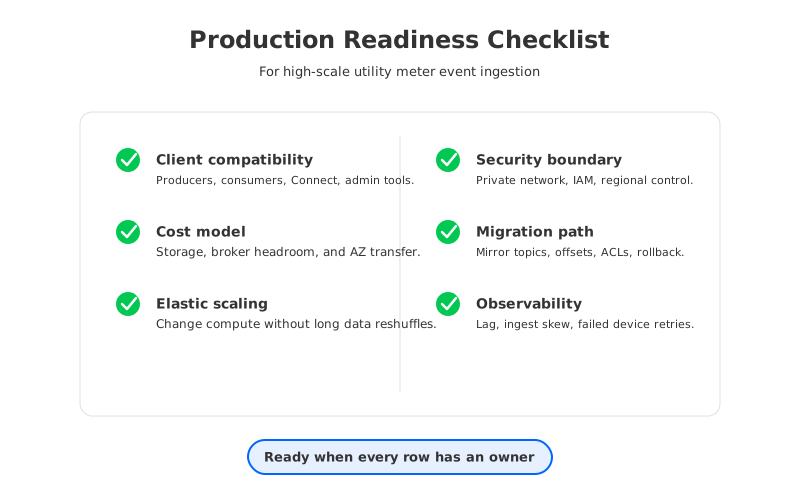
Use this readiness checklist before choosing the platform:
| Readiness area | What to verify |
|---|---|
| Compatibility | Existing Kafka clients, admin tools, Connect workers, and monitoring integrations behave as expected. |
| Elasticity | Broker capacity can change without long partition data movement becoming the dominant operation. |
| Durability | The write path and storage layer have clear failure semantics across Availability Zones or regions. |
| Cost visibility | Storage, compute, inter-zone traffic, connector runtime, and observability are modeled separately. |
| Security | Network paths, IAM, encryption, audit logs, and data residency boundaries are documented. |
| Migration | Topic sync, offsets, ACLs, rollback, and replay ownership are assigned before cutover. |
5How AutoMQ Changes the Operating Model
Once the evaluation is framed this way, Shared Storage architecture becomes easier to reason about. AutoMQ is a Kafka-compatible streaming platform that keeps the Kafka protocol and client experience while moving persistent data out of broker-local disks and into S3-compatible object storage. Brokers become stateless compute nodes, and storage durability comes from the shared storage layer.
For smart meter event ingestion, that changes the failure and scaling conversation. Adding compute capacity no longer has to mean moving large volumes of historical partition data from one broker disk to another. Replacing an unhealthy broker becomes closer to replacing compute capacity than repairing a storage owner. Long retention becomes primarily an object storage planning problem rather than a broker disk sizing problem. The practical benefit is not that operations disappear; the benefit is that fewer operations are dominated by data movement.
AutoMQ's WAL (Write-Ahead Log) layer is important in this model because object storage alone is not a low-latency write path. The WAL absorbs and protects writes before data is organized in object storage. Different deployments can use different WAL storage choices, and the right choice should be evaluated against the workload's latency, durability, and cloud boundary requirements. That is a more concrete conversation than asking whether the platform "uses S3."
The architecture also changes cross-zone traffic behavior. In traditional Kafka, replication traffic often crosses Availability Zone boundaries to maintain replica placement. In an S3-backed Shared Storage architecture, the platform can avoid broker-to-broker replica traffic for the durable log path. The exact result still depends on client placement, connector placement, and cloud pricing, so validate it with the utility's deployment topology.
AutoMQ BYOC is also relevant for teams that need customer-controlled deployment boundaries. The control plane and data plane run in the customer's cloud environment, which can make security review easier for organizations that are cautious about meter data leaving their account. That does not remove the need for security design. It gives the architecture team a clearer place to apply IAM, private networking, audit controls, and regional policy.
6Reference Architecture: Keep Raw Events Replayable
A production smart meter ingestion platform should separate the path that accepts events from the paths that interpret them. The ingestion edge normalizes authentication, schema validation, and routing, then publishes immutable records into Kafka-compatible topics. Downstream services can split into validation, billing preparation, outage analytics, device health scoring, and data lake delivery, but the raw stream should remain replayable. If a validation rule changes or a billing process needs reconstruction, replay should be a planned capability rather than an emergency workaround.
Topic design should reflect both ordering and ownership. A common pattern is to partition by meter ID for per-device ordering while using separate topics for interval reads, alarms, command responses, and lifecycle events. Kafka Connect should be monitored beside brokers because connector lag is still production behavior, especially when a warehouse, object storage sink, or operational database throttles writes.
Observability should be built around the questions operators ask during an incident:
- Are producers still writing, and are failed device retries increasing?
- Which topics or partitions are hot, and is the skew tied to a service territory or event type?
- Which consumer groups are falling behind, and are they blocking business deadlines?
- Is the platform constrained by CPU, network, storage, connector sinks, or downstream APIs?
- If a broker or zone fails, what work is automatic and what work needs an operator?
Those questions are more useful than a dashboard with hundreds of broker metrics and no workload vocabulary. Smart meter ingestion is a utility workflow first and a Kafka workload second.
7Migration Plan: Keep Rollback Boring
The safest migration plan is usually staged. Mirror a small set of topics into the target Kafka-compatible cluster, validate message counts, offsets, key ordering, consumer behavior, and schema handling, then move a non-critical consumer group. Only after reads are trusted should the team move producers, and the first producer cutover should have a written rollback path.
For high-scale utility data, rollback needs a record ownership rule. If both clusters accepted writes during a transition, decide which cluster owns the canonical log for that period. If consumer offsets diverge, decide which offsets are restored and who approves the replay. These details prevent the team from inventing recovery policy during an outage. The same discipline applies to performance validation: test reconnect storms, delayed device backfill, consumer group restarts, connector sink throttling, and retention boundary conditions, not only average write throughput.
8CTA
If your smart meter event ingestion Kafka architecture is starting to look like a storage, networking, and rollback problem, evaluate the operating model before you add another broker. You can explore AutoMQ deployment options through AutoMQ Cloud and map the same checklist against your own utility workload.
9References
- Apache Kafka Documentation: https://kafka.apache.org/documentation/
- Apache Kafka Consumer Configuration: https://kafka.apache.org/documentation/#consumerconfigs
- Apache Kafka Semantics: https://kafka.apache.org/documentation/#semantics
- Apache Kafka Connect: https://kafka.apache.org/documentation/#connect
- Apache Kafka KIP-405 Tiered Storage: https://cwiki.apache.org/confluence/display/KAFKA/KIP-405%3A+Kafka+Tiered+Storage
- AWS S3 Data Durability: https://docs.aws.amazon.com/AmazonS3/latest/userguide/DataDurability.html
- AWS PrivateLink: https://docs.aws.amazon.com/vpc/latest/privatelink/what-is-privatelink.html
- AutoMQ Overview: https://docs.automq.com/automq/what-is-automq/overview?utm_source=blog&utm_medium=reference&utm_campaign=aivk-0086
- AutoMQ Deployment Overview: https://docs.automq.com/automq/deployment/overview?utm_source=blog&utm_medium=reference&utm_campaign=aivk-0086
10FAQ
10.1Is Apache Kafka a good fit for smart meter event ingestion?
Yes, when the team needs ordered event logs, replay, independent consumers, and offset management. The harder question is which Kafka-compatible operating model fits the utility's retention, burst traffic, security, and recovery requirements.
10.2Should smart meter events be partitioned by meter ID?
Meter ID is often a strong starting point because it preserves per-device ordering. Some workflows may prefer premise ID, feeder, region, or event type. Test the key choice against ordering, skew, replay, and downstream joins.
10.3Does Tiered Storage solve the storage problem for utility event streams?
Tiered Storage can reduce local disk pressure for older data, but brokers still keep local hot data and remain stateful. If the pain point is elasticity, broker replacement, and data movement, evaluate Shared Storage architecture as a separate category.
10.4What should a migration plan include?
At minimum, include topic metadata, ACLs, producer cutover, consumer offsets, connector state, validation metrics, replay windows, and rollback ownership. Rollback should define which cluster owns records written during the transition.
10.5Where does AutoMQ fit in this architecture?
AutoMQ fits when a team wants Kafka compatibility with a Shared Storage architecture, stateless brokers, object-storage-backed durability, and customer-controlled deployment boundaries. It should still be tested with the utility's actual client versions, traffic patterns, and security requirements.


