
Table of Contents
Table of Contents
Teams usually search for kafka source sink isolation after the streaming platform has stopped being a single Kafka cluster with a few application teams. The platform now has source connectors pulling from operational databases, sink connectors feeding warehouses and object storage, Flink jobs joining streams, replay pipelines rebuilding derived data, and analytics consumers that do not always share the same failure tolerance. A slow sink task no longer means one delayed dashboard. It can hold offsets, grow lag, pressure brokers, and make the platform team choose between protecting ingestion and protecting delivery.
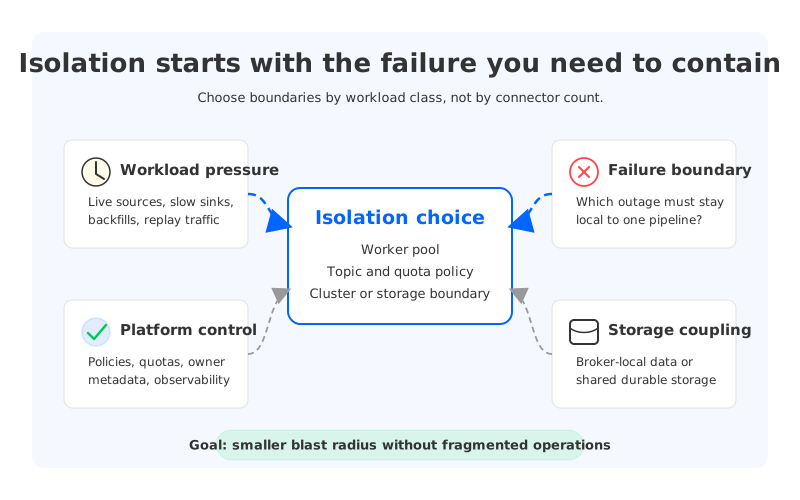
The word isolation sounds simple, but it hides several boundaries. You may need to isolate source connectors from sink connectors, critical pipelines from exploratory pipelines, replay traffic from live ingestion, or connector teams from Kafka infrastructure teams. The right design is rarely "one cluster for everything" or "one cluster per connector." It is a set of boundaries that make failures smaller without making operations unmanageable.
1Why Teams Search for Kafka Source Sink Isolation
Connector-heavy platforms create a different operating profile from application-only Kafka. Application producers and consumers often have clear owners and predictable traffic. Connectors sit at the edge of the platform, where source databases, SaaS APIs, object storage, warehouses, and stream processors bring their own rate limits, schema drift, retry behavior, and maintenance windows.
Source connectors are usually judged by freshness and capture completeness. They need to pull changes from upstream systems without overloading the source, losing ordering guarantees that matter to the business, or falling so far behind that downstream consumers start treating Kafka as stale storage. Sink connectors are judged by delivery guarantees, backpressure behavior, and how cleanly they recover when a target warehouse, search index, lake table, or object store slows down.
When both sides share the same broker capacity, the platform has a coupling problem. A sink outage can increase consumer lag and retention pressure. A large source backfill can consume write bandwidth and disk faster than planned. The Kafka API still works, but the operating boundary is wrong: unrelated teams can interfere through shared storage, network, task slots, and incident response paths.
2The Integration Constraint Behind the Pipeline
Kafka Connect gives teams a standard framework for running source and sink connectors, distributing tasks, and storing connector configuration, offsets, and status. That framework is useful because it separates connector runtime management from custom ingestion code. It does not remove the need to decide which workloads share Kafka infrastructure, which topics are safe to replay, and which failures should be contained before they affect the rest of the platform.
The integration constraint starts with offsets. Source connectors track progress against upstream systems, while sink connectors track progress against Kafka topics. If both workloads share a narrow capacity pool, one side can change the recovery profile of the other: a stalled sink increases lag and retention exposure, while a source backfill raises broker write pressure.
The second constraint is schema and contract ownership. Source teams often think in terms of upstream tables or events. Sink teams often think in terms of target formats, partitioning, merge behavior, and downstream SLAs. If every connector writes directly into shared topics with weak ownership, the platform team becomes the translator during every incident. Isolation should make ownership visible before the incident starts.
The third constraint is replay. Connector platforms need replay for backfills, bug fixes, audit reconstruction, and migration. Replay traffic is not normal traffic with a bigger number. It has different latency expectations, different cost behavior, and different blast radius. Treating replay as an isolated class lets the platform throttle it, schedule it, or route it without punishing live data.
3What Isolation Actually Means
Isolation is not one mechanism. It is a stack of boundaries, and each boundary solves a different problem. A serious design usually combines several of them instead of betting everything on cluster separation.
| Isolation layer | What it protects | Typical mechanism | Failure it reduces |
|---|---|---|---|
| Runtime | Connector workers and task slots | Separate worker pools or autoscaling groups | Bad connector code starving unrelated tasks |
| Topic | Data contracts and retention class | Topic naming, ACLs, quotas, retention policies | Backfills or sinks consuming the wrong streams |
| Cluster | Broker resources and metadata scope | Dedicated Kafka-compatible clusters or namespaces | Noisy workloads affecting critical pipelines |
| Network | Access paths and data movement | Private networking, subnet rules, endpoint policies | Uncontrolled cross-boundary traffic |
| Operations | Ownership and rollback | Runbooks, alert routing, migration batches | Incidents waiting for the wrong team |
The table shows why source and sink isolation cannot be delegated to a single product checkbox. Worker pools isolate connector execution, but not broker disk. Topic policies isolate data contracts, but not cluster bandwidth. Separate clusters reduce blast radius, but they add replication, governance, and migration work.
4Shared-Nothing Kafka Makes Isolation Expensive
Traditional Kafka was designed around brokers that own local storage. Partitions are placed on brokers, replicated between brokers, and moved when the cluster is rebalanced or expanded. This shared-nothing model is durable and well understood, but it makes storage locality part of every capacity decision. When a connector platform grows, isolation is no longer only about runtime scheduling. It becomes a question of where data lives and how much movement the cluster can tolerate.
Consider a platform that separates critical source ingestion from analytical sink delivery by putting them into different clusters. The boundary is clean, but now data must be mirrored, governed, monitored, and recovered across clusters. Keeping everything in one cluster avoids that overhead, but it accepts shared broker-local storage pressure.
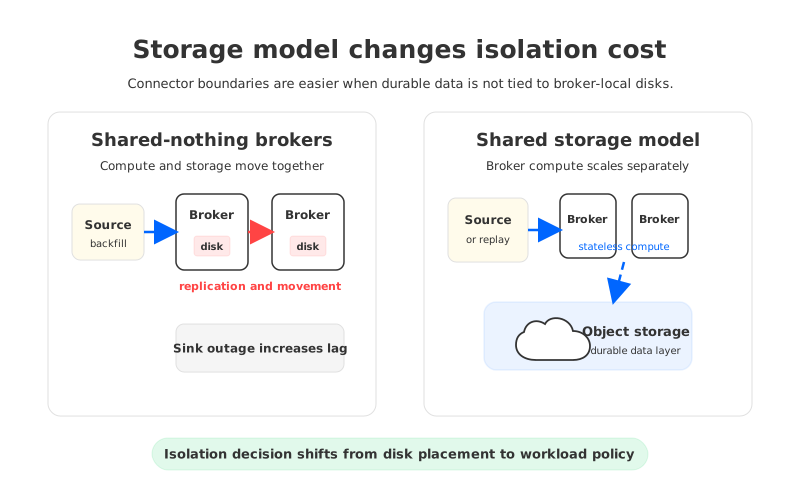
Tiered storage reduces some local disk pressure by moving older data to remote storage, but it does not make brokers stateless. Brokers still own active partitions, local replicas, and movement during reassignment. For connector-heavy workloads, the hard moments are often the active moments: a backfill, a sink outage, a partition increase, a rolling maintenance event, or a migration cutover. Those moments are exactly where local storage coupling can turn isolation into a capacity project.
This does not mean every team should abandon shared-nothing Kafka. It means platform teams should price isolation honestly. A dedicated cluster protects one workload, but it also creates another control plane. A shared cluster improves utilization, but it concentrates failure domains. There is no free boundary.
5Connector, Schema, Replay, and Stream Processing Trade-Offs
A strong isolation design starts with workload classes, not connector names. A database source connector that captures payments data has different requirements from a SaaS export connector used by marketing analytics. A sink into a customer-facing search index has a different failure budget from a sink into an offline data lake. Grouping both pairs as "connectors" hides the real operational contract.
One useful classification is to separate live-path, derived, and replay workloads. Live-path workloads move business events that other systems depend on within a short freshness window. Derived workloads transform, enrich, or deliver those events to systems that can tolerate controlled delay. Replay workloads repair history or rebuild state. Each class needs different quotas, retention expectations, alert thresholds, and rollback procedures.
Schema governance should follow the same boundary. Source topics should preserve source truth with clear compatibility rules. Derived topics should make transformation ownership explicit. Sink topics, when used as delivery buffers, should make target behavior visible without pretending the target is Kafka itself. This matters because connector teams and stream processing teams often debug together. A topic that hides whether it is raw, enriched, or target-shaped slows down every recovery conversation.
The common design mistake is to isolate too late. Teams wait until the warehouse sink has fallen behind, workers have restarted repeatedly, and retention has grown beyond the original plan. At that point every change touches offsets, topic contracts, dashboards, ACLs, and downstream recovery logic.
6Evaluation Checklist for Data Platform Teams
A practical kafka source sink isolation checklist should force the team to describe failure, ownership, and recovery before choosing topology. If the answers are vague, a diagram with more boxes will not fix the platform.
- Define workload classes first. Name the live, derived, and replay paths, then decide which sources and sinks belong in each class.
- Assign ownership at the topic and connector level. A source connector owner, topic contract owner, and sink delivery owner may be different teams.
- Decide which failures must stay local. Worker crashes, target outages, backfills, schema breaks, and slow consumers do not need the same boundary.
- Make replay a first-class path. Give it quotas, schedules, retention assumptions, and a rollback plan.
- Test migration and rollback. Isolation that cannot survive a connector upgrade, topic move, or cutover is only a drawing.
These checks are deliberately operational. They ask who gets paged, which traffic can wait, and how data moves when something goes wrong.
7How AutoMQ Changes the Operating Model
Once the team has a neutral evaluation framework, the infrastructure question becomes sharper: can the platform reduce storage coupling while keeping Kafka-compatible APIs and operational habits? This is where AutoMQ fits the discussion. AutoMQ is a Kafka-compatible streaming system that separates broker compute from durable storage, using a shared storage architecture backed by object storage and stateless broker design.
That architecture changes the isolation trade-off. In a traditional deployment, separating a connector workload often means provisioning broker-local storage for a new cluster or accepting data movement during rebalancing. With a shared storage model, broker compute can scale more independently from the durable data layer. The platform still has to design topics, ACLs, connector worker pools, and governance. The difference is that storage ownership is no longer tied as tightly to individual brokers.
For connector-heavy platforms, that distinction matters in three places. Replay and backfill workloads can be planned as traffic classes rather than permanent disk reservations on specific brokers. Source and sink teams can keep Kafka client compatibility while the platform changes the storage operating model underneath. Deployment boundaries can remain customer-controlled in cloud environments, which is important when integration touches private databases and regulated datasets.
AutoMQ is not a substitute for connector governance. It does not decide your topic contracts or rescue an unsafe schema evolution policy. Its value is architectural: it makes the infrastructure layer less resistant to the isolation model the platform already needs.
8Migration Readiness Scorecard
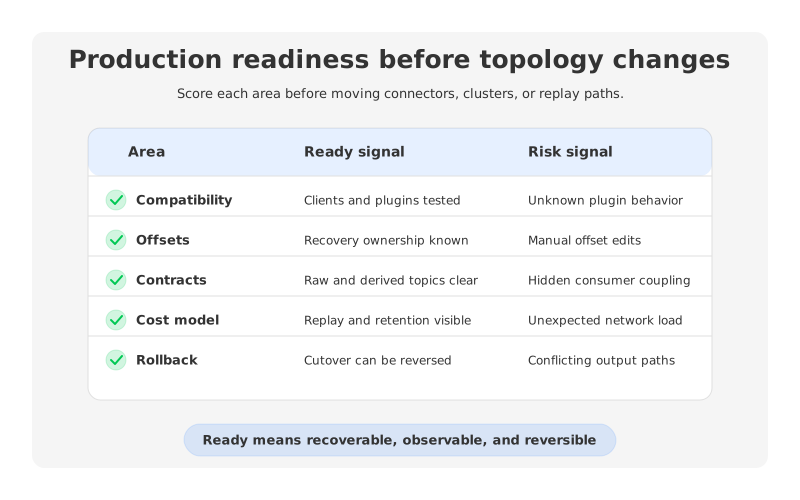
Before changing a production connector topology, score the current platform against the risks that usually derail migration. A simple three-level score is enough: green means ready, yellow means controlled gap, red means unresolved blocker.
| Area | Green signal | Red signal |
|---|---|---|
| Compatibility | Kafka clients, connector versions, and admin tooling are known | Unknown client behavior or untested connector plugins |
| Offsets | Source and sink offset ownership is documented | Recovery depends on manual offset edits during incidents |
| Data contracts | Raw, derived, and delivery topics are clearly separated | Consumers depend on undocumented connector side effects |
| Cost model | Replay, retention, and cross-boundary traffic are visible | Backfills appear as surprise broker or network pressure |
| Rollback | Cutover can be reversed without data ambiguity | The old and new paths can both write conflicting output |
| Observability | Lag, task health, broker capacity, and target delivery are correlated | Dashboards show each system but not the pipeline |
The scorecard prevents a common trap: treating source and sink isolation as a connector-team project. Connector teams can improve worker pools and task configuration, but platform teams own the Kafka-compatible substrate, security model, observability, and cost boundaries.
9Architecture Recommendations
For most teams, the right starting point is not a full cluster split. Start with explicit workload classes, enforce topic and metadata rules, separate connector worker pools for critical paths, and add quotas around replay. Then decide whether the remaining coupling is runtime, storage, network, or governance. Cluster isolation is useful when the remaining coupling is broker resource pressure or administrative blast radius, not when the real problem is unclear ownership.
Use shared clusters where workloads have similar failure budgets and clear quotas. Use dedicated clusters or namespaces where data sensitivity, replay volume, regulatory scope, or operational ownership demands a hard boundary. Use a Kafka-compatible shared storage architecture when the platform needs Kafka semantics but wants to reduce the operational drag of broker-local storage.
The key is to avoid accidental coupling. A source connector, a sink connector, and a Flink job can share a platform without sharing every failure mode. They need names that reveal ownership, topics that reflect data contracts, worker pools that contain bad tasks, storage architecture that does not turn every boundary into a disk project, and runbooks that make rollback boring.
If your connector estate is growing faster than your Kafka operations model, use this moment to review the boundary before the next backfill or sink outage forces the decision. AutoMQ can help teams evaluate a Kafka-compatible shared storage path for connector-heavy platforms while keeping deployment control in their own cloud environment: explore AutoMQ for cloud-native Kafka streaming.
10References
- Apache Kafka documentation: Kafka Connect
- Apache Kafka documentation: consumers and consumer groups
- Apache Kafka documentation: delivery semantics and transactions
- Apache Kafka documentation: KRaft mode
- AutoMQ documentation: architecture overview
- AutoMQ documentation: deployment overview
11FAQ
11.1What is kafka source sink isolation?
Kafka source sink isolation is the practice of separating ingestion, delivery, replay, and processing workloads so that failures in one path do not unnecessarily affect another. It can involve connector worker pools, topic policies, quotas, clusters, network boundaries, or operational ownership.
11.2Do source and sink connectors always need separate Kafka clusters?
No. Separate clusters are useful for strong blast-radius boundaries, regulatory separation, or heavy replay workloads, but they add replication and governance work. Many teams start with worker-pool isolation, topic governance, quotas, and better observability before splitting clusters.
11.3How does shared storage affect connector isolation?
Shared storage separates durable data from broker-local disks, which can reduce the operational cost of scaling or recovering broker compute. It does not replace connector governance, but it can make source, sink, and replay boundaries easier to operate when traffic changes quickly.
11.4What should be isolated first in a connector-heavy platform?
Start with the path that has the highest failure impact: usually live source ingestion, customer-facing sink delivery, or large replay jobs. Define ownership, quotas, alerting, and rollback for that path before adding more topology.


