
Table of Contents
Table of Contents
A Spark Streaming handoff to Kafka looks small on an architecture diagram. Spark reads from Kafka, transforms records, writes the results back to Kafka or another sink, and downstream services pick up the next stage. In production, that handoff is where batch-oriented habits meet streaming guarantees. A retry can duplicate output, a slow sink can turn into consumer lag, a schema change can break every consumer behind the topic, and a broker rebalance can convert a clean processing job into an operations incident.
The search for spark streaming handoff kafka usually starts after the easy part already works. The job can read a topic. The micro-batch or continuous query can process records. The real question is whether the team can hand data from Spark to a Kafka-compatible event store without losing ownership of ordering, offsets, recovery, cost, and governance. That question belongs to platform architecture as much as application code.
1Why Spark Handoffs Become Platform Decisions
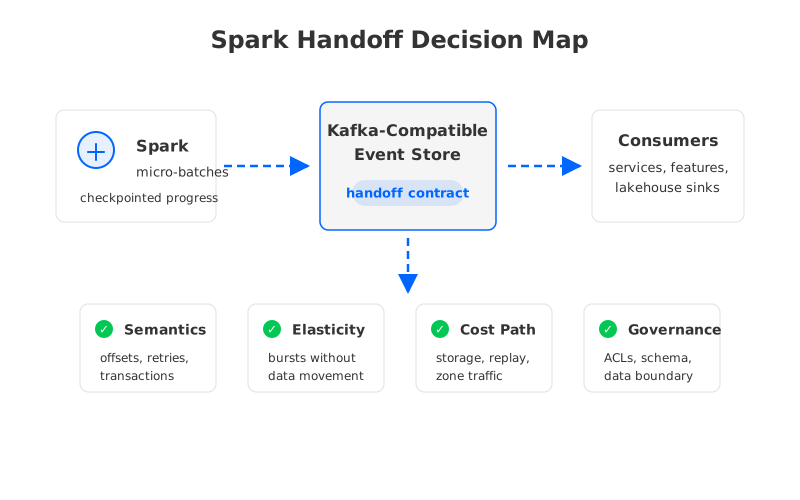
Spark Structured Streaming treats Kafka as both a source and a sink, which is exactly why the integration is attractive. Kafka gives Spark a durable stream boundary, while Spark gives the platform a rich processing engine for joins, aggregations, enrichment, and data quality checks. The handoff becomes a contract: Spark commits progress, Kafka stores the event stream, and downstream consumers assume the topic is a reliable source of truth.
That contract has more moving parts than a single connector setting can express. Spark has its own checkpointing model. Kafka has offsets, producer acknowledgments, transactions, consumer groups, retention, compaction, and partition-level ordering. Cloud infrastructure adds another layer: brokers run in zones, storage lives somewhere, network transfer has a bill, and security teams care about where data crosses boundaries. When the handoff fails, the failure rarely stays inside one layer.
The most common production questions are practical:
- Can Spark restart without replaying too much data or skipping records?
- Does the Kafka-compatible store preserve the semantics that existing Kafka clients expect?
- Can the platform absorb bursty Spark output without pre-provisioning brokers for the worst hour of the week?
- Who owns schema evolution, access control, observability, and rollback when the handoff feeds user-facing systems?
- What happens to cost when the same stream is retained for operational replay, feature freshness, and lakehouse ingestion?
Those questions are not signs that Kafka is the wrong boundary. They are signs that the boundary is important enough to deserve an operating model.
2The Handoff Contract: Offsets, Checkpoints, and Output Guarantees
A Spark-to-Kafka handoff has two progress markers that must be reasoned about together. Spark checkpoints track what the query has processed. Kafka offsets track where consumers are in a topic. If Spark reads from one Kafka topic and writes to another, a restart has to preserve the relationship between input progress and output records.
Kafka gives teams several tools for building that contract. Producer acknowledgments define when a write is considered durable. Idempotent producers and transactions help control duplicates and atomic writes across partitions. Consumer group offsets make downstream progress visible and manageable. These mechanisms are mature, but they are not magic; they still depend on correct client configuration, stable topic design, and infrastructure that can keep broker latency and availability inside the application budget.
Spark adds its own shape to the problem. Micro-batches create bounded units of work, which helps auditability and replay, but can also hide pressure. A slow Kafka sink may first appear as longer trigger duration. Then it becomes backlog, and the backlog becomes a recovery-time problem.
| Handoff surface | What can go wrong | Platform question |
|---|---|---|
| Spark checkpoint | Progress is not aligned with output durability | Can restart behavior be tested without relying on hope? |
| Kafka producer write | Retries create duplicates or latency spikes | Are idempotence, acknowledgments, and batching tuned for the workload? |
| Kafka topic design | Partition count locks in ordering and parallelism trade-offs | Can the event store scale without expensive data movement? |
| Consumer group progress | Downstream services fall behind silently | Is lag observable across Spark, Kafka, and consumers? |
| Retention and replay | Reprocessing becomes expensive or slow | Can storage grow independently from broker compute? |
The table is intentionally operational. Most handoff incidents are not caused by one exotic bug. They are caused by a mismatch between the processing contract and the infrastructure contract.
3Architecture Options for Kafka-Compatible Event Stores
The default answer is a traditional Kafka cluster with broker-local storage. It works, it is well understood, and it preserves the Kafka API and ecosystem. The challenge appears when Spark handoffs become elastic: scheduled enrichment jobs, bursty CDC normalization, feature generation, IoT aggregation, or lakehouse ingestion can produce sharp changes in write throughput and catch-up reads.
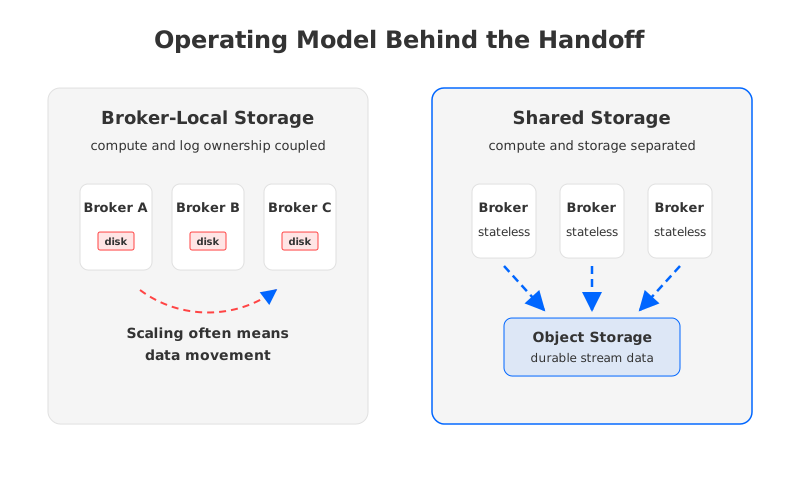
Broker-local storage makes those changes visible as operations work. More throughput means more brokers or larger disks. More retention means larger local volumes or tiered storage policy changes. Rebalancing partitions takes time because data placement is tied to broker ownership. Spark does not care about any of that in theory, but the handoff depends on it in practice.
Tiered storage improves the picture by moving older log segments to object storage. It can reduce pressure on local disks and make long retention more affordable. It does not automatically make brokers stateless or remove the need to reason about the hot path, replication, partition placement, and recovery behavior.
A shared storage architecture changes the operating model more directly. Brokers become primarily compute and protocol-serving nodes, while durable stream data is stored in object storage with a write-ahead log path for low-latency durability. That separation lets platform teams scale compute and storage along different axes because the broker is no longer the long-term owner of local log data.
The useful comparison is not "old Kafka versus new Kafka." It is whether the event store can keep the Kafka contract while removing the parts of broker-local storage that make Spark handoffs fragile under elastic workloads.
4A Decision Framework for Platform Teams
Start with compatibility, because Spark handoffs often sit inside an existing Kafka ecosystem. A Kafka-compatible event store should work with the Kafka clients, serializers, security model, consumer group behavior, and operational tooling the team already uses. Compatibility includes offset management, topic administration, client configuration, monitoring assumptions, and edge-case behavior during restart and failover.
Cost comes next, but not as a generic cloud bill complaint. Spark handoffs often create cost in four places: write throughput, retained data, catch-up reads, and cross-zone traffic. A platform that looks inexpensive at baseline can become expensive when every Spark replay pulls a large retained stream through broker disks or when replica traffic crosses availability zones. Cost analysis should follow the data path, not the invoice category.
Governance is the third decision point. Spark jobs often enrich, filter, join, and reshape sensitive data. The handoff topic may become the first place where raw data turns into operational truth, which makes access control, encryption, schema ownership, auditability, and data residency part of the architecture.
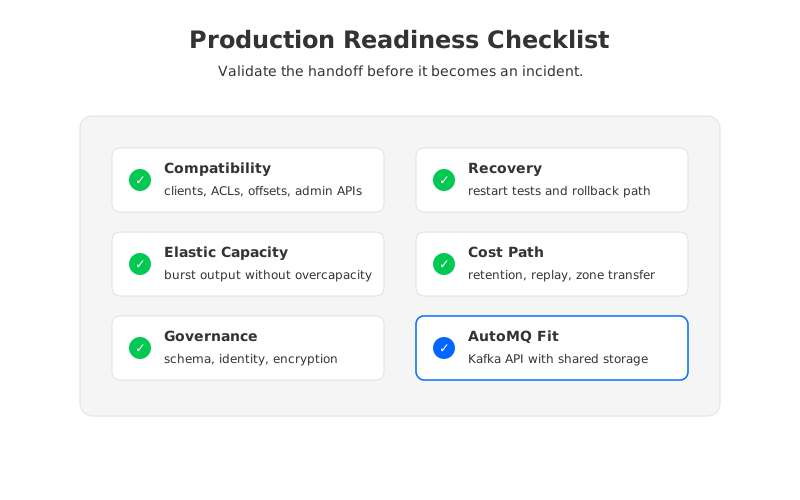
Use this checklist before choosing or changing the event store behind Spark:
- Kafka semantics: Confirm producer, consumer, offset, transaction, and admin behavior against the clients that will actually run in production.
- Restart model: Test Spark driver failure, executor loss, broker restart, and partial output retries with realistic checkpoint data.
- Elasticity: Measure how the platform behaves when Spark output spikes, not only when input throughput is steady.
- Storage growth: Separate retention planning from broker sizing so replay requirements do not force permanent overcapacity.
- Network path: Map producer, broker, object storage, and consumer zones to expose cross-zone traffic before it appears on the bill.
- Governance: Define owners for topic schemas, ACLs, service accounts, encryption, and deletion policies.
- Rollback: Keep a clear route back to the previous handoff path while downstream consumers continue to make progress.
The checklist is more useful than a feature matrix because it forces the team to test failure and ownership boundaries. If a platform cannot make those boundaries visible, the handoff will become an implicit contract.
5Where AutoMQ Fits in the Operating Model
Once the decision framework is clear, AutoMQ becomes relevant for a specific architectural reason: it is a Kafka-compatible streaming system that separates broker compute from durable stream storage. Spark can continue using Kafka integration patterns, while the platform underneath changes how data durability, capacity, and recovery are handled.
In AutoMQ's shared storage architecture, brokers are stateless from the perspective of long-term log ownership, and stream data is backed by object storage. The write-ahead log path absorbs low-latency writes before data is organized into shared storage. This model is useful for Spark handoffs because burst handling and retention planning no longer have to be solved primarily by keeping large broker-local disks attached to every node.
That difference shows up in day-two operations. Scaling broker compute can be treated as a capacity response rather than a data relocation project. Partition reassignment and load balancing become less tied to moving local log replicas. For Spark jobs that generate uneven output or need fast catch-up after downtime, the platform has more room to adapt without asking every application team to change code.
AutoMQ also matters when the handoff crosses cloud availability zones. Traditional Kafka deployments replicate data across brokers, and those brokers often sit in different zones for availability. In a cloud network, that can create inter-zone data transfer cost. AutoMQ's architecture is designed to reduce cross-zone traffic by using object storage as the durability layer and zone-aware routing for clients.
There is a governance angle as well. AutoMQ can be deployed in customer-controlled environments, including Kubernetes-based deployments, while preserving Kafka API compatibility. That matters for Spark handoffs in regulated systems because the event store is often the durable boundary between raw ingestion, derived streams, online features, and analytical sinks.
6Migration Pattern: Keep the Contract Stable
A Spark handoff migration should avoid changing the processing engine, event-store contract, and downstream consumer behavior at the same time. The safer pattern is to keep the Kafka-facing contract stable while the infrastructure changes behind it. The first migration question is not "How quickly can we move all topics?" It is "Which handoff has the smallest blast radius and the clearest rollback path?"
A practical sequence looks like this:
- Pick a Spark handoff topic with measurable throughput, known consumers, and a replayable source.
- Mirror or dual-write only when the team can compare counts, keys, timestamps, and consumer progress without ambiguity.
- Validate Spark checkpoint behavior by forcing controlled restarts instead of waiting for organic failures.
- Move a bounded downstream consumer group, watch lag and duplicate handling, then expand the cutover.
- Keep the original path available until the new event store has passed normal load, burst load, and recovery tests.
The sequence is deliberately conservative. The handoff is a contract, so the migration should prove contract preservation before it optimizes the last bit of throughput or cost.
7Production Signals to Monitor
The handoff is healthy when Spark, Kafka, and consumers agree on progress. Spark trigger duration should remain inside the expected window. Kafka producer latency should not drift upward during burst output. Consumer lag should be explained by downstream capacity, not broker instability.
The most useful dashboards combine signals across layers:
- Spark query progress, trigger duration, input rows, processed rows, and checkpoint location health.
- Kafka producer request latency, error rate, retry rate, and record batch behavior.
- Topic throughput, partition skew, under-replicated partitions where applicable, and broker resource saturation.
- Consumer group lag, rebalance frequency, and offset reset events.
- Storage growth, object storage request behavior, and network transfer by zone or subnet.
Alerting should focus on broken assumptions rather than isolated metrics. A longer Spark trigger becomes a problem when Kafka sink latency rises at the same time and downstream lag grows. A spike in retained data becomes waste when retention is compensating for slow recovery rather than supporting an explicit replay requirement.
If your Spark handoff is becoming an infrastructure decision rather than a connector setting, use the evaluation checklist above before changing application code. To see how a Kafka-compatible shared storage architecture changes the operating model, start with the AutoMQ architecture overview.
8References
- Apache Spark Structured Streaming + Kafka Integration Guide
- Apache Kafka Documentation: Message Delivery Semantics
- Apache Kafka Documentation: Consumer Configurations
- Apache Kafka Documentation: Kafka Connect
- AutoMQ Documentation: Shared Storage Architecture
- AutoMQ Documentation: Native Compatible with Apache Kafka
- AutoMQ Documentation: Zero Inter-Zone Traffic Overview
- AutoMQ Documentation: Migrating from Apache Kafka to AutoMQ
9FAQ
9.1Is Spark Streaming still a good fit with Kafka-compatible event stores?
Yes, when the handoff contract is explicit. Spark is a strong processing engine for enrichment, aggregation, and structured streaming workloads, while Kafka-compatible event stores provide a durable boundary for downstream services.
9.2Does a Kafka-compatible event store need transactions for Spark handoffs?
Not always. Transactions are useful when the workload requires stronger atomicity across writes, but some pipelines can tolerate idempotent output and downstream de-duplication. The choice should follow the business impact of duplicates, gaps, and reordering.
9.3Can AutoMQ replace an existing Kafka cluster behind Spark without rewriting Spark jobs?
AutoMQ is designed to be Kafka-compatible, so the migration target is usually the infrastructure layer rather than the Spark application model. Teams still need to validate client versions, security settings, topic behavior, checkpoint recovery, and rollback paths before production cutover.


