
Table of Contents
Table of Contents
Teams do not search for sql server cdc kafka pipeline because they need another diagram with a database on the left and a warehouse on the right. They search for it when a practical system boundary has become unclear. SQL Server is producing change records. Kafka is becoming the buffer, contract, and replay layer. Downstream systems want freshness, but the source database team still owns recovery, schema changes, and transaction semantics.
That boundary is where CDC projects become platform projects. A proof of concept can run with one connector, one topic, and a small sink. Production asks harder questions: what happens when a connector restarts halfway through a transaction batch, how far back consumers can replay, and who pays for the storage and network traffic created by a workload that never stops writing.
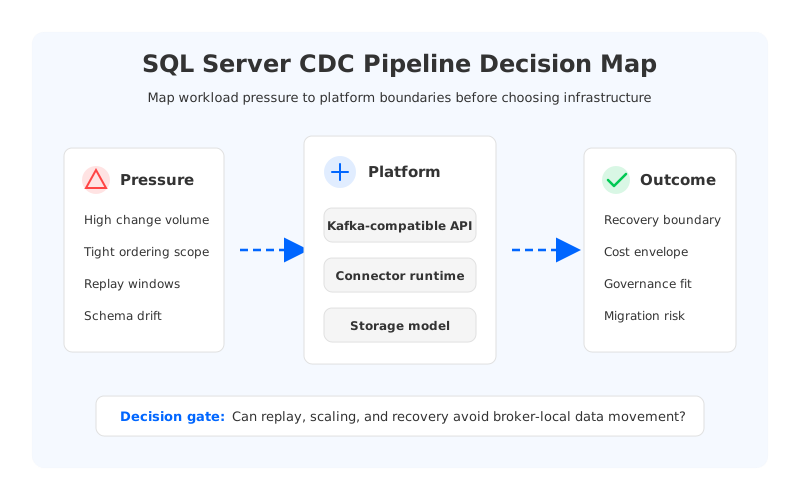
The real decision is not "SQL Server plus Kafka" in the abstract. It is whether the streaming platform can preserve enough ordering, recovery, and governance guarantees without turning every connector incident into a broker storage incident.
1Why teams search for sql server cdc kafka pipeline
SQL Server Change Data Capture records insert, update, and delete activity from tracked tables and exposes those changes through CDC tables and functions. That gives data teams a cleaner source than periodic full extracts, but it does not remove the operational contract. The database log, CDC capture job, connector offset, Kafka topic offset, schema history, and downstream sink checkpoint all become part of one recovery chain.
Kafka is attractive in this chain because it gives the platform a durable log between the database and the consumers. Kafka Connect adds a standard runtime for source and sink connectors. Consumer groups let multiple services process records independently while committing their own offsets. Transactions and producer idempotence can help with duplicate control in specific designs. None of that removes the need to define the unit of correctness.
For SQL Server CDC, the unit of correctness usually has four dimensions:
- Source progress. The connector must know which log sequence number, table, and snapshot phase it has reached, and it must resume from that position after restart.
- Topic ordering. Ordering is only meaningful inside the chosen key and partition strategy. A table-level stream, primary-key partitioning strategy, and multi-table transaction stream each create different guarantees.
- Replay horizon. Kafka retention must cover downstream outage, reprocessing, audit, and migration windows, not only the normal consumer lag target.
- Schema history. A CDC stream without schema history is a stream of bytes that may become ambiguous exactly when replay is needed most.
The search phrase looks narrow, but the platform surface is wide. A SQL Server CDC pipeline touches database operations, Kafka operations, connector runtime ownership, sink SLAs, security policy, and cloud cost.
2The operational constraint behind connector-heavy platforms
Connector-heavy platforms fail in boring ways. A task stalls after a database maintenance window. A downstream sink throttles and lag grows. A topic retention setting that was harmless during testing deletes the records needed for replay. A schema change lands outside the release window. Each incident starts as a connector issue, but the recovery path often depends on Kafka storage, offsets, and cluster capacity.
Traditional Kafka clusters add a second constraint: broker-local storage. In the classic Shared Nothing model, each broker owns local log segments for the partitions assigned to it. Replication keeps multiple copies across brokers, and Kafka's design has proven itself across an enormous range of workloads. The trade-off appears when CDC workloads require long retention and predictable replay in elastic cloud environments.
When storage and compute live together on brokers, several operational behaviors follow:
- Scaling brokers changes both compute capacity and storage placement. Adding capacity may require partition movement before the cluster is balanced.
- Broker failure recovery can involve copying or catching up partition data across the network while live CDC traffic continues.
- Retention decisions turn into disk sizing decisions. A replay window that grows from hours to days can force infrastructure changes rather than a storage policy change.
- Cross-zone placement matters twice: once for availability, and again for the data movement created by replicas, rebalancing, and consumers.
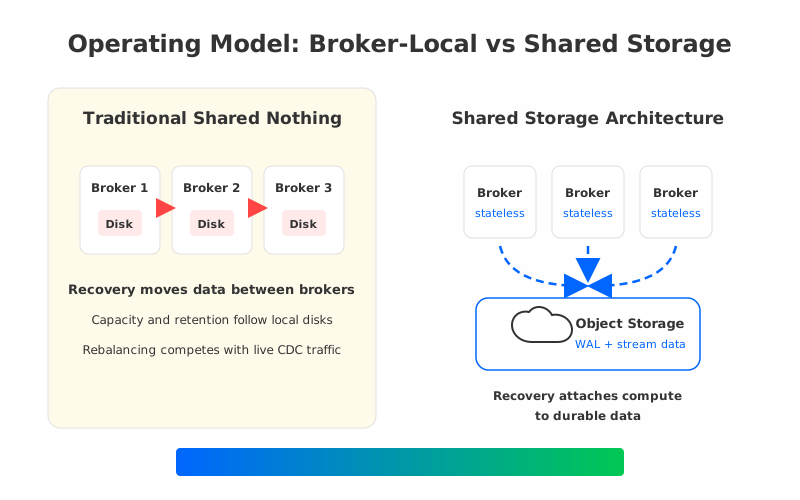
This is not a reason to avoid Kafka. It is a reason to evaluate the operating model instead of evaluating only API compatibility. A SQL Server CDC platform may be Kafka-compatible at the client layer and still expensive to recover if every growth event and broker replacement moves large amounts of partition data.
3Failure handling, schema, and replay trade-offs
Failure handling starts before the first incident. A CDC source connector has to coordinate snapshots, log reading, and offset commits. During the initial snapshot, the platform may produce a large historical load that does not behave like the steady-state change stream. During failover, the platform must distinguish records already written to Kafka from records read from SQL Server but not durably produced.
The most common mistake is to discuss duplicates without discussing replay. At-least-once delivery is often acceptable when downstream systems are idempotent by primary key or event key. It becomes dangerous when sinks apply non-idempotent side effects, when consumers mix multiple tables without a deterministic join strategy, or when schema changes alter the interpretation of an older record. Exactly-once language does not solve this by itself; the design has to define which operations participate in the transaction boundary.
Schema evolution deserves the same discipline. CDC records carry both data and interpretation. A column rename, type change, nullable field change, or table split can break consumers even when Kafka is healthy. The connector platform should keep schema history available for replay, enforce compatibility rules before deployment, and expose schema changes as operational events.
Recovery drills should answer concrete questions rather than rely on generic high availability claims:
| Recovery question | Why it matters for SQL Server CDC | Platform evidence to request |
|---|---|---|
| Can the connector resume from a known source position? | Prevents silent gaps after restart or failover. | Source offset, LSN progress, and connector task status. |
| Can consumers replay the required window? | Makes downstream repair possible without another database extract. | Topic retention, storage capacity, and offset reset process. |
| Can schema history be reconstructed? | Keeps older records readable during reprocessing. | Schema registry or connector schema history backup. |
| Can the cluster absorb catch-up reads? | Replay traffic competes with live ingestion. | Broker, storage, and network headroom under replay load. |
| Can rollback be rehearsed? | Migration and connector upgrades need a return path. | Parallel topics, offset mapping, and cutover runbook. |
The table is intentionally operational. Production CDC is less about whether the first record arrives and more about whether the thousandth failure can be handled without inventing a process during an outage.
4Evaluation checklist for platform teams
An evaluation should start with boundaries. SQL Server belongs to one operational domain. Kafka or a Kafka-compatible platform belongs to another. Connectors often sit between teams. A sink such as a warehouse, lakehouse, search index, or stream processor may belong to a fourth team. The architecture has to make these ownership lines visible.
Use this checklist before treating the pipeline as shared infrastructure:
- Compatibility. Existing Kafka clients, Kafka Connect connectors, ACL patterns, monitoring tools, and offset operations should work with minimal change. Compatibility is not only about produce and consume calls; it includes admin APIs, consumer groups, topic configuration, and operational tooling.
- Cost model. Retention, replication, catch-up reads, cross-zone traffic, connector compute, and sink retries should be visible before launch. CDC workloads are continuous, so small per-GB assumptions compound.
- Elasticity. The platform should scale compute for bursts without turning every scale event into a long storage rebalance. This matters when snapshot load, backfill, or downstream outage creates temporary traffic.
- Governance. The platform must support topic naming, access control, encryption, audit, schema policy, and environment isolation in a way that matches how the company already controls SQL Server data.
- Recovery. Runbooks should cover source connector restart, Kafka broker failure, consumer replay, schema rollback, and sink reprocessing. Each runbook needs a measurable success condition.
- Migration risk. If the team is moving from an existing Kafka cluster, the plan should cover topic configuration, offsets, ACLs, DNS or bootstrap changes, parallel validation, and rollback.
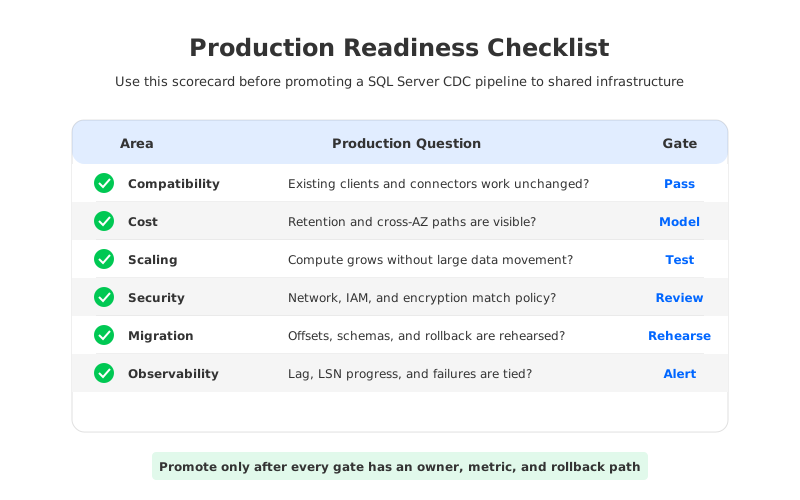
This evaluation often changes the buying conversation. The question is no longer whether a platform can ingest SQL Server changes. Many can. The question is whether it can keep the recovery boundary small when ingestion, replay, retention, and cloud elasticity overlap.
5How AutoMQ changes the operating model
If the core pain is broker-local storage, the architectural answer is to separate Kafka-compatible compute from durable stream storage. AutoMQ is a Kafka-compatible cloud-native streaming platform built around Shared Storage architecture: brokers remain compatible with Kafka clients and tools, while stream data is stored through an object-storage-backed design rather than being permanently tied to broker-local disks.
That changes the failure model for SQL Server CDC. A broker is no longer the long-term owner of a unique slice of durable data. Broker replacement and scaling can focus on compute attachment rather than large partition data movement. Platform teams can treat replay windows and retention as storage concerns while sizing brokers closer to active traffic and catch-up demand.
AutoMQ's architecture is relevant after the neutral checklist, not before it, because the checklist explains where the value appears:
- A Kafka-compatible API reduces migration friction for CDC connectors, Kafka clients, consumer groups, and operational practices.
- Shared Storage makes long retention and recovery less dependent on broker-local disk sizing.
- Stateless brokers reduce the operational cost of broker replacement, scale-out, and scale-in events.
- Object-storage-backed durability aligns stream retention with cloud storage economics and regional durability primitives.
- Zone-aware traffic controls can reduce cross-zone data transfer paths when clients and brokers are deployed with the right topology.
- BYOC and private deployment options help teams keep data-plane boundaries aligned with cloud accounts, VPCs, IAM, and compliance controls.
This does not remove CDC design work. Teams still need a connector strategy, schema governance, idempotent sink behavior, and recovery drills. The difference is that the streaming substrate does less to amplify those problems. When a downstream consumer falls behind, the platform can rely on shared durable storage for replay rather than treating the replay horizon as a broker disk crisis. When a broker is replaced, the operational question is less "where do the partition files move?" and more "how does compute reattach to data that already exists in shared storage?"
For teams evaluating a SQL Server CDC Kafka pipeline, AutoMQ is strongest when the business requirement includes at least one of these conditions: long replay windows, bursty snapshot or backfill traffic, multi-tenant connector platforms, strict cloud cost review, or a requirement to keep the data plane inside the customer's cloud boundary. If the workload is small, short-retention, and operationally isolated, a conventional Kafka deployment may be sufficient. The point is to match the architecture to the failure and cost shape of the pipeline, not to force every CDC stream into the same cluster pattern.
6Migration and readiness scorecard
A practical readiness scorecard should be written in terms that both database and platform teams accept. Start with a single SQL Server database and one representative table group. Define the snapshot strategy, steady-state change rate, replay window, schema policy, and downstream sink behavior. Then test the pipeline under failure, not only happy-path ingestion.
The minimum production rehearsal should include a connector restart during snapshot, a connector restart during incremental reading, a downstream sink outage long enough to create meaningful lag, a schema change that a consumer can tolerate, a schema change that a consumer must reject, a broker replacement event, and a replay from an older offset. If the platform cannot show these behaviors in a staging environment, the production launch is relying on faith.
The final architecture decision can be simple:
| If the CDC platform needs... | Give extra weight to... |
|---|---|
| Minimal application migration | Kafka protocol compatibility, admin API behavior, connector support. |
| Long replay and audit windows | Storage architecture, retention economics, catch-up read isolation. |
| Fast infrastructure scaling | Stateless broker behavior and partition reassignment model. |
| Strong cloud boundary control | BYOC deployment, private networking, IAM, encryption, audit. |
| Safer migration from Kafka | Offset migration, topic parity, parallel validation, rollback design. |
The search began with a SQL Server CDC pipeline. The production decision ends with boundaries: source boundary, connector boundary, stream storage boundary, consumer boundary, and cloud account boundary. When those boundaries are explicit, the platform choice becomes easier to defend.
If you are evaluating whether a Kafka-compatible Shared Storage architecture fits your CDC platform, review the AutoMQ architecture overview with the same checklist in hand: AutoMQ architecture overview.
7References
- Microsoft Learn: About Change Data Capture in SQL Server
- Apache Kafka documentation: Kafka documentation
- Apache Kafka documentation: Kafka Connect
- Apache Kafka documentation: Consumer groups and offsets
- Debezium documentation: SQL Server connector
- AutoMQ documentation: Compatibility with Apache Kafka
- AutoMQ documentation: Shared Storage architecture overview
- AutoMQ documentation: Eliminate inter-zone traffic overview
- AutoMQ documentation: Managed Kafka Connect overview
8FAQ
8.1What is the safest starting architecture for a SQL Server CDC Kafka pipeline?
Start with one source connector, table-level topic conventions, explicit key selection, schema history storage, and a retention window sized for recovery rather than normal lag. Add more tables and sinks after restart, replay, and schema-change drills pass.
8.2Does Kafka guarantee ordering for SQL Server CDC events?
Kafka preserves order within a partition. The pipeline has to choose keys and topic layout that match the ordering requirement. If multiple tables or aggregate boundaries are involved, the design must define where ordering is required and where downstream reconciliation is acceptable.
8.3Is at-least-once delivery enough for CDC?
Often, yes, when consumers and sinks are idempotent by primary key or event key. It is not enough when consumers trigger non-idempotent side effects without deduplication. Delivery semantics must be evaluated together with sink behavior.
8.4Where does AutoMQ fit in a CDC platform?
AutoMQ fits at the Kafka-compatible streaming layer. It does not replace SQL Server CDC or connector logic; it changes the broker storage and scaling model beneath Kafka-compatible APIs, which can reduce operational friction for retention, recovery, and elastic capacity.
8.5What should be tested before production?
Test snapshot restart, incremental restart, sink outage, replay from older offsets, schema evolution, broker replacement, and rollback. A CDC pipeline is ready when each failure has an owner, metric, and runbook.


