
Table of Contents
Table of Contents
Teams rarely search for flink kafka sql pipeline because they need another syntax example. They search because a real-time pipeline has crossed the line from experiment to production dependency. A SQL job now feeds a fraud score, a customer-facing dashboard, a warehouse ingest path, or an operations alert. The question is where that workload should live, who owns the failure modes, and how much infrastructure tax the team will pay as the pipeline grows.
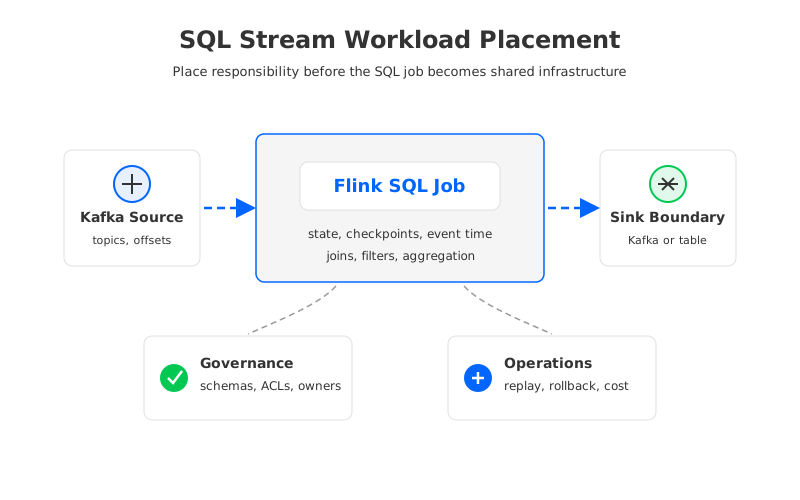
A SQL stream pipeline looks tidy on a whiteboard: source topic, Flink SQL, sink topic or table, downstream consumers. In production, the same flow touches Kafka retention, consumer offsets, schema compatibility, connector lifecycle, checkpoint storage, replay policy, network boundaries, and cost attribution. That is why workload placement matters. The wrong placement turns SQL into another hidden platform that every team depends on but no team can operate cleanly.
1Why Teams Search for flink kafka sql pipeline
Flink SQL gives data engineers a declarative way to express streaming joins, filters, aggregations, and enrichment without writing a custom application for every flow. Kafka already holds the event streams that operational systems produce and consume. Together, they create a familiar pattern: use Kafka as the durable event backbone and Flink SQL as the transformation layer that turns raw events into usable streams.
The search intent gets sharper when that pattern becomes shared infrastructure. A single team can tolerate manual topic setup, ad hoc connector configs, and a few dashboard links. A platform team supporting many SQL pipelines needs repeatable answers for resource isolation, backfills, schema changes, and incident ownership. The SQL layer may be declarative, but the operating model underneath it is not automatically simple.
The first placement question is therefore not "managed or self-hosted." It is more basic: which layer owns each responsibility?
- Kafka owns durable event history, topic retention, consumer offsets, access control, and compatibility with the broader Kafka ecosystem.
- Flink owns stateful stream computation, checkpoints, event-time semantics, joins, aggregations, and job recovery.
- Connectors own system-specific movement into warehouses, lakes, search indexes, databases, and operational sinks.
- The platform team owns the policy surface around all three: naming, identity, observability, cost attribution, and lifecycle management.
When these responsibilities are blurred, production failures become harder to debug. A slow dashboard might be caused by consumer lag, a Flink checkpoint stall, a sink connector retry loop, a schema mismatch, or a broker capacity limit. The pipeline is SQL at the top, but the failure tree is distributed.
2The Integration Constraint Behind the Pipeline
A flink kafka sql pipeline usually starts with a table definition over Kafka topics. The developer maps a topic to a logical table, defines formats and timestamps, and writes SQL that produces another stream or external table. This is the right abstraction for expressing business logic. It is the wrong abstraction for deciding whether the platform can replay two weeks of traffic, survive a zone failure, or scale a hot topic without a long storage operation.
Traditional Kafka deployments make that infrastructure decision heavier because broker compute and broker-local storage are coupled. Partitions live on brokers, replicas consume disk and network capacity, and rebalancing can move data through the cluster. Replay and backfill jobs can turn historical reads into a broker pressure event, while topic growth from SQL-derived streams can force capacity planning before the business logic is stable.
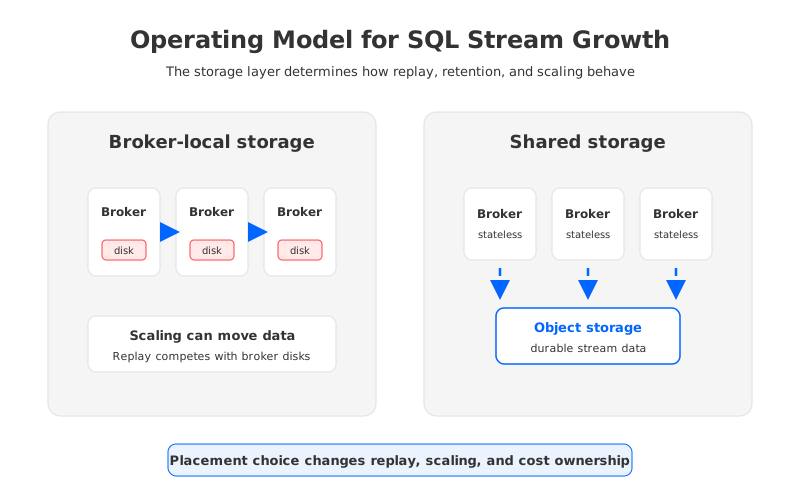
This does not make traditional Kafka a poor fit for every stream processing workload. It means the placement decision must respect the storage model. If the team expects many derived topics, frequent replay, elastic compute, and independent ownership across data domains, then broker-local storage becomes part of the SQL pipeline design even when no SQL statement mentions storage.
The integration constraint also shows up at the sink side. A SQL job that writes curated events back to Kafka has a different risk profile from a job that writes into a warehouse, object storage table, or operational database. External sinks add connector limits, batching behavior, credentials, network policy, and destination-specific failure semantics. Treating all sinks as equivalent underestimates operational risk.
3Connector, Schema, Replay, and Governance Trade-Offs
The most useful evaluation starts with the contracts around the pipeline, not the SQL text. Kafka topics define the durable stream boundary. Schemas define what records mean. Flink jobs define how records are transformed over time. Connectors define where the transformed records go next.
Those boundaries need explicit ownership because each one changes differently. A producer can add a field, a SQL job can change a join window, a connector can change batching behavior, and a consumer can depend on old semantics. If the platform lacks a contract model, every change becomes a meeting or an incident.
| Decision area | Question to answer | Production signal |
|---|---|---|
| Topic contract | Is the topic a source of record, derived stream, or transient stage? | Retention, ACLs, and ownership match the lifecycle. |
| Schema policy | Who can change fields and compatibility rules? | Schema changes are reviewed before jobs fail. |
| Replay policy | How far back can the team recompute state? | Retention and checkpoints support the recovery objective. |
| Sink ownership | Who operates the destination and connector? | Retries, dead letters, and alerts have clear owners. |
| Cost attribution | Which domain pays for reads, writes, storage, and network? | Pipeline growth is visible before budget review. |
This table is deliberately platform-oriented. Syntax examples do not answer whether a derived topic should keep data for hours, days, or longer. They do not decide whether replay is a normal workflow or reveal who owns a failed sink.
Governance should be applied at creation time. A self-service pipeline request should create or validate topics, schemas, ACLs, job metadata, sink credentials, observability labels, and cost tags together. If these records are created later, the team will fill the gaps with chat threads and private runbooks.
4Evaluation Checklist for Data Platform Teams
Once the contracts are clear, the infrastructure evaluation becomes more grounded. The question is not whether a vendor or deployment model supports "Kafka plus Flink." Many options can claim that. The question is whether the operating model matches the way your organization builds, changes, and recovers SQL stream workloads.
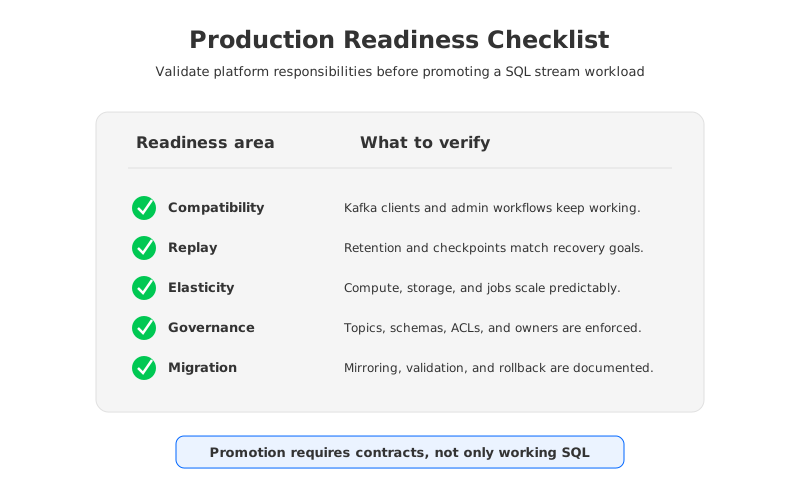
Use this checklist before committing a critical SQL stream workload to a platform:
- Kafka compatibility: Existing producers, consumers, admin tooling, security patterns, and client libraries should work without forcing a platform-specific rewrite.
- Storage and replay: Retention and historical reads should be planned as normal operations, not as exceptional events that surprise broker capacity.
- Elasticity: Compute growth, storage growth, and SQL job parallelism should be scaled through clear controls with predictable blast radius.
- Governance: Topic names, schemas, ACLs, owners, cost labels, and observability labels should be enforced by automation.
- Migration and rollback: The team should know how to mirror traffic, preserve offsets where needed, validate output, and reverse the change.
- Operational boundaries: The platform should make it obvious who owns Kafka, Flink jobs, connectors, destination systems, and incident response.
These checks expose a useful distinction. Some teams need an application pattern: one or two SQL jobs near a product service, with limited sharing and a small operational surface. Other teams need a platform pattern: many SQL jobs, shared Kafka infrastructure, formal governance, and measurable cost ownership. The same SQL can be valid in both patterns, but the workload placement is different.
5How AutoMQ Changes the Operating Model
At this point, AutoMQ enters the discussion as an architecture option, not as a shortcut around the evaluation. AutoMQ is a Kafka-compatible streaming platform that keeps the Kafka protocol and ecosystem surface while moving durable stream storage to shared object storage with stateless brokers. For SQL stream workloads, the important shift is operational: brokers are no longer the long-term home of data, so scaling and recovery are less tied to broker-local disks.
This changes the placement conversation in practical ways. Kafka clients and tools can continue to interact through Kafka-compatible APIs, while the platform team evaluates storage growth, replay, and broker elasticity through a shared-storage model. For Flink SQL pipelines, that means the Kafka layer can remain the durable stream boundary without forcing every retention or replay decision to become a broker disk planning event.
The architecture is especially relevant when many teams create derived streams. Stateless brokers make compute capacity easier to treat as an elastic serving layer. Object-storage-backed durability gives the platform a different cost and recovery profile from broker-local disks. AutoMQ also supports deployment boundaries for teams that need Kafka-compatible streaming inside their own cloud account or private environment.
Flink still owns state and checkpoints, so a shared-storage Kafka layer does not remove the need for Flink capacity planning, state backend design, checkpoint tuning, and job observability. Connectors still need destination-specific reliability controls. The benefit is narrower and more concrete: the Kafka substrate can align better with elastic, governed, multi-team stream placement.
6A Placement Model That Survives Production
A durable placement model starts by classifying each SQL stream workload before choosing infrastructure. The classification should be small enough for developers to use and strict enough for platform automation to enforce. A useful model has four classes: operational transformation, analytical fan-out, migration or replay, and exploratory streaming.
Operational transformations enrich or filter events for low-latency services, so they need tight observability, clear ownership, and fast rollback. Analytical fan-out prepares streams for warehouses, lakehouse tables, or BI systems, which makes sink reliability and cost controls more important. Migration or replay jobs rebuild state or feed replacement systems, so they need deterministic input ranges and validation. Exploratory jobs should expire unless they are promoted into a production contract.
Each class should map to policy rather than personal judgment:
- Operational transformations require production ACLs, owner escalation, lag alerts, and a rollback path.
- Analytical fan-out requires sink ownership, batching policy, data classification, and cost tags.
- Migration or replay workloads require source retention checks, output validation, and a cutoff plan.
- Exploratory workloads require expiration, limited privileges, and a promotion process before other teams depend on them.
This is where platform teams can make SQL safer without slowing delivery. Developers still express transformations in SQL. The platform turns that request into topics, schemas, job metadata, connector settings, and alerts that match the workload class. Existing estates should start with inventory rather than a rewrite: map each job to its source topics, output topics, schemas, checkpoints, connectors, dashboards, and owners, then move the riskiest classes into the governed path.
7The Decision Framework
The right answer for flink kafka sql pipeline is rarely a single product choice. It is a placement decision across event storage, stream computation, connectors, governance, and team boundaries. A team that ignores placement may still ship the SQL job, but it will inherit the operating model by accident.
Use this decision sequence when evaluating a production SQL stream workload:
| Step | Decision | Good outcome |
|---|---|---|
| 1 | Classify the workload | Operational, analytical, migration, or exploratory policy is clear. |
| 2 | Define contracts | Topics, schemas, owners, ACLs, and replay policy are known. |
| 3 | Evaluate infrastructure | Kafka compatibility, storage model, elasticity, and cost fit the class. |
| 4 | Validate operations | Alerts, rollback, sink behavior, and incident ownership are tested. |
| 5 | Promote deliberately | Exploratory SQL becomes a managed contract before others depend on it. |
The point of the framework is to make trade-offs visible early. A small internal stream may not need a full platform workflow. A cross-domain pipeline feeding revenue operations almost certainly does. The difference should be encoded in policy, not rediscovered during an outage.
If your team is evaluating Kafka-compatible infrastructure for Flink SQL, derived streams, replay-heavy analytics, or multi-team governance, review how shared-storage Kafka changes the operating model before finalizing placement. The AutoMQ product overview is a practical next step: explore AutoMQ for Kafka-compatible streaming.
8References
- Apache Kafka Documentation: https://kafka.apache.org/documentation/
- Apache Flink Table API and SQL Documentation: https://nightlies.apache.org/flink/flink-docs-stable/docs/dev/table/overview/
- Apache Flink Kafka Connector Documentation: https://nightlies.apache.org/flink/flink-docs-stable/docs/connectors/table/kafka/
- Apache Kafka Connect Documentation: https://kafka.apache.org/documentation/#connect
- AutoMQ Architecture Overview: https://docs.automq.com/automq/architecture/overview?utm_source=blog&utm_medium=reference&utm_campaign=aivk-0065
- AutoMQ Kafka Compatibility: https://docs.automq.com/automq/what-is-automq/compatibility-with-apache-kafka?utm_source=blog&utm_medium=reference&utm_campaign=aivk-0065
- AutoMQ Deployment Overview: https://docs.automq.com/automq/deployment/overview?utm_source=blog&utm_medium=reference&utm_campaign=aivk-0065
9FAQ
9.1What is a flink kafka sql pipeline?
A flink kafka sql pipeline is a streaming data flow where Flink SQL reads from Kafka topics, transforms records through SQL tables or views, and writes the result to Kafka or another sink. The SQL layer expresses the transformation, while Kafka provides durable event streams and consumer coordination.
9.2Should Flink SQL pipelines write back to Kafka or directly to a warehouse?
Write back to Kafka when downstream systems need a reusable real-time stream or when multiple consumers share the transformed data. Write to a warehouse or lakehouse when the primary consumer is analytical storage. The platform should still define schema, replay, ownership, and sink reliability rules in both cases.
9.3How does Kafka storage architecture affect Flink SQL workloads?
Flink SQL jobs often create derived streams, read historical data, and trigger catch-up traffic during recovery or replay. In broker-local Kafka deployments, those operations interact with broker disks, replicas, and rebalancing. In a shared-storage Kafka architecture, durable data is separated from broker-local disks, which changes the scaling and recovery model for the Kafka layer.
9.4Does AutoMQ replace Flink?
No. AutoMQ is a Kafka-compatible streaming platform, while Flink is a stream processing engine. AutoMQ can provide the Kafka-compatible event storage layer for Flink SQL workloads, but Flink still owns SQL execution, state, checkpoints, and job recovery.
9.5What should a production checklist include before launching a Flink Kafka SQL pipeline?
A production checklist should cover source and output topics, schemas, ACLs, owner metadata, retention, replay range, checkpoint strategy, connector behavior, alerting, cost attribution, rollback, and migration validation. The checklist should be automated through the platform wherever possible so every pipeline follows the same contract lifecycle.


