
Table of Contents
Table of Contents
Teams usually search for iceberg table write path kafka after the first prototype works. Records move from Apache Kafka into an Apache Iceberg table, queries can see the data, and the demo looks clean enough to show. Then the production questions arrive: what happens when a writer restarts during a commit, how far can the consumer replay, who owns schema changes, and how much Kafka storage must be kept around while downstream table commits catch up? The hard part is not connecting Kafka to Iceberg. The hard part is making the write path recoverable when the streaming layer and the table layer fail on different clocks.
That distinction matters because Iceberg changes what "successfully written" means. In Kafka, the durable unit is a record in a partition with an offset. In Iceberg, the visible unit is a table snapshot that references data files and metadata. A pipeline can acknowledge records at the streaming layer while a table commit is still pending, or it can write files that are not yet visible to query engines. The practical thesis is simple: an Iceberg table write path is a state-management problem first and a connector choice second.
1Why Teams Search for iceberg table write path kafka
The search intent is usually specific. A data platform team has Kafka topics that already feed operational services, and the analytics team wants the same data in Iceberg for Trino, Spark, Flink, or another query engine. They do not want a nightly batch export. They want a continuously updated table that preserves enough ordering, schema, and recovery semantics to be trusted by downstream users.
Apache Iceberg supports streaming writes through engines such as Flink, and the official Iceberg Kafka Connect sink is designed to write Kafka records into Iceberg tables. Those are useful building blocks, but neither removes the need to reason about the source log. Kafka still owns offsets, consumer groups, retention, transactions, and replay behavior. Iceberg owns snapshots, manifests, data files, commit coordination, and table-level visibility. The write path sits between those two systems, so the failure boundary sits there too.
A production review should start with three questions that are easy to ask and uncomfortable to answer late:
- If a writer crashes after producing files but before committing an Iceberg snapshot, can the next writer identify and clean up the unfinished work?
- If Kafka retention expires before the table path has caught up, can the team rebuild the table from another durable source?
- If a schema change is accepted by producers before the table catalog accepts it, which system blocks the bad write?
These questions make the architecture visible. They also prevent a common mistake: treating Kafka as a temporary pipe once Iceberg appears in the diagram. For real-time table ingestion, Kafka is still the recovery ledger. The more important the Iceberg table becomes, the more carefully the Kafka side must be planned.
2The Production Constraint Behind the Problem
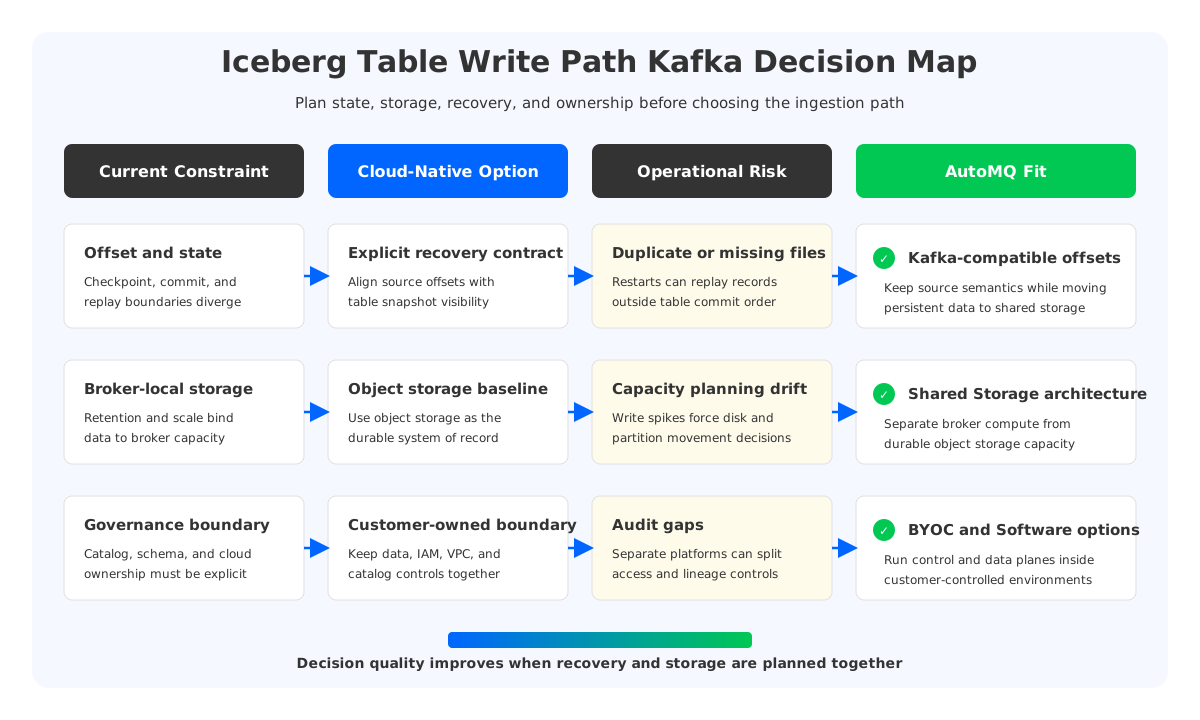
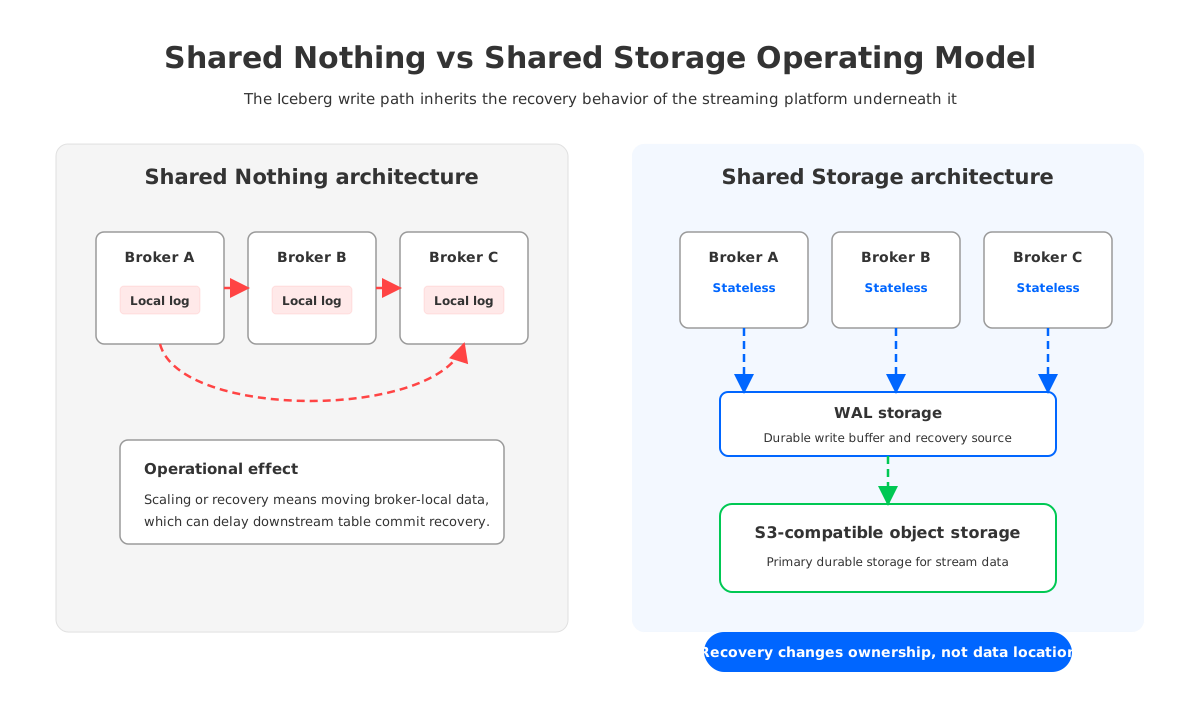
Traditional Kafka deployments use a Shared Nothing architecture. Each broker owns local storage, and partitions are replicated across brokers for durability and availability. This model is well understood and reliable when capacity, retention, and partition movement are stable. It becomes harder to operate when the write path to Iceberg increases both retention pressure and recovery expectations.
An Iceberg sink often needs enough Kafka history to replay from a known offset after a connector, Flink job, catalog, or object storage incident. That retention is not abstract. It lands on broker-local disks or cloud volumes, competes with hot operational traffic, and has to be provisioned before the incident occurs. If the downstream table path falls behind because commits are slow, a producer spike arrives, or query-side object storage throttling appears, the streaming platform must absorb the difference.
The second constraint is data movement. Scaling a Shared Nothing Kafka cluster can require partition reassignment and replica movement. That movement is normal Kafka operation, but it becomes part of the Iceberg write path's risk budget because rebalancing affects the same partitions that sinks are reading. A platform team can tune consumer fetch sizes, commit intervals, and file rolling policies, but those settings do not change the fact that the source log is tied to broker capacity.
The third constraint is cross-team ownership. Kafka operators tend to own brokers, topic policies, ACLs, and retention. Lakehouse teams tend to own catalogs, table schemas, object storage layout, and query performance. Iceberg write paths fail in the space between those teams. A connector may be healthy while table commits are delayed; a table may be consistent while Kafka retention is too short for a rebuild; a producer may pass Kafka validation while creating table-level schema pain. The architecture needs a shared runbook, not only a working connector configuration.
3Architecture Options and Trade-Offs
There are several valid ways to write Kafka data into Iceberg. The right choice depends on how much transformation, governance, and operational control the team needs.
| Option | Where state lives | Good fit | Main risk |
|---|---|---|---|
| Kafka Connect Iceberg sink | Connector tasks, Kafka offsets, Iceberg commit coordination | Standardized ingestion from topics into tables | Connector state and table commit behavior must be tested together |
| Flink streaming job | Flink checkpoints, Kafka offsets, Iceberg snapshots | Stateful transformations, joins, enrichment, and custom routing | More moving parts in checkpoint, savepoint, and job upgrade workflows |
| Custom consumer writer | Application state plus Kafka offsets and table commits | Highly specialized logic or strict domain control | Teams must implement recovery and idempotency discipline themselves |
| Platform-native table topic | Streaming platform and table path share one managed operating model | Teams that want fewer ingestion services to own | Feature scope and catalog constraints must match the workload |
The table is deliberately neutral. Kafka Connect is often the cleanest path for direct ingestion. Flink is often the stronger path when the table write depends on stateful computation. A custom writer can be appropriate when the domain requires control that a connector cannot express. A platform-native table path can reduce operational surface area, but only if it preserves the Kafka and Iceberg semantics the team depends on.
What matters is the state contract. Every option should define the same boundaries: the source offset considered safe, the table snapshot considered visible, the temporary files considered recoverable, and the rollback point considered acceptable. If those boundaries are implicit, the first incident will discover them for you.
4Evaluation Checklist for Platform Teams
The evaluation should start before vendor selection. A good checklist forces each team to describe the production behavior they need, then map that behavior to the Kafka-compatible platform, the writer, the catalog, and object storage. The goal is not to find a perfect architecture. The goal is to avoid an architecture whose failure mode is vague.
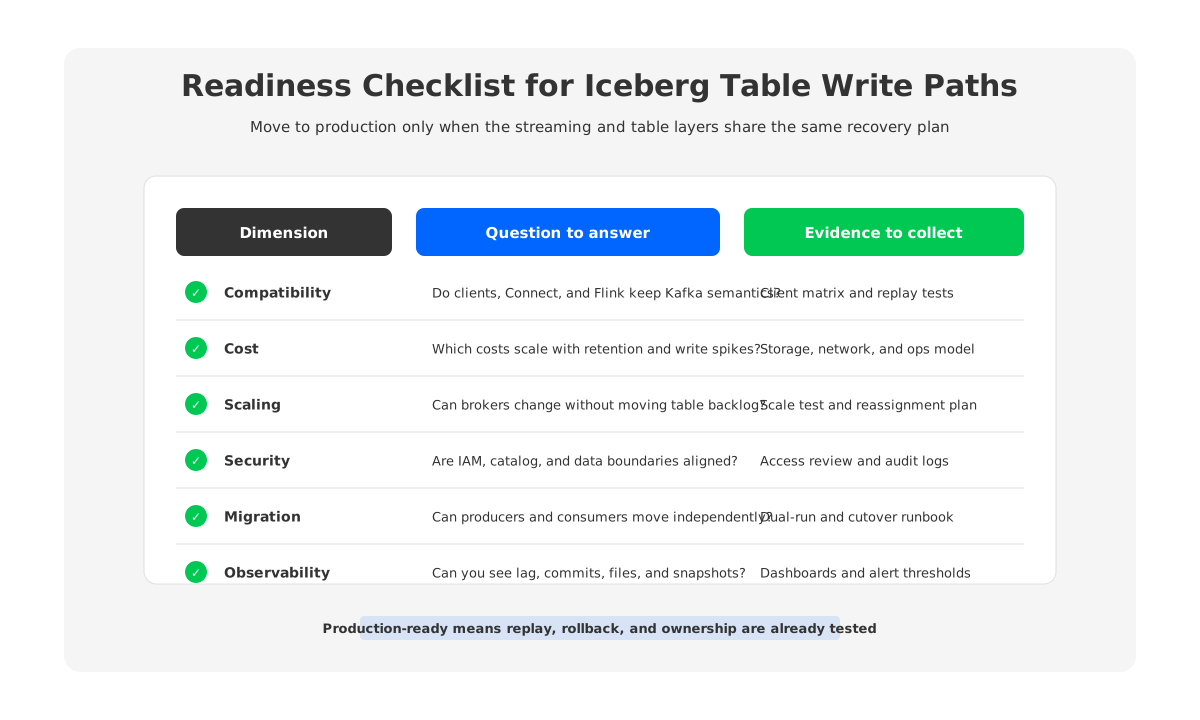
Use this checklist as a readiness scorecard:
- Compatibility: Confirm that producers, consumers, Kafka Connect workers, Flink jobs, Schema Registry integration, ACLs, and monitoring tools keep the Kafka behavior your teams already rely on. A table path should not require a rewrite of upstream applications.
- Cost: Model storage, network, compute, object storage API requests, and operations separately. Retention for replay is a cost driver, and so is every data copy created by replication, export, or temporary table files.
- Scaling: Test broker scaling, writer scaling, and table commit scaling as separate events. The system should remain understandable when Kafka traffic grows but query traffic does not, or when table commits slow down but producers continue normally.
- Security and governance: Align topic ACLs, object storage permissions, catalog permissions, encryption, and audit logs. The production boundary should show who can read raw records, who can commit snapshots, and who can change schemas.
- Migration: Plan whether producers move first, consumers move first, or the table path runs in parallel. Keep a rollback path that does not depend on guessing the last safe offset.
- Observability: Track consumer lag, writer checkpoint state, table commit latency, object storage errors, file counts, snapshot frequency, and dead-letter behavior in one operational view.
A team that can answer these points has a workable design even if it chooses a familiar stack. A team that cannot answer them is still in prototype mode, even if the pipeline is moving data.
5How AutoMQ Changes the Operating Model
Once the evaluation framework is clear, the storage architecture underneath Kafka becomes a first-order decision. AutoMQ is a Kafka-compatible streaming platform that keeps Kafka APIs and ecosystem semantics while replacing broker-local persistent storage with a Shared Storage architecture. The important point for Iceberg write paths is not a new connector checkbox. It is the shift from broker-owned data placement to shared object-storage-backed durability with stateless brokers.
In AutoMQ, persistent stream data is stored through S3Stream, with WAL (Write-Ahead Log) storage used for durable write buffering and recovery, and S3-compatible object storage used as the primary storage layer. That changes the operational shape of retention and recovery. Brokers still serve Kafka clients, own partition leadership, and participate in the Kafka-compatible compute layer, but durable data is not trapped on the broker's local disk. Reassignment and replacement become metadata and traffic-management problems rather than large data-copy projects.
For an Iceberg table write path, that separation helps in three concrete ways. First, replay capacity can be planned against object storage rather than broker disk ceilings. Second, broker scaling is less likely to become a table ingestion incident because adding or replacing brokers does not require moving the retained log data in the same way. Third, customer-controlled deployment models such as AutoMQ BYOC and AutoMQ Software can keep data plane resources, object storage, IAM, VPC boundaries, and catalog access inside the customer's environment.
AutoMQ also provides Table Topic, a feature that can write topic data into Apache Iceberg tables for teams that want the streaming platform and table ingestion path to share a tighter operating model. That does not eliminate architecture review. Teams still need to validate schema evolution, catalog type, commit interval, rollback behavior, and observability. The difference is that the review can focus on whether the integrated table path fits the workload rather than on how many separate services must be operated to keep Kafka and Iceberg in sync.
The useful mental model is not "Kafka versus Iceberg." Kafka remains the event log and recovery ledger. Iceberg becomes the analytical table abstraction. A cloud-native Kafka-compatible storage layer gives the event log a better operating model for long retention, elastic capacity, and failure recovery, which makes the table path easier to reason about.
6A Practical Readiness Scorecard
Before moving an Iceberg write path into production, write down the pass/fail evidence for each layer. The artifact can be short, but it should be concrete enough for an on-call engineer to use during an incident.
| Layer | Production question | Pass evidence |
|---|---|---|
| Kafka source | Can we replay from the last known safe offset? | Retention policy, lag alert, and replay test are documented |
| Writer | Can the job restart without duplicate visible rows? | Crash test covers pending files and commit recovery |
| Iceberg table | Can readers identify the last valid snapshot? | Snapshot history and rollback procedure are verified |
| Storage | Can object storage failures be observed and retried? | Error budgets, retry policy, and cleanup jobs are monitored |
| Governance | Can schema and access changes be audited? | Catalog, schema, ACL, and IAM changes have owners |
| Migration | Can we return to the previous path? | Dual-run, cutover, and rollback steps have named owners |
This scorecard turns a search query into an engineering decision. If the table is a convenience copy, a simpler connector path may be enough. If the table is becoming a shared analytical source of truth, the Kafka-compatible platform under it deserves the same design attention as the writer and the catalog. The write path is only as recoverable as its least explicit state boundary.
7FAQ
7.1Is Kafka Connect enough for writing Kafka data into Iceberg?
Kafka Connect can be enough for direct topic-to-table ingestion when the data shape is stable and the team validates connector recovery, offset handling, schema behavior, and Iceberg commit semantics. Stateful transformations or complex routing often push teams toward Flink or a managed table-path feature.
7.2Does Iceberg replace Kafka retention?
No. Iceberg stores table snapshots and data files; Kafka retention still determines how far the streaming source can replay. If the table path must recover from writer or catalog failures, Kafka retention must cover the expected recovery window.
7.3Why does broker storage architecture matter if the final table is in object storage?
The source log still absorbs producer spikes, writer downtime, and replay windows. If that log is tied to broker-local disks, retention and scaling decisions remain broker capacity decisions. Shared Storage architecture changes that operational model by moving durable stream data to shared object storage.
7.4Where should AutoMQ enter the evaluation?
AutoMQ should enter after the team defines compatibility, recovery, cost, governance, and migration requirements. It is most relevant when teams want Kafka-compatible APIs with stateless brokers, object-storage-backed durability, customer-controlled deployment boundaries, or an integrated Table Topic path for Iceberg.
If your team is planning a Kafka-to-Iceberg production path, use the checklist above as the design review. When the source log needs cloud-native elasticity without changing Kafka clients, explore AutoMQ through the product workspace: start with AutoMQ.


