
Table of Contents
Table of Contents
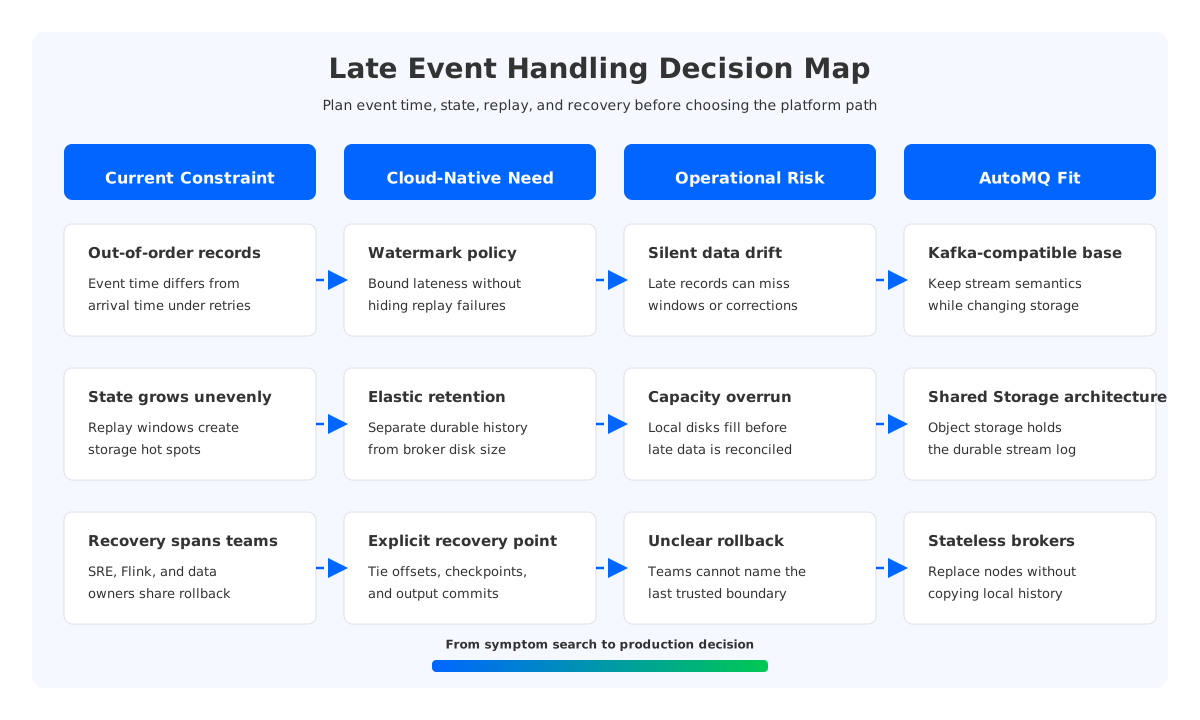
Teams usually search for late event handling kafka after the first dashboard or stream processor has already made someone nervous. A windowed metric looks right most of the time, but an upstream retry, mobile batch upload, CDC delay, or cross-region network pause sends records into Kafka after the business event actually happened. The stream processor has to decide whether to update an old result, drop the record, route it for correction, or replay a slice of history. That decision is not only a Flink, Kafka Streams, or SQL setting. It is a production contract across event time, retained Kafka offsets, state storage, recovery procedures, and platform capacity.
The hard part is that late events create pressure in two directions at once. Processing logic wants more history so it can correct results, while operations wants bounded state, predictable storage, and a clear rollback point. If those goals are handled separately, the system either loses correctness quietly or keeps so much replay capacity that Kafka becomes expensive and fragile to operate. The practical thesis is simple: late event handling in Kafka is a state and recovery design problem first, and a watermark configuration problem second.
1Why Teams Search for late event handling kafka
The search intent is usually specific. A team already has Apache Kafka in the middle of its data path, and a stream processing job is producing session metrics, fraud signals, inventory updates, billing events, or lakehouse tables. The team understands event time in principle. What they need is a production rule for records that arrive after the processor has advanced its watermark, closed a window, committed an offset, or emitted a result that downstream systems treat as final.
Apache Kafka gives the pipeline a durable ordered log per partition, offsets, consumer groups, transactions, Kafka Connect, and compatibility across a large ecosystem. Stream processors add event-time semantics, watermarks, windows, checkpoints, and state backends. Those pieces are powerful, but the boundary between them is where late-event incidents happen. Kafka can still contain the record, while the processing job has already moved past the window. A checkpoint can be successful, while a downstream table or serving layer still needs a correction. A consumer group can be healthy, while the business metric is wrong because the lateness policy was too aggressive.
That is why the first design review should ask operational questions before picking a framework option:
- What is the maximum event-time lateness the business is willing to correct in the primary path?
- Which records are dropped, which records update prior output, and which records go to a correction topic?
- How far back can the system replay from Kafka without rebuilding unrelated state?
- Which team owns the last trusted recovery point: Kafka operators, stream processing owners, or the downstream data product team?
These questions make late-event handling visible as a platform concern. A watermark can express when the processor stops waiting, but Kafka retention, broker storage, checkpoints, output idempotency, and runbooks determine whether the team can recover when that decision was wrong.
2The Production Constraint Behind the Problem
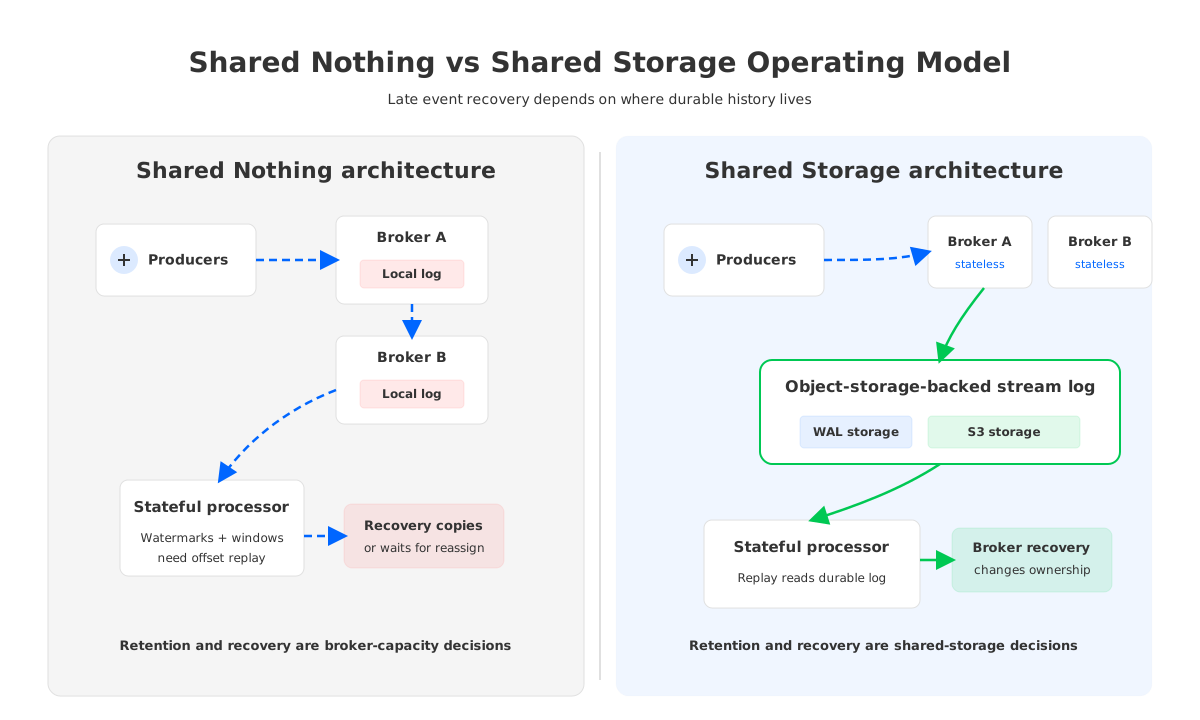
Traditional Kafka deployments use a Shared Nothing architecture. Each broker owns local storage, and partitions are replicated across brokers for durability and availability. This model is mature and reliable when retention, traffic, and partition placement are stable. Late-event handling pushes against that stability because correctness depends on retained history and replay capacity, not only on current throughput.
Consider a fraud-detection pipeline that keeps event-time windows open long enough to account for delayed payment and device signals. If the lateness window grows, the processor holds more state and Kafka must retain more source history for replay. If the output has already been consumed by another service, the pipeline also needs a correction strategy. None of this is solved by raising a single timeout. The team has to coordinate source retention, processor checkpoints, output semantics, and the operational cost of replay.
The storage side becomes more important than teams expect. In a Shared Nothing Kafka cluster, longer retention lands on broker-local disks or cloud volumes. Scaling those disks, replacing a broker, or reassigning partitions can become part of the late-event recovery path because the retained log is physically tied to brokers. A replay window that looks small in processing code can become a large operational commitment when it has to survive traffic spikes, failed jobs, and broker maintenance.
There is also a cross-team problem. Application owners decide how late a record can arrive. Stream processing owners decide how state and checkpoints behave. Kafka operators decide topic retention, replication, quotas, and broker capacity. Data platform owners decide whether downstream tables or serving stores accept updates. Late-event handling fails when these teams each configure their own boundary and nobody can name the last point where Kafka offsets, processing state, and output state all agree.
3Architecture Options and Trade-Offs
There are several valid patterns for late-event handling in Kafka-backed systems. The right choice depends on whether late records are rare corrections, normal business behavior, or a signal that upstream systems produce data in batches.
| Pattern | Where state lives | Good fit | Main risk |
|---|---|---|---|
| Grace period in stream processing | Processor windows and checkpoint state | Bounded lateness with predictable event-time skew | State grows quietly when lateness assumptions drift |
| Correction topic | Kafka source topic, correction topic, downstream merge logic | Auditable updates to previously emitted results | Consumers must understand correction semantics |
| Replay from retained offsets | Kafka log, consumer group offsets, processor checkpoints | Incident recovery and backfill of affected windows | Retention and broker capacity must cover the recovery window |
| Dead-letter or quarantine path | Kafka topic plus review workflow | Invalid, extreme, or low-confidence late records | Manual process can become the real bottleneck |
| Table or serving-layer upsert | Downstream table, key-value store, or materialized view | Results that can be updated by key | Requires idempotency and clear conflict rules |
The table is deliberately neutral. A grace period is often the cleanest option when event-time skew is bounded and measured. A correction topic is stronger when downstream users need an audit trail. Replay is essential for incidents, but it should not be the everyday answer to normal lateness. A quarantine path is useful when bad records need human or batch review, and an upsert path fits workloads where results are naturally revised.
The platform choice underneath these patterns still matters. If the Kafka-compatible layer makes retained history costly to scale, teams will shorten retention and push complexity into downstream corrections. If broker replacement or partition movement is slow, recovery drills become disruptive. If migration changes offsets or client behavior, late-event logic tied to consumer progress becomes risky. A good architecture keeps the semantic decision and the operational recovery path aligned.
4Evaluation Checklist for Platform Teams
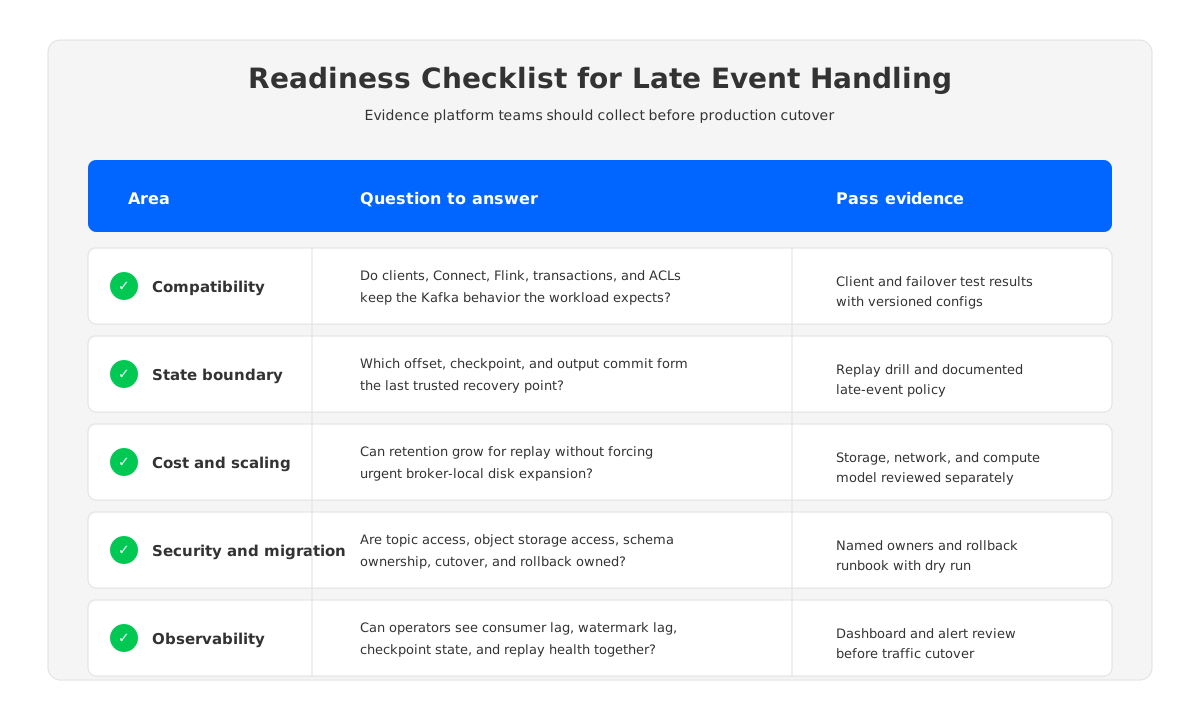
The evaluation should start before vendor selection. A platform team needs to describe what late-event handling means for its workload, then map that definition to Kafka compatibility, stream processing state, storage cost, governance, migration, rollback, and observability. The goal is not to remove every trade-off. The goal is to make each trade-off explicit enough that an on-call engineer can act during an incident.
Use this checklist as a readiness scorecard:
A team that can answer these points has a production design even if it keeps a familiar stack. A team that cannot answer them is still relying on defaults, and defaults are rarely where late-event correctness is decided.
5How AutoMQ Changes the Operating Model
Once the evaluation framework is clear, the storage architecture under Kafka becomes a first-order decision. AutoMQ is a Kafka-compatible streaming platform that keeps Kafka APIs and ecosystem semantics while replacing broker-local persistent storage with a Shared Storage architecture. For late-event handling, the important change is not that a watermark becomes smarter. The change is that retained stream history and broker compute are no longer coupled in the same way.
AutoMQ stores persistent stream data through S3Stream. WAL (Write-Ahead Log) storage provides durable write buffering and recovery, while S3-compatible object storage serves as the primary storage layer. AutoMQ Brokers still serve Kafka clients and participate in the Kafka-compatible compute layer, but durable data is not trapped on broker-local disks. That changes the operational shape of replay, broker replacement, and retained history.
For late-event handling, this helps in three concrete ways. First, replay planning can be tied to object-storage-backed durability rather than only to local broker disk ceilings. Second, stateless brokers make scaling and replacement less likely to disturb the same retained history that stream processors need for correction. Third, customer-controlled deployment models such as AutoMQ BYOC and AutoMQ Software let teams keep data plane resources, object storage, VPC boundaries, IAM, and observability inside their own environment.
AutoMQ also matters during migration. Late-event logic often depends on consumer group progress and offset continuity, so a migration that changes offsets can turn a platform move into a processing incident. AutoMQ commercial editions provide Kafka Linking for byte-to-byte message synchronization and consumer progress synchronization during migration. That does not remove the need for a replay drill, but it gives platform teams a cleaner way to preserve the state boundaries their processors depend on.
There is one more practical angle: cloud networking. In multi-Availability Zone deployments, traditional Kafka replication and client access patterns can create cross-AZ traffic. AutoMQ's S3-based shared storage and routing model are designed to reduce cross-AZ data movement in supported deployment patterns. For late-event workloads that keep more history and replay more often, network behavior belongs in the same review as state and storage.
The useful mental model is not "late events are a processing problem." Processing logic decides what to do with an old event. The streaming platform decides how durable, replayable, migratable, and operable the source history remains when that decision has to be revisited.
6A Practical Readiness Scorecard
Before moving a late-event policy into production, write down the pass/fail evidence for each layer. The document can be short, but it should be concrete enough for a responder to use without finding the original project owner.
| Layer | Production question | Pass evidence |
|---|---|---|
| Source log | Can we replay affected partitions from the last trusted offset? | Retention policy, lag alert, and replay drill are documented |
| Processor state | Can checkpoints or state snapshots restore the relevant windows? | Restore test covers watermark and state behavior |
| Output path | Can late updates be applied or audited without duplicate results? | Idempotency, correction topic, or upsert rule is verified |
| Storage | Can retained history grow without urgent broker-local expansion? | Storage model separates replay history from hot compute planning |
| Governance | Can schema, access, and correction decisions be audited? | Owners are named for topic, processor, and output changes |
| Migration | Can platform cutover preserve offsets and rollback options? | Dual-run, cutover, and rollback steps have named owners |
This scorecard turns a search query into an engineering decision. If late events are rare and low impact, a bounded grace period and correction topic may be enough. If late events affect billing, fraud, customer state, or analytical truth, the Kafka-compatible platform under the processor deserves the same design attention as the processing framework. The policy is only as reliable as the least explicit recovery boundary.
7FAQ
7.1What is late event handling in Kafka?
Late event handling is the set of policies and recovery procedures for records that arrive in Kafka after their business event time. Kafka stores records by partition offset, while stream processors often reason about event time, watermarks, windows, and checkpoints. Production handling must connect those concepts.
7.2Is a longer watermark grace period enough?
Sometimes. A longer grace period works when lateness is bounded, state growth is acceptable, and downstream output can wait or accept updates. It is not enough when the team also needs replay, auditability, correction topics, or rollback across multiple systems.
7.3How long should Kafka retain data for late-event recovery?
The retention window should cover the maximum expected recovery interval, not only the expected lateness interval. Include job downtime, incident detection time, human response time, backfill duration, and downstream validation. Avoid publishing a universal number; the right value is workload-specific.
7.4Why does broker storage architecture matter?
Late-event recovery often depends on retained source history. If that history is tied to broker-local disks, replay capacity, broker replacement, and partition movement become part of the same operational risk. Shared Storage architecture changes the operating model by moving durable stream data to shared object storage.
7.5Where should AutoMQ enter the evaluation?
AutoMQ should enter after the team defines compatibility, state, cost, governance, migration, and observability requirements. It is most relevant when teams want Kafka-compatible APIs with stateless brokers, object-storage-backed durability, customer-controlled deployment boundaries, and migration paths that preserve offsets and consumer progress.
Return to the first nervous dashboard: the issue was not that a record arrived late. The issue was whether the system had a clear, affordable, and testable way to correct the result. If your team is planning late-event handling on a Kafka-compatible platform, use the checklist above as the design review, then evaluate AutoMQ when retained history and broker operations need a cloud-native model: start with AutoMQ.


