
Table of Contents
Table of Contents
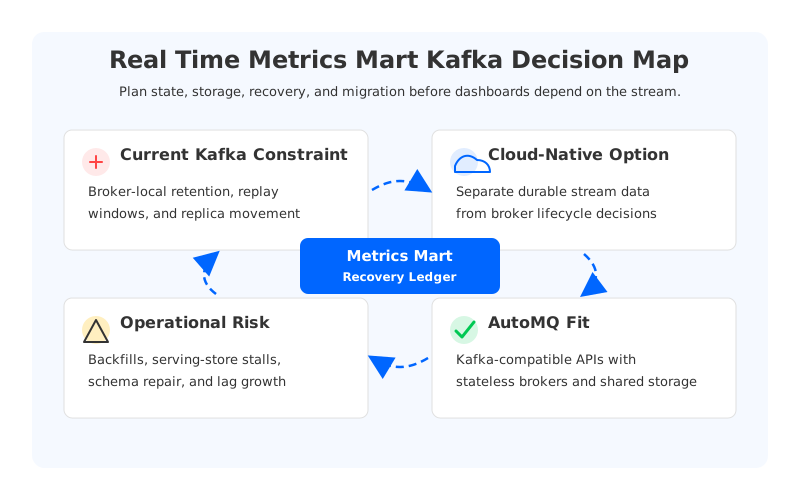
A team usually searches for real time metrics mart kafka after dashboards have become part of operations, not after a lab exercise. Product managers are checking funnel metrics during a launch, SREs are watching latency, and finance wants usage numbers before the billing cycle closes. Kafka is already in the middle because it is the event log that carries the raw signals. The uncomfortable question is whether the platform underneath that log can keep enough state, storage, and recovery headroom when the metrics mart becomes a shared dependency.
The phrase "metrics mart" sounds analytical, but the failure mode is operational. A late consumer, a replay, a schema mistake, or a broker replacement can change what the business sees on a dashboard. A real-time metrics mart therefore needs two plans at the same time: a serving plan for low-latency aggregates and a recovery plan for rebuilding those aggregates from a durable stream. The thesis is simple: the Kafka layer is not a temporary pipe for metrics marts. It is the recovery ledger, and its storage architecture determines how expensive and predictable that ledger is to operate.
1Why Teams Search for real time metrics mart kafka
The search intent is rarely "how do I produce a Kafka message?" The team already has producers, topics, and consumers. What they need is a production model for metrics that are updated continuously, queried by many teams, and trusted enough to drive action. That model has to respect Kafka offsets, Consumer group behavior, retention, exactly-once or idempotent write patterns, stream processor checkpoints, and the serving store that exposes the final aggregates.
A typical metrics mart has three layers. The event layer captures source-of-truth records, the compute layer turns those records into keyed aggregates, and the serving layer exposes the results to dashboards, APIs, or lakehouse tables. Kafka sits at the front because it gives producers and consumers a durable log with offsets and replay. But the metrics mart does not fail as one unit. The stream processor can restart while Kafka is healthy. The serving store can be slow while producers continue writing. The dashboard can ask for a backfill while the online job is still catching up.
That separation is useful only when the state contract is explicit. Teams should be able to answer where the authoritative offset lives, how much source history is retained, what happens to partial aggregates after a restart, and which system decides that a metric is ready for consumers. When those answers are implicit, each incident invents a different recovery procedure.
2The Production Constraint Behind the Problem
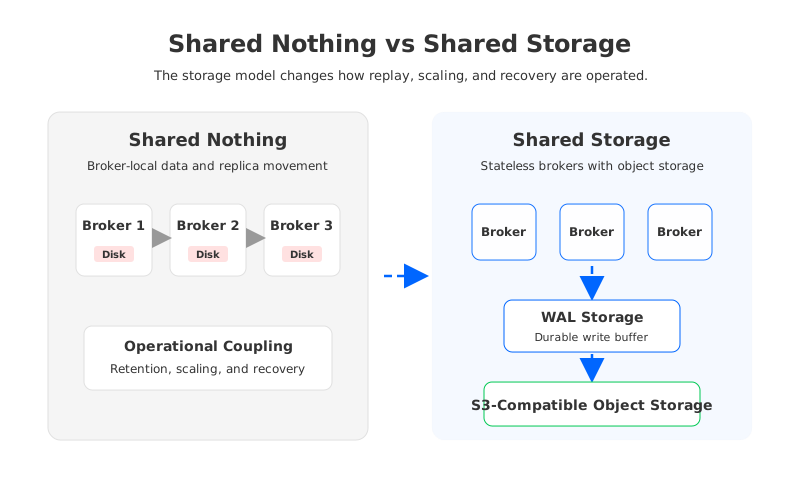
Traditional Apache Kafka deployments use a Shared Nothing architecture. Each broker owns local storage, and partition replicas are copied across brokers through ISR (In-Sync Replicas) for availability and durability. That design is familiar, mature, and still valid for many workloads. The constraint appears when a metrics mart needs long replay windows, elastic ingestion, and predictable recovery while the cluster is also carrying hot operational traffic.
Metrics marts amplify storage pressure because recovery windows are not decorative. If a stream job corrupts an aggregate, a serving table needs a rebuild, or a governance rule requires recalculation after a schema fix, the team needs enough Kafka history to replay from a trusted offset. In a broker-local storage model, that history lands on broker disks or cloud block volumes before anyone knows whether it will be used. Capacity must be reserved ahead of the incident.
Scaling adds another constraint. In Shared Nothing Kafka, partitions are attached to brokers that own local log segments. When the cluster expands, shrinks, or recovers from a failed node, partition reassignment and replica movement can move large amounts of data. That movement is normal Kafka operation, but it competes with the same network, disk, and operational attention that the metrics mart needs during a backlog or replay. The larger the retained log, the more visible this coupling becomes.
Cross-zone traffic and governance boundaries make the problem less tidy. A metrics mart often spans Availability Zones for availability, and consumers may run in different subnets, accounts, or Kubernetes pools. Every copy, fetch, connector hop, and replica transfer has a cost and a security surface. The design review cannot stop at "Kafka can retain the data." It has to ask what retaining the data does to broker sizing, network paths, IAM boundaries, and on-call recovery.
3Architecture Options and Trade-Offs
There are several valid ways to build a Kafka-backed metrics mart. The right answer depends on whether the team optimizes for operational simplicity, transformation depth, serving latency, or lakehouse integration. The useful comparison is not tool branding. It is where state lives and how recovery works.
| Option | Where state lives | Good fit | Main risk |
|---|---|---|---|
| Stream processor plus serving store | Kafka offsets, processor checkpoints, local or remote state, serving indexes | Low-latency counters, windows, and operational dashboards | Recovery touches both processor state and serving-store consistency |
| Kafka Connect into an analytical store | Connector offsets, sink retries, destination table or index state | Standard ingestion into search, OLAP, or warehouse systems | Destination backpressure can exhaust Kafka retention or hide partial writes |
| Lakehouse table path | Kafka offsets, writer checkpoints, table snapshots, object storage files | Durable metrics facts for BI, audit, and reprocessing | Commit semantics and replay semantics must be tested together |
| Platform-native table topic | Streaming platform and table path share one managed operating model | Teams that want fewer ingestion services and direct table output | Feature scope, catalog support, and rollback behavior must match the workload |
The matrix shows why the Kafka layer deserves more than a checkbox. A stream processor can protect aggregate state through checkpoints, but it still depends on Kafka replay when state is lost or a logic bug requires a rebuild. A sink connector can be reliable for ordinary ingestion, but it cannot make the destination store fast or consistent under every failure. A lakehouse table path can give durable analytical history, but it adds snapshot and file lifecycle semantics to the recovery plan.
The trade-off is not "real time versus batch" either. A production metrics mart usually needs both. It needs fresh aggregates for operators, and it needs a replayable history for audit, correction, and model changes. Kafka-compatible streaming is the bridge between those needs, so platform teams should evaluate it as a long-lived storage and recovery substrate, not only as a message broker.
4Evaluation Checklist for Platform Teams
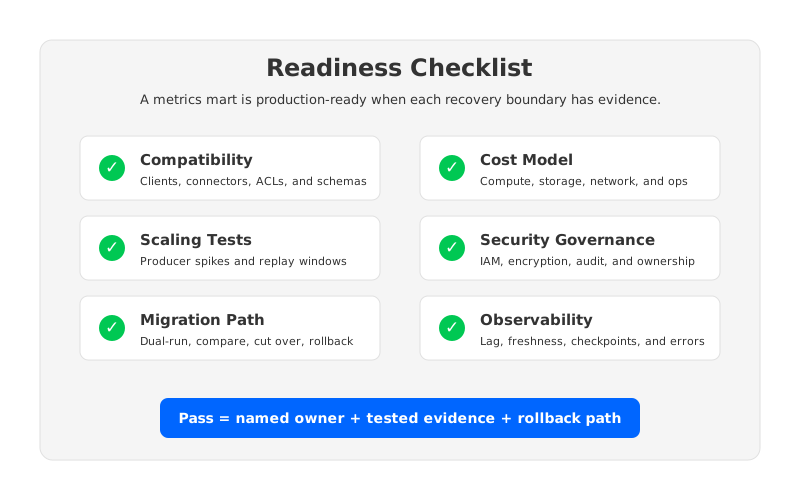
The strongest metrics-mart designs start with an evaluation checklist that is independent of any one product. The checklist should force platform, SRE, and application owners to describe behavior under normal load and during recovery. If the answers are concrete, vendor and service choices become easier to compare.
- Compatibility: Verify that existing Kafka producers, consumers, Kafka Connect workers, stream processors, Schema Registry usage, ACLs, and observability tools keep the behavior teams rely on. Migration should not begin by rewriting every upstream application.
- Cost: Model compute, broker storage, object storage, network transfer, endpoint processing, API requests, and on-call work separately. Metrics marts often look cost-effective in prototypes because retention and replay have not been priced yet.
- Elasticity: Test producer spikes, consumer backlog, stream-job restart, broker replacement, and serving-store backpressure as different events. A platform that scales one layer but stalls another still creates an incident.
- Governance: Align topic ACLs, schema ownership, PII handling, encryption, storage permissions, catalog permissions, and audit trails. A metrics mart becomes a shared data product, so its raw and derived states need owners.
- Recovery: Write down the last safe offset, the aggregate checkpoint, the destination snapshot, and the rollback target. Recovery plans that depend on human memory age badly.
- Migration: Decide whether to dual-run, mirror topics, move consumers gradually, or backfill from a frozen offset. The migration plan should include how to prove that the new mart and the old mart agree within an accepted tolerance.
- Observability: Put Consumer lag, processor checkpoint age, write failure rate, destination commit latency, object storage errors, and dashboard freshness in one view. Operators need to see the whole path when numbers on a dashboard stop moving.
This checklist is intentionally blunt. It does not assume that every team needs the same architecture. It does assume that a real-time metrics mart is production software, and production software needs named failure boundaries before it becomes business-critical.
5How AutoMQ Changes the Operating Model
Once the neutral evaluation is complete, the storage architecture underneath Kafka becomes a first-order choice. AutoMQ is a Kafka-compatible streaming platform that keeps Kafka APIs and ecosystem semantics while changing the broker storage model from broker-local persistent disks to a Shared Storage architecture. The reason this matters for metrics marts is practical: durable stream data no longer has to be managed as data tied to individual brokers.
AutoMQ uses S3Stream to store stream data on S3-compatible object storage, with WAL (Write-Ahead Log) storage used for durable write buffering and recovery. AutoMQ Brokers still handle Kafka protocol requests, partition leadership, caching, and client traffic, but the persistent log is backed by shared object storage. That separation changes the operating model for retention, broker replacement, and scaling. Reassignment becomes more about ownership, metadata, and traffic than about copying retained log data between broker disks.
For a real-time metrics mart, this shift helps in three places. First, replay windows can be planned against object-storage-backed durability instead of being bounded mainly by broker-local disk capacity. Second, scaling brokers is less likely to collide with a backfill or replay, because stateless brokers do not carry the durable data placement problem in the same way. Third, customer-controlled deployments such as AutoMQ BYOC and AutoMQ Software let teams keep data plane resources, object storage, network policy, and access controls inside their own cloud account or private environment.
AutoMQ also supports capabilities that fit common metrics-mart operating needs. Kafka Linking can support migration patterns where offset continuity matters. Self-Balancing helps redistribute traffic as workloads change. Table Topic can write streaming data into Apache Iceberg tables when teams want a tighter path from Kafka-compatible ingestion to analytical tables. These features do not remove the need for design review; they change what the review focuses on. Instead of asking how much broker-local data must be moved during scaling or recovery, the team can spend more time on compatibility, governance, table semantics, and rollback criteria.
The right mental model is not that AutoMQ makes metrics marts automatic. No platform can define metric correctness for you. The value is that a Shared Storage architecture reduces the amount of operational state trapped inside brokers, which makes the Kafka layer easier to plan as a durable recovery ledger for real-time and historical metrics.
6A Practical Readiness Scorecard
Before promoting a metrics mart into production, write a short scorecard that an on-call engineer can use without joining a design meeting. Tie each layer to a recovery question and a piece of evidence. If the evidence does not exist, the architecture is still a prototype.
| Layer | Production question | Pass evidence |
|---|---|---|
| Kafka source | Can we replay from the last trusted offset? | Retention, lag alerting, and replay drill are documented |
| Stream compute | Can state recover after restart or code rollback? | Checkpoint, savepoint, and rollback test results exist |
| Serving store | Can dashboards identify stale or partial data? | Freshness metric and partial-write behavior are visible |
| Storage | Can retained history survive broker replacement? | Storage architecture and restore path are verified |
| Governance | Can schema, access, and PII changes be audited? | Owners and audit trails are documented |
| Migration | Can we compare old and new marts before cutover? | Dual-run, reconciliation, and rollback steps have owners |
This scorecard turns the search query into an engineering artifact. If the metrics mart is a convenience dashboard, a simple connector and short retention window may be enough. If the mart is becoming a shared operational source of truth, Kafka-compatible streaming needs the same scrutiny as the stream job and serving store. The state you fail to name during design becomes the state you debug during an incident.
7FAQ
7.1Is Kafka a good foundation for a real-time metrics mart?
Kafka is a strong foundation when teams need durable event ingestion, ordered partition logs, Consumer group scaling, offsets, and replay. It still needs a planned compute layer and serving layer, because Kafka does not define metric aggregation semantics by itself.
7.2How long should Kafka retention be for metrics recovery?
Retention should cover the longest expected recovery, correction, and backfill window, plus operational margin. A mart that must support schema correction or aggregate rebuilds usually needs more history than a pipeline that only feeds live dashboards.
7.3Do exactly-once semantics remove the need for replay planning?
No. Transactions and idempotent processing can reduce duplicate effects within a defined path, but replay planning still matters for logic bugs, destination corruption, schema repair, and rebuilding derived state from a trusted offset.
7.4Why does Shared Storage architecture matter for metrics marts?
Shared Storage architecture separates durable stream data from broker-local disks. That matters when the mart needs long retention, backfills, broker replacement, or elastic scaling, because the recovery ledger is less tightly coupled to individual broker storage capacity.
7.5Where should AutoMQ enter the decision?
AutoMQ should enter after the team defines compatibility, cost, elasticity, governance, recovery, and migration requirements. It is most relevant when teams want Kafka-compatible APIs with stateless brokers, object-storage-backed durability, customer-controlled deployment boundaries, and a clearer operating model for retained stream data.
If your team is turning Kafka events into a production metrics mart, start with the scorecard above and test the recovery path before dashboards depend on it. When the source log needs cloud-native elasticity without changing Kafka clients, evaluate AutoMQ through the product workspace: start with AutoMQ.


