
Table of Contents
Table of Contents
Teams searching for stateful function pipeline kafka usually already have functions in production: enrich an event, call a feature store, update a search document, emit a derived signal, write an audit trail, or route a fraud decision. The difficult part starts when those functions become stateful enough that replay, ordering, checkpoints, offsets, and storage cost are no longer background details.
Kafka is attractive in this pattern because it gives the pipeline a durable, replayable log. A function can fail, restart, and resume from committed offsets. A downstream consumer can rebuild its view by reading history rather than asking every upstream system for a custom backfill path. That is the right mental model, but it is incomplete. The pipeline is only as elastic as the storage layer under the log.
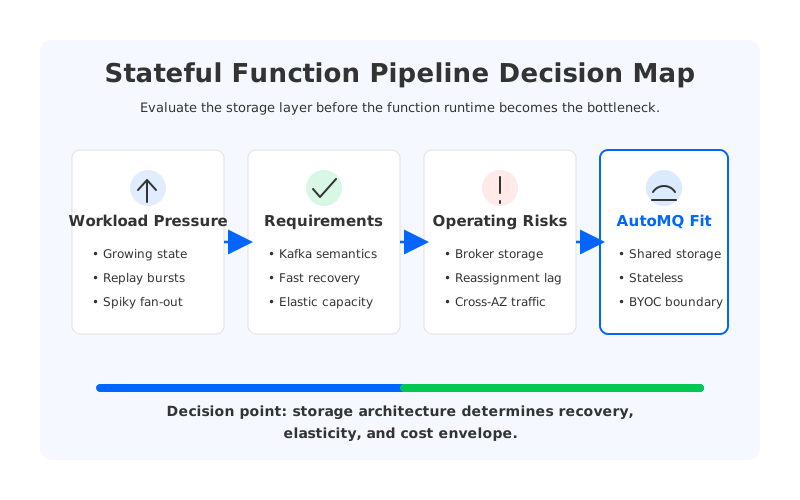
The production question is not "Can Kafka feed a stateful function?" It can. The better question is whether the Kafka-compatible platform can absorb the operating shape stateful functions create: write bursts, long replay windows, state rebuilds, sink retries, connector backpressure, multi-AZ recovery, and governance requirements.
1Why Teams Search for stateful function pipeline kafka
A stateless function pipeline has a forgiving failure mode. If a service receives one event, transforms it, and emits one event, the infrastructure mainly needs to preserve throughput and retry semantics. Once the function keeps state, the platform has to preserve a relationship between input records, local or external state, output records, and consumer progress. A duplicate record is no longer a harmless inconvenience. A replay can update state twice. A partial sink write can leave the function and the downstream index disagreeing about reality.
This is why Kafka shows up in architecture discussions for stateful functions. Kafka consumer groups coordinate parallelism. Offsets give applications a durable position in the log. Transactions and idempotent producers can help bind consumed input and produced output into a stronger delivery contract. Kafka Connect adds a standard framework for moving data between Kafka and external systems.
The hard part is that each mechanic increases dependence on the broker layer. A consumer group is only useful if the cluster can keep its coordinators healthy. Offsets are only useful if they survive failures and are operationally visible. Transactions are only useful if the platform preserves Kafka semantics under load. Connectors are only useful if the sink can fall behind without turning broker storage into a capacity incident.
Stateful function pipelines therefore create a platform problem, not only an application pattern. The function runtime decides how code is executed. The stream processing framework decides how state is checkpointed or materialized. The Kafka-compatible layer decides how much history is retained, how quickly it can be replayed, and how painful it is to move partitions when traffic shifts.
2The Production Constraint Behind the Problem
Traditional Kafka was built around broker-local log storage. Each broker owns partitions, stores log segments on local disks, replicates partitions to other brokers, and serves consumers from the brokers that hold the data. In a data center where machines, disks, and network paths are treated as part of one capacity pool, this model is predictable. In the cloud, the same model exposes a different cost and operations profile.
The first constraint is capacity coupling. If storage and compute live inside the same broker, adding throughput often means adding storage whether the workload needs it or not. Retaining more history can force larger disks on brokers that are otherwise compute-light. Replaying old data can turn retained history into live broker load during an already stressful recovery event.
The second constraint is data movement. Scaling a broker-local Kafka cluster is rarely only a scheduling event because partition reassignment moves log data between brokers. Recovery after broker replacement depends on replicas catching up. Stateful function pipelines amplify this because they often need replay for normal workflows: rebuild a materialized view, reprocess after a schema fix, or warm a new function version before cutting traffic.
The third constraint is cloud network topology. Multi-AZ deployment is the standard answer for availability, but cross-AZ traffic is not free in many cloud designs. Stateful pipelines can create cross-zone movement through producer writes, replication traffic, consumer reads, connector sinks, and recovery flows. AWS documents data transfer pricing separately from compute pricing, so platform teams should treat network movement as a first-class cost line.
3Architecture Options and Trade-Offs
The usual architecture choices fall into three groups. The mistake is evaluating them only by API compatibility or headline throughput while ignoring the recovery and storage model underneath.
| Option | What it optimizes | What to test before committing |
|---|---|---|
| Broker-local Kafka | Mature operations and direct control over brokers, disks, and partition placement. | Reassignment windows, multi-AZ network cost, disk headroom, and replay behavior under sink backpressure. |
| Managed Kafka service | Reduced infrastructure ownership and cloud-integrated operations. | Quotas, version compatibility, migration path, connector model, cost predictability, and operational escape hatches. |
| Shared-storage Kafka-compatible platform | Independent scaling of compute and durable storage, faster broker replacement, and lower dependence on local disk movement. | Kafka semantic compatibility, WAL design, object storage behavior, observability, and deployment boundary. |
This table is deliberately neutral. A small pipeline with predictable traffic and short retention may run well on a conventional cluster for years. A compliance-heavy platform with long retention and frequent replay may care more about storage elasticity than raw broker count.
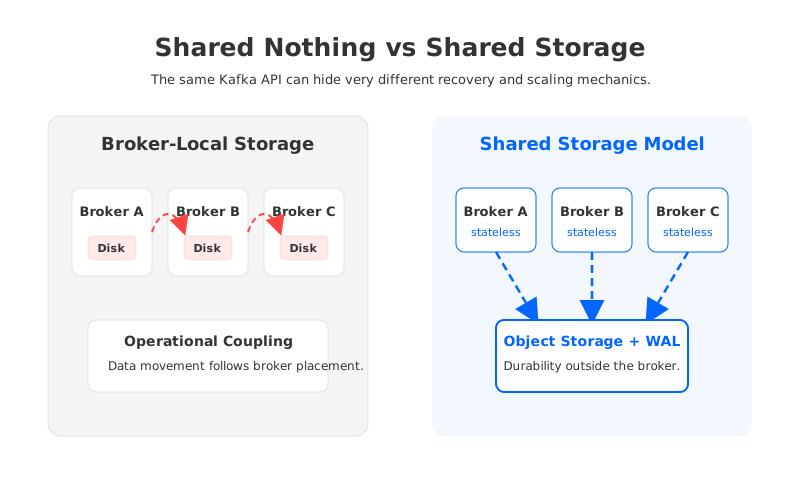
The architectural line that matters most is whether durable log data is bound to the broker. In a broker-local model, the broker is both compute process and storage owner. In a shared-storage model, brokers handle protocol, coordination, cache, and serving responsibilities while durable data lives outside the broker. The trade-off moves from "How do we move broker-local data safely?" to "How do we design the write-ahead path, cache, and object storage interaction so Kafka semantics remain intact?"
That shift matters because the most stressful stateful pipeline events are storage-heavy. Reprocessing for a new function version is a read-amplification event. Backfilling a sink is a retained-history serving event. Replacing brokers during a capacity change is a data ownership event when brokers own disks.
4Evaluation Checklist for Platform Teams
Before choosing a Kafka-compatible layer for stateful functions, put the application design and the broker design in the same review. The function team will naturally focus on code, state stores, external calls, schemas, and sink behavior. The platform team has to ask what happens when those choices meet retention, replay, multi-tenant traffic, and cloud failure domains.
Use the following checklist as a readiness review:
- Kafka compatibility: Validate the exact client versions, producer settings, consumer group behavior, offset reset workflows, transaction use, ACLs, and admin operations your applications rely on. "Kafka-compatible" should mean compatible with the semantics your pipeline actually uses.
- State recovery path: Define how a function rebuilds state after deployment, region impairment, bad code, corrupted sink output, or schema evolution. Recovery must include offset handling, idempotency rules, and sink reconciliation.
- Cost envelope: Model compute, durable storage, request volume, cross-AZ data transfer, replay reads, connector nodes, observability data, and retained history. A stateful pipeline can look inexpensive during steady state and expensive during recovery.
- Elasticity behavior: Test scale-out, scale-in, broker replacement, partition redistribution, and hot-topic mitigation while the pipeline is running. The important metric is not only throughput; it is how much operational work is required to restore balance.
- Governance boundary: Map where data lives, who owns cloud accounts, how encryption keys are managed, how network access is restricted, and which logs or metrics leave the environment. Stateful functions often touch sensitive derived data, not only raw events.
- Migration and rollback: Plan topic batches, consumer group migration, DNS or bootstrap changes, dual-write avoidance, replay validation, and rollback triggers. Migration is a pipeline event, not a broker-only project.
- Observability: Track consumer lag, commit latency, transaction errors, broker saturation, connector retries, object storage errors, state rebuild duration, and sink-side reconciliation. The dashboard should show whether the pipeline is correct, not only whether brokers are alive.
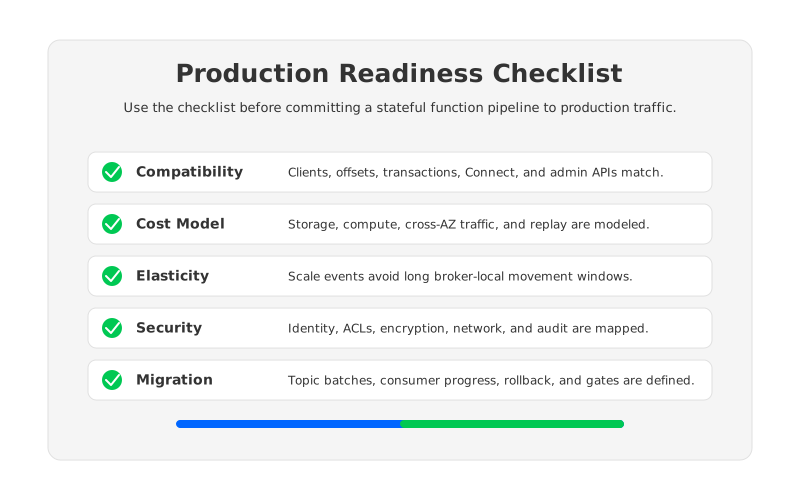
The checklist exposes a useful pattern. Most risks in stateful function pipelines are not isolated to one layer. A connector retry policy affects broker reads. A longer retention policy affects replay cost. A multi-AZ requirement affects network traffic. A transaction setting affects producer throughput and failure semantics. The platform architecture should make these interactions visible before an incident.
5How AutoMQ Changes the Operating Model
If the bottleneck is the coupling between broker compute and broker-local storage, the architecture answer is to separate those responsibilities without asking applications to abandon the Kafka protocol. AutoMQ is a Kafka-compatible, cloud-native streaming platform built around Shared Storage architecture. It keeps Kafka clients and operational concepts familiar while moving durable stream storage to object storage and making brokers stateless in the storage ownership sense.
For a stateful function pipeline, this changes the failure and scaling model. Broker replacement is less about rebuilding local log ownership from peer brokers and more about reattaching compute to durable shared data. Capacity planning can reason separately about serving capacity and retained history. Replay-heavy workflows still need careful throughput and cache planning, but they do not force the same broker-local data movement pattern as a shared-nothing cluster.
AutoMQ's Write-Ahead Log design is the key detail that prevents "object storage" from becoming a hand-wavy answer. Object storage is durable and elastic, but raw object storage latency is not a drop-in replacement for Kafka's append path. AutoMQ uses WAL storage with S3Stream so brokers can acknowledge writes through a low-latency persistence path while offloading log storage to object storage. The result is not a generic object-store archive. It is a Kafka-compatible storage layer designed for streaming.
The cloud cost argument also becomes more concrete. In traditional multi-AZ Kafka, replication and consumption patterns can create inter-zone traffic. AutoMQ documents a design for eliminating inter-zone traffic by using S3-based storage and zone-aware routing so clients can fetch from the local zone where possible. That matters because recovery and replay tend to magnify read paths.
There is also a governance angle. AutoMQ Cloud supports BYOC deployment, where the data plane runs inside the customer's cloud account and VPC. For pipelines that process regulated or business-critical state, deployment boundary affects network controls, identity integration, encryption posture, audit evidence, and procurement review.
None of this removes the need for application discipline. Stateful functions still need idempotent sink writes, schema compatibility rules, bounded external calls, explicit retry policies, and tested offset handling. A shared-storage Kafka-compatible layer does not make a bad function correct. It changes the infrastructure failure modes so the platform team spends less time moving broker-local data and more time validating pipeline semantics.
6A Practical Readiness Scorecard
Use a simple scoring model before production rollout. Give each dimension a score from 1 to 5, where 1 means "unknown or manual" and 5 means "tested, automated, and observable." Do not average the score too early. A pipeline with excellent throughput and poor rollback is fast until it is wrong.
| Dimension | Score 1 looks like | Score 5 looks like |
|---|---|---|
| Compatibility | Client behavior is assumed from protocol claims. | Client, offset, transaction, ACL, Connect, and admin workflows are tested against the target platform. |
| Recovery | Replay is a manual runbook with unclear owner. | Replay, state rebuild, sink reconciliation, and offset reset are rehearsed with success criteria. |
| Elasticity | Scaling depends on long partition movement windows. | Broker changes and traffic shifts are routine, observable, and bounded. |
| Cost | Steady-state compute is estimated. | Storage, network, replay, connectors, observability, and migration overhead are modeled. |
| Governance | Data boundary is described informally. | Cloud account, VPC, encryption, identity, audit, and operational access are documented. |
| Migration | Cutover depends on a maintenance window. | Topic batches, consumer progress, validation, and rollback triggers are defined before cutover. |
The scorecard is intentionally plain. Can we replay history without exhausting broker disks? Can we replace brokers during peak load? Can a function version be rolled back without corrupting downstream state? Can finance explain the next cloud bill after a backfill? Can security prove where the derived data lived?
When the answer is unclear, the team is choosing whether the storage layer can remain implicit. Stateful function pipelines make that layer visible because they depend on replay, history, ordering, and recovery as everyday operations.
If you are evaluating a Kafka-compatible platform for stateful functions, start with the storage and recovery model before comparing dashboards. AutoMQ's Shared Storage architecture is one option worth testing when you need Kafka compatibility, cloud-native elasticity, and customer-controlled deployment boundaries in the same design. You can explore the architecture and deployment model at AutoMQ.
7References
- Apache Kafka Documentation
- Apache Kafka Kafka Connect Documentation
- Apache Kafka Transactions Design and Operations
- Apache Kafka KRaft Documentation
- AutoMQ Architecture Overview
- AutoMQ Native Compatibility with Apache Kafka
- AutoMQ Stateless Broker
- AutoMQ S3Stream Shared Streaming Storage
- AutoMQ Eliminate Inter-Zone Traffic Overview
- AutoMQ Migration Overview
- AWS EC2 On-Demand Pricing: Data Transfer
8FAQ
8.1Is a stateful function pipeline the same as Kafka Streams or Flink?
Not exactly. Kafka Streams and Flink are common implementations, while "stateful function pipeline" usually describes the architecture pattern: functions process events while preserving state, progress, and recovery semantics. The infrastructure questions are similar across Kafka Streams, Flink, serverless functions, and custom services.
8.2Why does the Kafka storage layer matter if my function state is external?
External state does not remove the need for the log. The pipeline still depends on Kafka for replay, ordering, offsets, backpressure absorption, and recovery after bad deployments or sink failures. If retained history is expensive or slow to replay, the state store can be hard to rebuild.
8.3Do I need transactions for every stateful function pipeline?
No. Transactions are useful when consumed input and produced output need stronger atomicity, but they add design and operational complexity. Some pipelines use idempotent writes, deterministic keys, compaction, or sink-side reconciliation instead. The right choice depends on failure tolerance and downstream semantics.
8.4How should platform teams test a Kafka-compatible service for this workload?
Test the behaviors your functions depend on: client compatibility, consumer group rebalancing, offset reset, transaction behavior if used, replay under load, connector backpressure, broker replacement, multi-AZ routing, metrics, and rollback. Steady-state throughput benchmarks miss the recovery-heavy shape of stateful pipelines.
8.5Where does AutoMQ fit in this architecture?
AutoMQ fits when a team wants Kafka compatibility without tying durable log storage to broker-local disks. Its Shared Storage architecture, stateless brokers, WAL design, and BYOC deployment model are most relevant for pipelines with long retention, frequent replay, elastic traffic, multi-AZ cost sensitivity, or strict deployment boundaries.


