
Table of Contents
Table of Contents
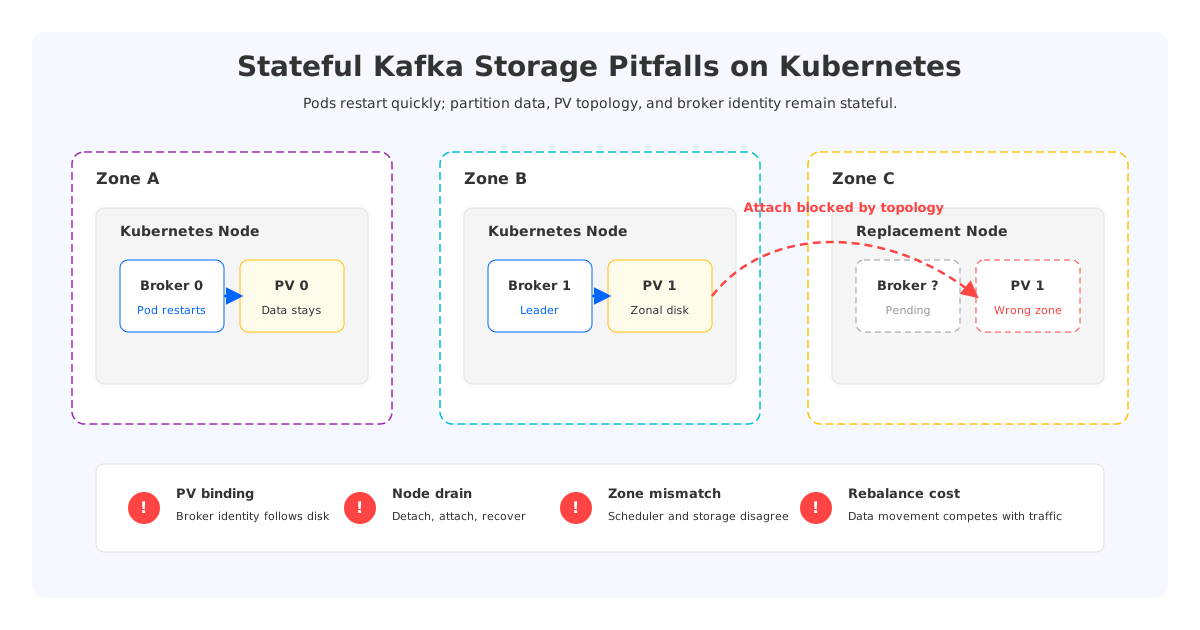
A Kafka pod can restart in seconds. The data it used to own usually cannot. That gap is where many kafka on kubernetes storage incidents begin: the orchestration layer treats a broker pod as replaceable, while Kafka still treats partition replicas and log directories as durable, locality-sensitive state.
Kubernetes gives teams useful primitives for stateful systems: StatefulSets, PersistentVolumeClaims, StorageClasses, PodDisruptionBudgets, topology-aware scheduling, and rollout controls. They do not remove the fact that traditional Kafka is built around broker-local log replicas. When a broker identity is tied to a PersistentVolume, a node, a zone, and a set of partition replicas, the operational problem is no longer "can Kubernetes restart the pod?" The real question is "can the replacement broker find the right data, in the right topology, with enough capacity, without forcing a large reassignment or risking availability?"
1Why Kafka Remains Stateful on Kubernetes
StatefulSets were designed for workloads that need stable network identities and stable storage. That maps neatly to the surface shape of Kafka: each broker has an identity, stores logs, and participates in replication. The difficult part is not creating a broker pod with a PersistentVolumeClaim. The difficult part is preserving the operational semantics Kafka expects when Kubernetes reschedules pods, drains nodes, updates machines, expands disks, or replaces failed infrastructure.
In traditional Kafka, each partition has replicas assigned to brokers. Those replicas live in the brokers' log directories, and Kafka replication keeps the in-sync replica set healthy. Kubernetes does not know that a PVC contains the leader replica for a busy partition. From Kubernetes' point of view, the pod, volume, node, and zone are schedulable resources. From Kafka's point of view, they are part of the durability and availability topology.
That mismatch shows up in routine platform work. A cloud provider may replace a node. A storage class may bind a volume to one availability zone. A broker may run out of disk while other brokers have room. An SRE may drain a node and discover that the "restart" is actually a volume detach, attach, mount, broker recovery, controller update, and consumer impact event. None of this means Kafka should never run on Kubernetes. It means Kubernetes does not make Kafka stateless by wrapping it in a StatefulSet.
2Common Storage Pitfalls
The most painful kafka k8s storage issues are not exotic failure modes. They are ordinary infrastructure events amplified by broker-local data. A good runbook can reduce mistakes, and a mature operator can automate many steps, but the underlying constraints remain visible.
- PV binding becomes broker binding. With StatefulSets, a PVC can follow the broker identity rather than the transient pod. That is correct for stateful Kafka, but it also means a broker replacement is not clean compute replacement. The new pod must land where its volume can attach, and the broker identity remains coupled to that storage object.
- Node drain is not only pod eviction. Draining a node may evict a Kafka pod, but the operational cost depends on volume detach and attach behavior, broker shutdown timing, partition leadership, and replica health. If the pod cannot restart promptly elsewhere, Kafka may need leadership movement or replica recovery.
- Zone mismatch can block recovery. Kubernetes supports topology-aware volume binding, and cloud disks are often zonal. If the scheduler tries to place a pod in a zone where its volume is not available, the pod cannot recover there. If replicas are not spread with rack or zone awareness, a zone event can affect more partitions than expected.
- Disk expansion fixes capacity, not balance. Expanding a PersistentVolumeClaim can give one broker more room, provided the storage class and filesystem support it. It does not automatically redistribute hot partitions, rebalance storage utilization, or remove the need to watch log directory pressure.
- Broker replacement can turn into data movement. If a volume is lost or a broker is intentionally replaced with fresh storage, Kafka must rebuild replicas from other brokers. That consumes network, disk, and broker resources while the cluster is already operating with reduced redundancy.
- Rebalance work competes with production traffic. Partition reassignment is often the right tool for moving load and storage, but it is still a data movement process in traditional Kafka. Throttling helps, yet a slow reassignment extends the period where the cluster carries operational risk.
These pitfalls interact. A single event can include a node drain, zonal placement constraint, under-replicated partitions, and storage imbalance. The incident feels like a Kubernetes problem because the visible symptom is a pod that will not come back cleanly, but the deeper cause is the data locality model.
3PV Binding and Node Replacement
PersistentVolumes are a feature, not a bug. Kafka needs durable storage, and Kubernetes needs a way to make storage survive pod recreation. The catch is that a durable volume often has infrastructure-level attachment rules. On many cloud platforms, block volumes are tied to a zone and can attach to one node at a time. A pod reschedule therefore depends on both Kubernetes scheduling and storage detach, attach, and mount behavior.
For Kafka admins, broker identity matters as much as the volume. If broker 3 owns certain replicas, a replacement pod for broker 3 is not interchangeable with broker 7. The PVC naming pattern used by StatefulSets preserves that identity, which is precisely why StatefulSets are attractive for Kafka. It also means the broker failure domain includes its PVC, storage class, attachable node, and Kafka partition assignment.
This is where "Kubernetes will restart it" becomes too optimistic. Kafka recovery depends on whether the replacement broker can reuse the right log directories, whether the replicas are still valid, whether the broker rejoins cleanly, and whether leadership needs to move. A healthy design treats pod replacement as a controlled storage recovery workflow, not as a generic deployment restart.
4Zone-Aware Scheduling
Zone awareness is one of the most important details in stateful Kafka Kubernetes deployments. Kafka has rack awareness so replicas can be spread across failure domains. Kubernetes has topology labels, node affinity, pod affinity and anti-affinity, topology spread constraints, and StorageClass volume binding modes. The architecture works when those layers agree with each other.
The problem appears when they do not. A volume may be created in one zone because of early binding. The scheduler may prefer another zone because of available CPU. Kafka may place partition replicas without the intended rack mapping. A broker may recover, but its replicas may be concentrated in a way that weakens availability during the next zone event.
The practical check is simple: storage topology, pod scheduling topology, and Kafka replica topology must be designed together. If the storage class uses delayed binding, the first scheduling decision can influence where the volume is provisioned. If Kafka rack awareness is enabled, broker rack labels must reflect the actual zone or failure domain. Operators also need to know which traffic is intra-zone, which traffic is cross-zone replication, and which traffic appears during recovery.
5Disk Expansion and Rebalance
Running out of disk on one broker while other brokers have capacity is a classic Kafka problem, and Kubernetes does not make it disappear. PVC expansion may be available, depending on the StorageClass and CSI driver. That solves the immediate capacity ceiling for one volume, but it does not solve uneven partition placement or skewed traffic.
Kafka storage pressure usually comes from retention, partition count, message size, topic growth, and uneven leader or replica distribution. Enlarging a volume buys time. Reassignment changes placement. Retention tuning reduces footprint. A platform team often needs all three. The dangerous pattern is treating disk expansion as the whole fix because it is the easiest Kubernetes action to perform.
Rebalance also has a cost profile. Moving replicas transfers data between brokers and can increase disk I/O, network usage, and controller activity. In a busy production cluster, the safest rebalance is often slow and throttled, which means the cluster spends longer in an intermediate state. That tradeoff is manageable when planned. It becomes painful when triggered under incident pressure after a broker has already reached a storage limit.
6What Operators Can Automate
Kafka operators are valuable because they encode many steps that humans otherwise perform by hand. Strimzi, for example, provides Kubernetes-native management for Kafka clusters, users, topics, listeners, storage configuration, rolling updates, and supporting components. An operator can reduce manual YAML drift, coordinate rollouts, and express Kafka operations in a Kubernetes control-loop model.
The boundary is storage semantics. An operator can automate parts of the lifecycle, but it does not turn broker-local persistent data into shared storage. If a broker's data lives on a zonal PersistentVolume, the replacement path still has to respect that volume. If replicas need to move, Kafka still performs reassignment work.
That distinction matters when choosing architecture:
| Approach | What improves | What remains stateful |
|---|---|---|
| Hand-managed Kafka on Kubernetes | Maximum control, but high runbook burden | Broker identity, PVs, replicas, reassignment |
| Operator-managed Kafka | Safer lifecycle automation and consistent Kubernetes resources | Broker-local data, storage topology, recovery data movement |
| Managed Kafka service | Less infrastructure operation for the customer | Provider-specific limits, cost model, migration constraints |
| Stateless shared-storage Kafka | Broker pods become closer to replaceable compute | Shared storage, metadata, cache, and object storage operations still need design |
Operators are often the right answer for teams committed to self-managed Kafka on Kubernetes. They are not an architecture escape hatch. They make the existing stateful model more operable; they do not remove the broker-to-disk relationship.
7Stateless Kafka as an Architecture Alternative
If the root problem is that durable partition data is bound to broker-local volumes, the architecture alternative is to move durable data out of broker-local volumes. That is the idea behind stateless shared-storage Kafka designs: brokers still handle Kafka protocol work, leadership, caching, and coordination, but long-lived log data is stored in shared storage rather than in PVs attached to individual broker pods.
AutoMQ is one example of this architecture category. It is Kafka-compatible and uses object-storage-backed shared storage so broker pods on Kubernetes are less tightly coupled to persistent volumes. Kubernetes still schedules compute, manages rollouts, and runs the control plane. The difference is that broker replacement no longer has to center on recovering a specific local disk full of partition replicas.
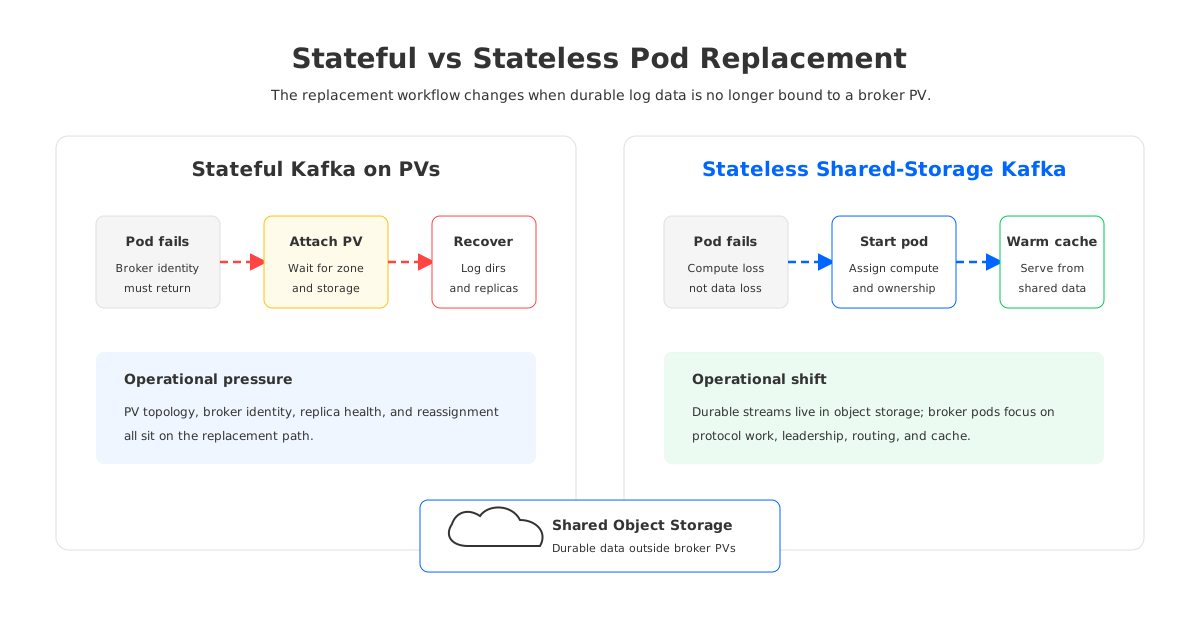
In the stateful model, replacing a broker means preserving or rebuilding its local data. In a shared-storage model, replacement can focus more on assigning compute to existing durable streams and warming cache. That changes the shape of node maintenance, autoscaling, and failure recovery. It also changes capacity planning: local disks are no longer the main retention boundary, while object storage, metadata scale, cache sizing, and request behavior become the areas to validate.
This is not a free lunch. Object storage has different latency and request characteristics from local SSDs or cloud block volumes. A serious shared-storage Kafka architecture needs a write path, cache layer, metadata model, and failure protocol designed for Kafka's append and fetch behavior. It is attractive on Kubernetes because pods can be replaced more easily when durable state is not trapped inside an attached volume.
8Architecture Decision Framework
The right answer depends on whether your pain is operational complexity, infrastructure ownership, cost control, elasticity, or all of the above. Teams often jump from "Kafka on Kubernetes is hard" to "we need a managed service," but that skips several valid middle paths.
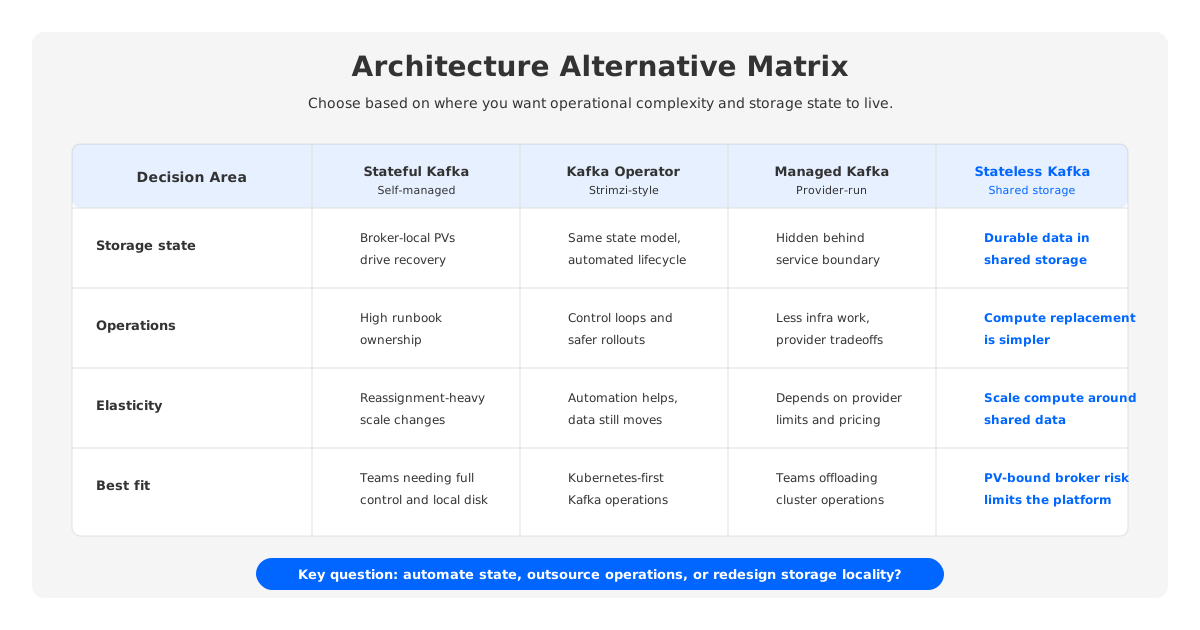
Use these questions before choosing a path:
- Do you need to own the Kubernetes runtime? If yes, operator-managed Kafka or stateless Kafka on Kubernetes may fit better than a provider-managed service. If no, managed Kafka may reduce operational scope.
- Is the main issue runbook complexity or data locality? Operators help most with lifecycle consistency. Shared-storage architectures help most when PV-bound broker risk, reassignment time, and local disk capacity planning are the limiting factors.
- How sensitive are workloads to latency and cache behavior? Traditional Kafka with local disks remains a familiar fit when the team is comfortable managing state and wants predictable local storage behavior. Shared-storage designs should be evaluated with realistic hot-read, cold-read, and failure-recovery tests.
- What does broker replacement look like during maintenance? If every node replacement turns into a careful PV and replica operation, the architecture is carrying hidden operational cost. That cost may be acceptable, but it should be explicit.
- Where do you want the hard problem to live? Stateful Kafka puts much of the hard problem in broker disks, PVs, and reassignment. Managed Kafka moves it to a provider boundary. Stateless shared-storage Kafka moves it into shared storage, cache, and metadata design.
For many platform teams, the near-term move is improving stateful Kafka with stronger scheduling rules, rack awareness, PodDisruptionBudgets, tested drain procedures, disk alerts, and operator automation. That is a rational path. The architecture starts to strain when the team wants frequent node replacement, elastic scaling, large retention, fast broker recovery, and lower PV operations at the same time.
9References
- Kubernetes StatefulSet documentation
- Kubernetes PersistentVolumes documentation
- Kubernetes StorageClasses and volume binding mode
- Kubernetes safely drain a node
- Apache Kafka operations: expanding a cluster
- Apache Kafka operations: rack awareness
- Strimzi documentation: storage configuration
- AutoMQ documentation: Deploy AutoMQ on Kubernetes
10FAQ
10.1Is Kafka on Kubernetes a bad idea?
Not by default. Kafka can run successfully on Kubernetes when the team designs storage, scheduling, replica placement, disruption budgets, monitoring, and recovery procedures carefully. The risk comes from assuming that Kubernetes pod restart behavior makes Kafka data stateless.
10.2Should Kafka use PersistentVolumes on Kubernetes?
Traditional Kafka on Kubernetes normally needs PersistentVolumes because broker log directories must survive pod restarts. The key is to choose storage classes, binding modes, zone topology, and retention policies deliberately rather than treating a PVC as a generic disk.
10.3Do Kafka operators solve Kubernetes storage problems?
Operators reduce operational complexity, standardize configuration, and automate lifecycle tasks. They do not remove Kafka's broker-local data model. PV binding, zonal storage, replica placement, disk capacity, and partition reassignment still need architecture-level attention.
10.4What is stateless Kafka on Kubernetes?
In this context, stateless Kafka means broker pods are not the long-term home of durable partition data. Brokers still have runtime state, cache, leadership, and metadata responsibilities, but persistent log data lives in shared storage such as object storage. That makes broker pod replacement closer to compute replacement.
10.5When should a team consider stateless shared-storage Kafka?
Consider it when PV-bound broker recovery, slow reassignment, disk capacity planning, frequent node maintenance, or elastic scaling are becoming the main limits of your Kafka platform. It is especially relevant for teams that want Kubernetes-native operations without making every broker pod a long-lived storage appliance.


