
Table of Contents
Table of Contents
The phrase "stateful stream processing scale" usually appears after a team has already built the first version of a pipeline. The job is no longer a neat demo that counts clicks in a five-minute window. It is calculating fraud features, joining customer context, maintaining session state, or feeding an AI decision loop where stale inputs become bad decisions. At that point, the hard question is not whether Flink, Kafka Streams, or another engine can hold state. The hard question is whether the surrounding Kafka-compatible streaming platform can survive checkpoint pressure, replay storms, broker replacement, and traffic growth without turning every scale event into a storage project.
Stateful processing is unforgiving because compute and storage failures meet in the same place. The processor keeps state. The source stream keeps the ordered history. Checkpoints tie those worlds together so a failed job can restart from a consistent point. If either side becomes slow or operationally fragile, recovery time, freshness, and cost drift away from the service-level objective.
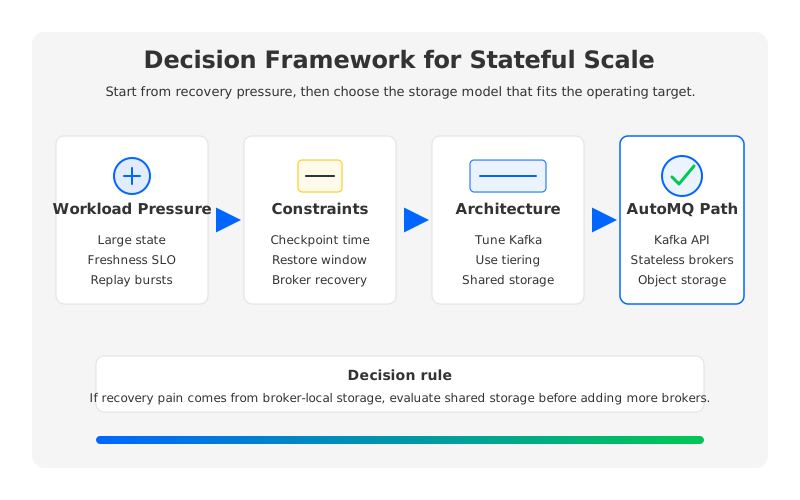
For platform teams, this is a design problem more than a tuning problem. You can increase task parallelism, tune RocksDB memory, or shorten checkpoint intervals, but those changes only work inside the limits set by the streaming backbone. A broker architecture that binds partitions to local disks creates a different recovery profile than one where log data lives in shared storage. A cluster that depends on replica movement for capacity changes behaves differently from one where brokers are mostly compute.
1Why Stateful Scale Breaks Differently
Stateless stream processing fails loudly and recovers cleanly. If a task only maps, filters, or routes records, a restart mainly needs fresh compute and the last committed offsets. Stateful processing adds a second recovery dimension: the job must restore its state and resume reading from the stream position that matches that state. Apache Flink's stateful processing model describes common examples such as pattern detection and windowed aggregation, where operators remember information across multiple events rather than treating each event independently.
That memory is what gives stateful systems their value. It is also what makes scale planning harder. When a payment risk job maintains user-level aggregates, a restart must not forget recent behavior. When an inventory pipeline joins orders with stock movement, a missed or duplicated update can leak into customer-facing availability. When an AI enrichment service builds fresh context from events, lag changes the quality of downstream answers.
The production constraints usually show up in four places:
- Checkpoint duration. Larger state means checkpoints take longer, and long checkpoints narrow the margin between normal operation and cascading backpressure.
- Restore time. A failed job may need to reload large state and replay source data. The source cluster has to serve that replay without starving live consumers.
- Partition elasticity. More partitions and more processing tasks increase parallelism, but they also increase assignment, metadata, and balancing work.
- Storage locality. If stream data is tied to broker-local disks, scaling or replacing brokers can require moving partition data before the platform is healthy again.
The pattern is easy to miss because the symptoms look unrelated. The Flink team sees checkpoint alignment delays. The Kafka team sees catch-up reads and broker disk pressure. The SRE team sees recovery drills running longer than the incident budget. These are different surfaces of the same architecture.
2The Storage Contract Behind Checkpoints
A checkpoint is only useful if the source stream can replay from the matching position. In Kafka-compatible pipelines, offsets are the bridge between stream history and processing state. The processing engine records a consistent state snapshot and the corresponding source progress. After failure, it restores state and resumes consuming from the recorded offsets, expecting the stream platform to preserve ordered records for the required retention window.
That contract sounds simple until the system is large. Recovery traffic is bursty. A failed job often reads older data as fast as the cluster allows. Kafka's own tiered storage documentation separates local and remote tiers, with local broker storage serving hot data and external systems such as S3 storing completed log segments for older data. That model helps retention economics, but brokers still matter for active segments, metadata, fetch serving, and local capacity.
The evaluation question is not "does the platform support long retention?" It is sharper: what happens when the platform must serve live writes, tail reads, and catch-up reads at the same time a stateful job is restoring?
| Constraint | What to inspect | Why it matters during recovery |
|---|---|---|
| Hot-path write latency | Producer acknowledgment path and replication model | Checkpoints lose value if the source stream cannot keep up with live writes. |
| Catch-up read isolation | How older data is fetched and cached | Restore traffic can interfere with tailing consumers if read paths are not isolated. |
| Retention placement | Local disk, remote tier, or shared object storage | Retention cost and broker replacement time depend on where history lives. |
| Broker elasticity | Whether scaling requires partition data movement | Recovery windows get longer when compute changes require storage migration. |
| Governance boundary | Account, network, identity, and encryption controls | Stateful applications often process regulated or customer-sensitive context. |
The table avoids a common trap: treating the stream processor and the stream store as separate procurement decisions. They are separate components, but their failure modes are coupled. A state backend can be well tuned and still wait on stream replay. A Kafka cluster can be healthy under normal traffic and still become the bottleneck during a restore storm.
3Why Shared-Nothing Kafka Amplifies the Problem
Traditional Kafka uses a shared-nothing architecture. Each broker owns local log segments for its assigned partitions, and replication distributes copies across brokers for durability. This design has served Kafka well for years because it is simple to reason about and efficient for steady tail reads. The issue is not that shared-nothing is broken. The issue is that cloud-scale stateful processing stresses the exact places where shared-nothing is least elastic.
Broker-local storage turns data placement into an operational dependency. If a broker fills up, fails, or needs to be replaced, the cluster must care about compute capacity and where partition data lives. Reassignment moves data over the network. Replication protects availability but also increases write amplification and cross-zone traffic in multi-AZ deployments. Capacity planning becomes a negotiation among CPU, network, and disk, even when the workload only needs more of one dimension.
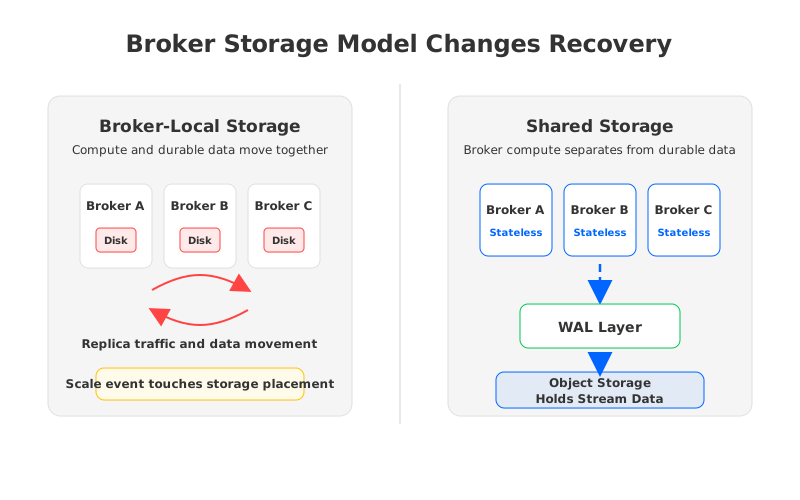
For stateful stream processing, this matters because recovery and scaling happen under pressure. A job restore asks for historical data. A traffic spike asks for more write and read capacity. A broker event asks the platform to heal itself. In a shared-nothing model, these requests can all compete for the same broker disks and network links. The team can overprovision, throttle recovery, or split workloads across clusters, but each answer carries cost and operational overhead.
Tiered storage reduces part of the pain by moving older completed segments to remote storage. It is useful for longer retention and less frequent backfill. But tiered storage is not the same as making brokers stateless. Local storage remains part of the active data path, and the platform still has to manage the boundary between local and remote tiers. Tiering changes where colder data lives; shared storage changes what it means for a broker to own data.
4A Neutral Evaluation Framework
The cleanest way to evaluate stateful stream processing scale is to start from failure and work backward. Pick a representative job, define its state size, define the acceptable recovery point and recovery time, and then ask what the streaming platform must do during that interval. If the answer depends on heroic manual operations, the architecture is not ready for the workload.
A useful review covers six dimensions:
- State and checkpoint design. Confirm checkpoint interval, timeout, state backend, savepoint process, and schema evolution plan. The processor must be able to create and restore consistent snapshots under production load.
- Stream retention and replay. Retention should exceed the longest realistic restore and rollback window. Replay should be tested against older offsets, not only the hot tail of the stream.
- Broker failure behavior. Test replacement of a broker during live traffic and during catch-up reads. Measure how much data moves before the cluster returns to a balanced state.
- Elasticity boundary. Separate compute scaling from storage growth where possible. A platform that needs more brokers for CPU should not automatically force a data migration project.
- Cost allocation. Attribute storage, inter-zone traffic, remote reads, and idle capacity to the pipelines that create them. Stateful workloads hide cost in recovery headroom.
- Migration and rollback. Validate client compatibility, offset translation, topic configuration, and the ability to return to the previous platform if the cutover does not meet SLOs.
This framework keeps the conversation away from feature checklists. A product can claim high throughput and still perform poorly when a stateful job restores from a large checkpoint. Another platform can look expensive per broker but reduce incident risk by making recovery more predictable. The right answer depends on the dominant constraint.
5Where AutoMQ Changes the Operating Model
Once the evaluation reaches the broker-storage boundary, AutoMQ becomes relevant as a Kafka-compatible cloud-native streaming platform built around shared storage. The point is not to replace stream processing engines such as Flink. The point is to change the behavior of the Kafka-compatible backbone those engines depend on.
AutoMQ keeps Kafka protocol compatibility while replacing broker-local log storage with a shared storage architecture. In AutoMQ's S3Stream design, data is written through a write-ahead log layer and then stored in object storage. The WAL handles the write acknowledgment path and batches data before it reaches object storage. Brokers become stateless in the sense that durable stream data is not bound to a specific broker's local disk.
That distinction changes several operational assumptions:
- Scaling brokers does not require moving full partition histories. When storage is shared, adding or removing broker compute is not the same as relocating all durable data.
- Recovery can focus on metadata and recent WAL data. A replacement broker does not need to inherit a local disk full of partition segments before it can be useful.
- Retention economics follow object storage. Long retention for replay and audit workloads no longer implies the same broker disk footprint.
- Multi-AZ traffic can be reduced by architecture rather than constant tuning. AutoMQ documents a zero cross-AZ traffic approach based on its S3 storage architecture and client/broker zone awareness.
This is the natural point to discuss AutoMQ, after the evaluation has already shown why stateful workloads care about broker ownership of data. If your current Kafka architecture meets checkpoint, restore, and cost targets, a major platform change may not be the first move. If restore traffic, partition movement, and storage overprovisioning keep returning, shared storage deserves a serious look.
6Production Readiness Checklist
The readiness test for stateful stream processing should be run like an incident rehearsal, not a whiteboard exercise. Create a workload that represents real state size and retention needs. Kill tasks. Replace brokers. Force a restore from an older checkpoint. Run a backfill while live consumers continue. Then compare the measured result with the budget product teams need.
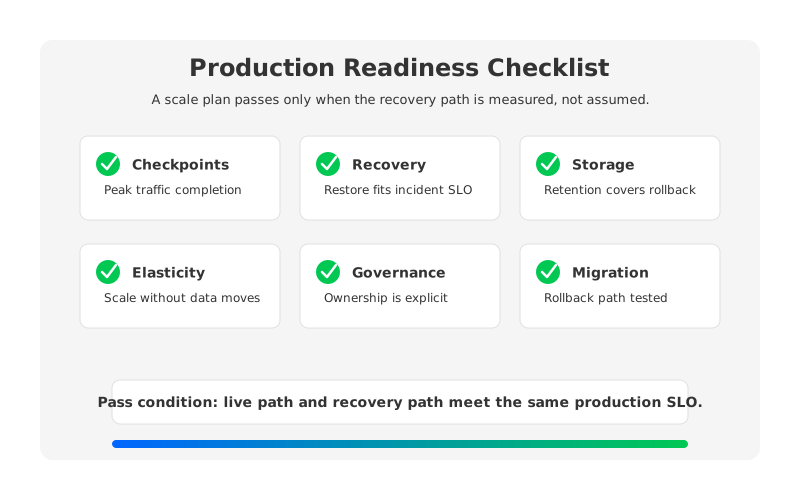
Use the following checklist before scaling the next generation of stateful workloads:
| Area | Pass condition | Warning sign |
|---|---|---|
| Checkpoints | Stable completion under peak traffic | Checkpoints time out when input spikes. |
| Recovery | Restore time fits the incident SLO | Replay saturates brokers or remote reads. |
| Storage | Retention supports rollback and audit windows | Broker disks are sized for rare events. |
| Elasticity | Compute can scale without large data movement | Partition reassignment is treated as a project. |
| Governance | Data location, encryption, and access are clear | Platform ownership is split across unclear boundaries. |
| Migration | Client compatibility and rollback are tested | Cutover depends on undocumented operator knowledge. |
The checklist also helps decide whether to optimize in place or evaluate a new architecture. Tune the processor first when checkpoint settings, state layout, or backpressure are the dominant issue. Tune Kafka first when retention, partition count, or fetch behavior are misconfigured. Evaluate a shared-storage Kafka-compatible platform when the recurring bottleneck is the coupling between broker compute and durable stream storage.
For teams exploring that third path, AutoMQ's documentation is the practical next step: review the shared storage architecture, WAL options, Kafka compatibility notes, and deployment model against one real workload rather than an abstract platform wish list. Stateful scale is won in the recovery path. The architecture you choose should make that path boring.
7References
- Apache Flink: Stateful Stream Processing
- Apache Flink: Checkpointing
- Apache Kafka: Tiered Storage
- AutoMQ Architecture Overview
- AutoMQ S3Stream Shared Streaming Storage
- AutoMQ WAL Storage
- AutoMQ Zero Cross-AZ Traffic Overview
8FAQ
8.1Is stateful stream processing scale mostly a Flink problem or a Kafka problem?
It is both. Flink or another processing engine owns state layout, checkpointing, and restore behavior. Kafka or a Kafka-compatible platform owns ordered history, retention, replay throughput, and broker recovery. Large stateful systems fail when those two responsibilities are tuned independently.
8.2Does Kafka tiered storage solve stateful recovery by itself?
Tiered storage helps with longer retention by moving older completed log segments to remote storage, but it does not automatically make brokers stateless. Active segments, fetch behavior, metadata, and local capacity still need operational planning.
8.3When should a team consider shared-storage Kafka-compatible architecture?
Consider it when broker-local storage is repeatedly driving cost, recovery time, or scaling complexity. If adding compute requires large partition movement, if restore drills saturate broker disks, or if long retention forces expensive overprovisioning, shared storage may address the root constraint.
8.4How does AutoMQ fit with Flink?
AutoMQ is not a stream processing engine. It provides a Kafka-compatible streaming backbone that Flink and other Kafka clients can use as a source or sink. The architectural difference is in the storage layer: AutoMQ separates broker compute from durable stream storage through WAL and object storage.
8.5What should be tested before migrating a stateful pipeline?
Test client compatibility, topic configuration, offset behavior, checkpoint restore, backfill throughput, failure recovery, and rollback. A migration is ready only when the team can prove that both live processing and recovery paths meet the required SLOs.


