
Table of Contents
Table of Contents
Most platform teams already know what good cloud elasticity feels like. A Deployment loses a pod, Kubernetes starts another one, and the application keeps serving traffic because durable state lives somewhere else. The compute instance matters while it is running, but the system does not depend on that exact instance surviving.
Kafka has not traditionally behaved that way. A broker is not only a request handler. It owns local partition logs, participates in replica placement, serves leaders and followers, and carries disk capacity that directly shapes whether the cluster can scale, drain, or recover. When a broker disappears, the question is not only "can another process start?" The real question is "where is the data that broker was responsible for?"
That is why the phrase stateless Kafka brokers needs a careful definition. It does not mean brokers have zero runtime state. Brokers still manage client connections, request queues, metadata caches, leadership responsibilities, buffers, metrics, and in-flight work. It means the durable record state of the Kafka log is no longer bound to broker-local disks. Once durable data lives in shared storage, a broker can become a replaceable compute unit instead of a storage owner with a network endpoint attached.
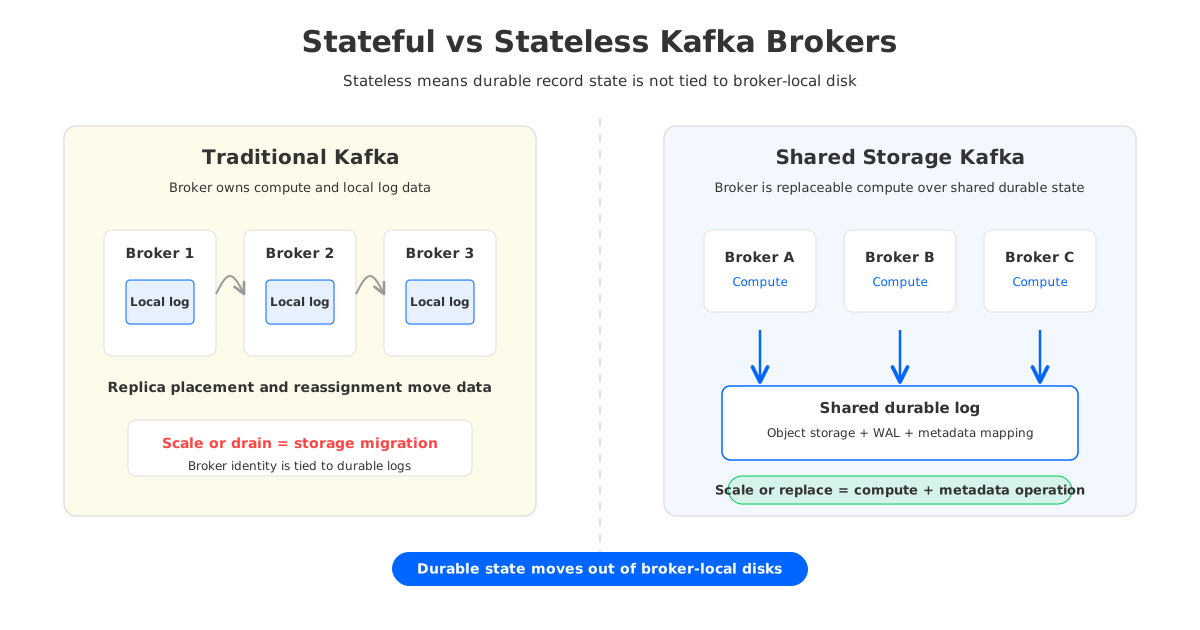
This distinction sounds small until you operate Kafka under changing load. Traditional Kafka can add brokers, but adding brokers does not automatically make the cluster elastic. The slow part is moving partition data and rebalancing responsibility without destabilizing the workload. Stateless brokers change the unit of movement: instead of copying durable logs from one machine to another, the system updates which broker serves which partition over shared storage.
1Why Traditional Kafka Brokers Are Stateful
Kafka's original architecture is elegant because it makes the partition log the core abstraction. A topic is split into partitions; each partition is an ordered log; each partition has a leader and replicas; producers and consumers talk to the broker that owns the relevant leader. Apache Kafka's documentation describes this distribution model directly: partitions are spread across servers, each server handles a share of partitions, and each partition is replicated across configurable servers for fault tolerance.
That design turns broker identity into more than an address. A broker is a storage participant. Its local log directories contain partition data, and its placement in the replica set determines how writes, reads, replication traffic, failover, disk usage, and reassignments behave. If the cluster needs more capacity, the new broker is empty at first. To make it useful, partitions or replicas need to be reassigned, which means data has to move or new replicas have to catch up.
The operational consequences show up in familiar places:
- Scaling out adds compute before it adds useful data ownership. The cluster has to move replicas or leaders before the new broker meaningfully absorbs load.
- Scaling in requires draining partitions away from a broker before the instance can be removed safely.
- Maintenance is tied to partition placement. Restarting a broker may trigger leadership movement, under-replicated partitions, catch-up traffic, and careful rolling procedures.
- Recovery depends on surviving replicas and how much data must be copied before the cluster returns to its intended durability and balance.
None of this is a flaw in Kafka's original context. Kafka was designed for data centers where disks were attached to servers and application-level replication was the normal way to survive server failure. The mismatch appears when that model runs in a cloud environment where compute can appear in seconds, object storage is elastic, and operations teams expect pods and instances to be replaceable.
2What Stateless Brokers Actually Mean
In Kubernetes language, statefulness usually appears when a workload needs stable identity or persistent storage. The official StatefulSet documentation describes a StatefulSet as useful for applications that need persistent storage or stable, unique network identity; it also notes that stateless replicas are better suited when those stable guarantees are not required. Kafka brokers have traditionally looked much closer to the StatefulSet side of that line.
A stateless Kafka broker architecture moves the durable log out of the broker's local disk. The broker still runs Kafka protocol handling, authorization, networking, batching, fetch serving, metrics, and coordination logic, but the durable record history is stored in a shared layer that can be reached by another broker. In practical terms, the broker becomes a compute process that can be replaced without first rescuing its disk.
That definition avoids two common mistakes. First, stateless does not mean "no state anywhere." The state still exists; it has moved to systems designed to hold durable state, such as object storage, WAL storage, and the metadata quorum. Second, stateless does not mean "no coordination." Partition ownership, leadership, offsets, and routing still need strongly consistent metadata. The architecture changes what must move during operations, not whether the system needs correctness.
The useful test is simple:
| Question | Stateful broker model | Stateless broker model |
|---|---|---|
| Where is the durable partition log? | Broker-local disk, replicated across brokers | Shared storage outside broker-local disk |
| What makes a new broker useful? | Data movement, replica catch-up, leader movement | Metadata assignment and available compute |
| What blocks scale-in? | Need to drain local data safely | Need to update serving responsibility safely |
| What survives broker loss? | Other broker replicas and recovery traffic | Shared durable log plus replacement compute |
| What is still stateful? | Logs, replicas, leadership, metadata, runtime state | Metadata, WAL/checkpoints, runtime state; durable records are not tied to the broker disk |
The table is deliberately blunt because the word "stateless" gets abused in infrastructure marketing. A broker process that holds sockets, caches, buffers, and metadata is never literally stateless. The architectural claim is narrower and more important: durable Kafka record state should not be imprisoned on the local disk of the broker currently serving it.
3Shared Storage as the Enabling Pattern
Shared storage is the pattern that makes stateless brokers possible. Instead of treating each broker as the owner of its own durable log files, the storage layer becomes a separate system. Brokers read and write through that layer, while metadata records which broker is currently responsible for serving each partition.
This differs from tiered storage in an important way. Tiered storage can offload older segments to object storage, but the active log and primary write path may still depend on broker-local disk. That helps retention cost, but it does not fully remove the operational coupling between broker placement and active partition data. A shared-storage architecture goes further: the durable log path itself is externalized so partition reassignment does not require moving the full historical log from one broker disk to another.
The design usually needs three pieces working together:
- A durable shared data layer stores the Kafka record history outside broker-local disks. Object storage is attractive because it is elastic, widely available across cloud providers, and designed for durability.
- A write-optimized WAL layer absorbs the latency and I/O mismatch between Kafka's write path and object storage. This keeps the broker from pretending that object storage behaves like a local SSD.
- A metadata authority maps partitions to brokers and coordinates changes. The data may not move during reassignment, but ownership still has to change safely and consistently.
The hard part is not drawing the diagram. The hard part is preserving Kafka semantics while changing the storage implementation underneath. Producers still expect acknowledgments to mean something. Consumers still expect ordered partition reads. Operators still expect Kafka tooling and protocol compatibility. A credible stateless broker design has to make the storage layer invisible to applications while making it very visible to operations.
4How AutoMQ Implements Stateless Kafka Brokers
AutoMQ implements this pattern by replacing Kafka's native local-log storage layer with S3Stream, a shared streaming storage layer built on cloud storage. AutoMQ's architecture documentation describes the shift from Kafka's shared-nothing architecture to a shared-storage architecture, with WAL storage and object storage together supporting stateless broker nodes. Its stateless broker documentation is explicit that AutoMQ offloads Kafka's storage layer to cloud storage, making broker nodes stateless for operations and scaling.
The important architectural move is that broker-local disk stops being the place where durable record history lives. AutoMQ brokers continue to speak the Kafka protocol, but persistent stream data is stored through the shared storage layer. WAL storage handles the write path where low-latency durability matters, while object storage provides the elastic durable repository. Cluster metadata then determines which broker serves which partition.
That is why partition reassignment becomes a different kind of operation. In a traditional broker-local model, reassignment means data synchronization. In AutoMQ's shared-storage model, the durable log is already outside the broker, so reassignment can focus on metadata and a small amount of buffered state. AutoMQ's partition reassignment documentation describes this as seconds-level reassignment enabled by shared storage, and its technical advantage documentation states that shared storage avoids copying data during reassignment.
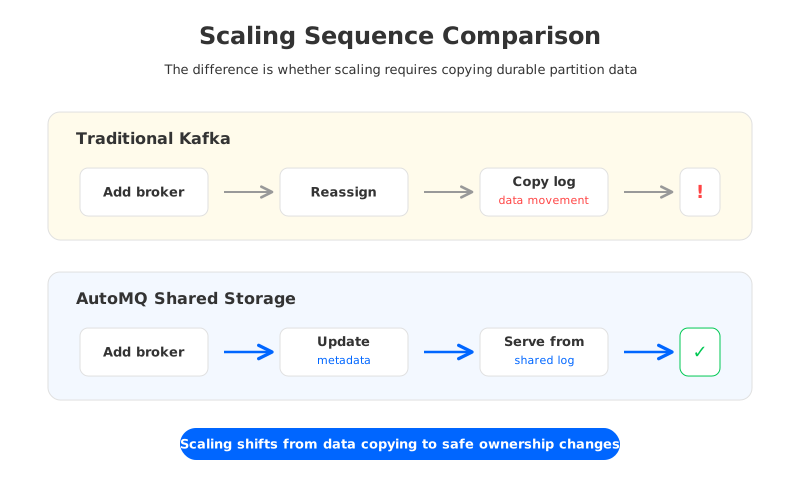
There is still engineering behind the phrase "metadata update." A broker may need to flush or recover buffered data, fetch checkpoints, refresh routing, and coordinate leadership changes. The point is that the amount of work is no longer proportional to the full size of the partition's durable history. A large partition and a small partition do not require the same kind of full broker-to-broker disk copy before the target broker can serve them.
This is also where the "Kafka-compatible" part matters. Statelessness is much more useful when applications do not have to rewrite producers, consumers, connectors, or operational tooling. AutoMQ keeps the Kafka protocol surface while changing the storage architecture beneath it. From the application side, the topic and partition model remains familiar; from the operations side, broker replacement and scaling start to look more like cloud compute management.
5What Changes for Operations
The operational impact is not that Kafka magically becomes a small service. Streaming platforms still need capacity planning, quota design, observability, failure testing, security controls, and careful upgrade procedures. The change is that the highest-friction operation, moving durable partition data between broker-local disks, stops dominating every capacity decision.
Once brokers are replaceable compute, platform teams can treat several workflows differently:
- Autoscaling becomes more realistic because adding a broker can add serving capacity without waiting for large partition copies. Scaling policies still need guardrails, but the architecture no longer fights every adjustment.
- Failure recovery can focus on replacing compute and updating metadata instead of rebuilding local disk ownership before the cluster becomes balanced again.
- Maintenance and upgrades can look closer to rolling compute updates. A broker restart is still a production event, but it is less likely to become a storage migration event.
- Spot and preemptible instances become more practical for the broker layer because losing an instance does not imply losing a broker-local durable log.
- Cost control improves when compute can follow traffic more closely and durable storage can use cloud object storage economics instead of over-provisioned local or block storage.
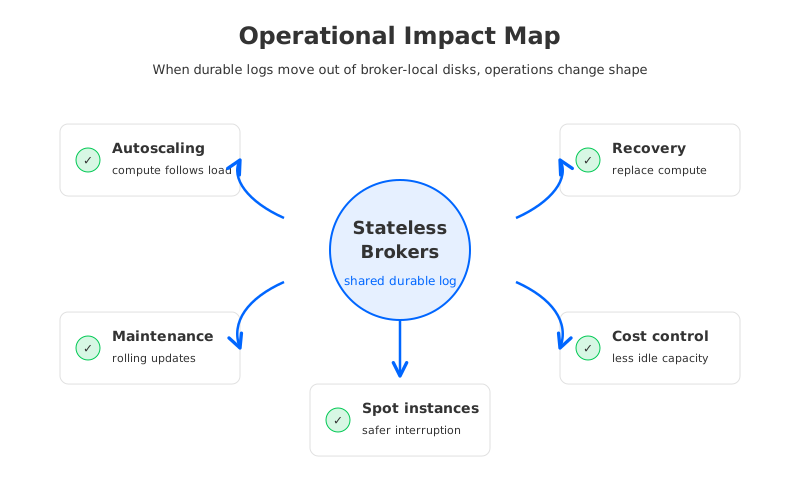
The most useful mental model is not "Kafka without state." It is "Kafka with state placed where cloud infrastructure can manage it better." Durable records belong in a durable shared layer. Broker compute belongs in a layer that can scale, restart, and be replaced. Metadata belongs in a consistent authority that makes those changes safe.
That separation is the architecture pattern behind elastic streaming. Traditional Kafka made the broker both the data owner and the request handler because that was the right tradeoff for its original environment. Stateless Kafka broker architectures split those responsibilities so the broker can behave more like cloud compute without giving up the Kafka protocol model that applications already depend on.
6Sources
- AutoMQ Stateless Broker documentation
- AutoMQ Architecture overview
- AutoMQ Technical Advantage overview
- AutoMQ Partition Reassignment in Seconds
- Apache Kafka 4.2 documentation: Basic Kafka Operations
- Kubernetes StatefulSet documentation
7FAQ
7.1Are stateless Kafka brokers truly stateless?
No. A broker process still has runtime state such as connections, metadata caches, buffers, metrics, and in-flight requests. In a stateless broker architecture, the durable Kafka record log is not tied to broker-local disk. That is the operationally important part.
7.2Is stateless Kafka the same as tiered storage?
Not necessarily. Tiered storage often moves older log segments to object storage while the active log remains broker-local. Stateless broker architectures require the durable log path to be externalized enough that broker replacement and partition reassignment do not depend on copying the full partition history from one broker disk to another.
7.3Why does shared storage make scaling faster?
In a broker-local architecture, adding or removing brokers requires data movement before the cluster is balanced. With shared storage, durable partition data is already outside the broker, so scaling can focus on metadata assignment and compute capacity. Some buffered or checkpointed state may still need coordination, but the operation is not proportional to the full retained log size.
7.4Does this remove the need for Kafka replication?
It changes where durability comes from. Traditional Kafka relies on broker-to-broker replicas for partition durability and availability. A shared-storage architecture relies on the durability and availability properties of the storage layer, plus WAL and metadata mechanisms, rather than treating broker-local replicas as the primary durable copy.
7.5Can stateless brokers help with Kubernetes operations?
Yes, because the broker layer becomes closer to replaceable compute. That does not eliminate production discipline, but it makes broker restarts, scheduling, scaling, and replacement fit better with Kubernetes-native operational patterns than a broker-local disk architecture does.


