
Table of Contents
Table of Contents
"Stateless Kafka" is a useful phrase only after one caveat is made explicit: Kafka does not stop having state. Topics still have partitions. Records still have offsets. Consumer groups still track progress. Cluster metadata still records brokers, controllers, leaders, epochs, and configuration. A system that removed those things would not be a practical Kafka-compatible streaming platform.
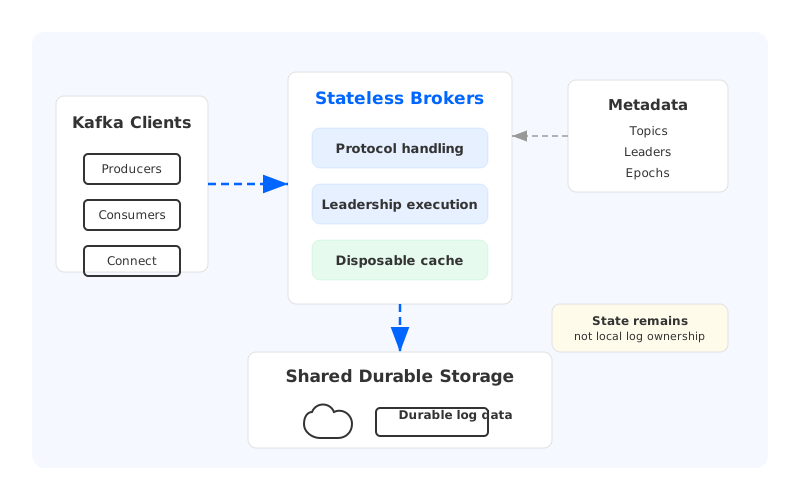
The term usually points to a narrower architectural change. In a stateless Kafka broker design, brokers do not rely on their own local persistent logs as the long-term owner of partition data. The broker still serves Kafka clients, sequences writes, manages runtime responsibility, maintains caches, and participates in the control plane. The difference is that durable log ownership moves away from broker-local disks and into a shared storage layer.
That distinction matters because "stateless" can otherwise sound like a marketing shortcut. A broker can be stateless with respect to durable data while still holding temporary runtime state. A Kafka cluster can use shared storage while still enforcing ordering, leader fencing, metadata consistency, and offset semantics. The architecture is not trying to make Kafka state disappear; it is trying to stop binding long-lived data ownership to a replaceable broker instance.
1Stateless Kafka does not mean no Kafka state
Kafka's value comes from durable, ordered logs and the metadata that makes those logs usable at scale. A partition is an ordered sequence of records. Each record has an offset. Producers and consumers interact with brokers through the Kafka protocol, and the cluster uses metadata to route requests to the correct leaders. In KRaft-based Kafka, cluster metadata is managed by a quorum-based controller architecture rather than ZooKeeper.
None of that goes away in a stateless Kafka architecture. If a platform says it is Kafka-compatible, architects should expect the Kafka-facing contract to remain recognizable: client APIs, producer acknowledgments, consumer offsets, partition leadership, topic configuration, ACLs, and operational observability should still behave in ways Kafka teams can reason about.
The semantic caveat is worth spelling out:
In this article, "stateless Kafka" means broker-local persistent logs are no longer the long-term source of truth for partition data. It does not mean Kafka has no durable records, offsets, partitions, metadata, or coordination state.
This terminology is not universal. Some teams use "diskless Kafka" to mean brokers do not depend on attached disks for durable storage. Others use "Kafka storage compute separation" to emphasize that compute capacity and retained data capacity scale independently. Some vendors use "shared storage Kafka" to describe the durable layer, while "stateless broker" describes how broker replacement behaves operationally. The words overlap, so the useful question is not whether a product uses the phrase. The useful question is what state is local, what state is durable, and what happens when a broker disappears.
2What becomes stateless in the broker
Traditional Kafka brokers are stateful because partition replicas live in broker log directories. A broker is not only a process that handles client requests; it is also the local home of persistent log segments for the replicas assigned to it. If the broker or its storage is replaced, the cluster has to recover both serving capacity and the desired replica layout.
Stateless Kafka changes that responsibility boundary. The broker still performs Kafka-facing work, but durable log data is stored in a shared layer that can be accessed by the right broker under the right ownership rules. That creates a more cloud-native failure model: the broker process can be treated as replaceable compute, while the storage layer preserves the authoritative data.
The boundary is easier to evaluate if you separate three kinds of state:
| State type | Traditional broker-local Kafka | Stateless broker architecture |
|---|---|---|
| Durable log data | Stored in local broker log directories as partition replicas | Stored in shared durable storage, often object-storage-backed |
| Runtime state | Connections, buffers, page cache, leadership work, metrics | Still exists, but can be rebuilt, reassigned, or warmed again |
| Metadata and control state | Stored and managed by Kafka controllers | Still required; must coordinate ownership, fencing, and routing |
Persistent data is the center of the change. Cache state may be local, but cache misses should not imply data loss. Buffers may exist, but acknowledged writes must be protected by a durable write path. Metadata may remain in the Kafka control plane, but it has to align with the shared storage layer so stale brokers cannot keep writing after ownership changes.
3Traditional brokers bind compute and storage
In a conventional Kafka deployment, capacity modeling tends to couple CPU, memory, network, and local disk. Adding throughput often means adding brokers. Adding retention often means adding disk or brokers. Replacing failed brokers may trigger replica movement, and rebalancing partition placement can move large amounts of data.
This shared-nothing design is not wrong; it is one reason Kafka became a durable, high-throughput log system. Local disks are close to the broker, followers replicate from leaders, and in-sync replicas provide failover candidates. The problem appears when Kafka is expected to behave like elastic cloud infrastructure, where compute instances are replaceable, Kubernetes pods move, and cloud storage services scale separately from compute.
Broker-local data gravity shows up in familiar operational moments:
- Scaling out. Adding brokers may require partition reassignment before the new capacity is useful across the workload.
- Scaling in. Removing brokers safely often means moving data off them first.
- Recovery. A failed broker can be replaced quickly as compute, but restoring the desired local replica layout may require copying data.
- Cost model. Retention, replication, and over-provisioned broker disks are tied to compute fleet size.
- Maintenance. Upgrades and node replacement have to respect where persistent replicas live.
For a small and stable cluster, these trade-offs may be acceptable. For a platform team operating many clusters, bursty workloads, long retention, or frequent infrastructure churn, the coupling can become the main constraint.
4Why stateless brokers matter
Stateless brokers matter because they change the unit of recovery. In a broker-local architecture, losing a broker is both a compute failure and a local-storage placement event. Kafka can elect another in-sync replica, but the cluster may still need data movement to return to the intended redundancy and balance.
In a shared-storage architecture, the goal is different. If durable log data is already outside the failed broker, a replacement broker should be able to take over responsibility by using metadata, ownership fencing, and shared durable state. Local cache warmth may be lost. Temporary buffers may need recovery through the platform's write-ahead path. But the replacement should not need the failed broker's local disk as the authoritative source of partition history.
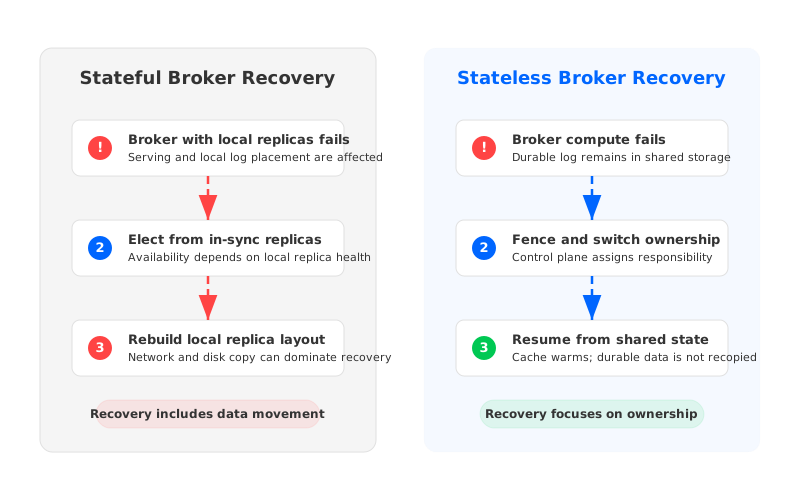
That shift affects several operational areas:
| Area | What changes when brokers are stateless |
|---|---|
| Scaling | Compute can be added or removed with less partition data movement |
| Failure recovery | Broker replacement focuses on ownership transfer and cache rebuild |
| Operations | Kubernetes-style scheduling becomes more realistic for Kafka brokers |
| Cost structure | Storage retention can be planned separately from broker fleet size |
| Maintenance | Broker upgrades and node replacement carry less local data gravity |
Stateless brokers move complexity from local disk replication into the shared storage design. The write path must be durable, the read path efficient, the cache observable, and the control plane capable of fencing stale writers. If those questions are not answered, the architecture has changed names without reducing risk.
5Write path, read path, and cache are the real test
A serious evaluation of stateless Kafka should start with the write path. When does a producer acknowledgment become safe? Is the record durable in object storage, a shared write-ahead log, replicated low-latency storage, or some combination? What happens if the leader broker fails after acknowledging a write but before background flush completes? Can a new broker recover the unflushed tail without depending on the failed broker's local disk?
The next question is fencing. Shared storage is dangerous if multiple brokers can write the same logical stream without a precise ownership protocol. Kafka has leader epochs and controller metadata for a reason: writes need ordering, and stale leaders must not append after leadership changes. A stateless broker platform has to make the storage layer obey the same correctness boundary.
The read path deserves equal scrutiny. Kafka workloads are not only sequential producers with hot consumers. They include consumer catch-up, replay, fan-out, compacted topics, small fetches, long retention, and uneven partition access. If every cold read turns into expensive or high-latency object storage access, the platform may be correct but operationally unpleasant.
Cache design is therefore part of the product's performance envelope:
- What data is cached locally: active log tail, indexes, object metadata, read-ahead buffers, or all of the above?
- How does the cache warm after broker replacement?
- Can operators observe cache hit rate, storage latency, throttling, and request amplification?
- What happens when consumers replay old data outside the hot cache?
- Are cache contents disposable, or are any of them required for correctness?
The last point is the dividing line. Disposable cache is compatible with stateless brokers. Hidden durable state in local cache is not.
6How AutoMQ fits this architecture
AutoMQ is a Kafka-compatible streaming platform built around stateless brokers and object-storage-backed shared storage. Its architecture keeps the Kafka protocol-facing broker layer while replacing broker-local persistent log storage with S3Stream, a storage engine designed to use S3-compatible object storage as the durable foundation.
That positioning is important because a stateless Kafka platform should not ask application teams to rewrite around a new storage API. Producers, consumers, Kafka Connect, Kafka Streams, and operational tooling need a Kafka-compatible surface. The architecture change sits beneath that surface: brokers continue to handle Kafka protocol traffic, while durable stream data is no longer permanently owned by one broker's attached disk.
AutoMQ also illustrates why "object storage" alone is not a complete answer. Object storage is durable and scalable, but Kafka writes are ordered, latency-sensitive, and failure-sensitive. A Kafka-compatible shared-storage system needs a write-ahead path, object layout, metadata coordination, read caching, and failover logic that preserve Kafka behavior. In AutoMQ's case, S3Stream is the layer that maps streaming log requirements onto object storage, while KRaft-compatible metadata keeps broker and partition ownership coordinated.
The practical claim is not that every workload should use stateless Kafka. The claim is that when broker-local data gravity is the limiting factor, stateless brokers can make Kafka feel more like cloud infrastructure: compute scales with traffic, storage scales with retention, and recovery depends less on rebuilding data from a failed server.
7Evaluation checklist for stateless Kafka
Teams evaluating Kafka shared storage, diskless Kafka, or stateless Kafka brokers should avoid starting with broad labels. Start with failure drills and concrete paths through the system. A platform that looks elegant in an architecture diagram still has to preserve the Kafka contract under broker loss, storage slowdown, consumer replay, and rolling upgrades.
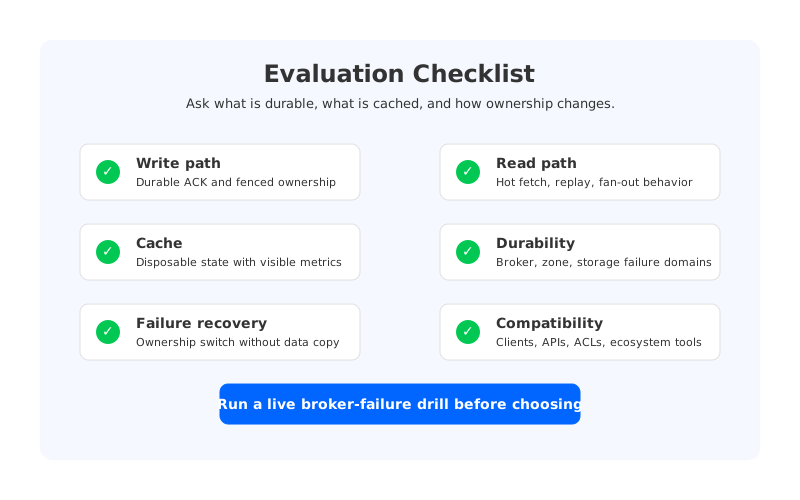
Use these questions in architecture review:
| Evaluation area | Questions to ask |
|---|---|
| Write path | Where is an acknowledged record durably protected? How is the unflushed tail recovered after broker failure? |
| Read path | Are hot reads served from broker cache? How are cold reads, replay, and fan-out handled? |
| Cache | Is cache disposable runtime state, or does correctness depend on local files? What metrics expose cache behavior? |
| Durability | Which failure domains are covered: broker, disk, zone, storage service, controller quorum? |
| Recovery | Does broker replacement require partition data copying, WAL replay, metadata reassignment, or all three? |
| Compatibility | Which Kafka clients, APIs, topic features, transactions, ACLs, quotas, and ecosystem tools are supported? |
| Operations | How are scaling, rolling upgrades, storage throttling, and observability handled in production? |
The highest-signal test is a controlled broker failure while traffic is running. Watch producer acknowledgments, consumer lag, leader changes, cache behavior, and storage metrics. Then repeat the test with replay-heavy consumers and with storage latency injected if your environment allows it. Stateless Kafka is most convincing when the recovery path is boring.
8When stateless Kafka is a good fit
Stateless Kafka is most attractive when Kafka is constrained by broker-local storage rather than by the Kafka protocol itself. Long retention, uneven traffic, elastic workloads, multi-cluster platform operations, Kubernetes scheduling, and frequent broker replacement all make the separation of storage and compute more valuable.
It is also a natural fit when teams want Kafka compatibility but prefer cloud storage economics and operational models. If the durable log can live in object storage or another shared durable layer, storage capacity can grow without forcing the broker fleet to grow in the same shape. That can reduce over-provisioning pressure, especially when retained data is large but active compute demand is variable.
The fit is weaker when a small cluster is stable, local disks are inexpensive in context, recovery procedures are already acceptable, and the team does not need elastic operations. In that environment, traditional Kafka may be easier to reason about. The decision should be based on the bottleneck you actually have, not on the appeal of the word "stateless."
9References
- Apache Kafka Documentation
- Apache Kafka KRaft Documentation
- Apache Kafka Protocol Guide
- AutoMQ Documentation: Compatibility with Apache Kafka
10FAQ
10.1Is stateless Kafka the same as Kafka without partitions or offsets?
No. Stateless Kafka still has Kafka-visible state such as partitions, offsets, leaders, consumer group progress, topic configuration, and metadata. The term refers to removing long-term durable log ownership from broker-local disks, not removing Kafka semantics.
10.2Is diskless Kafka the same thing as stateless Kafka?
They are closely related but not always identical. Diskless Kafka emphasizes that brokers do not rely on attached local disks for durable log storage. Stateless Kafka emphasizes the operational result: brokers can be replaced without treating their local disks as the authoritative data source.
10.3Does shared storage make Kafka slower?
Not automatically, but it changes the performance problem. The platform must design a durable write path, efficient read caching, object layout, and recovery logic. Evaluate measured behavior for your workload rather than assuming either local disk or shared storage is always faster.
10.4What should I test before choosing a stateless Kafka platform?
Test producer acknowledgments during broker failure, consumer lag during failover, cold replay performance, cache warm-up, storage throttling behavior, client compatibility, and operational workflows such as scaling and rolling upgrades. The architecture should be clear about what is durable, what is cached, and how ownership changes.


