
Table of Contents
Table of Contents
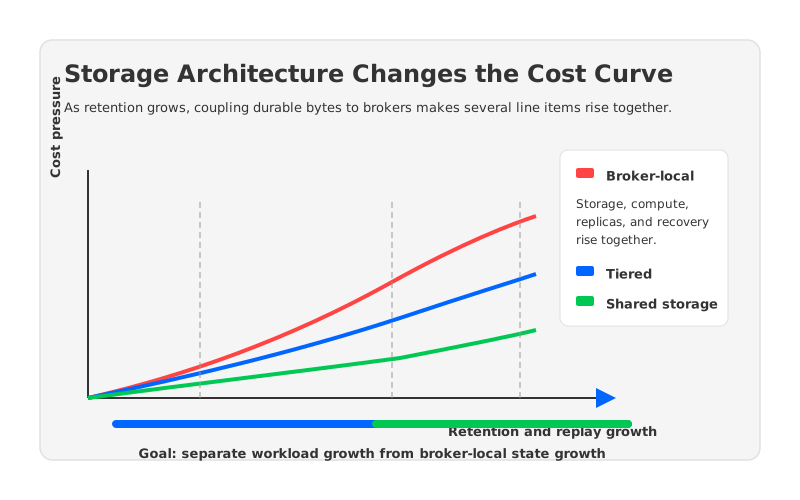
Kafka cost reviews often begin with a bill, but the bill is a late symptom. By the time FinOps notices broker spend, storage growth, or data transfer, the expensive decisions have already been encoded into the platform: where durable bytes live, how many times they move, how tightly compute is tied to storage, and how much spare capacity the team keeps because recovery is slow. A monthly invoice can show the pressure, but it cannot explain the architecture.
That is why the useful Kafka cost question is not "Which service has the lowest unit price?" The better question is: "Which storage architecture makes the workload's cost curve steeper than it needs to be?" A cluster with modest ingress can become expensive when every retained byte sits on broker-attached storage. A high-throughput cluster can remain predictable when storage, compute, and network paths are separated with discipline. The difference is not a discount. It is the shape of the system.
1Why kafka cost Is Really an Architecture Search
Teams search for kafka cost when the first-order answer has stopped helping. They already know broker instances cost money. They know retained data costs money. They know managed services include service charges and support boundaries. What they need is a way to connect those line items back to design choices that can be changed without breaking Kafka semantics.
The hard part is that Kafka cost is not one meter. It is a portfolio of meters triggered by the same byte at different points in its life. A record may enter through a producer, be acknowledged by a leader, replicated to followers, stored on local volumes, retained for replay, fetched by several consumer groups, copied into another region, and moved again during partition reassignment. A small change in storage architecture can alter several of those paths at once.
Three cost forces tend to dominate production reviews:
- Durable state placement: Local broker disks, remote tiers, and shared object storage create different ratios of hot storage, retained storage, and recovery movement.
- Data movement: Replication, consumer fan-out, cross-zone reads, backfills, and broker replacement can turn normal Kafka behavior into recurring cloud transfer.
- Operational headroom: Teams over-provision when scaling, reassignment, failover, or upgrades are risky enough that running lean feels irresponsible.
These forces explain why cost conversations that start with price sheets often stall. Unit prices matter, but Kafka's cost curve is controlled by how often the architecture asks cloud infrastructure to do paid work on behalf of every record.
2The Baseline: Broker-Local Storage Makes Cost Follow the Broker
Traditional Kafka was built around a replicated local log. Each broker owns partition replicas on its local storage, and availability comes from maintaining multiple replicas across the cluster. This model is understandable, proven, and operationally familiar. It also means that storage capacity, broker count, network movement, and failure recovery are tied together more tightly than many cloud teams expect.
When brokers own durable state, adding storage often means adding or resizing brokers. Reducing broker count requires careful reassignment. Replacing a failed broker may involve moving large amounts of partition data. Increasing retention expands the state that the broker fleet must carry or offload. Even when the cluster is healthy, platform owners pay for the ability to survive the next broker failure, rebalance, or traffic spike.
The cost pattern looks like this:
| Broker-Local Design Property | Cost Effect to Inspect |
|---|---|
| Replicas live on broker storage | Attached storage grows with retention and replication factor |
| Brokers hold durable state | Scale-in, broker replacement, and reassignment can move large data volumes |
| Leaders and followers span zones | Replication and client placement can create transfer across availability boundaries |
| Compute and storage scale together | A storage-heavy workload may require broker capacity that compute does not need |
None of this makes broker-local Kafka wrong. It explains why the cost curve can become steep as retention, replication, and operational safety margins grow together. If the workload is low-retention, latency-sensitive, and operationally stable, the tradeoff may be acceptable. If the workload carries long retention, replay-heavy consumers, or large peaks, the same design can force the platform to buy capacity for reasons unrelated to steady-state processing.
3Tiered Storage Changes Retention Economics, Not Every Cost Path
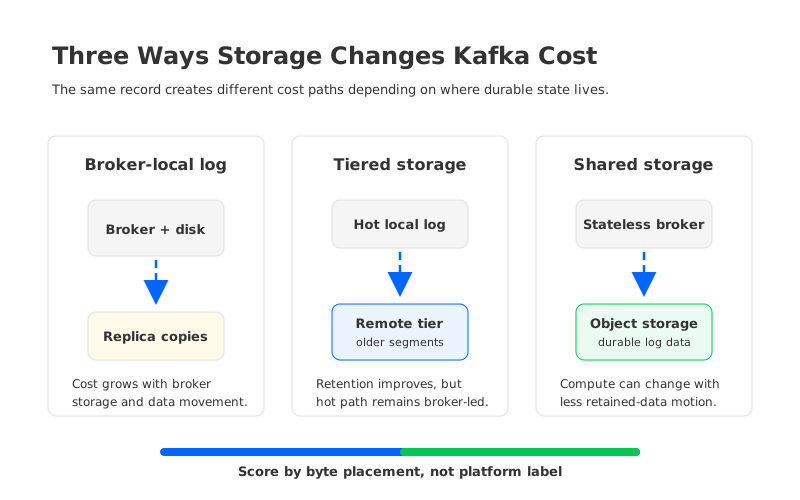
Apache Kafka tiered storage addresses a real pressure point: long retention on broker disks. By moving older log segments into a remote storage tier, teams can reduce the amount of historical data that must remain on local broker volumes. For workloads where retained history is large and hot working sets are modest, that is a meaningful architectural lever.
Tiered storage should still be evaluated as a partial change to the byte path, not a universal cost reset. The active log remains tied to brokers. Fetch behavior changes depending on whether consumers read hot local data or older remote segments. Remote storage introduces request patterns, read paths, and operational policies that need monitoring. Rebalancing and broker recovery can improve because less historical data has to move through broker-local disks, but the system still retains a broker-centered execution model.
That distinction matters during procurement and design review. A platform owner should ask where each category of bytes lives after tiering:
- Active producer writes and recent consumer reads still need a hot path that meets latency and durability requirements.
- Older retained segments move to remote storage, which changes storage cost but also changes how replays and backfills behave.
- Metadata, compaction, quotas, security, client compatibility, and operational workflows remain part of the Kafka platform contract.
- Network placement remains important because consumers and storage services may sit across availability-zone, VPC, or regional boundaries.
Tiered storage is strongest when the cost problem is "we keep too much historical data on broker disks." It is less complete when the cost problem is "broker-local state makes scaling, replacement, and cross-zone movement expensive." The first problem is about retention. The second is about architecture coupling.
4Shared Storage Changes the Slope of the Curve
Shared-storage Kafka-compatible systems make a deeper change: durable topic data is placed in shared storage, often object storage, while brokers become more focused on protocol handling, cache, coordination, and compute. That separation changes the cost curve because retained bytes no longer have to be owned by a specific broker's local disk. Broker replacement and scaling can depend less on copying durable log replicas between machines.
The appeal is clear, but the architecture must earn trust. Kafka is not a generic queue that can trade semantics for lower infrastructure cost. Production teams depend on ordering, acknowledgments, consumer groups, compaction, transactions where used, security controls, observability, and mature client behavior. A shared-storage design has to explain its write path, write-ahead log durability, cache behavior, object storage request pattern, failure isolation, and recovery model before the cost story is credible.
Use this test: if an architecture claims lower Kafka cost, ask which expensive actions disappear and which actions move elsewhere.
| Question | Why It Matters |
|---|---|
| What happens to durable bytes when a broker is replaced? | Determines whether recovery requires large replica movement |
| How does the write path reach durable storage? | Determines acknowledgment safety, latency profile, and WAL cost |
| How are hot reads served? | Determines cache size, object storage reads, and consumer tail latency |
| What traffic crosses zones? | Determines whether replication, reads, or storage paths create transfer charges |
| Can compute scale without moving retained data? | Determines whether peak handling requires storage reshuffling |
Shared storage does not remove cost. It changes where cost is incurred and which costs scale with workload growth. Object storage, WAL resources, caches, requests, and network paths must be modeled honestly. The advantage appears when the architecture avoids paying broker-local prices for retained data and avoids moving durable state whenever compute capacity changes.
5Network Boundaries Decide Whether Storage Savings Survive
Storage architecture and network cost cannot be separated in cloud Kafka. AWS pricing materials make a practical point that applies broadly: data transfer depends on where traffic crosses service, zone, VPC, and regional boundaries. Kafka diagrams usually emphasize producers, brokers, topics, and consumers; invoices emphasize where bytes crossed a billable line.
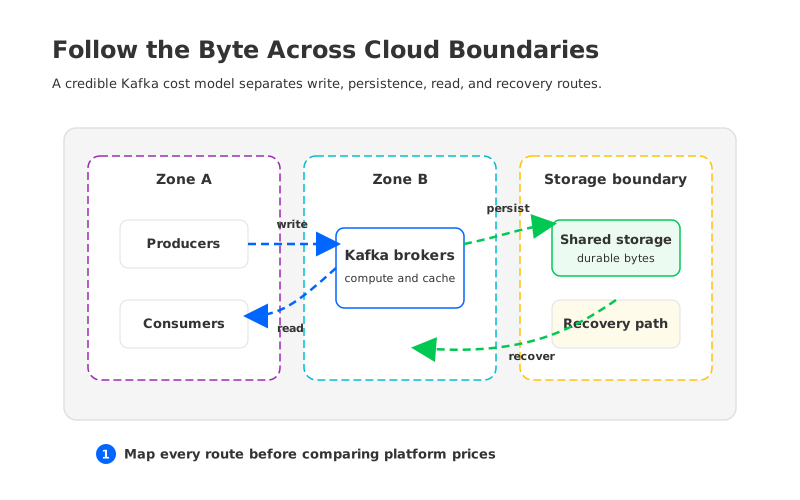
This is why a storage migration can fail financially even when broker disk spend falls. If consumers frequently read across zones, if stream processors sit far from broker leaders, if disaster recovery copies traffic continuously across regions, or if remote storage access crosses a costly path, the savings can leak into network charges. The right model follows bytes through physical and cloud boundaries, not through logical Kafka components alone.
For each high-cost workload, map four routes:
- Write route: producer location, broker leader placement, acknowledgment path, and durability target.
- Replication or persistence route: follower placement, remote tier, shared storage, or WAL path.
- Read route: consumer group placement, fan-out count, replay frequency, and cache hit assumptions.
- Recovery route: broker replacement, partition movement, region failover, and backfill behavior.
The route map should be built before vendor comparison. It prevents a common mistake: treating cross-zone transfer as an external tax rather than an architecture outcome. If an option reduces broker storage but increases cross-boundary reads, the total cost model should show that. If an option keeps traffic local while placing durable data in shared storage, the model should show that as well.
6A Practical Cost-Curve Scorecard
The fastest way to make Kafka cost review useful is to score architecture choices by the cost curve they create, not by the first monthly estimate. A first estimate answers "What would this cost?" A cost-curve scorecard answers "What happens when retention doubles, fan-out grows, brokers fail, or a team needs more compute for a peak?"
Use a scorecard with five dimensions:
| Dimension | What to Score | Healthy Signal |
|---|---|---|
| Storage elasticity | Whether retained bytes can grow without proportional broker growth | Retention growth does not force compute growth |
| Compute elasticity | Whether brokers can scale for throughput without moving retained data | Scale-out and scale-in avoid large data reshuffling |
| Network locality | Whether common reads, writes, and persistence paths avoid unnecessary boundary crossings | Normal traffic stays near producers, consumers, and storage |
| Semantic compatibility | Whether client behavior and Kafka features survive the architecture change | Existing applications require minimal change |
| Recovery cost | Whether failures and upgrades trigger large data movement or long over-provisioning windows | Recovery is bounded and operationally predictable |
This scorecard also improves internal alignment. SREs can evaluate recovery and observability. FinOps can evaluate storage and transfer. Application owners can validate client compatibility. Procurement can compare offers without reducing the decision to a discount table. The scorecard does not hide tradeoffs; it makes them explicit enough to test.
7Where AutoMQ Fits the Evaluation
After the scorecard exposes which cost drivers come from architecture coupling, AutoMQ fits into one category worth evaluating: a Kafka-compatible, cloud-native streaming system that separates compute from storage and uses object storage as the durable foundation through its S3Stream shared storage architecture. That positioning is relevant when the team wants to keep Kafka APIs and ecosystem behavior while changing how durable state, broker scaling, and cloud network paths are handled.
AutoMQ documentation describes stateless brokers, object-storage-backed persistence, WAL and cache design, BYOC and software deployment options, and guidance for reducing cross-AZ traffic exposure. The product should be evaluated with the same scorecard as any other platform option. A useful proof of concept should include representative producers and consumers, the client features the estate depends on, a retention-heavy workload, a fan-out workload, broker replacement tests, and traffic placement checks.
That keeps the evaluation grounded. AutoMQ is not a generic answer to every Kafka invoice. It is worth testing when the current platform's cost curve is driven by broker-local state, retention growth, slow recovery, or paid network movement, and when application teams still need Kafka-compatible behavior.
8Turning the Review Into an Engineering Decision
A defensible Kafka cost decision ends with an architecture choice and an evidence packet. The packet should include workload inputs, current byte routes, estimated cost drivers, compatibility tests, recovery tests, and operational ownership. It should also state what the team will not optimize yet. Trying to optimize every topic at once usually produces an average model that is precise in a spreadsheet and weak in production.
Start with one workload class where the storage architecture clearly affects the curve. Long-retention event history, replay-heavy analytics, high fan-out telemetry, and clusters kept oversized because reassignment is painful are good candidates. Build the model around that workload's writes, reads, retention, and recovery behavior. Then compare broker-local Kafka, managed Kafka, tiered storage, and shared-storage Kafka-compatible options using the same assumptions.
Kafka cost becomes manageable when every line item has an engineering cause. Broker-local storage, tiered storage, and shared storage can all be valid choices, but they create different curves as data grows and operations change. If your current review shows that broker-local state and cross-boundary traffic are shaping the bill more than the workload itself, examine AutoMQ's architecture overview as a next step: AutoMQ architecture overview.
9References
- Apache Kafka Documentation
- Apache Kafka KIP-405: Kafka Tiered Storage
- Amazon EC2 On-Demand Pricing: Data Transfer
- Amazon MSK Pricing
- Amazon S3 Pricing
- AWS Architecture Blog: Overview of Data Transfer Costs for Common Architectures
- AutoMQ Documentation: Architecture Overview
- AutoMQ Documentation: S3Stream Shared Streaming Storage
10FAQ
10.1What usually changes Kafka cost curves the most?
The strongest levers are durable state placement, data movement, and operational headroom. Broker size matters, but the larger curve often comes from how much retained data stays tied to brokers, how often bytes cross cloud boundaries, and how much spare capacity the team keeps because recovery or scaling is risky.
10.2Does Kafka tiered storage replace the need for shared storage?
No. Tiered storage and shared storage solve different parts of the problem. Tiered storage helps move older log segments away from broker disks. Shared-storage designs change the relationship between brokers and durable topic data more deeply, which can affect scaling, recovery, and retained-data economics. Both require workload-specific validation.
10.3Is network transfer a Kafka architecture problem or a cloud billing problem?
It is both. Cloud providers define the billing boundaries, but Kafka architecture and deployment placement decide how often bytes cross them. Producer placement, consumer fan-out, replication, remote storage access, and recovery workflows all influence transfer cost.
10.4When should AutoMQ be evaluated?
Evaluate AutoMQ when Kafka-compatible behavior remains important, but the current cost curve is driven by broker-local storage, long retention, scaling friction, or cross-AZ traffic exposure. The evaluation should use real workloads and verify client compatibility, write-path durability, read behavior, recovery, and network placement.


