
Table of Contents
Table of Contents
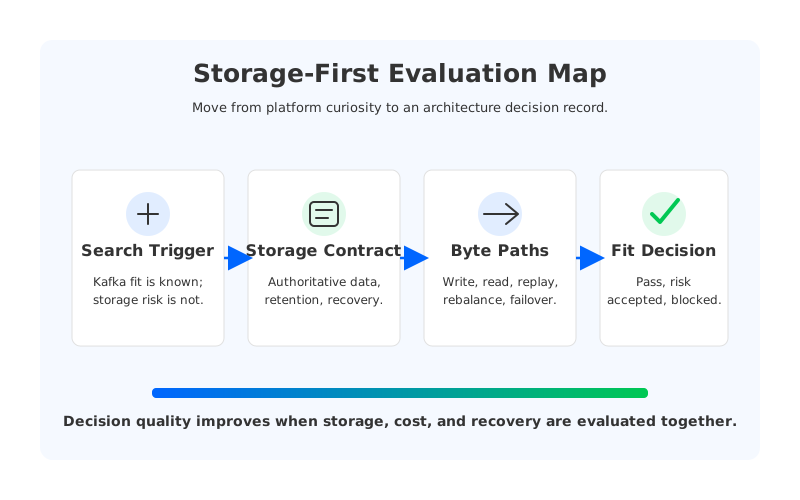
Teams do not search for redpanda alternatives because Redpanda is unserious. They search because Redpanda is serious enough to make the next round of questions sharper. Once a Kafka-compatible platform proves that applications can produce and consume records, the harder review starts: where does durable data live, how does recovery work, what cloud bill grows with traffic, and how much Kafka behavior must the team retest before production cutover?
That shift matters because event streaming platforms are not interchangeable queues. A broker architecture that looks elegant in a benchmark can behave very differently under long retention, bursty catch-up reads, cross-zone traffic, regulated data residency, or an emergency scale-out. The right alternative is not the product with the loudest comparison page. It is the system whose storage model matches the workload contract your business actually needs to keep.
1Why storage architecture belongs in Redpanda alternative research
Redpanda is often evaluated by teams that already know the Kafka API and want a different implementation trade-off. That is a reasonable starting point. Kafka compatibility reduces application rewrite risk, and a non-JVM broker model can simplify some operational concerns. But the storage layer is where many long-term platform decisions become visible: replication, retention, recovery, network paths, elasticity, and the split between managed service responsibility and customer-side control.
The first mistake is treating "Kafka-compatible" as a complete answer. Compatibility should be tested across producer acknowledgments, consumer group behavior, offset management, transactions if used, ACLs, quotas, observability, and client versions. Yet compatibility only tells you whether applications can talk to the platform. It does not tell you whether the platform can absorb a regional traffic spike without moving terabytes of local logs, or whether an availability-zone failure creates a predictable recovery path.
A better evaluation starts with four questions:
- Where is the authoritative copy of a record after it is acknowledged?
- Which bytes move during normal replication, consumer reads, rebalancing, and failure recovery?
- Can compute scale independently from retained data?
- Who owns the control plane, the data plane, and the cloud account boundary?
Those questions separate product preference from architecture fit. They also keep the evaluation respectful. Redpanda, Confluent, Amazon MSK, Apache Kafka deployments, Aiven, WarpStream, and AutoMQ all make different choices. The platform team's job is not to declare one architecture universally superior. It is to decide which constraints are acceptable for the workloads in front of them.
2Start with the durability path, not the logo
Kafka's original durability model was built around broker-local logs and replication between brokers. That design is battle-tested and still excellent for many environments. In the cloud, however, local-disk replication interacts with availability zones, instance lifecycle, attached storage, and data transfer pricing. A three-AZ deployment is not only a high-availability topology; it is also a set of byte paths that can show up as storage and network cost.
Tiered storage changes part of that equation by moving older log segments to remote storage while keeping the hot path on brokers. Apache Kafka documents tiered storage as a way to offload older data and expand retention without relying entirely on broker disks. That is useful, but it is not the same as a diskless or shared-storage architecture. The decisive question is whether object storage is an archive behind local logs or the primary durability layer behind stateless brokers.
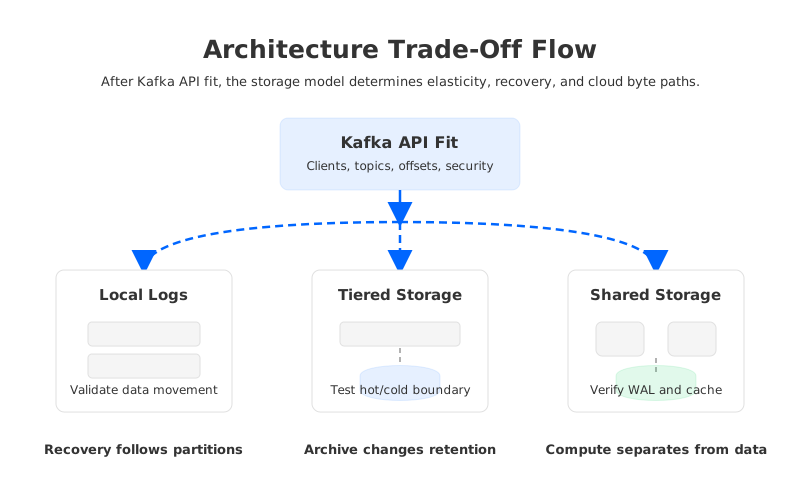
The difference shows up during failure and scaling events. In a local-log architecture, adding brokers or replacing failed brokers often involves data movement, reassignment, or catch-up work tied to partitions. In a shared-storage architecture, the broker can become closer to a compute role: it serves traffic, writes through a durability path, and recovers by reconnecting to shared data rather than rebuilding a large local copy. That does not remove engineering trade-offs. It moves them into the write-ahead log, cache, object storage layout, metadata management, and read amplification controls.
Platform buyers should make that distinction explicit in the evaluation record:
| Criterion | Local-log Kafka family | Tiered storage | Shared-storage Kafka-compatible systems |
|---|---|---|---|
| Primary durable copy | Broker-local replicas | Broker-local hot data plus remote older segments | Shared storage with broker-side WAL/cache design |
| Elastic scaling question | How much data must move with partitions? | How much hot data remains tied to brokers? | Can compute change without moving retained logs? |
| Cost model to inspect | Instances, disks, replication traffic, operations | Instances, disks, remote storage, fetch behavior | Compute, object storage, WAL, cache, network locality |
| Main validation risk | Reassignment and recovery time | Hot/cold boundary behavior | WAL latency, cache hit ratio, metadata correctness |
This table is not a product leaderboard. It is a reminder that alternatives are architecture families first and vendor names second. A low-latency trading workload, a CDC pipeline with seven-day retention, and a multi-tenant analytics stream should not be forced through the same scoring sheet.
3Map the byte paths before comparing costs
Cost comparison gets unreliable when it only lists license or broker prices. Streaming systems generate cost through bytes in motion. Producers write records, brokers replicate or persist them, consumers read them, compaction rewrites data, catch-up consumers scan historical ranges, and recovery flows rebuild state after failure. Each path can touch compute, storage, and network billing differently.
AWS documentation and pricing pages are useful here because they force teams to separate service charges from transfer and storage dimensions. Amazon MSK pricing includes broker or capacity charges, storage-related charges, and other service-specific dimensions depending on the cluster type. AWS also documents best practices around client and broker placement because network topology affects performance and cost. The exact bill depends on region, instance type, traffic shape, and architecture, so a trustworthy evaluation should model the paths rather than borrow someone else's percentage claim.
For a Redpanda alternative shortlist, draw the byte map in plain language:
- Producer path: Does an acknowledged write require local disk, cross-zone replication, object storage, a WAL service, or some combination?
- Consumer path: Do consumers fetch from leaders, followers, local-zone replicas, cache, or object storage-backed data?
- Retention path: Are old segments still coupled to broker capacity, moved to object storage, or written there as the primary data plane?
- Rebalance path: When partitions move, does data move with them, or does ownership change while data remains in shared storage?
- Failure path: After a broker loss, does the system rebuild local logs, replay from shared storage, or use a hybrid path?
The act of drawing this map often changes the conversation. A platform that looks cost-effective at steady state may become expensive under catch-up reads. A system with excellent local latency may require careful capacity planning for long retention. A managed service may reduce staffing cost while limiting data-plane control. None of these trade-offs are disqualifying by themselves. They become disqualifying when the team discovers them after the migration.
4Migration risk is a storage question too
Most migration plans start at the API boundary: clients, bootstrap servers, authentication, topic configs, and offset continuity. That is necessary, but storage architecture affects migration safety in ways that application teams can feel. If a target platform handles retention differently, compaction differently, or catch-up reads differently, the migration can pass a small functional test and still surprise consumers during a replay, failover, or peak traffic window.
The safest evaluation creates a workload contract before product scoring begins. A workload contract should state the real requirements that the platform must preserve:
| Workload contract item | What to verify before migration |
|---|---|
| Client behavior | Producer acks, retries, idempotence, transactions if used, consumer commits, offset reset policies |
| Topic semantics | Partition count, replication or durability policy, retention, compaction, ordering expectations |
| Read profile | Tail reads, fan-out, catch-up scans, replay windows, consumer lag recovery |
| Failure behavior | Broker loss, zone impairment, throttling, restart time, rebalance impact |
| Operations | Metrics, alerts, ACLs, audit needs, Terraform or API automation, upgrade process |
This contract prevents two common evaluation errors. The first is over-indexing on a synthetic throughput benchmark that does not resemble the production read pattern. The second is assuming that "Kafka API compatible" means every operational behavior is identical. Compatibility is a starting line; production equivalence is proven through tests that exercise the workload's inconvenient edges.
Storage architecture also changes rollback planning. If the migration uses mirroring, dual writes, or staged consumer movement, the team must know which system is authoritative at each phase. A storage-backed recovery story is only useful when the operational runbook names the source of truth, the acceptable lag, and the point at which rollback stops being safe.
5A production scorecard for the shortlist
By the time a platform reaches procurement or architecture review, the discussion needs a compact scorecard. The scorecard should not be a vendor popularity table. It should preserve the constraints that matter once the system is carrying real traffic.
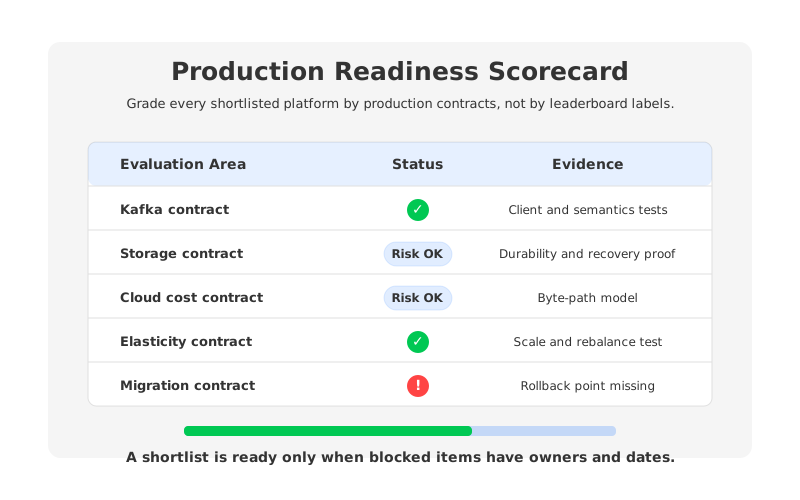
Use a simple grading method: pass, risk accepted, or blocked. "Risk accepted" is important because no streaming platform removes every trade-off. A team may accept a managed control plane to reduce staffing load. Another team may accept more operational ownership to keep the data plane in its own cloud account. A third may accept a shared-storage architecture because the current model cannot scale retention economically.
The core categories are stable across vendors:
- Kafka contract: client compatibility, semantics, ecosystem tooling, security, and governance.
- Storage contract: primary durability location, retention design, compaction behavior, object storage use, and recovery path.
- Cloud cost contract: compute, storage, cross-zone traffic, request costs, data transfer, and operational labor.
- Elasticity contract: scale-out time, scale-in safety, partition movement, cache warm-up, and workload isolation.
- Migration contract: mirroring approach, offset continuity, rollback point, and cutover monitoring.
This is where respectful competitor evaluation becomes easier. Confluent may be attractive when a team wants a broad managed Kafka ecosystem and enterprise governance. Amazon MSK may fit organizations standardizing on AWS-native managed services. Redpanda may appeal to teams that like its Kafka-compatible implementation and operational model. The storage-focused question is whether each option's durability, elasticity, and byte paths match the workload rather than whether a comparison page names it first.
6How AutoMQ fits the storage-architecture evaluation
After the evaluation reaches the storage layer, AutoMQ belongs in the conversation as a Kafka-compatible streaming platform built around shared storage. AutoMQ keeps Kafka protocol compatibility as the application-facing contract, while its S3Stream architecture uses object storage as the storage foundation with a WAL and cache design for low-latency writes and reads. The practical implication is that brokers are designed to be stateless compute nodes instead of long-lived owners of large local logs.
That architecture targets a specific class of Redpanda alternative research: teams that want Kafka compatibility but are constrained by local-disk scaling, long-retention cost, partition reassignment overhead, or cross-zone traffic patterns. AutoMQ documentation describes shared storage, stateless brokers, seconds-level scaling, Kafka compatibility, migration guides, and inter-zone traffic optimization. Those claims should still be validated with the same workload contract used for every other platform. The benefit of a framework is that AutoMQ does not get a special scoring sheet.
AutoMQ is especially relevant when the evaluation includes these requirements:
- Independent compute and storage scaling, where retained data should not force broker capacity decisions.
- Object-storage-backed durability, where cloud storage is part of the primary design rather than a distant archive.
- Kafka API compatibility, where application rewrites are unacceptable and existing clients need a familiar contract.
- BYOC or private deployment needs, where the data plane must remain inside the customer's cloud or infrastructure boundary.
- Cross-zone traffic scrutiny, where the platform team wants locality-aware paths instead of treating network transfer as background noise.
There are also cases where another option may fit better. If a team needs a fully managed ecosystem tightly coupled to a vendor's broader data platform, that may outweigh storage-model concerns. If a workload is small, short-retention, and already stable on a managed Kafka service, a migration may not repay its risk. The point of adding AutoMQ to the shortlist is not to replace evaluation with a product claim. It is to test whether shared-storage Kafka compatibility solves the constraint that triggered the search.
The search that began with redpanda alternatives should end with a storage architecture decision record. Name the authoritative data path, the recovery model, the network cost assumptions, and the migration rollback point. If shared-storage Kafka compatibility is part of that decision, review the AutoMQ architecture documentation or contact AutoMQ with your workload contract and cloud boundary requirements.
7References
- Apache Kafka documentation: Tiered storage
- Apache Kafka KIP: KIP-1150: Diskless Topics
- AWS documentation: Best practices for Amazon MSK Express brokers
- AWS pricing: Amazon MSK pricing
- AWS documentation: Amazon S3 User Guide
- AutoMQ documentation: S3Stream shared storage overview
- AutoMQ documentation: Compatibility with Apache Kafka
- AutoMQ documentation: Eliminate inter-zone traffic overview
- AutoMQ documentation: Migration overview
8FAQ
8.1Are Redpanda alternatives mainly about performance?
Performance is only one dimension. Teams should also evaluate Kafka semantics, storage durability, recovery behavior, network cost, governance, deployment boundary, and migration risk. A platform that wins a narrow benchmark can still be the wrong fit if its storage model conflicts with retention or recovery requirements.
8.2Is tiered storage the same as diskless Kafka?
No. Tiered storage usually keeps the hot path on brokers and offloads older log segments to remote storage. Diskless or shared-storage designs make remote or object storage central to the durability model and aim to reduce the amount of retained log data tied to individual brokers.
8.3Should every Kafka team consider AutoMQ as a Redpanda alternative?
Not every team needs a migration. AutoMQ is most relevant when the current evaluation is blocked by local-disk scaling, long retention cost, cross-zone traffic, slow partition movement, or the need to keep a Kafka-compatible data plane inside the customer's cloud boundary.
8.4What should be tested before choosing a Kafka-compatible platform?
Test the actual workload contract: producer acknowledgments, consumer group behavior, offset handling, transactions if used, ACLs, retention, compaction, failover, catch-up reads, observability, and cutover rollback. Compatibility should be proven through production-like behavior, not only through a client smoke test.


