
Table of Contents
Table of Contents
When a platform team searches for Kafka on S3, the words look simple, but the intent is rarely simple. One team may want to land Kafka records in S3 for analytics. Another wants to reduce broker disk pressure with tiered storage. A third is asking a deeper question: can object storage become the durable foundation of a Kafka-compatible platform, while brokers become closer to elastic compute?
Those are not small variations of the same architecture. They change who owns the primary log, which component acknowledges writes, how consumers replay old data, where cloud network charges appear, and how much data must move during recovery. The bucket is the least interesting part of the decision.
1Why Teams Search for Kafka on S3
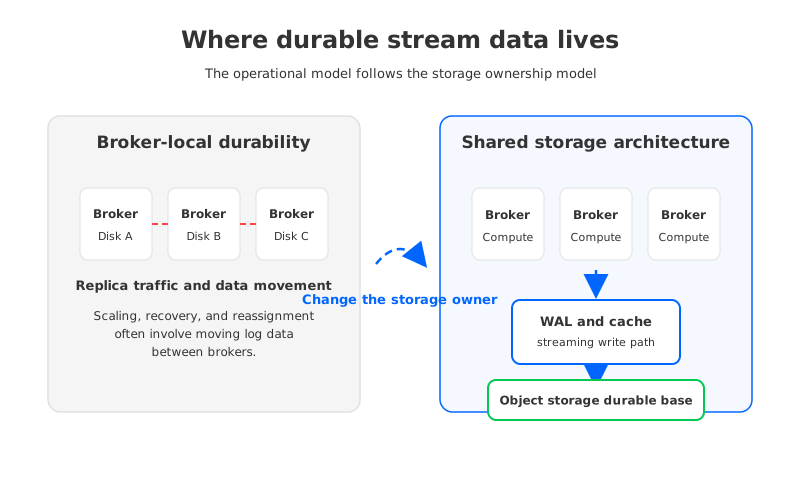
Kafka operators usually arrive at this question after a cloud bill, a retention request, or a migration review exposes the same constraint: broker-attached storage grows into an operational boundary. Kafka's traditional model binds durable topic-partition data to broker-local disks. That model is proven and still works well in many environments, but it also couples compute, storage capacity, replica traffic, and recovery work in ways that cloud teams eventually have to price.
The first pain is retention. Keeping more history in Kafka often means sizing broker disks for data that is rarely read, and then replicating that storage according to the cluster's durability policy. The second pain is elasticity. Adding broker capacity does not automatically make old data less attached to the brokers that already own it; reassignment still has to move log data. The third pain is cloud networking. In multi-Availability Zone deployments, replication and consumer placement can create data transfer patterns that are easy to underestimate during design.
Object storage looks attractive because it changes the economic shape of retained data. Services such as Amazon S3 provide elastic capacity, regional durability, lifecycle controls, and broad ecosystem integration. But putting Kafka data near S3 is not the same as making S3 the storage layer of Kafka.
2The Three Storage Paths Hidden in One Phrase
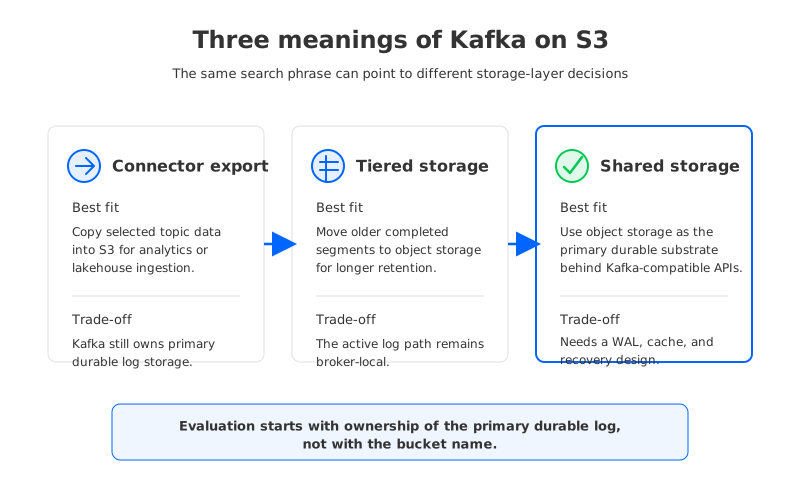
The cleanest way to evaluate a Kafka on S3 option is to ask where the primary durable log lives. If the log still lives on brokers, S3 is an export target or a secondary tier. If the log lives behind a shared storage layer, S3 becomes part of the core streaming architecture, and the system needs a write path, cache model, metadata model, and recovery model designed for that role.
| Architecture path | What S3 does | What still needs scrutiny |
|---|---|---|
| Connector export | Receives selected records from Kafka topics for analytics, lakehouse ingestion, backup-style pipelines, or downstream processing. | Kafka still owns the primary log; connector lag, exactly-once behavior, schema evolution, retries, and replay boundaries matter. |
| Tiered storage | Stores older log segments after they roll from the active broker-local log. | The active write path and active data still depend on broker storage; fetch behavior for remote segments must be tested. |
| Shared storage engine | Acts as the durable base behind Kafka-compatible brokers, usually with a WAL and cache layer in front of object storage. | The design must prove write durability, compatibility, latency, recovery, metadata scale, and operational visibility. |
Connector export is often the right answer when the goal is to make Kafka data available to S3-native analytics systems. It keeps the Kafka cluster's architecture intact and adds a sink pipeline, but it does not reduce the cost or complexity of the Kafka cluster's own storage model.
Tiered storage goes one level deeper. Apache Kafka's tiered storage work, represented by KIP-405, moves older log segments to remote storage while brokers keep responsibility for the local active log. This can reduce local disk pressure for long retention workloads. It does not automatically make brokers stateless for durable data ownership, because the active log path still matters for writes, leadership, and recovery.
Shared storage is the more architectural path. In this model, Kafka-compatible brokers still speak Kafka APIs and handle protocol work, partition leadership, caching, and request routing. Durable stream data is externalized into a shared storage layer, commonly built on object storage with a WAL for low-latency durable writes. This is closer to the direction discussed in diskless Kafka proposals such as KIP-1150, where the community is examining how Kafka topics could rely less on broker-local disks.
3Cost Modeling Starts Below the API
Many Kafka on S3 discussions start with storage price per GB, but that is too narrow. A production cost model needs to follow the bytes through the system. The same 1 TB/day ingest rate can produce very different bills depending on replication factor, retention, consumer fan-out, cross-zone placement, object request patterns, and compaction behavior.
For a connector export pipeline, the cost model includes the existing Kafka cluster plus the connector runtime, S3 PUT requests, stored objects, and downstream reads. The Kafka cluster still pays for broker storage and replication. The connector can be cost-effective when it replaces custom export jobs or enables lakehouse workflows, but it should not be counted as a Kafka storage redesign.
For tiered storage, the model shifts older data out of broker disks, so retention-heavy topics may benefit. The hot set still sits on broker-local storage, and operators still need to model local disk headroom, remote fetch cost, object request volume, cache hit rate, and consumer replay patterns. A topic with rare historical replays behaves differently from a topic where many consumers repeatedly scan remote data.
For shared storage, the model changes the deepest assumption: the broker is no longer the permanent owner of durable log bytes. That can reduce the need for broker-to-broker data movement and can let compute scale more independently from retained storage. But the cost model must include the WAL medium, object storage requests, metadata operations, cache capacity, and any network path between clients, brokers, WAL, and object storage.
The practical FinOps question is not "Is S3 lower cost than broker disks?" It is: which architecture removes the bytes you are currently paying to store, replicate, transfer, and move during operations?
4Production Questions the Bucket Does Not Answer
S3 compatibility is not a production readiness statement. It tells you where bytes may land, not whether your Kafka workload will behave correctly during a leader change, consumer replay, rolling upgrade, permission rotation, or region-level incident. Platform teams should evaluate the design through operational failure modes, because that is where storage abstractions become real.
Start with write acknowledgement. A streaming system cannot treat object storage like a local append-only file and hope latency behaves the same. The design has to explain what durable component acknowledges a produce request, how unflushed data recovers after broker failure, and how ordering is preserved when many partitions share the same storage substrate. A WAL is often the answer, but the WAL type, failure domain, flush behavior, and recovery semantics matter.
Then examine read behavior. Kafka workloads include tailing reads, catch-up reads, replays, and fan-out. A design that works for steady tailing consumers may behave differently when a large consumer group rewinds offsets or when a compliance workload scans months of history. Cache policy, object layout, prefetch behavior, and metadata lookup cost all become part of the streaming path.
Governance belongs in the same evaluation. Moving data into object storage changes the boundary around encryption, IAM, lifecycle rules, deletion, audit, and backup. That can be a benefit, because cloud storage services provide strong native controls. It also creates a responsibility to define which identities can read objects, who manages keys, how topic deletion maps to object deletion, and how retention is enforced across the streaming system and the storage layer.
5A Technical Evaluation Framework for Platform Teams
The decision becomes easier when you separate workload intent from architecture labels. If your goal is analytics export, optimize for connector reliability and downstream file layout. If your goal is longer Kafka retention without expanding broker disks as aggressively, evaluate tiered storage. If your goal is elastic Kafka-compatible streaming with less broker-local durable state, evaluate a shared-storage architecture.
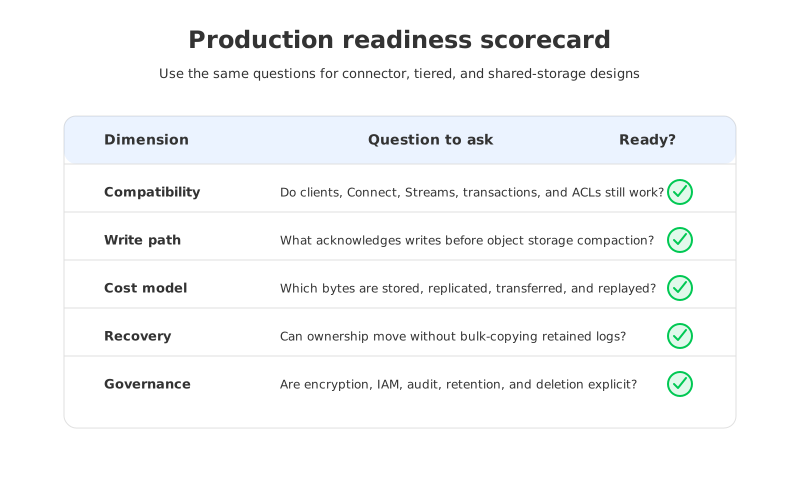
The following questions keep the evaluation grounded:
- Compatibility: Do existing producers, consumers, Kafka Connect jobs, Kafka Streams applications, transactions, ACLs, quotas, and observability tools keep working without application rewrites?
- Write path: Which component acknowledges a write, what is its failure domain, and how does the system recover acknowledged data after broker loss?
- Latency profile: What happens to p99 produce latency, tailing fetch latency, and catch-up read latency under your actual workload?
- Network cost: Which paths cross Availability Zones or regions, and are those paths tied to every produced byte or only to specific operational events?
- Reassignment and recovery: Does adding, removing, or replacing brokers require bulk-copying retained log data, or can the system mostly move ownership and traffic?
- Governance: Are bucket policy, encryption, key ownership, audit logs, retention, and deletion semantics part of the design rather than an afterthought?
- Operational tooling: Can SREs see WAL health, cache hit rate, object upload lag, remote read pressure, metadata scale, and recovery progress?
This framework also prevents a common mistake: comparing an export connector with a storage engine as if they were substitutable products. They are not. They sit at different layers of the stack. A connector may still be essential even after a storage redesign, because applications still need lakehouse exports, archival pipelines, or specialized sinks. A storage engine changes the economics and operations of the Kafka cluster itself.
6Where AutoMQ Fits
Once the evaluation reaches the shared-storage category, AutoMQ becomes relevant as one implementation of Kafka-compatible cloud-native streaming. AutoMQ preserves Kafka protocol compatibility and Kafka ecosystem behavior while replacing the traditional broker-local storage layer with S3Stream, a shared streaming storage layer backed by object storage and a WAL/cache design.
That placement matters. AutoMQ is not a sink connector that copies Kafka data into S3 after the fact. It is also not only a cold-tier feature for old segments. In AutoMQ's architecture, brokers process Kafka protocol traffic and coordinate partition work, while durable stream data is stored through the shared storage layer. Brokers are designed to be stateless with respect to persistent partition data, so scaling and recovery can focus more on ownership, metadata, cache, and traffic rather than copying retained logs between broker disks.
The same framework should still be applied. Teams should validate client compatibility, write latency, replay behavior, object storage configuration, WAL choice, cross-zone traffic, monitoring, and operational runbooks against their own workloads. The architectural advantage is that the expensive part of traditional Kafka on cloud infrastructure is addressed at the storage layer, where the cost and elasticity problem originates.
AutoMQ's BYOC and Software deployment models are also relevant for governance. In BYOC, the control plane and data plane run in the customer's cloud account and VPC, and Kafka record data remains in customer-owned infrastructure. For teams evaluating Kafka on S3 because of data ownership, compliance, or cloud boundary requirements, that deployment boundary is part of the architecture discussion, not a procurement detail.
7Migration and Procurement Implications
A storage-layer decision should not sit only with the platform team. Application owners care about compatibility and migration risk. SREs care about failure modes and observability. FinOps cares about storage, transfer, request, and compute costs. Security teams care about IAM, encryption, retention, and audit. Procurement cares whether the chosen path creates another managed-service dependency, self-managed operational burden, or customer-controlled deployment model.
The safest procurement process asks vendors and internal platform teams to answer the same scenario-based questions. What happens when a broker dies during high ingest? What happens when a consumer rewinds 7 days? What happens when retention grows from 7 days to 90 days? What happens when a node group scales down? What happens when credentials rotate? What metrics prove the system is healthy before users notice lag?
Those questions reveal the real architecture. A system can look elegant in a data flow diagram and still push complexity into a place your team cannot operate. A system can also look unfamiliar at first because it changes the storage layer, yet reduce day-to-day work once broker-local durable state is no longer the center of every scaling and recovery event. The right answer depends on the workload, but the evaluation should make that dependency explicit.
8Closing Thought
Kafka on S3 is a useful search phrase because it points to a real architectural pressure: Kafka teams want the Kafka ecosystem, but they also want cloud-native storage economics and operational elasticity. The phrase becomes dangerous only when it hides the difference between exporting data, tiering older segments, and redesigning the primary storage layer.
If your evaluation has moved beyond export pipelines and into Kafka-compatible shared storage, review the architecture directly. AutoMQ's documentation is a good next step for understanding how a Kafka-compatible system can use object storage as the durable base while keeping brokers focused on protocol and compute work: explore AutoMQ.
9References
- Apache Kafka KIP-405: Kafka Tiered Storage: https://cwiki.apache.org/confluence/display/KAFKA/KIP-405%3A+Kafka+Tiered+Storage
- Apache Kafka KIP-1150: Diskless Topics: https://cwiki.apache.org/confluence/display/KAFKA/KIP-1150%3A+Diskless+Topics
- AWS Amazon S3 pricing: https://aws.amazon.com/s3/pricing/
- AutoMQ architecture overview: https://docs.automq.com/automq/architecture/overview?utm_source=blog&utm_medium=reference&utm_campaign=gs100-0044
- AutoMQ S3Stream shared storage architecture: https://docs.automq.com/automq/architecture/s3stream-shared-streaming-storage/overview?utm_source=blog&utm_medium=reference&utm_campaign=gs100-0044
10FAQ
10.1Is Kafka on S3 the same as a Kafka S3 sink connector?
No. A sink connector copies data from Kafka topics into S3 or S3-compatible storage for downstream use. Kafka still owns the primary durable log. That is different from tiered storage or a shared-storage engine, where object storage participates in the Kafka storage model.
10.2Does tiered storage make Kafka brokers stateless?
Not by itself. Tiered storage can move older completed segments to remote storage, but the active log path still depends on broker-local storage. Stateless broker behavior requires a deeper storage architecture change where durable stream data is no longer permanently owned by broker disks.
10.3Why does a Kafka-compatible shared-storage system need a WAL?
Object storage is durable and elastic, but streaming writes need low-latency acknowledgement, ordering, and recovery behavior. A WAL provides a durable write path before data is uploaded, compacted, or organized into object storage layouts. The exact WAL design is one of the most important evaluation points.
10.4What cost items should be included in a Kafka on S3 comparison?
Include broker compute, broker-local storage, object storage capacity, object requests, cross-zone or cross-region transfer, connector runtime if used, cache or WAL resources, replay behavior, and operational data movement during reassignment or recovery. Storage price per GB is only one line item.
10.5When should AutoMQ be considered?
Consider AutoMQ when the goal is not only exporting Kafka data to S3, but reducing the operational and cost impact of broker-local durable storage while keeping Kafka-compatible APIs and ecosystem behavior. It is most relevant for teams evaluating shared-storage or diskless Kafka architectures.


