
Table of Contents
Table of Contents
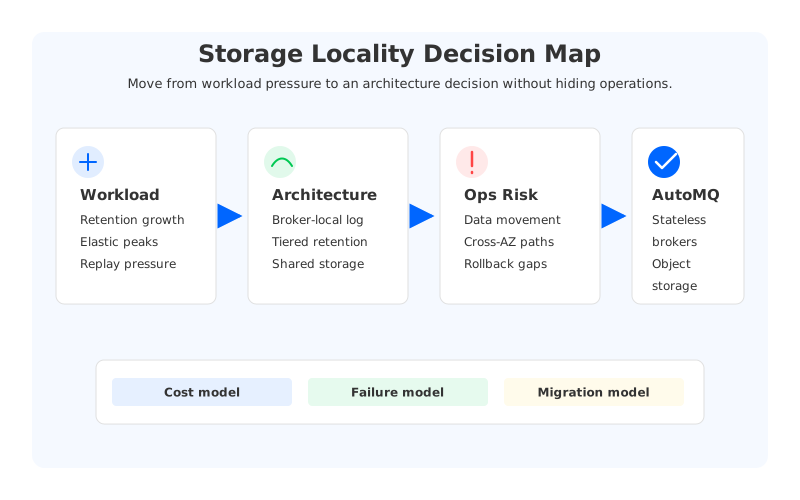
Teams usually search for storage locality tradeoff kafka after a production constraint has become expensive enough to be visible. A platform group may be planning longer retention for replay, a FinOps team may be questioning cross-AZ transfer lines, or an SRE team may be tired of treating broker replacement as a storage migration. The question sounds narrow, but it is rarely about disks alone. It is about where durable stream data lives, which systems are allowed to move it, and how many operational decisions become constrained by that location.
Kafka made broker-local storage a practical default for a long time. A broker owns log segments for partitions, producers write to partition leaders, followers replicate data, and consumers read according to offsets and group coordination. That design is still useful because locality can keep the hot path close to the broker process. The trade-off appears when the environment around Kafka changes faster than the data it retains: cloud regions, Availability Zones, elastic compute, object storage, private network boundaries, and governance rules all start to ask whether durable data should remain tied to a particular broker.
1Why Teams Search for storage locality tradeoff kafka
The first signal is usually capacity planning. Retention grows from hours to days because downstream systems need replay windows, compliance teams need auditability, or AI and analytics pipelines need more historical context. In broker-local Kafka, that retention is not an abstract policy. It becomes local disk, block volume, or instance-storage capacity attached to the broker fleet, with enough headroom for replication, leader movement, compaction, and failure recovery.
The second signal is operational drag. Adding brokers does not only add compute; it may require partition reassignment and replica movement before the added capacity helps the right partitions. Replacing brokers does not only restart a process; it may trigger catch-up traffic and data placement decisions. Shrinking after a peak is even harder because retained data has to be somewhere before the broker can disappear. Storage locality turns elasticity into a multi-step operation.
The third signal is the cloud bill. Kafka replication, consumer reads, connector traffic, and rebalancing all create network paths. When those paths cross Availability Zones or private connectivity boundaries, the bill may not follow the same mental model as a data-center deployment. AWS documents data transfer pricing separately from compute and storage, and that separation matters because application-level replication can generate traffic that is not obvious from topic throughput alone.
Storage locality is therefore a design choice with consequences, not a defect. The right answer depends on workload shape, durability requirements, failure domain design, governance boundaries, and migration tolerance. A low-retention, steady-throughput cluster with predictable brokers may benefit from local storage. A cloud platform that needs elastic scaling, long replay windows, and strict network cost control may need a different storage model.
2The Cloud Cost Drivers Behind the Workload
The cost discussion becomes clearer when you separate four traffic sources that are often blended together in capacity reviews:
- Producer write traffic enters the cluster and is acknowledged according to producer settings, replication, and durability policy. The broker-local model then places durable copies on multiple brokers.
- Inter-broker replication protects availability, but it can also create cross-AZ movement when replicas are intentionally spread across zones.
- Consumer and connector reads may fan out across applications, sink systems, and analytics jobs. Consumer group behavior makes this operationally manageable, but it does not make the bytes disappear.
- Operational movement appears during reassignment, broker replacement, recovery, and tier-management activity. It often disappears from steady-state estimates and then becomes painful during incidents.
These paths interact with storage locality. If the durable log is broker-local, the platform must keep enough broker-attached capacity for retained data and enough network budget for replica placement. If data can move to a shared storage layer, the compute fleet may become easier to resize, but the design must still prove low-latency writes, correct Kafka semantics, metadata consistency, and recovery behavior.
| Evaluation area | Broker-local storage question | Shared storage question |
|---|---|---|
| Retention | How much broker-attached capacity is reserved for replay and compaction? | How does object-storage-backed durability affect read patterns and recovery? |
| Scaling | How much data must move before added brokers help? | Can compute scale independently without weakening the write path? |
| Failure recovery | Which replicas are current, and how much catch-up is required? | Which WAL and metadata mechanisms preserve ordering and durability? |
| Network cost | Which replication and read paths cross Availability Zones? | Which paths remain local, and which use object storage or private links? |
| Governance | Who controls placement, encryption, identity, and region boundaries? | Does the shared storage layer stay inside the customer's chosen boundary? |
The table is intentionally vendor-neutral. A storage architecture can look elegant in a diagram and still fail a production review if it hides network charges, weakens rollback paths, or forces a team to change its client model. The useful question is not "local storage or shared storage?" It is "which operating model gives this team fewer irreversible decisions under load?"
3Storage, Network, and Compute Trade-Offs
Traditional Kafka follows a Shared Nothing pattern: each broker owns local persistent data for the partitions assigned to it, and the cluster uses replication to keep additional copies. That model makes the broker a combined compute, network, and storage unit. The benefit is locality on the hot path. The cost is coupling. When one dimension changes, the others often move with it.
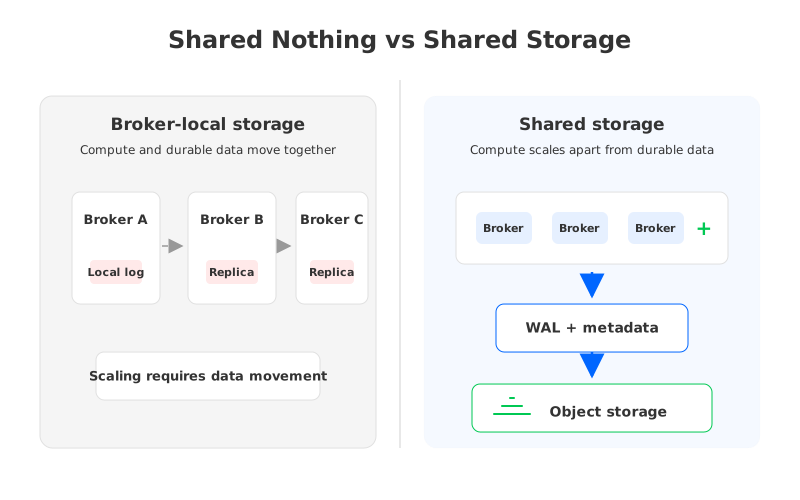
Tiered Storage changes part of this picture by allowing older log segments to move to remote storage while recent data remains broker-local. Apache Kafka documents Tiered Storage as a way to separate retention growth from local disk pressure for older data. That is valuable, but it is not the same as making brokers stateless. Teams still need to understand what remains local, how remote reads behave, how recovery works, and which operational actions still depend on broker-owned data.
A shared storage architecture goes further by moving durable stream storage away from broker-local ownership. The architecture can reduce the amount of data that has to move when compute changes, but it must answer a tougher question: how does the system preserve Kafka-compatible behavior while object storage is not a low-latency append log by itself? The answer usually involves a write-ahead log, metadata coordination, cache strategy, and a recovery model that treats brokers as replaceable compute rather than durable data owners.
This is the point where teams should be strict. A platform is not "cloud-native Kafka" because it uses object storage somewhere. It earns that label only if object storage changes the operational model without breaking the expectations that Kafka clients and operators rely on: topic semantics, offsets, consumer groups, transactions where required, connectors, security controls, and predictable failure handling.
4Evaluation Checklist for FinOps and Platform Teams
A practical evaluation should start with the workload, not the vendor category. The same Kafka-compatible API can sit on top of very different storage assumptions, and those assumptions decide which team pays the cost: application owners, SREs, FinOps, security, or procurement. The checklist below is useful because it forces the architecture discussion into operational language.
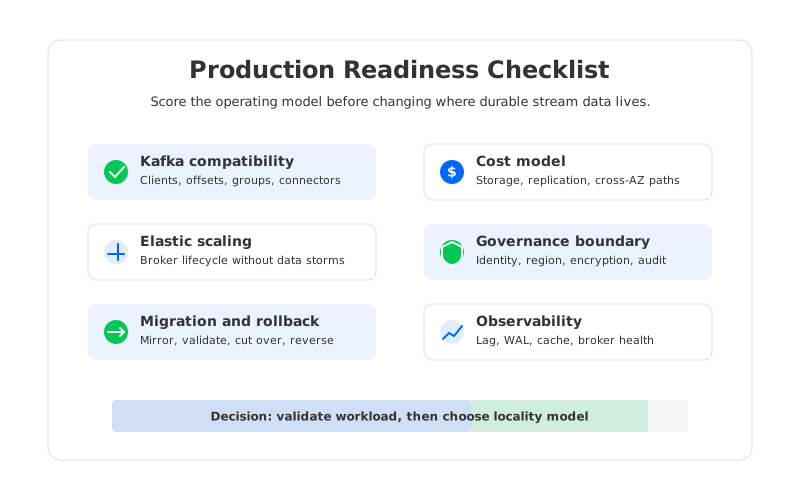
Start with compatibility. If the platform claims Kafka compatibility, confirm the client versions, protocol coverage, topic configuration behavior, consumer group semantics, offset handling, transactions, Kafka Connect support, and monitoring surface. A migration that saves storage cost but breaks a connector, an ACL workflow, or a transaction-heavy application is not a successful migration.
Then evaluate elasticity. Ask what happens when write throughput doubles for a week, when retention increases for one namespace, or when a broker needs replacement during peak traffic. In a broker-local model, the answer often includes reassignment, replica catch-up, and disk headroom. In a shared storage model, the answer should explain broker add/remove behavior, cache warm-up, WAL durability, metadata changes, and rollback.
Cost comes next, but it should not be reduced to a storage price comparison. Object storage is often cost-effective for retained data, and cloud block storage can be expensive at high retention, but network paths can dominate the discussion if they are ignored. Map producer writes, replication, consumer fan-out, connector sinks, rebalancing, and disaster recovery flows. If data crosses zones, regions, VPCs, or private links, include those paths in the TCO model.
Governance is the part technical teams sometimes postpone until procurement asks the hard questions. A production streaming platform has to fit identity management, encryption, audit logging, region control, backup expectations, and change approval. Fully managed services may reduce operational burden, but they can also move control boundaries. BYOC and self-managed models can preserve customer control, but they require clearer responsibility for upgrades, observability, and incident response.
Finally, score migration risk. A platform can be attractive and still be wrong for the first migration if the cutover path is fragile. Teams should know whether they can mirror data, keep applications on familiar clients, validate consumer lag, compare offsets, run rollback, and observe both clusters during the transition. Storage locality affects migration because it determines whether the target platform can absorb retained data growth without turning the migration itself into a storage-placement exercise.
5How AutoMQ Changes the Operating Model
Once the evaluation reaches durable data placement and operational movement, AutoMQ becomes relevant as an architectural option rather than a product interruption. AutoMQ is a Kafka-compatible cloud-native streaming system that keeps the Kafka API while using a Shared Storage architecture with stateless brokers and object-storage-backed durability. The architectural claim is specific: if brokers no longer own durable log storage locally, scaling and recovery can become compute operations instead of storage relocation projects.
AutoMQ's documentation describes a design where stream data is written through a WAL and persisted to object storage, while brokers serve as replaceable compute nodes. That changes the storage locality trade-off in three ways. First, retained data can use object storage economics rather than requiring every replay window to sit on broker-attached capacity. Second, broker replacement and scaling can reduce dependence on long partition data movement. Third, deployment boundaries such as BYOC or AutoMQ Software can keep infrastructure inside a customer's cloud account or controlled environment when governance requires it.
The strongest AutoMQ fit is not every Kafka workload. It is the cluster where storage and compute are growing at different rates, where cross-AZ traffic is under cost review, where retention keeps expanding, or where the platform team needs to resize without scheduling large data movement. AutoMQ also documents Zero cross-AZ traffic as an architectural capability, which matters when a multi-AZ deployment is paying for replication paths that were acceptable in a data center but costly in cloud billing.
The trade-off does not disappear; it moves to a better-defined place. Teams still need to validate write latency, cache behavior, object storage access, WAL choice, metadata recovery, and operational tooling. The difference is that the validation can focus on the shared-storage system's correctness and performance instead of repeatedly moving retained partition data whenever the broker fleet changes.
For technical buyers, that distinction matters. A Kafka-compatible platform should not ask application teams to relearn streaming semantics in exchange for a lower storage bill. It should let platform teams change the infrastructure model while keeping familiar client behavior, observability expectations, and migration paths. That is where AutoMQ's shared-storage approach is worth evaluating alongside traditional broker-local Kafka and tiered-storage variants.
If your current Kafka review started with a storage-locality question, turn it into a workload assessment before choosing an architecture. Map where the bytes move, who owns the failure domains, how retained data scales, and what has to happen when brokers change. If that assessment points toward stateless brokers and object-storage-backed durability, review the AutoMQ architecture documentation and validate the model against your own traffic, retention, and governance constraints.
6References
- Apache Kafka documentation: Consumer configuration and group behavior
- Apache Kafka documentation: Kafka Connect
- Apache Kafka documentation: KRaft metadata mode
- Apache Kafka documentation: Tiered Storage
- AWS: Data transfer pricing
- AWS: Amazon S3 storage classes and durability
- AutoMQ docs: Architecture overview
- AutoMQ docs: Difference with Tiered Storage
7FAQ
7.1Is storage locality always bad for Kafka?
No. Broker-local storage can be a good fit for steady workloads with predictable capacity, short retention, and operational teams that are comfortable with partition placement and broker lifecycle management. The trade-off becomes more visible when retention grows, compute needs to scale independently, or cloud network paths make replication and reassignment expensive.
7.2Is Tiered Storage the same as stateless brokers?
No. Tiered Storage can move older log segments to remote storage, which helps with retention pressure, but brokers may still own the hot local log and related recovery behavior. Stateless broker designs aim to separate durable stream storage from broker-local ownership more completely, usually with a WAL, shared storage, and metadata coordination.
7.3What should a FinOps team ask first?
Ask where bytes move during steady state and during operations. Producer writes, inter-broker replication, consumer fan-out, connector traffic, reassignment, recovery, and disaster recovery flows should all be mapped. A storage architecture that lowers one line item can still be expensive if it increases cross-AZ, cross-region, or private connectivity traffic.
7.4When should AutoMQ be evaluated?
Evaluate AutoMQ when Kafka compatibility is required but the current operating model is constrained by broker-local storage, long retention, data movement during scaling, or cross-AZ traffic cost. The fit is strongest when the team wants to keep Kafka client behavior while changing the infrastructure foundation toward shared storage and stateless brokers.


