
Table of Contents
Table of Contents
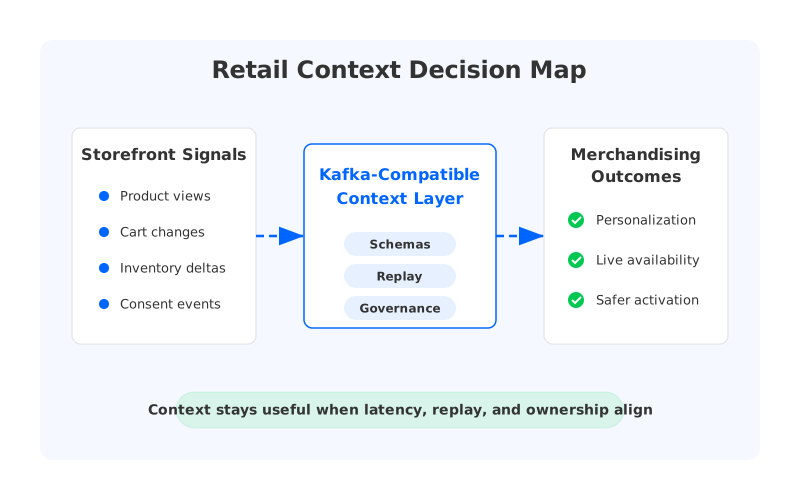
Retail merchandising fails in small delays before it fails in dashboards. A customer views a product, changes size, applies a promotion, checks inventory, abandons the cart, returns through an email link, and expects the storefront to remember the whole context. Teams search for real time retail context kafka when batch personalization, nightly inventory joins, or loosely connected event pipelines can no longer keep up with that path.
The hard part is not publishing clickstream events into Kafka. The harder problem is keeping a usable context stream across product catalog updates, stock changes, price rules, consent changes, fraud signals, and downstream analytics without turning the platform into a fragile web of connectors and replay jobs. Low-latency merchandising is really an infrastructure question: can the platform move context quickly, replay it safely, and govern it without forcing every retail team to become a Kafka operations team?
1Why Teams Search for real time retail context kafka
The search usually starts after a gap appears between what the storefront knows and what the business wants it to do. Merchandising teams want recommendations to respond to session behavior. Inventory teams want availability to reflect near-live stock movement. Marketing teams want promotion decisions to respect customer consent and cart state. Data teams want the same signals in analytics systems without building a second pipeline that disagrees with production.
Apache Kafka is a natural fit for the event layer because it gives producers and consumers a shared log, partitioned ordering, replay through offsets, and a mature ecosystem around Kafka Connect, stream processing, and client libraries. A retail context pipeline can publish product views, cart changes, inventory deltas, pricing events, and order updates as records, then let multiple systems consume the same facts at their own pace.
The pressure builds when those consumers start depending on each other indirectly. A promotion service may need product availability, customer segment, and cart value in the same decision window. A search ranking job may need clickstream events and inventory changes together. Kafka can carry those streams, but the platform design decides whether the result is a reliable context fabric or a set of topic names that only the original team understands.
2The Integration Constraint Behind the Pipeline
Retail context is not one stream. It is a set of streams with different owners, update rates, and correctness expectations. Clickstream events are high volume and often lossy at the edge. Inventory events are lower volume but operationally sensitive. Price, promotion, identity, and consent events bring business risk and governance into the critical path.
That mix creates four integration constraints that are easy to underestimate:
- Temporal alignment. A decision engine needs to know which product, inventory, price, and customer state were valid at the moment of the storefront interaction. Late events and replayed events must be handled intentionally.
- Replay boundaries. Teams need to rebuild context after bugs, schema changes, and model updates, but replay should not accidentally re-trigger emails, payments, or fulfillment actions.
- Ownership boundaries. Product, inventory, marketing, analytics, and platform teams all write or read context. The pipeline needs ownership and access rules that match those boundaries.
- Cost boundaries. Real-time pipelines often run all day, even when demand is spiky. Broker capacity, connector fleets, storage retention, and cross-zone traffic become part of the merchandising bill.
Those constraints explain why a retail context pipeline should be designed as a product interface, not as an internal queue. Once the event layer becomes the place where storefront behavior, operational facts, and data products meet, shortcuts in naming, retention, schema governance, or replay design show up in customer-facing workflows.
3Shared Nothing Architecture Turns Context Into Operations Work
Traditional Kafka follows a Shared Nothing architecture. Each broker owns local storage for its assigned partitions, and durability comes from replication across brokers. This design is proven and familiar, but it couples merchandising workload growth to broker-local disk, partition placement, replica traffic, and rebalance work. In a retail pipeline, that coupling can become visible during the exact moments when the business wants the platform to be most elastic.
Seasonal campaigns make the problem concrete. A promotion can increase product view events, cart updates, inventory reads, and downstream warehouse writes at the same time. If the platform has to add brokers, move partition replicas, rebalance hot topics, and watch local disk headroom while traffic rises, the operations team is managing storage topology during a business event.
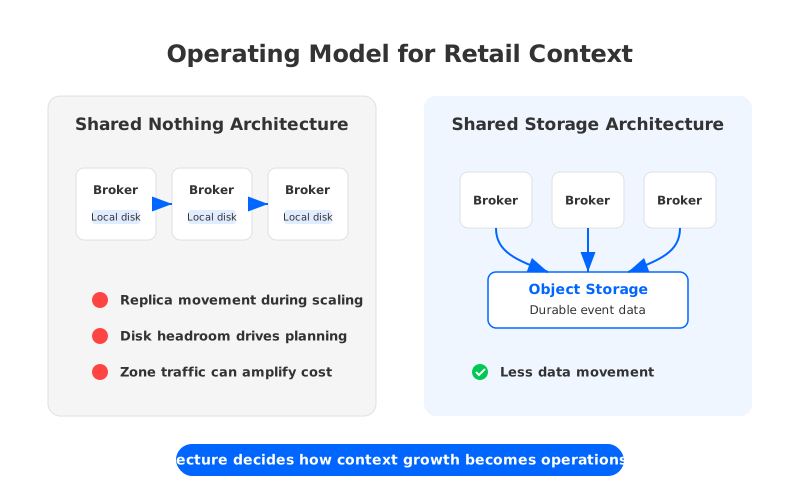
This does not make traditional Kafka a poor choice. It means the evaluation has to include the operating model, not only the API. A context pipeline that starts with a handful of topics can grow into a platform dependency for merchandising, supply chain, analytics, and AI features.
4Connector, Schema, Replay, and Stream Processing Trade-Offs
Kafka Connect often becomes the bridge between operational systems and the streaming layer. It can move product catalog updates from databases, send enriched context to data warehouses, write events to object storage, or feed search and recommendation systems. The connector layer standardizes integration work, but it also introduces task parallelism, offset tracking, error handling, secret management, and monitoring responsibilities.
Schema design is the next control point. Product attributes expand, promotions gain rules, consent models evolve, and inventory sources split by region or fulfillment center. Without schema compatibility rules, producers can break consumers that were never in the same meeting. With rules that are too rigid, teams create shadow topics to avoid the process.
Replay deserves special treatment because it is both a strength and a risk. Kafka offsets let consumers reprocess records, and retention lets teams rebuild derived state. That is powerful for recommendation models, audit trails, and bug recovery. It is dangerous when replay crosses a side-effect boundary, such as notifications or inventory reservation.
| Pipeline Area | Design Question | Failure Mode If Ignored |
|---|---|---|
| Connectors | Which systems are sources of truth, sinks, or derived views? | Duplicate pipelines disagree under incident pressure. |
| Schemas | Which topics are public contracts and which are internal steps? | A field change breaks a consumer with no clear owner. |
| Replay | Which consumers can replay safely, and which require guards? | A recovery job triggers customer-visible side effects. |
| Stream processing | Where is context joined, enriched, and materialized? | Business logic spreads across services, jobs, and SQL snippets. |
| Governance | Who approves access to customer, inventory, and pricing signals? | The platform passes data faster than policy can track it. |
Reviews often get stuck on whether to use Kafka Streams, Flink, a database CDC connector, or a warehouse sink. Those choices matter, but the durable decision is where context is owned, how it is replayed, and which teams can change it without breaking the storefront.
5Evaluation Checklist for Data Platform Teams
A neutral evaluation should start with workload shape. Measure the streams by write rate, read fan-out, retention, partition skew, message size, and consumer recovery tolerance. Then classify the context domains by business impact. A product view event and a stock decrement may both flow through Kafka, but they should not carry the same rollback policy.
Use the checklist below before selecting or changing a Kafka-compatible platform:
- Compatibility. Confirm that producers, consumers, Kafka Connect jobs, stream processors, Schema Registry usage, and admin tooling can run with minimal code change.
- Elasticity. Test how the platform handles campaign spikes, hot partitions, connector backlogs, and broker replacement without long data movement windows.
- Replay safety. Define which topics are safe to replay, which require idempotent consumers, and which need side-effect guards.
- Governance. Map topics to owners, schemas, access controls, audit records, data classes, and retention rules before self-service creation opens broadly.
- Cost model. Include compute, storage, network traffic, connector workers, observability, and operations work.
- Migration path. Decide how existing topics, offsets, schemas, ACLs, and connectors move, and where rollback stops being clean.
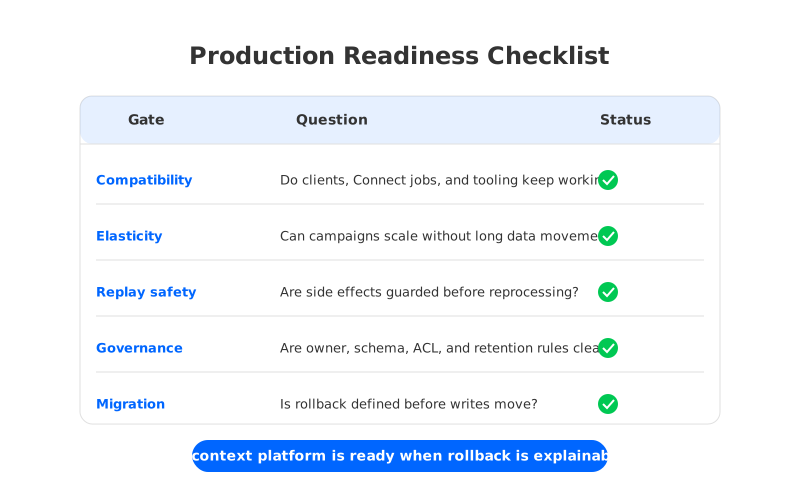
The checklist should produce a decision record, not a general preference. For each workload group, the record should say what latency matters, what replay means, who owns the contract, how long the data is retained, and what must happen during failure.
6How AutoMQ Changes the Operating Model
Once the evaluation is framed around operating model, a different architecture becomes relevant. AutoMQ is a Kafka-compatible cloud-native streaming system that keeps the Kafka protocol surface while moving durable data into a Shared Storage architecture backed by object storage. Brokers become more stateless, and compute can be scaled with less dependence on broker-local data placement.
That matters for real-time retail context because the pipeline is rarely static. During a campaign, platform owners may need more compute for producer load, consumer fan-out, or connector throughput. In a broker-local model, those decisions are tied to local disks and replica movement. In a Shared Storage architecture, durable data is not treated as permanently resident on a specific broker.
AutoMQ also changes the cost conversation. Traditional Kafka deployments in the cloud can amplify traffic through replication across brokers and Availability Zones. AutoMQ's Zero cross-AZ traffic design is intended to reduce that amplification by routing traffic around shared object storage rather than copying durable data between broker-local disks. The actual financial impact still depends on region, workload, retention, and cloud networking paths, so teams should model their own traffic.
The product fit is strongest when the organization wants Kafka compatibility but dislikes the operational gravity of broker-local storage. AutoMQ BYOC keeps the deployment inside the customer's cloud boundary, while AutoMQ Software is available for private infrastructure. For retail teams handling customer behavior, inventory, pricing, and consent data, those boundaries can matter as much as throughput.
AutoMQ should not be used as a reason to relax governance. It gives the platform team a different storage and scaling model, but the event contracts still need owners, schemas, ACLs, retention policy, and replay rules. The benefit is that stronger governance no longer has to be paired with the same amount of broker-local storage work.
7Migration and Rollback Without Surprising the Storefront
Existing retail pipelines rarely start clean. Some topics were created for one experiment and became permanent. Some connectors were deployed before a platform standard existed. Some consumers commit offsets in ways that make replay hard to reason about.
Start by grouping topics by business workflow rather than by cluster location. A storefront session workflow may include clickstream events, cart updates, product metadata, and promotion decisions. Moving only one stream can split context across platforms.
Rollback should be designed before the first production cutover. Producers need a controlled routing change. Consumers need a tested offset strategy. Connectors need ownership for retries, dead-letter topics, and destination writes. Track three workflow states: ready to mirror, ready to serve reads, and ready to receive writes.
8The Decision Is About Context, Not Messaging
The point of a real-time retail context pipeline is not to move more messages. It is to keep product, customer, inventory, and merchandising decisions aligned while the storefront is changing underneath them. Kafka gives the event foundation, but the platform architecture decides whether that foundation stays manageable as workloads grow.
If your team is evaluating Kafka-compatible infrastructure for retail context, use the checklist above with your own topics, connectors, consumer groups, and replay rules. When the review shows that broker-local storage, cross-zone traffic, and slow scaling are central risks, a Shared Storage architecture is worth testing directly. You can start with the AutoMQ BYOC product page to validate deployment boundaries, Kafka compatibility, and operating model fit: explore AutoMQ for Kafka-compatible streaming.
9References
- Apache Kafka documentation: Core concepts and APIs
- Apache Kafka documentation: Consumer configuration
- Apache Kafka documentation: Kafka Connect
- Apache Kafka wiki: KIP-405: Kafka Tiered Storage
- Apache Kafka wiki: KIP-1150: Diskless Topics
- AWS documentation: Amazon S3 User Guide
- AutoMQ documentation: What is AutoMQ
- AutoMQ documentation: Architecture overview
- AutoMQ documentation: Compatibility with Apache Kafka
10FAQ
10.1What does real-time retail context mean in Kafka architecture?
Real-time retail context means storefront, inventory, pricing, promotion, customer, and operational events are available as streaming facts that services can consume with low delay. Kafka provides the shared event log and replay model, while stream processing and governance turn those facts into usable context.
10.2Is Kafka enough for low-latency merchandising?
Kafka is a strong event foundation, but it is not the whole platform. Low-latency merchandising also needs schema governance, connector operations, replay safety, access control, observability, and a cost model that can handle campaign spikes.
10.3Where should teams place enrichment logic?
Keep source capture topics close to the original facts, then place enrichment in a controlled stream processing layer. This makes replay and debugging easier because teams can distinguish raw storefront behavior from derived context.
10.4When should a retail team consider a Kafka-compatible Shared Storage architecture?
Consider it when broker-local storage operations are becoming a constraint: slow scaling, long rebalancing windows, high cross-zone traffic, retention pressure, or recovery procedures that depend heavily on broker state. Compatibility testing is still required.
10.5How should teams make replay safe?
Classify consumers by side-effect risk. Analytics, model rebuilds, and materialized views are usually easier to replay than workflows that send customer notifications, reserve inventory, or trigger payment-adjacent actions. Use idempotent processing, versioned context, explicit replay windows, and runbooks where replay can affect customers.


