
Table of Contents
Table of Contents
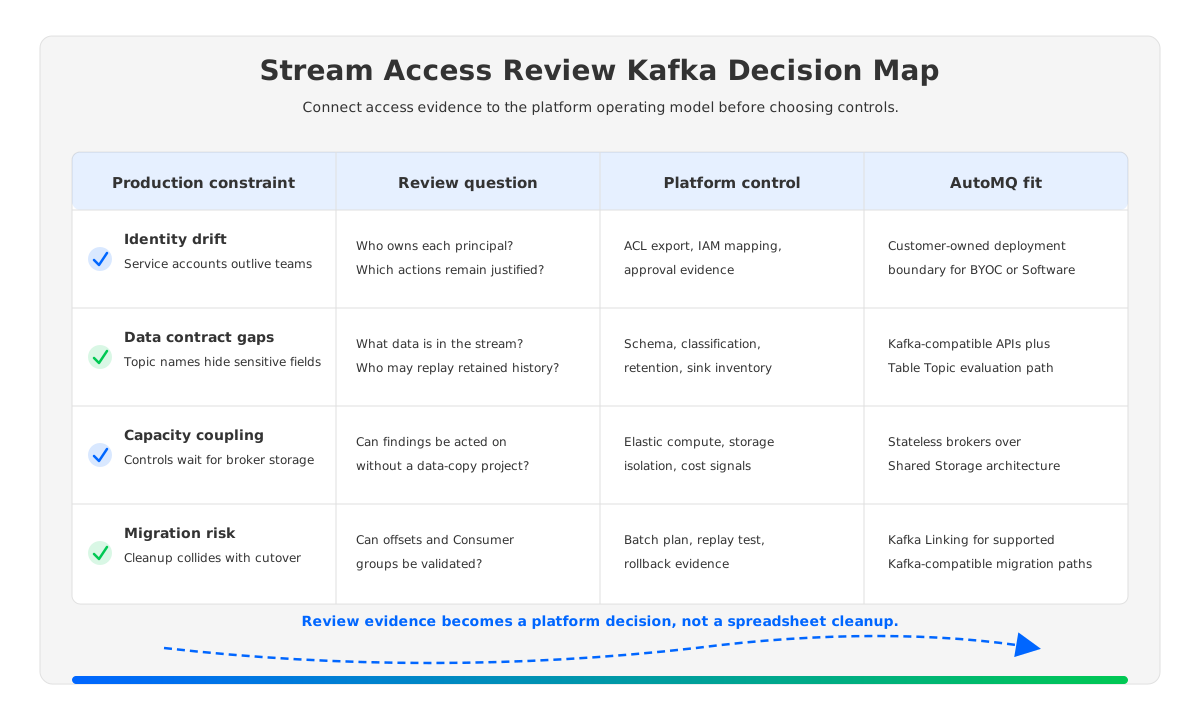
Teams usually search for stream access review kafka after Kafka has become more than a transport layer. The platform is already carrying payment events, security telemetry, user behavior, operational logs, CDC records, AI context updates, or product analytics. A quarterly access review that once meant checking a few application accounts starts to involve topics, Consumer groups, schemas, offsets, connectors, cloud identities, network paths, and retention policies. The practical question is not "who can connect to Kafka?" It is "can we prove that every stream access path still matches business ownership, compliance scope, and operational risk?"
That proof is harder than it looks because Kafka access is not a single permission. A Producer may write to a topic whose schema implies sensitive data; a Consumer group may replay retained records later for a different purpose; a connector may copy data into a lake or warehouse. A platform team can have reasonable Kafka ACLs and still fail an access review because evidence is scattered across brokers, IAM, schema registries, CI/CD systems, ticketing, Terraform, and downstream jobs.
The useful framing is therefore architectural: a production stream access review is a control system around Kafka-compatible data movement. It has to connect identity, topic ownership, data contracts, runtime behavior, storage boundaries, and migration plans. If any of those pieces is missing, the review becomes a spreadsheet exercise that finds stale users but misses the bigger risk.
1Why teams search for stream access review kafka
Access review pressure often starts outside the Kafka team. Security wants evidence that service accounts are still owned. Compliance wants proof that regulated fields are not consumed by unapproved systems. Data governance wants topic ownership and schema discipline. Platform engineering wants to retire old principals without breaking a revenue workflow. Each group is asking a valid question, but Kafka turns those questions into a shared dependency problem.
In a relational database, access review can often start with users, roles, tables, and query logs. Kafka adds time and replay. A Consumer that was allowed to read a topic last year may still replay retained records, and a schema change can make a previously safe topic carry stricter data. The access decision is attached to current records, retained history, and downstream use.
A strong review has to answer five questions in the same language:
- Who or what has access? Human users, service accounts, applications, connectors, stream processors, and operational roles need separate treatment.
- What can they do? Produce, consume, describe, alter, delete, create, reset offsets, and manage ACLs carry different risks.
- Which data contract applies? Topic names are not enough. The review needs schema, classification, owner, retention, and permitted purpose.
- Where can the data move? The answer includes VPC paths, private endpoints, object storage, downstream sinks, and cross-region replication.
- How is evidence retained? ACL state, audit logs, schema history, deployment history, and exception approvals must survive the review window.
The last question is where many reviews slow down. Kafka can produce strong operational signals, but the evidence model is usually assembled after the fact. Platform teams should design the review as an operating control, not as an annual cleanup script.
2The production constraint behind the problem
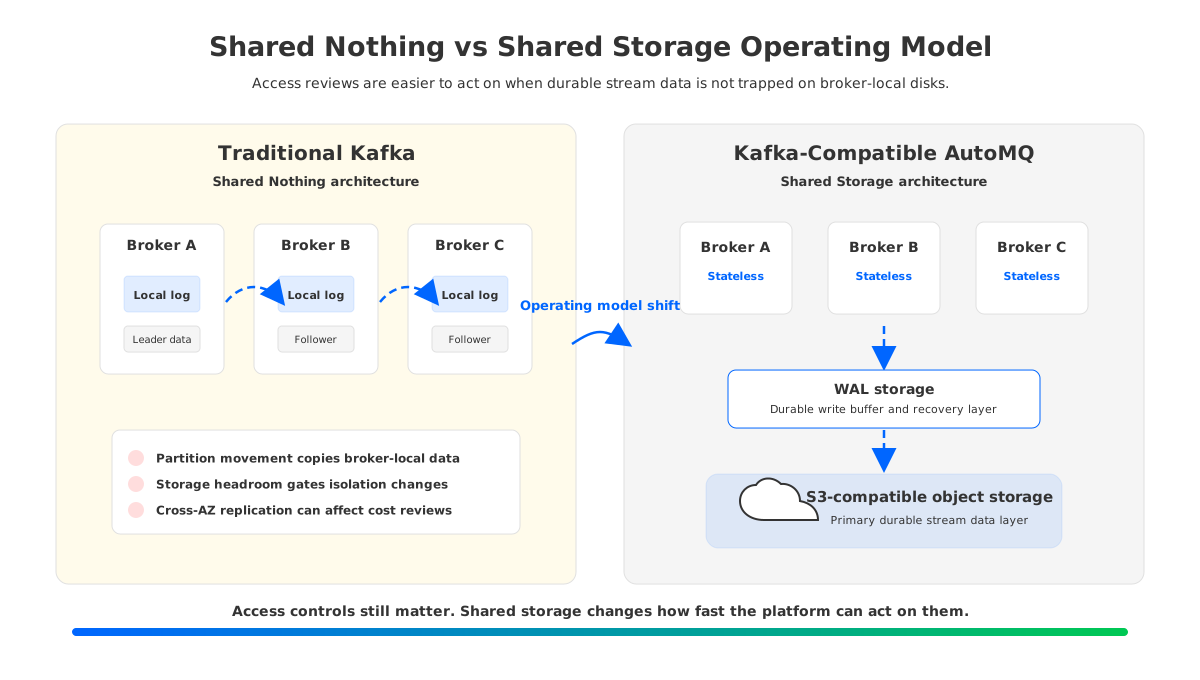
Traditional Kafka uses a Shared Nothing architecture: brokers own local log storage, partitions live on broker disks, and leader/follower replication provides durability. That architecture is well understood, but operational control follows broker-local state. Capacity planning, reassignment, retention changes, and recovery all have to respect where the data physically sits.
Access review inherits those constraints. Moving a restricted topic to an isolated cluster may depend on partition data movement, broker headroom, replication bandwidth, and rebalancing risk. Shortening retention for a sensitive stream requires coordination across storage pressure, consumer lag, recovery assumptions, and legal hold requirements. Retiring a legacy Consumer group depends on offset history and replay behavior, not only its ACL entry.
This is why governance teams often feel that Kafka reviews are "too operational," while Kafka teams feel that governance requests ignore production reality. Both are right. Stream access review is not only an RBAC problem. It touches storage architecture, network cost, cluster elasticity, failure domains, migration tooling, and data contract maturity.
The constraint becomes sharper in cloud environments. Broker-local storage is usually provisioned ahead of demand, replication can create cross-Availability Zone traffic, and scaling a busy cluster can require data copying. Those are not access-review features, but they affect how quickly a team can isolate data, split workloads, test rollback, and keep evidence without making the platform brittle.
3Architecture options and trade-offs
Before selecting tooling, separate the review problem into three layers: Kafka semantics, governance metadata, and the platform operating model. The first covers topics, partitions, offsets, Consumer groups, transactions, ACLs, and clients. The second covers schema ownership, classification, purpose, retention, and exceptions. The third covers storage, broker scaling, network isolation, migration, and control-plane ownership.
Most teams choose among three broad patterns. None is automatically correct. The right answer depends on whether the main pressure is audit evidence, operational elasticity, infrastructure control, migration risk, or all of them at once.
| Platform path | What it preserves | What it changes | Review risk to test |
|---|---|---|---|
| Operate existing Kafka more tightly | Existing clients, clusters, runbooks, and team knowledge | Adds stronger ACL hygiene, schema governance, audit export, and ownership workflows | Governance can remain bolted on if topic ownership and data contracts are incomplete |
| Use managed Kafka or cloud-provider Kafka | Kafka APIs with more provider-managed operations | Shifts some broker lifecycle and patching work to the service boundary | Data plane control, audit export, networking, and cost visibility vary by provider model |
| Adopt Kafka-compatible Shared Storage architecture | Kafka-compatible client surface and ecosystem behavior | Moves durable stream data away from broker-local disks and makes brokers more stateless | Requires validation of WAL behavior, object storage, compatibility, migration, and control boundaries |
Tiered Storage deserves a separate note because it is often confused with shared storage. Apache Kafka Tiered Storage offloads older log segments to remote storage while local broker storage remains active. A Shared Storage architecture goes further: object storage becomes the primary durable data layer, while brokers focus on protocol handling, leadership, caching, and coordination, with WAL storage used for write durability and recovery.
For access review, the distinction matters. A review framework should ask whether storage architecture changes the control you can exercise, not only the price of retention. Can you replace brokers without rebuilding the authoritative log from local disks? Can you scale compute without coupling every decision to disk capacity? Can migration preserve offsets and Consumer group progress? Those answers shape control evidence as much as the ACL model.
4Evaluation checklist for platform teams
A useful checklist should use language that security, governance, and platform teams can all accept. "Do we have Kafka permissions?" is too small. Ask whether the platform can map permissions to data purpose, runtime behavior, and operational boundaries.
Start with compatibility because a broken application is a governance failure in a different form. Confirm client libraries, protocol expectations, authentication modes, Admin API usage, Consumer group behavior, offsets, transactions, Kafka Connect workloads, and monitoring integrations. Test actual clients and operational scripts, not only a happy-path producer and consumer.
Then examine the data contract layer. Every production topic should have an owner, classification, schema or payload rule, retention policy, approved producers, approved consumers, and downstream destination inventory. The Kafka ACL may say a service can read a topic, but the data contract should say why.
The cost and elasticity section should be practical. Reviews create action items: split a topic family, isolate a regulated workload, extend retention, move a cluster, or run a replay. If every action requires weeks of broker sizing and data movement, the control is slow even if the policy is well written.
Finally, migration and rollback must be in scope. A team improving access controls may need to migrate from a legacy cluster, consolidate platforms, or introduce a Kafka-compatible architecture. The review should require topic batches, offset validation, Consumer group cutover, producer cutover, audit continuity, and rollback evidence.
5How AutoMQ changes the operating model
After the neutral framework is clear, AutoMQ becomes relevant as a Kafka-compatible streaming platform built around Shared Storage architecture. It keeps the Kafka protocol and ecosystem surface while replacing broker-local persistent storage with S3Stream, WAL storage, data caching, and S3-compatible object storage. The access-review value is not that storage grants permissions; it is that scaling, recovery, isolation, and migration become easier to reason about.
With stateless brokers, durable stream data is not tied to a specific broker's local disk. Brokers still process Kafka requests, own partition leadership, serve hot reads, and participate in coordination, but persistent data lives in shared object storage with WAL storage in the write path. That changes the review conversation from "can we move this data without destabilizing the cluster?" to "what ownership, metadata, and traffic changes are required, and how do we validate them?"
AutoMQ BYOC and AutoMQ Software also matter for control boundaries. In BYOC deployments, the control plane and data plane run in the customer's cloud account and VPC. In AutoMQ Software, the platform runs in the customer's private environment. For regulated teams, that boundary belongs in the access review: where Kafka records live, where logs are exported, which identities can operate the platform, and what metadata is visible.
Schema and data contracts still require discipline. AutoMQ does not remove the need to classify topics, review ServiceAccount ownership, validate Consumer groups, or document downstream sinks. It does give platform teams a Kafka-compatible foundation where storage, compute, and deployment ownership can be evaluated separately.
Migration is another place where operating model affects review quality. AutoMQ Kafka Linking is designed for Kafka-compatible migration workflows that preserve topic data and Consumer group progress in supported paths. Access review can use that as a migration control: define topic batches, verify offsets, test cutover, align permissions, and document rollback before production traffic changes.
6A production scorecard
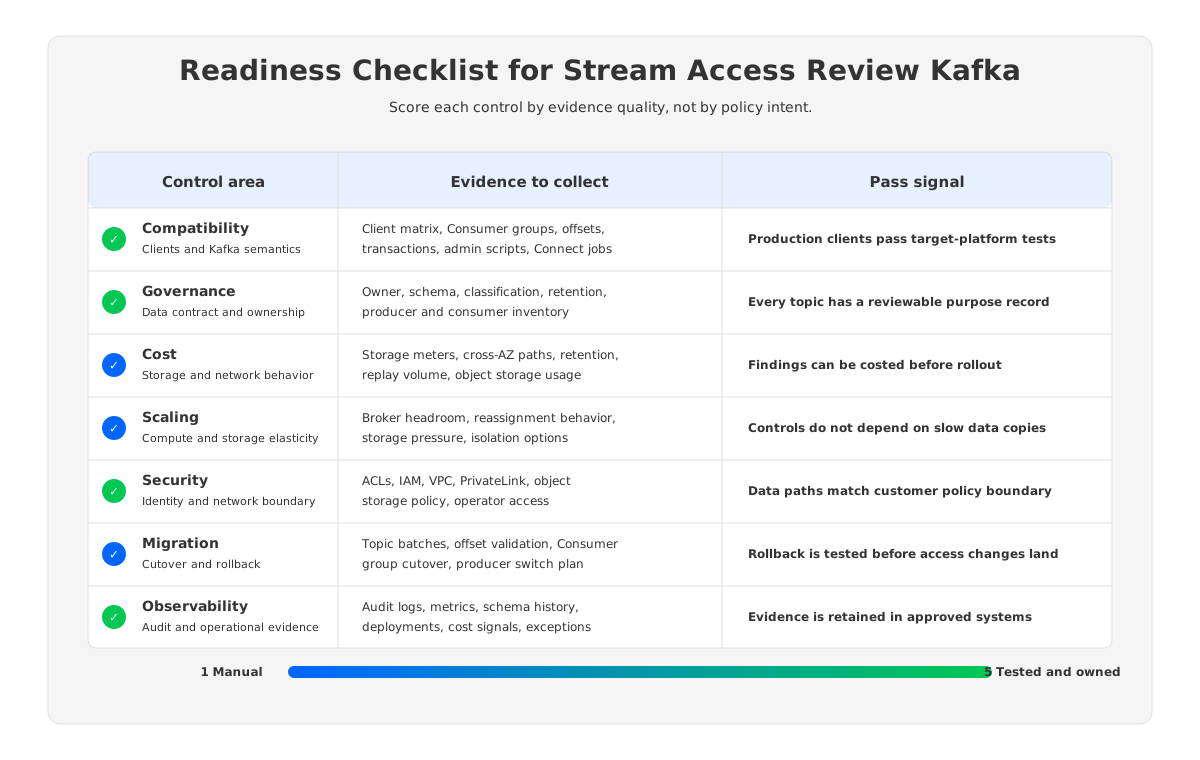
Use a scorecard when the review has to drive a platform decision, not only a cleanup ticket. Score each dimension from 1 to 5, where 1 means "unknown or manual" and 5 means "documented, tested, automated, and owned." Do not let one strong area hide a weak one.
| Dimension | What a high score looks like |
|---|---|
| Kafka compatibility | Real clients, Consumer groups, offsets, transactions, Connect jobs, and admin scripts pass tests against the target platform |
| Data contracts | Topic owner, schema rule, classification, retention, producers, consumers, and downstream sinks are recorded and reviewed |
| Cost and elasticity | Review findings can be acted on without excessive broker-local capacity work or unexpected network cost |
| Security boundary | Identity, ACLs, network paths, object storage, logs, metrics, and operator access are mapped to customer policy |
| Recovery and rollback | Failover, replay, migration, Consumer group cutover, and rollback are tested before access changes affect production |
| Observability | Audit logs, platform metrics, schema history, deployment changes, and cost signals are retained in approved systems |
The scorecard turns access review into an engineering roadmap. Low scores show where the platform contract is still implicit. A low score on data contracts calls for ownership and schema work; a low score on elasticity points to architecture and capacity; a low score on migration means access cleanup should not be combined with a risky cutover.
7FAQ
7.1What is a stream access review for Kafka?
A stream access review checks whether every human user, service account, application, connector, and operational role still has the right level of access to Kafka topics and platform controls. A production review should include ACLs, Consumer groups, schemas, offsets, retention, downstream sinks, audit logs, and cloud network boundaries.
7.2Is Kafka ACL review enough for streaming data governance?
No. Kafka ACLs are necessary, but they do not explain data purpose, schema sensitivity, downstream copies, retention risk, or migration safety. Governance needs ACLs plus data contracts, ownership, audit evidence, and operational controls.
7.3How does Shared Storage architecture affect access reviews?
Shared Storage architecture does not replace identity management. It changes the operating model around scaling, broker replacement, storage ownership, and retention. That can make review findings easier to act on because durable data is less coupled to broker-local disks.
7.4Where should AutoMQ enter the evaluation?
AutoMQ should enter after the team defines compatibility, governance, cost, security, migration, and evidence requirements. It is most relevant when teams want Kafka-compatible APIs, stateless brokers, object-storage-backed durability, and customer-controlled deployment boundaries.
7.5What is the first practical step?
Pick one regulated topic family and build the complete access record: owner, schema, classification, producers, consumers, Consumer groups, retention, downstream sinks, network path, audit evidence, and rollback plan. If that record is hard to assemble, the access review process needs platform work before it can scale.
The original search started with stream access review kafka, but the durable answer is bigger than a permission export. Treat the review as a control framework for data movement. If broker-local storage and unclear deployment boundaries are limiting your ability to act on that framework, evaluate a Kafka-compatible Shared Storage architecture in your own environment. Start with AutoMQ Cloud and compare the operating model against your next access review scorecard.
8References
- Apache Kafka Documentation: Consumer groups, offsets, transactions, Kafka Connect, and operations
- Apache Kafka Documentation: KRaft configuration and operations
- Apache Kafka Documentation: Tiered Storage
- AutoMQ Documentation: Shared Storage architecture overview
- AutoMQ Documentation: WAL storage
- AutoMQ Documentation: Kafka Linking migration overview
- AWS Documentation: Amazon S3 pricing


