
Table of Contents
Table of Contents
Searches for stream processing recovery kafka usually come from teams that have already felt the gap between a healthy dashboard and a recoverable system. The stream processor may be running, the Kafka cluster may be accepting writes, and consumers may still be committing offsets. Then a bad deployment, corrupted enrichment table, broken connector, or downstream outage appears, and the real question becomes uncomfortable: can the team rebuild the correct processing state from the event log without guessing?
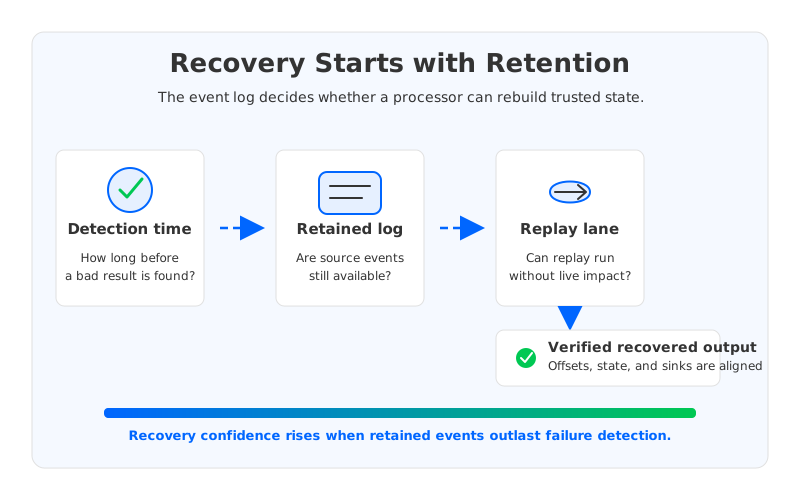
Recovery in stream processing is not only a Flink, Spark, Kafka Streams, or application framework problem. Those engines can checkpoint state, track offsets, and resume work, but their recovery boundary is only as strong as the retained events behind them. If the Kafka-compatible log no longer holds the source sequence, if retention was shortened to protect disk capacity, or if broker recovery moves too much data during an incident, the stream processor is trying to recover on unstable ground.
That is why durable event retention deserves to be treated as a first-class recovery design, not as a storage setting buried inside a topic template. Retention controls whether a team can replay events, repair state, test a corrected processor, and investigate the sequence that produced a wrong output. The harder part is that retention also affects cost, scaling, cross-zone traffic, governance, and migration risk. A platform team that optimizes only for low latency can still leave recovery fragile.
1Why teams search for stream processing recovery kafka
The search intent is practical. Engineers are not asking whether Kafka can buffer events for a stream processor; they already know it can. They are asking how to design the Kafka side of the system so recovery does not depend on luck, heroic manual work, or a narrow time window before old data disappears. In production, recovery scenarios rarely look like a clean restart from the latest checkpoint. They involve partial output, late events, bad code, poisoned records, schema changes, connector lag, and teams trying to decide how far back to replay.
Kafka's core ideas are useful here: ordered records within partitions, consumer groups, committed offsets, log retention, replication, and a broad ecosystem of stream processors and connectors. Those ideas let a processor resume from known positions and let another consumer inspect the same event history independently. They also create a false sense of safety when teams assume the event log is always recoverable because it is called a log. A log with insufficient retention is not a recovery source; it is a short memory.
The first design decision is therefore the recovery time horizon. A fraud pipeline may need to replay several hours after a rules bug. A billing adjustment workflow may need days of history. A customer-facing analytics application may need enough retained events to rebuild materialized views after a downstream data store restore. Each horizon changes the storage footprint, network behavior, and operational blast radius of Kafka-compatible infrastructure.
2The production constraint behind recovery
Stream processors fail in ways that make the source event log more important than any single checkpoint. A checkpoint captures a consistent processing state at a point in time, but it does not prove that the business result is correct. If a deployment introduced a wrong aggregation key, a checkpoint after that deployment can preserve the wrong state perfectly. The team still needs the retained event sequence to rebuild from a known-good version of the processor.
That is where recovery design moves from framework configuration into platform architecture. The event log must be durable enough for replay, available enough during broker or zone impairment, and affordable enough that the retention policy survives the next cost review. It also has to support more than the main processor. Debug consumers, audit jobs, backfill pipelines, and migration tools may all need to read older events without interfering with production consumption.
Several constraints tend to show up together:
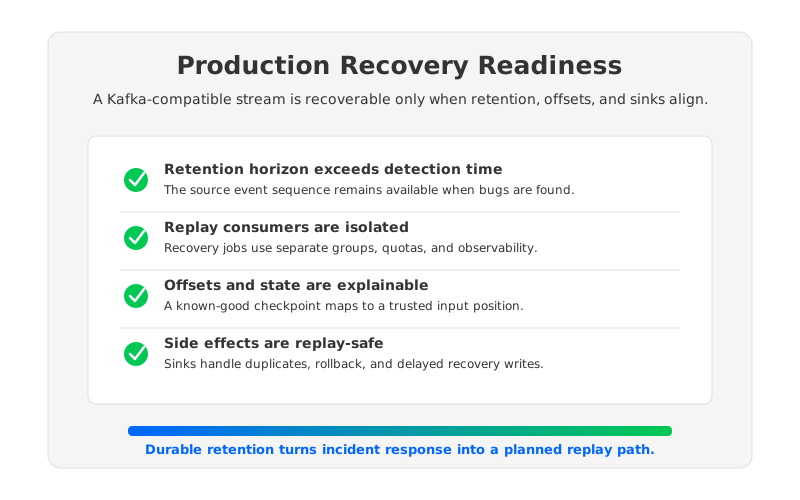
- Retention must outlast detection time. If bugs are discovered after the topic's recovery window closes, replay becomes a backup-restore or source-system extraction project.
- Replay must not destabilize live traffic. A recovery job that saturates brokers, disks, or cross-zone links can turn one bad processor into a platform incident.
- Offsets must be explainable. Teams need to know which consumers committed which offsets, where a replay should begin, and how to prevent duplicate side effects.
- Governance must follow the data. Long retention increases the value of the log, but it also increases the importance of access control, encryption, data classification, and deletion policy.
These constraints are why stream processing recovery should be designed around the log first. Checkpoints and state stores are necessary, but they are derived from the event sequence. When the event sequence is missing, too short-lived, or too expensive to retain, the rest of the recovery plan becomes fragile.
3Architecture options and trade-offs
Traditional Kafka uses a shared-nothing model where each broker owns local log data and replicates partitions to other brokers. This model is mature and proven. It works well when retained data, partition movement, and traffic patterns remain within the capacity envelope the team planned for. Recovery workloads stretch that envelope because they combine long retention with bursty catch-up reads and operational stress at exactly the moment the platform has less tolerance for surprise.
The operational coupling is easy to underestimate. More retention means more broker-local storage. More broker-local storage can mean larger brokers, longer replacement paths, more careful partition placement, and more risk when the team needs to rebalance. Catch-up reads compete with hot traffic unless the cluster has enough headroom. Multi-zone deployments improve availability, but replica movement and consumer placement can also turn recovery into a networking and cost problem.
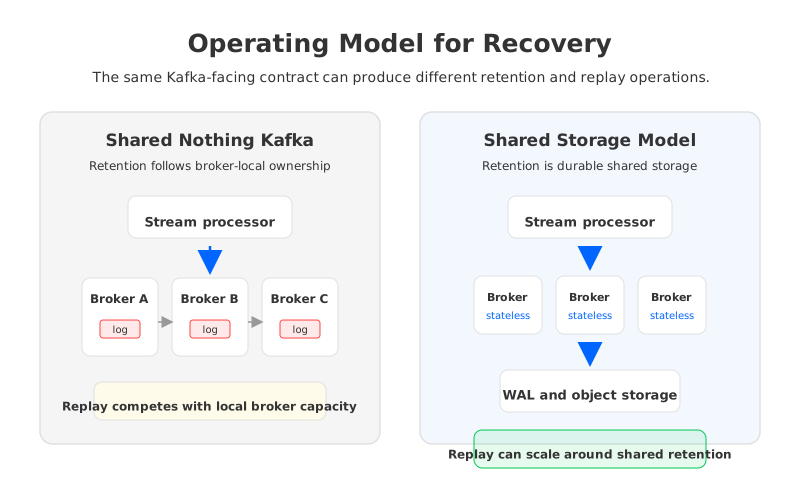
Tiered storage reduces part of this pressure by moving older segments to remote storage. That is useful, especially for long historical reads. It does not fully remove the shared-nothing operating model because the hot path and broker ownership of active data still matter. A shared storage architecture takes a different position: keep the Kafka-compatible client contract, but make retained stream data a shared storage concern rather than a permanent broker-local ownership problem.
For recovery, the distinction matters. If durable event retention is backed by cloud object storage and brokers are closer to stateless compute, replay history can grow without forcing the same compute and local disk growth. Broker replacement and scaling can involve less retained-data movement. A write-ahead log layer can protect low-latency ingestion while object storage provides durable capacity for retained streams. The result is not magic; teams still design retention, partitioning, and consumer behavior carefully. The operating burden moves away from constantly reshaping broker-local data.
4Evaluation checklist for platform teams
Architecture decisions should start from the recovery behaviors the business actually needs. A single benchmark number cannot answer whether a platform can recover a stream processor after a bad release, a connector outage, or a downstream restore. The useful test is to walk through the failure path and ask what the event log can still prove.
| Evaluation area | What to test | Why it matters for recovery |
|---|---|---|
| Event retention | Topic retention, compaction behavior, storage growth, deletion policy | Recovery depends on the source sequence still being present |
| Processor state | Checkpoints, savepoints, committed offsets, state-store restore path | The team needs a known-good point for replay |
| Catch-up reads | Backfill throughput, live traffic impact, cold read behavior | Recovery jobs should not create a second incident |
| Side effects | Idempotent writes, transaction boundaries, duplicate handling | Replays can otherwise corrupt downstream systems |
| Governance | ACLs, encryption, audit logs, sensitive-field handling | Long retention increases data-control obligations |
| Migration and rollback | Dual running, offset continuity, topic cutover, rollback rehearsal | Platform changes must preserve the recovery path |
This checklist deliberately puts event retention before processor internals. Framework-level recovery is essential, but it cannot compensate for a missing source log. It also puts side effects on the same level as storage. Many recovery plans look good until the processor writes to a database, sends a notification, or triggers a workflow that was not built for replay.
A practical readiness drill is to pick one production stream and answer four questions. How far back can you replay with confidence? Which exact offsets define a safe restart? Which consumers or sinks will see duplicate work? Which metrics prove the recovery job is catching up without starving live traffic? If those answers require several teams to improvise in a chat room, the system is not ready for a serious recovery event.
5How AutoMQ changes the operating model
Once the evaluation framework is clear, AutoMQ belongs in a specific architecture category: a Kafka-compatible, cloud-native streaming system that keeps Kafka protocol compatibility while separating broker compute from durable shared storage. AutoMQ's public documentation describes S3Stream shared streaming storage, WAL storage, and stateless broker principles. For stream processing recovery, the important shift is that retained events no longer have to be planned as long-lived data owned by a particular broker's local disk.
That shift changes the economics of recovery design. A team can think about retained event history as durable shared storage and broker capacity as serving and processing capacity. Long retention does not have to force the same amount of idle compute. Broker scaling and replacement can involve less data movement because the broker is not the permanent home of the retained log. In cloud deployments, reducing application-layer data movement across zones also matters because recovery traffic is often heavy, urgent, and poorly timed.
AutoMQ does not remove the need for disciplined stream processing design. Teams still need deterministic event keys, compatible Kafka clients, clear offset ownership, observability, access controls, and replay-safe sinks. It also does not turn every workload into a migration candidate. A small application with short retention and simple restart behavior may be fine on an existing Kafka cluster. The case becomes stronger when recovery windows are long, catch-up reads are common, cloud cost is visible, and the organization wants Kafka compatibility without operating every retained byte as broker-local state.
Relevant AutoMQ capabilities for this recovery model are:
- Kafka-compatible APIs and client behavior. Stream processors, producers, consumers, and operational tooling can continue to use the Kafka ecosystem contract.
- Shared Storage architecture. Durable stream data is backed by shared storage, changing how teams reason about retention growth and broker replacement.
- Stateless broker principles. Brokers focus more on serving the Kafka interface and less on owning long-lived retained data.
- WAL-backed ingestion. The write path can preserve low-latency durability while older retained data lives in object storage.
- Customer-controlled deployment boundaries. BYOC and software deployment models can keep the data plane inside the customer's cloud, network, and governance scope.
The design conversation then becomes more concrete. Instead of asking whether a shared storage system is "better" in the abstract, ask whether it makes recovery drills less dependent on over-provisioned brokers, manual partition movement, and narrow retention windows. That is a testable claim in a real stream processing estate.
6Recovery design patterns that survive production
A durable event retention strategy starts with topic classes. Not every topic deserves the same recovery window, and forcing one global policy usually creates either runaway cost or weak recovery. Classify topics by business consequence: audit-critical streams, materialized-view sources, operational telemetry, transient coordination events, and experimental streams. The retention policy should follow that classification, not the order in which teams created topics.
The second pattern is replay isolation. Recovery consumers should have their own consumer groups, quotas where appropriate, dashboards, and runbooks. They should not borrow production group IDs or rely on manual offset edits without review. If the processor writes side effects, rehearse replay against a staging sink or an idempotent path before touching production. This sounds procedural, but it is architecture by another name: the platform must give teams a safe place to recover before the incident.
The third pattern is measuring recovery as a workload. Track retained bytes by class, catch-up read throughput, consumer lag burn-down, broker saturation, object-storage request behavior, and downstream sink pressure. The goal is not to predict every incident. It is to make recovery boring enough that the team can execute it under pressure without discovering a hidden bottleneck.
For teams evaluating a Kafka-compatible recovery architecture, the next useful step is to map one important stream from source event to recovered output. If the retained log is the weak point, fix that before tuning another checkpoint interval. AutoMQ's verified architecture overview is a good starting point for comparing a shared-storage operating model against the broker-local assumptions in your current Kafka estate: review the AutoMQ architecture documentation.
7References
- Apache Kafka Documentation
- Apache Kafka Consumer Configuration
- Apache Kafka Design: Replicated Log
- Apache Kafka Connect Documentation
- Apache Flink Checkpoints
- AutoMQ Architecture Overview
- AutoMQ S3Stream Shared Streaming Storage
- AutoMQ WAL Storage
- AutoMQ Compatibility with Apache Kafka
- AutoMQ Migration from Apache Kafka
8FAQ
8.1Is Kafka retention the same as stream processing recovery?
No. Retention is the source history that makes recovery possible; recovery is the full operational process of choosing a restart point, restoring processor state, replaying events, and controlling side effects. Kafka retention is necessary when the processor needs to rebuild state from the event sequence, but it is not sufficient by itself.
8.2How long should Kafka topics retain events for stream processing recovery?
The retention window should exceed the time it takes to detect, diagnose, fix, and replay the most important failure class for that stream. A low-risk telemetry stream may need a short window, while billing, fraud, audit, or customer-state streams may need much longer retention. The right answer comes from business recovery objectives, not a default broker setting.
8.3How do checkpoints and Kafka offsets work together?
Stream processors use checkpoints or similar mechanisms to capture processing state, while Kafka offsets identify positions in the input log. A successful recovery usually needs both: a state snapshot that is known to be safe and retained input events from the corresponding offset range. If either side is missing or inconsistent, replay becomes harder to trust.
8.4Why does shared storage help with stream processing recovery?
Shared storage changes the relationship between retained event history and broker-local capacity. It can make long retention and catch-up reads easier to plan because durable data is not permanently tied to a specific broker's local disk. Teams still need to test replay behavior, but the storage model gives them a different operating baseline.
8.5Should every stream processing workload migrate to AutoMQ?
No. Workloads with short retention, predictable traffic, and simple restart behavior may run well on existing Kafka infrastructure. AutoMQ becomes more relevant when teams need Kafka compatibility, long durable retention, cloud cost control, faster broker operations, and customer-controlled deployment boundaries for production recovery workflows.


