
Table of Contents
Table of Contents
Teams usually search for stream processing vs real time olap after the first version of a real-time system is already working. Events arrive in Kafka, a Flink job calculates something useful, and a dashboard or API shows fresh numbers. Then the awkward questions begin. Why is the stream job answering ad hoc analytical queries? Why is the OLAP cluster behaving like a low-latency decision engine? Why does a backfill suddenly become a Kafka capacity incident?
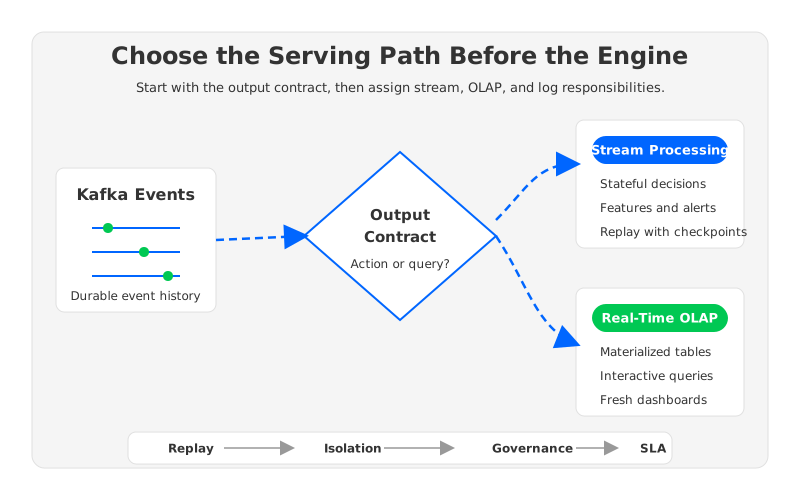
The distinction matters because stream processing and real-time OLAP serve different kinds of truth. Stream processing reacts to ordered events as they happen: fraud decisions, feature updates, enrichment, alerts, routing, session windows, and incremental state. Real-time OLAP queries materialized data with interactive latency: dashboards, drill-downs, aggregate exploration, analytics, and operational reporting.
The architectural mistake is to choose the engine before choosing the serving path. A serving path defines who consumes the event log, where state is materialized, how replay works, and which system owns the user-facing SLA. Once that path is clear, a stream processor can keep decisions fresh, an OLAP store can keep queries fast, and the Kafka-compatible backbone can remain durable enough for both.
1Why the Search Is a Production Signal
The phrase sounds like a tool comparison, but the pressure is operational. Data teams are often asked to support three requirements at once: low-latency reaction, historical replay, and flexible query. Those requirements overlap at ingestion, yet they diverge at serving time. A system that optimizes for event-by-event state updates is not automatically good at arbitrary group-by queries. A system that optimizes for columnar scans is not automatically good at coordinating exactly-once decisions against a changing event stream.
Kafka makes the overlap visible because it is the common substrate. The Apache Kafka model gives teams a durable log, topics, partitions, offsets, and consumer groups. That model decouples producers from multiple downstream consumers, so a Flink job, a ClickHouse ingestion pipeline, a Pinot real-time table, and a replay job may all read from the same source history. The question becomes less "which engine is more real time?" and more "which consumer should own which responsibility?"
Three production symptoms usually reveal that the boundary is wrong:
- Interactive queries are routed through stream jobs. The stream processor becomes a fragile API layer because business users want arbitrary filters, pivots, or time ranges that were not part of the original event-time logic.
- Every dashboard refresh turns into a log replay concern. The OLAP system lacks the right materialization path, so teams compensate by repeatedly reading Kafka history or overloading ingestion jobs.
- Kafka capacity planning follows downstream spikes. A hot analytical workload, model refresh, or historical rebuild forces the log layer to behave like elastic storage even when broker-local data placement was not designed for that rhythm.
2Stream Processing Owns Decisions Over Events
Stream processing is strongest when each event changes the next action. A payment event may update a fraud score. A product click may update a session feature. A device signal may trigger an alert after a windowed aggregation. The system is not merely storing data for later inspection. It is maintaining state that affects what happens next.
That is why Flink-style stateful stream processing has a different operating model from OLAP. Checkpoints, keyed state, timers, watermarks, and event-time windows exist because the processor must recover a running computation, not only reload a table. When a job fails, recovery must restore state and resume from consistent source offsets. When parallelism changes, state must be redistributed.
A good stream processing serving path has these traits:
- The output is a decision, feature, alert, or derived stream. The result is consumed by another service, model, topic, or sink that expects continuous updates.
- The query shape is known in advance. The job encodes business logic, joins, windows, and aggregations instead of accepting arbitrary analytical questions.
- Correctness depends on replay and recovery. Kafka offsets and Flink checkpoints become part of the same reliability story.
- Latency is measured from event to action. The important number is not how fast a dashboard scans a table; it is how quickly the pipeline changes downstream behavior.
This path is powerful, but it is not a replacement for an analytical serving layer.
3Real-Time OLAP Owns Questions Over Materialized Data
Real-time OLAP is strongest when many users ask many questions over data shaped for query. ClickHouse, Apache Pinot, Apache Druid, and similar systems are built around columnar storage, indexing, segment management, and query execution. They can ingest from Kafka and expose fresh analytical tables, but the serving contract is different: users expect flexible reads, not event-by-event decisions.
The key word is materialized. An OLAP system becomes useful when the ingestion path has turned raw event records into a queryable representation. That may involve schema design, sorting keys, partitioning, rollups, deduplication, and retention policies. A stream processor may feed that table, or the OLAP system may ingest directly from Kafka.
The common mistake is to treat real-time OLAP as a magic sink that removes upstream design work. It does not. A poorly keyed event stream, unbounded cardinality, or uncontrolled replay pattern can still create ingestion pressure. Real-time OLAP reduces query latency by materializing data close to the query engine, but that materialization has to be designed.
| Question | Better fit | Why |
|---|---|---|
| Should this payment be blocked now? | Stream processing | The answer changes an immediate action and depends on stateful event logic. |
| What was conversion by campaign for the last 30 days? | Real-time OLAP | The answer is an analytical query over materialized dimensions and measures. |
| Update a model feature within seconds of a user action | Stream processing | The output is a continuously maintained feature value. |
| Let operations teams drill into regional error rates | Real-time OLAP | Users need flexible filters, grouping, and time-range exploration. |
| Recompute a derived topic after business logic changes | Stream processing plus replay | Kafka retention and processor state define the recovery path. |
The boundary is healthy when each row has one primary owner.
4Kafka Is the Backbone, Not the Whole Serving Layer
Kafka sits before both paths, which can make it look like the neutral answer to every storage problem. That works for integration, replay, and decoupling. It becomes expensive when Kafka is expected to absorb every downstream serving concern without regard to storage architecture.
Traditional Kafka is shared-nothing: brokers own local storage, partitions live on broker disks, and replication copies data between brokers. This design is proven and widely deployed, but it couples storage growth, broker lifecycle, partition movement, and recovery. A stream processing backfill, an OLAP ingestion rebuild, and a consumer group catch-up all read from the same broker fleet that handles live writes and replication.
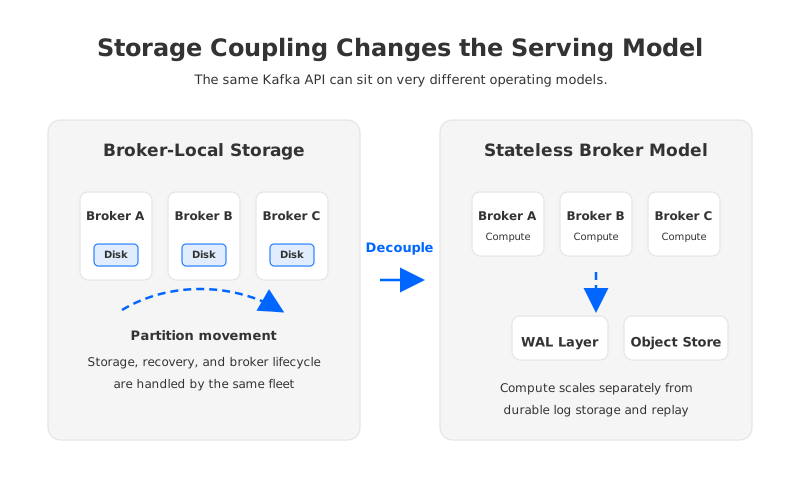
Tiered storage addresses part of this pressure by moving older log segments to remote storage. That is useful when retention grows beyond local disk economics. But tiered storage should not be confused with a fully stateless broker model. The hot path, write-ahead log design, metadata behavior, cache strategy, and recovery flow still determine whether broker capacity can scale independently from durable storage.
This is where cloud-native Kafka-compatible architecture changes the evaluation. After a team separates stream decisions from OLAP queries, the next question is whether the log backbone can support both without becoming the bottleneck. The platform needs durable replay, protocol compatibility, predictable scaling, and a deployment boundary that satisfies governance requirements.
AutoMQ fits this category as a Kafka-compatible streaming platform built around shared storage and stateless brokers. Instead of binding durable log data to broker-local disks, AutoMQ uses object storage as the shared storage foundation and a WAL layer for the write path. The effect is not that every downstream problem disappears. It is that replay, scaling, and recovery are evaluated against cloud-elastic storage rather than the local disk attached to each broker.
5A Serving-Path Evaluation Framework
The decision should start with workload semantics, then move to platform mechanics. Engine names are easier to debate than ownership boundaries, but the better sequence is to ask what the output is, how it fails, and who owns recovery.
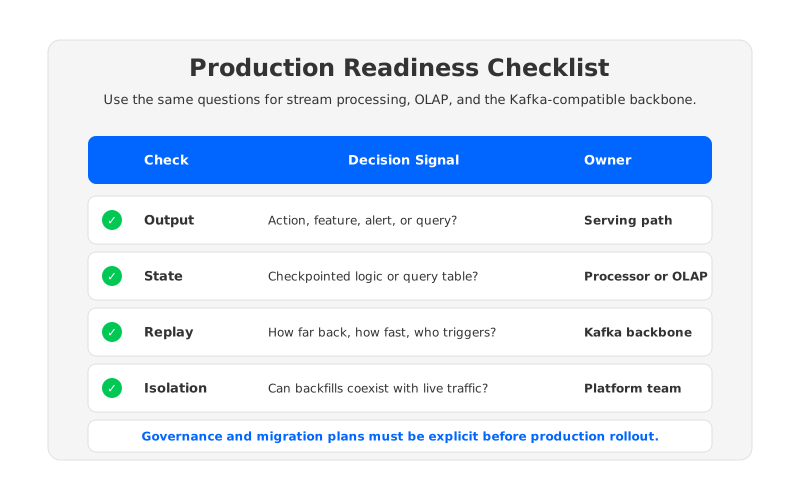
Use this checklist before committing to a serving path:
- Output contract. If the output is an action, feature, stream, or alert, start with stream processing. If the output is an exploratory query or dashboard, start with real-time OLAP.
- State contract. If correctness depends on keyed state, windows, timers, or checkpoint recovery, the stream processor owns the hard part. If correctness depends on table freshness, dimensions, and query consistency, the OLAP layer owns the hard part.
- Replay contract. Decide how far back Kafka must retain data, who triggers replay, and whether replay traffic can coexist with live producers and consumers.
- Isolation contract. Heavy backfills, OLAP rebuilds, and model refreshes should not starve unrelated workloads. The answer may be quotas, separate topics, separate clusters, or a more elastic log storage layer.
- Governance contract. Regulated teams need to know where data resides, who controls the deployment boundary, how access is audited, and whether cross-zone or cross-region movement is intentional.
The checklist also prevents a migration trap. A team may move from batch to streaming because dashboards need fresher data, then discover that the real problem was unclear ownership between computation, log retention, and analytical serving. Streaming ingestion can reduce freshness lag, but it cannot rescue a query model that never had a stable materialization design.
6Cost, Scaling, and Governance Change the Answer
Pure engine comparisons rarely survive contact with cloud bills. Stream processing costs accumulate through job slots, state backends, checkpoints, network traffic, and replay time. Real-time OLAP costs accumulate through ingestion capacity, storage, query CPU, indexing, and retention. Kafka costs sit underneath both: brokers, storage volumes, replication, inter-zone traffic, labor, and headroom.
The cost question is not "which path is lower cost?" A stream processor and an OLAP system are buying different things. The better question is which path pays for valuable work. Paying OLAP query CPU to support dashboard exploration is sensible. Paying a stream processor to simulate arbitrary dashboards is usually waste. Paying Kafka brokers to store ever-growing retained history on local disks becomes questionable when replay and retention dominate the operating model.
Governance has the same shape. A public SaaS analytics feature may need strict query isolation and tenant-aware materialization. A regulated AI pipeline may need customer-controlled infrastructure, private networking, auditable access, and deterministic replay. In those environments, AutoMQ BYOC and AutoMQ Software keep the data plane in the customer's environment while preserving Kafka compatibility for applications and tools.
The useful answer is often a composed architecture: Kafka-compatible log backbone, stream processor for event decisions, real-time OLAP for analytical serving, and object storage as the durable base for cloud economics. The pieces are pressure valves for different parts of the same real-time system.
7Decision Table
When the debate gets stuck, put the workload into a table. The right answer often appears when the team writes down the user-facing SLA and the recovery path in the same row.
| Workload pattern | Primary serving path | Kafka responsibility | Platform risk to watch |
|---|---|---|---|
| Fraud scoring, routing, real-time enrichment | Stream processing | Ordered input, offsets, replay, fan-out | Checkpoint recovery and state growth |
| Operational dashboards with drill-down | Real-time OLAP | Continuous ingestion source | Query isolation and materialization design |
| Historical reprocessing after logic changes | Stream processing over replay | Retained event history | Replay pressure on brokers and sinks |
| Customer-facing analytics API | Real-time OLAP | Source-of-truth event stream | Tenant isolation, freshness SLA, query cost |
| AI feature freshness pipeline | Stream processing plus analytical store | Durable log and backfill source | Feature correctness, replay, and storage elasticity |
If the log backbone becomes the limiting factor in several rows, tuning one engine will not fix the architecture. That is where evaluating a cloud-native Kafka-compatible platform such as AutoMQ becomes rational rather than promotional. The goal is to make the shared event backbone elastic enough that each serving path can do its job.
Real-time systems fail quietly when every layer is asked to be every other layer. Stream processing should own decisions over events. Real-time OLAP should own questions over materialized data. Kafka should own durable event history and replay. Once those contracts are explicit, the architecture becomes easier to scale and govern.
For teams evaluating the log layer behind these serving paths, the next practical step is to test whether Kafka compatibility, shared storage, and customer-controlled deployment can reduce operational coupling in your own workload. AutoMQ's architecture documentation is a good starting point for that evaluation, especially if broker-local storage or replay pressure is already shaping your platform roadmap.
8References
- Apache Kafka Documentation: Consumers
- Apache Kafka Documentation: Exactly-Once Semantics
- Apache Flink Documentation: Stateful Stream Processing
- Apache Flink Documentation: Checkpointing
- ClickHouse Documentation: Kafka Table Engine
- Apache Pinot Documentation: Stream Ingestion
- AutoMQ Documentation: Architecture Overview
- AutoMQ Documentation: WAL Storage
9FAQ
Is stream processing faster than real-time OLAP?
Not in a universal sense. Stream processing is faster for event-to-action workflows because computation runs continuously as events arrive. Real-time OLAP is faster for interactive analytical queries because data is materialized and indexed for flexible reads.
Can Kafka replace a real-time OLAP database?
Kafka can retain and replay events, but it is not designed to execute arbitrary analytical queries over materialized dimensions and measures. Most production architectures use Kafka as the ingestion and replay backbone, then serve analytics from an OLAP store.
Do I need Flink if my OLAP database can ingest from Kafka?
Direct ingestion may be enough for append-only dashboards or simple transformations. Flink becomes important when you need stateful computation, joins, event-time windows, feature updates, enrichment logic, or controlled reprocessing before data reaches the serving table.
Where does AutoMQ fit in this architecture?
AutoMQ fits at the Kafka-compatible log backbone layer. It is relevant when broker-local storage, replay pressure, scaling, cross-zone traffic, or customer-controlled deployment boundaries are material concerns for both stream processing and real-time OLAP consumers.
What is the simplest decision rule?
If the system must decide or update state as each event arrives, start with stream processing. If users need to ask flexible questions over fresh materialized data, start with real-time OLAP. In both cases, design the Kafka-compatible backbone for durable replay and isolation from the beginning.


