
Table of Contents
Table of Contents
Teams usually search for stream processing recovery kafka after a restart has stopped being harmless. A Flink job restarts after a state backend issue, a Kafka Streams application comes back with a different task assignment, or a connector resumes after a sink outage and drains backlog too fast. The immediate question sounds operational: can we restart this processor without corrupting output, losing data, or turning a short incident into a replay storm?
The deeper question is architectural. Stream processors are recoverable when the backbone can replay data predictably, expose offsets clearly, absorb catch-up traffic, and keep live ingestion separate from recovery work. Kafka is a strong fit because consumer groups, offsets, partitions, and retention give processors a durable input log. The runbook still has to cover state, external writes, schema changes, broker capacity, and team ownership.
1Why Teams Search for stream processing recovery kafka
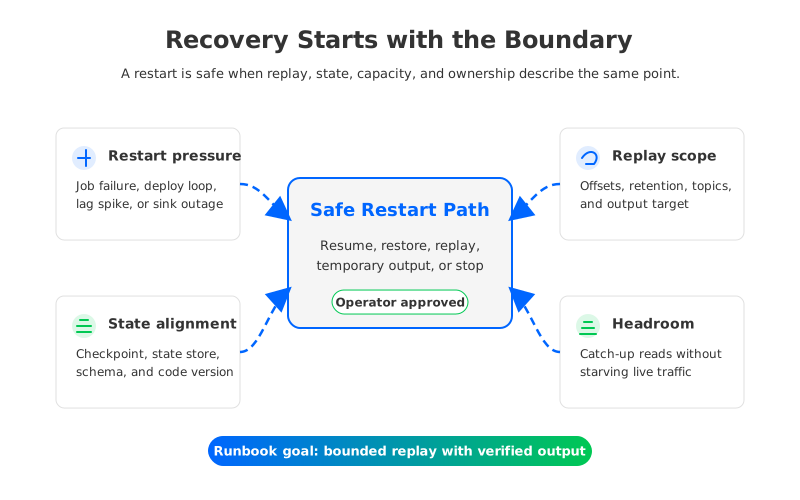
Restart pressure usually arrives through a concrete production symptom. Lag is growing after a deploy, a checkpoint cannot be restored, or a processor is writing duplicate rows to a warehouse. A consumer group reset looks tempting, but nobody is sure which downstream tables will be rebuilt and which ones will be appended again. The platform has become a recovery substrate for multiple stateful systems.
The most dangerous restart is the one that looks local. A processor owner sees a failed job and thinks about the job manager, task slots, and logs. The Kafka platform team sees consumer offsets, retained input topics, broker read pressure, partition assignment, producer idempotence, and catch-up reads colliding with live traffic. Both views are correct, but the runbook fails if they stay separate.
Search intent around stream processing recovery kafka tends to mix four questions:
- How far back can the processor safely replay, and does Kafka still retain the needed input?
- Which offsets, checkpoints, and external outputs define the true recovery point?
- Can the cluster handle catch-up reads without starving live producers and consumers?
- Who can approve a rollback, reset, replay, or partial output repair?
A useful runbook starts by making those concerns explicit. Restarting a stateless consumer is mostly about assignment and offset progress. Restarting a stateful processor is about aligning the input log, local or remote state, and side effects outside Kafka.
2The Integration Constraint Behind the Pipeline
Stream processing recovery is harder than ordinary consumer recovery because processors sit between systems with different truth models. Kafka tracks input progress through offsets, the processor tracks computation progress through state and checkpoints, and the sink tracks output progress through files, rows, indexes, or transactions. A restart is safe only when these markers describe the same point.
That alignment becomes fragile during incidents. A processor may consume records before committing output, or write output before committing offsets. Kafka transactions and exactly-once processing semantics can narrow these gaps for supported patterns, but they do not remove every side effect in an end-to-end data platform.
This is why a restart runbook should define the recovery unit before the command sequence. The unit might be a consumer group, a Flink job and checkpoint, a Kafka Streams application ID, or a connector plus destination table. Choosing the wrong unit creates an illusion of safety: the process restarts while the business data is still inconsistent.
3Replay Is a Product Requirement, Not an Incident Hack
Replayable Kafka backbones give platform teams a controlled way to recover processors, rebuild derived views, and validate fixes. Replay is not the same thing as "read from the beginning." It is a contract between retention, offset control, topic design, schema compatibility, processor determinism, and output idempotence.
The contract has to be designed before the outage. If a critical input topic keeps less history than the longest expected recovery window, Kafka cannot be the source for repair. If derived topics mix raw events, enrichment output, and sink-specific formatting, replay may rebuild more than intended. If downstream writes are not idempotent, retries become correctness risks.
The cleanest platforms separate replay from live flow without treating it as a second-class path. Replay jobs may use different consumer groups, quotas, schedules, temporary output topics, or isolated processing pools. The point is not to make replay slow. The point is to make replay deliberate.
| Recovery dependency | What the runbook must know | Failure if unknown |
|---|---|---|
| Input retention | Whether the needed offsets are still available | Recovery falls back to source-system exports or partial repair |
| Processor state | Which checkpoint or state snapshot matches the code | Restart replays with incompatible or stale state |
| Output behavior | Whether writes are idempotent, transactional, or append-only | Duplicate rows, missing updates, or inconsistent materialized views |
| Cluster headroom | How much catch-up read traffic the backbone can absorb | Replay delays live ingestion or raises broker pressure |
| Ownership | Who approves offset resets and output repair | Incident stalls while teams debate responsibility |
The architecture matters because it decides whether the runbook can answer these questions quickly under pressure.
4Shared-Nothing Kafka Makes Recovery a Capacity Event
Traditional Kafka uses a shared-nothing architecture where brokers own local log segments and replicas. This design is durable, familiar, and widely operated. It also ties recovery work to broker-local storage and network behavior. When a processor restarts and reads a large backlog, the cluster may already be balancing live writes, replication, compaction, retention, and other consumers.
Broker-local storage makes some recovery decisions expensive. Extending retention increases disk requirements on partition owners. Adding brokers may require reassignment before capacity is useful. Splitting replay workloads into another cluster can reduce blast radius, but then the platform inherits replication, mirrored offsets, access control, monitoring, and cutover work.
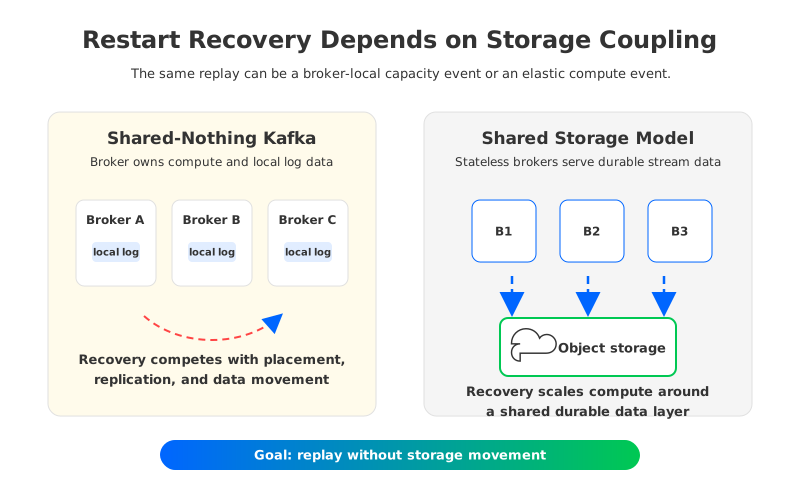
Tiered storage can reduce pressure on local disks by moving older segments to remote storage. That helps retention-heavy workloads, but it does not make brokers stateless. Active partitions, leader placement, reassignment, and hot reads still matter during recovery. The hard question remains: can the Kafka backbone support catch-up reads, state rebuilds, and live traffic together?
This is where cost and reliability meet. Overprovisioning brokers for rare recovery windows leaves steady-state waste. Running close to steady-state demand improves utilization, but it makes replay risky. A serious runbook names this trade-off instead of hiding it behind a restart command.
5Runbook Design for Stateful Stream Processors
A restart runbook should be short enough for an incident and precise enough to prevent data damage. Strong versions separate diagnosis, decision, action, and verification. They also contain stop conditions before destructive offset resets or output repair.
Start with diagnosis. Identify whether the failure is in the processor runtime, Kafka input, state backend, external sink, schema contract, or infrastructure capacity. A failed task manager and an incompatible schema can both show up as restart loops, but they require different recovery points.
The decision step should choose one recovery path:
- Resume from committed offsets and the latest valid state when the processor failed before consuming new input.
- Restore from a known checkpoint or state snapshot when the runtime state is corrupted or code changed.
- Replay from a bounded offset range when derived output must be rebuilt.
- Route output to a temporary target when correctness must be validated before replacing production results.
- Stop and escalate when input retention, schema compatibility, or output idempotence is uncertain.
The action step can then use the right tool for the processor framework. Kafka Streams teams may reason about application IDs, changelog topics, and state directories. Flink teams may reason about checkpoints, savepoints, and Kafka source offsets. Connector teams may reason about connector offsets, task status, and sink delivery. The Kafka backbone is common, but the controls are not identical.
Verification closes the loop. A recovered processor is healthy when lag moves as expected, sampled output is correct, state has converged, error topics are quiet, and live traffic is not starved by catch-up reads.
6Evaluation Checklist for Data Platform Teams
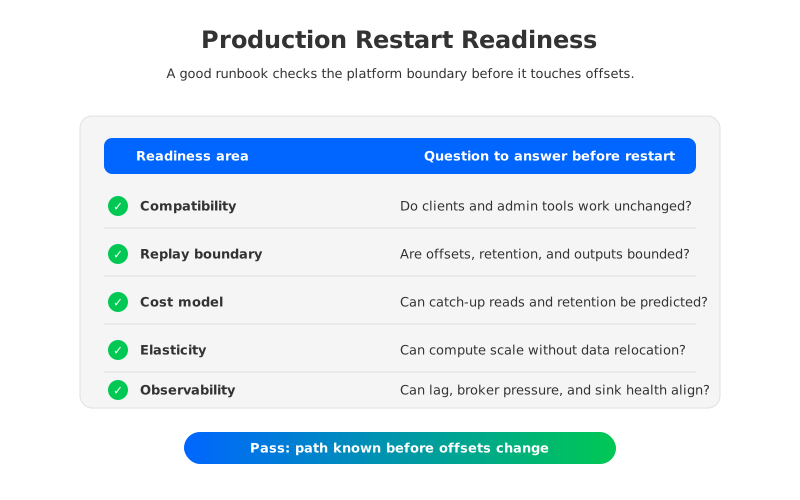
The neutral evaluation framework should ask whether the platform can support controlled recovery across compatibility, replay, cost, governance, and migration. That is more useful than asking whether a deployment pattern "supports Kafka," because recovery depends on behavior under stress.
| Evaluation area | Strong signal | Weak signal |
|---|---|---|
| Kafka compatibility | Clients, processors, admin tools, and security patterns are known to work | Recovery requires client rewrites or special protocol behavior |
| Replay boundary | Topics, offsets, retention, and output targets define bounded replay | Operators rely on "start over" without knowing downstream impact |
| Cost model | Catch-up reads, retention, and cross-zone traffic are visible | Recovery cost appears after replay or expansion |
| Elasticity | Compute can scale for recovery without major data relocation | Extra capacity waits on broker storage movement or manual rebalancing |
| Governance | Owners for input contracts, processor state, and output repair are named | Kafka, processing, and sink teams all assume another team owns correctness |
| Migration risk | Cutover and rollback preserve offsets and data contracts | Migration creates two possible truths for the same derived output |
| Observability | Lag, throughput, errors, broker pressure, and sink health are correlated | Dashboards show each subsystem but not the recovery path |
The checklist surfaces a useful pattern: the failure is rarely only in the processor. A restart can expose weak topic contracts, under-sized retention, unclear ownership, or infrastructure that cannot separate live and recovery traffic.
7How AutoMQ Changes the Operating Model
After the evaluation framework is clear, the infrastructure question becomes narrower: can the Kafka-compatible backbone make recovery less dependent on broker-local storage? AutoMQ fits this category as a Kafka-compatible streaming system built around Shared Storage architecture, stateless brokers, and object-storage-backed durability. It preserves Kafka-facing APIs while changing how durable stream data is placed underneath.
That operating model matters for restart runbooks. In a shared-nothing cluster, adding capacity or isolating recovery work often intersects with partition placement and broker-local data movement. In a shared storage model, broker compute can be treated more independently from the durable data layer. The platform still has to design topics, offsets, state handling, quotas, and downstream idempotence, but replay planning is less tightly coupled to local log ownership.
AutoMQ also gives platform teams a clearer path for cloud cost control. Object storage is the durable backbone, while stateless brokers serve the Kafka protocol and process traffic. For multi-zone deployments, AutoMQ's zero cross-AZ traffic design can reduce one recurring cost surprise: data moving between zones for replication or reads. Recovery does not become automatic, but the runbook can focus more on processor correctness and less on broker-local storage mechanics.
There are still limits. AutoMQ does not make a non-idempotent sink safe, repair an unsafe schema change, or decide whether replay should overwrite or append. Those are application and governance decisions. Its value is architectural: a replayable backbone less resistant to elastic recovery operations.
8A Restart Runbook Template
A concise runbook should fit on one page without becoming a command list that hides judgment. This template works across Kafka Streams, Flink, and connector-style processors.
- Identify the recovery unit: application ID, consumer group, connector, topic set, checkpoint, and output target.
- Confirm input availability: topics exist, offsets are retained, schemas are compatible, and no upstream correction is pending.
- Choose the recovery point: committed offsets, checkpoint, bounded offset range, or temporary replay target.
- Protect live traffic: set replay quotas, schedule catch-up, isolate workers where needed, and watch broker read pressure.
- Execute restart or replay with the processor-native mechanism first; reset Kafka offsets only with data owner approval.
- Verify correctness: compare sampled input and output, check lag, inspect error topics, and confirm downstream state.
- Close or rollback: document final offsets, checkpoint identifiers, output repair actions, and temporary capacity changes.
The template is conservative around offset resets. Offsets are progress markers, not correctness markers. Resetting them can be right, but only after the team knows what output will be rebuilt and how duplicates or gaps will be handled.
9Architecture Recommendations
Treat restart recovery as a steady-state design requirement, not a rare incident path. Critical processors need retention windows that match recovery objectives, bounded replay procedures, and downstream outputs that tolerate retries or controlled rebuilds. The Kafka backbone should connect processor lag with broker pressure and sink health so teams know whether the processor is broken or the platform is protecting itself.
Use shared clusters when workloads have similar recovery windows and the same failure budget. Use dedicated clusters or stricter namespaces when replay volume, data sensitivity, or ownership demands a harder boundary. Use Kafka-compatible shared storage when the team needs Kafka semantics but wants to reduce storage-bound broker recovery, elastic catch-up, and multi-zone cost friction.
The useful test is simple: can a processor restart during business hours without becoming a company-wide Kafka event? If not, start with the replay boundary, recovery point, and architecture that lets the platform honor both.
If your stream processors are becoming harder to restart because replay, retention, and broker-local capacity are tangled together, evaluate whether a Kafka-compatible shared storage backbone fits your recovery model. AutoMQ can help teams explore that path while keeping Kafka APIs and customer-controlled deployment boundaries: explore AutoMQ for cloud-native Kafka streaming.
10References
- Apache Kafka documentation: consumers and consumer groups
- Apache Kafka documentation: delivery semantics and transactions
- Apache Kafka Streams documentation
- AutoMQ documentation: architecture overview
- AutoMQ documentation: Kafka compatibility
- AutoMQ documentation: stateless broker
- AutoMQ documentation: eliminate inter-zone traffic
11FAQ
11.1What does stream processing recovery in Kafka mean?
Stream processing recovery in Kafka means restoring a processor to a correct point in the input log, state, and downstream output after a failure, restart, migration, or replay. It usually involves consumer offsets, checkpoints or state stores, retained topics, and output correctness.
11.2Is restarting a stream processor the same as restarting a Kafka consumer?
No. A simple Kafka consumer restart may only need committed offsets and group rebalancing. A stateful stream processor also needs compatible state, checkpoint alignment, deterministic replay behavior, and downstream write handling.
11.3When should a team reset Kafka offsets during recovery?
Offset resets should be treated as controlled data repair actions. Use them only after confirming input retention, output behavior, replay scope, and data owner approval. A reset can rebuild correct output, but it can also duplicate or erase business results if the downstream path is not prepared.
11.4How does shared storage help stream processor restart runbooks?
Shared storage separates durable stream data from broker-local disks, so recovery traffic and elastic broker compute are less tied to local log ownership. It does not replace checkpoints or idempotent output design, but it can reduce infrastructure friction around replay and catch-up operations.


