
Table of Contents
Table of Contents
Teams usually search for stream to iceberg write path kafka after the first lakehouse ingestion prototype has crossed a dangerous line: it works well enough to depend on. Kafka receives events, a connector or processing job writes files, Apache Iceberg exposes snapshots, and analysts start asking why the table is not fresher. Production asks a sharper question: who owns the write path when the streaming layer, the table commit layer, and the catalog layer fail on different schedules?
That question matters because a stream-to-Iceberg path is not a single pipe. It is a chain of offset ownership, buffering, file creation, table commits, schema decisions, and recovery choices. Kafka can retain the source records, Iceberg can preserve table snapshots, and a processing engine can checkpoint progress, but those guarantees do not automatically compose into a clean operational contract. A platform team has to define where records are durable, when offsets can advance, what happens to partial files, and how far the system can roll back without losing the table's auditability.
The first production mistake is treating the write path as an ETL detail owned by one job. It is really a platform boundary. Once table freshness becomes part of customer analytics, feature engineering, or financial reporting, the Kafka-compatible platform underneath the workload influences cost, recovery time, and governance as much as the Iceberg writer does.
1Why Teams Search for stream to iceberg write path kafka
The search phrase is awkward, but the intent is precise. Readers are trying to connect systems with different ideas of progress. Kafka tracks append order and consumer offsets. A stream processor or connector turns records into files and commits progress. Iceberg tracks table metadata through snapshots, manifests, partition specs, and catalog commits.
In a small workload, the gap is easy to hide. A single writer consumes a topic, flushes files, commits the Iceberg snapshot, and then commits Kafka offsets. In a larger workload, the same sequence is stressed by partition growth, writer parallelism, schema evolution, late data, compaction, catalog latency, and object storage behavior. If the writer commits offsets before the table commit is durable, records can disappear from the table. If it waits too long, lag grows and Kafka retention becomes a recovery dependency.
The useful evaluation starts by separating the write path into responsibilities:
- Kafka-compatible ingestion must preserve record order, offsets, client compatibility, and replay windows for the topics that feed the table.
- The writer must transform records into table files, coordinate commits, handle partial output, and expose enough state for rollback.
- Iceberg must maintain table metadata, snapshots, schema evolution, partition evolution, and catalog consistency.
- The platform team must monitor lag, commit latency, failed tasks, storage growth, network paths, access control, and recovery drills.
This split prevents a common review failure. A team may ask whether Kafka can write to Iceberg, when the harder question is whether the organization can operate the whole path under load and incident response.
2The Lakehouse Freshness Constraint Behind the Workload
Iceberg changes the shape of the lakehouse because table metadata gives readers a consistent view while writers keep adding files. That consistency is valuable, but it is not free. Each streaming write path must decide how frequently to commit snapshots, how large files should be, how schemas are enforced, and how maintenance jobs compact or expire old metadata. Short commit intervals improve freshness but can increase metadata pressure, while long intervals push table visibility behind the stream.
Kafka introduces a second freshness clock: consumer lag. If the Iceberg writer falls behind, the platform has to retain source records long enough for replay. Retention is not only a Kafka setting in this case. It is a promise that the table pipeline can recover from catalog outages, writer restarts, bad schema deployments, and downstream maintenance delays. A topic retention policy that looks generous for ordinary consumers may be too narrow for a table writer that has to replay hours of committed and uncommitted work.
This is why the write path should be designed around recovery points rather than around the happy-path data flow. The operator needs to know the last durable table snapshot, the offset range represented in that snapshot, and the status of files produced after that point.
3Stream-to-Table Architecture Options
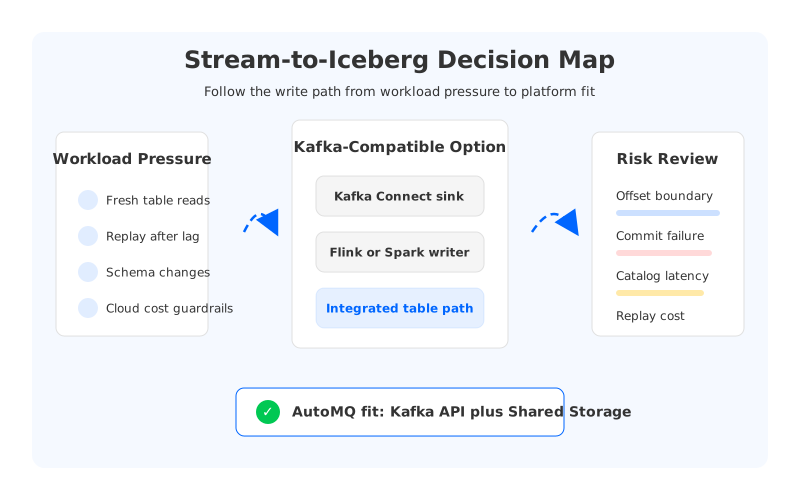
Most production designs fall into three categories. The first is Kafka plus a connector or sink framework. Kafka Connect is attractive when the workload is mostly ingestion and the organization already operates connectors. It gives teams a familiar deployment model, but the Iceberg-specific behavior still depends on connector implementation, catalog support, schema policy, and failure semantics.
The second category is Kafka plus a stream processor such as Flink or Spark Structured Streaming. This path fits workloads that need stateful transformations, joins, deduplication, enrichment, or event-time processing before the table commit. The trade-off is a wider operating surface across Kafka, the processing cluster, checkpoint storage, job deployment, Iceberg catalog integration, and table maintenance.
The third category is an integrated stream-table path in the Kafka-compatible platform. This is most interesting when the goal is reliable materialization of topic data into Iceberg without building a separate processing estate for basic ingestion. The platform still has to prove compatibility, governance, observability, and rollback behavior.
| Option | Good fit | Main operating risk | Review focus |
|---|---|---|---|
| Kafka Connect sink | Standard ingestion, existing connector operations | Connector-specific commit and retry behavior | Offset-to-snapshot mapping, task scaling, schema handling |
| Stream processor | Stateful transformations before table writes | More infrastructure and checkpoint ownership | Job recovery, checkpoint storage, catalog latency, backpressure |
| Integrated stream-table path | Direct topic-to-Iceberg materialization | Platform feature maturity and constraints | Compatibility, table configuration, rollback and observability |
The table makes one point clear: no option removes the need for architecture review. It changes who owns the riskiest part of the write path.
4Shared Nothing Pressure in a Table-First Workload
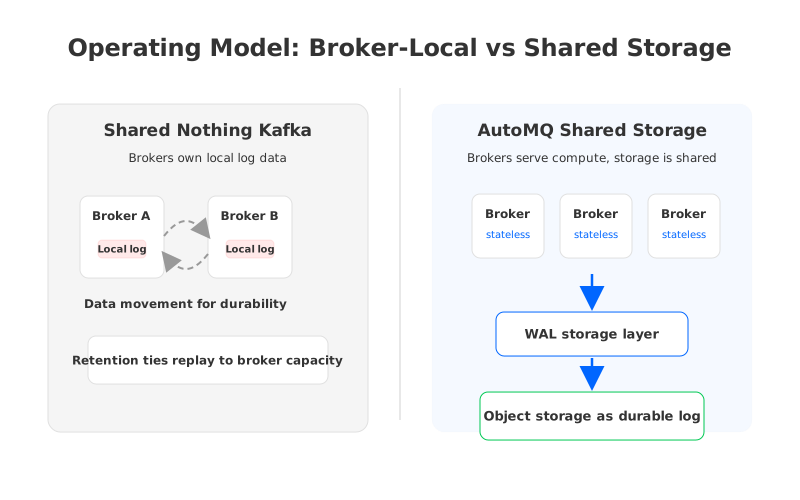
Traditional Kafka deployments use a Shared Nothing model where brokers own local data and replication moves data between brokers for durability. The pressure appears when the lakehouse workload forces the cluster to retain more data, absorb bursty replay, scale partition counts, and keep multi-AZ availability while a separate writer drains topics into Iceberg.
Broker-local storage turns retention and replay into capacity planning problems. If the Iceberg writer falls behind, Kafka must hold data longer. If a broker fails or the cluster expands, data movement competes with producer traffic, consumer reads, and connector catch-up. If the deployment spans availability zones, replication and client placement can become network cost drivers.
Tiered storage can reduce some local disk pressure by offloading older data to object storage, but it does not always remove the operational coupling between partitions, brokers, and local primary storage. For stream-to-Iceberg workloads, the practical question is whether the platform can scale retention and replay windows without turning every table delay into a broker capacity event.
5Evaluation Checklist for Platform Teams
A serious evaluation should start before any product name enters the discussion. The platform team needs to define the contract that the write path must satisfy, then map each candidate architecture to that contract.
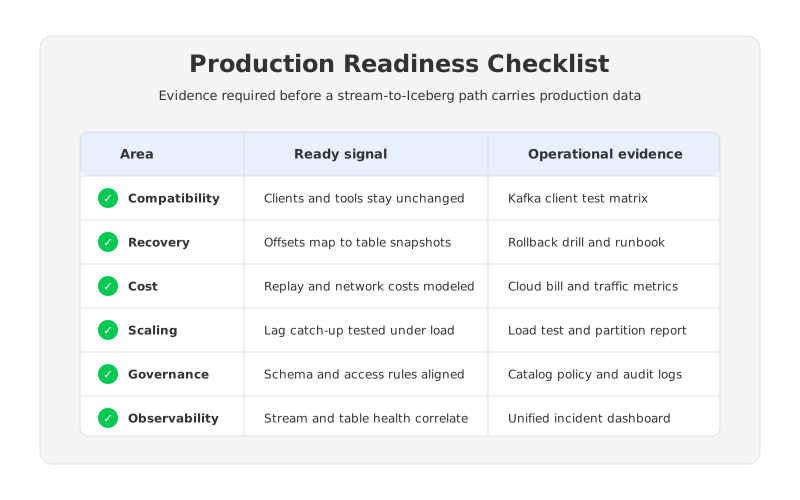
- Compatibility: Which Kafka client versions, producer settings, consumer group behavior, transactions, security features, and ecosystem tools must keep working unchanged?
- Recovery: Where is the last known durable table snapshot, how are Kafka offsets tied to it, and what is the rollback path after a failed commit?
- Cost: How much storage is held in Kafka for replay, how much data crosses availability zones, and which object storage or catalog operations grow with write frequency?
- Elasticity: Can the platform absorb bursty producer traffic, writer lag, partition growth, and catch-up reads without long data reassignment windows?
- Governance: Who owns schema evolution, table properties, access control, lineage, audit logs, and retention policies across the stream and the table?
- Migration: Can producers, consumers, connector jobs, and table readers move in phases, and can the team fall back without corrupting table state?
- Observability: Can operators see lag, file creation, commit duration, failed snapshots, catalog errors, storage growth, and replay health in one incident timeline?
The checklist keeps the discussion close to production ownership. A low-latency demo that cannot answer rollback or schema questions is not ready. A cost model that ignores replay retention or cross-zone traffic is incomplete.
6How AutoMQ Changes the Operating Model
Once the evaluation framework is clear, AutoMQ becomes relevant as a Kafka-compatible, cloud-native streaming platform that separates broker compute from durable storage. AutoMQ keeps Kafka protocol compatibility while replacing Kafka's local log storage with a Shared Storage architecture based on object storage and WAL storage. In practical terms, brokers become stateless relative to long-lived stream data, and the platform can scale compute and storage more independently than a broker-local deployment.
That shift matters for stream-to-Iceberg write paths because table freshness problems often show up as streaming platform problems. If the writer lags, the topic needs a larger replay window. If a table deployment causes bursty catch-up reads, the streaming layer must serve replay without destabilizing producers. Shared Storage does not make Iceberg commits easier by itself, but it changes the cost and operational profile of the Kafka-compatible source that feeds those commits.
AutoMQ also has a specific feature, Table Topic, for materializing topic data into Apache Iceberg tables. It is not a replacement for stream processing jobs that perform complex joins, enrichment, or event-time computation. It is a different fit: direct topic-to-Iceberg ingestion where the team wants the streaming platform and the table write path to share a tighter operating model. The right question is whether a given pipeline is mostly ingestion, mostly transformation, or mostly governance.
For teams running in cloud environments, the network path deserves special attention. Multi-AZ Kafka deployments can accumulate inter-zone traffic from producer placement, broker replication, and consumer reads. AutoMQ's inter-zone traffic design uses its S3-based shared storage architecture and zone-aware routing to reduce broker-to-broker replication traffic and keep clients aligned with local-zone access patterns.
The migration question is equally practical. A Kafka-compatible platform is useful only if existing producers, consumers, connectors, and operational tools can move with controlled risk. AutoMQ's compatibility model retains Kafka protocol and ecosystem compatibility while changing the storage layer, so evaluation can focus on workload behavior rather than client replacement.
7A Readiness Scorecard for Production
The final decision should produce a scorecard, not a slide with architecture boxes. A stream-to-Iceberg path is production-ready when the team can explain how data moves forward and how it moves backward after a failure.
| Area | Ready signal | Not ready signal |
|---|---|---|
| Offset ownership | Offsets advance only after a durable table boundary is known | Offset commits are treated as connector internals |
| Table commits | Failed and partial commits have documented cleanup behavior | Operators cannot explain orphan files or snapshot rollback |
| Replay window | Kafka retention covers realistic writer and catalog outages | Retention is copied from ordinary consumer defaults |
| Schema governance | Producer schema, table schema, and evolution policy are aligned | Schema changes are handled after incidents |
| Platform elasticity | Catch-up reads and partition growth are tested under load | Scaling depends on long broker-local data movement |
| Observability | Stream lag and Iceberg commit health appear in one timeline | Kafka and table alerts fire in separate operational worlds |
Kafka Connect, Flink, Spark, and integrated table paths can all be valid. A Shared Nothing Kafka cluster, a tiered Kafka deployment, and a Shared Storage Kafka-compatible platform can all be part of a serious evaluation. The differentiator is whether the architecture keeps the write path understandable as traffic, retention, and governance demands grow.
If your team is reviewing a stream-to-Iceberg path and wants to compare a Kafka-compatible Shared Storage approach with an integrated Table Topic option, the next practical step is to test the workload against your own replay, schema, and recovery requirements. AutoMQ provides documentation for the architecture and Table Topic path, and you can start from the AutoMQ site here: explore AutoMQ for Kafka-compatible lakehouse ingestion.
8References
- Apache Kafka documentation
- Apache Iceberg documentation
- AWS S3 performance guidelines
- AWS EC2 on-demand pricing and data transfer reference
- AutoMQ Shared Storage architecture
- AutoMQ Kafka compatibility
- AutoMQ inter-zone traffic overview
- AutoMQ Table Topic overview
9FAQ
9.1What is a stream-to-Iceberg write path?
A stream-to-Iceberg write path is the operational chain that consumes records from a streaming system such as Kafka, writes data files, commits Apache Iceberg table metadata, and advances source offsets. It includes the writer, catalog, table storage, replay policy, schema governance, and observability around those steps.
9.2Is Kafka Connect enough for writing Kafka topics to Iceberg?
Kafka Connect can be enough for standard ingestion when the connector behavior, catalog support, schema policy, and recovery model match the workload. It is less suitable when the pipeline needs complex stateful transformations, joins, enrichment, or custom event-time logic. Those cases usually fit a stream processor better.
9.3When should a team use Flink or Spark instead of an integrated table path?
Use Flink or Spark when the pipeline must transform the stream before writing the table. Examples include deduplication, joins, windowed aggregations, enrichment, or event-time processing. An integrated table path is more appropriate for direct materialization of topic data into Iceberg where ingestion reliability and operational simplicity are the main goals.
9.4How does AutoMQ Table Topic relate to Iceberg ingestion?
AutoMQ Table Topic is a built-in path for materializing topic data into Apache Iceberg tables. It is designed for teams that want Kafka-compatible streaming and table ingestion to share a tighter operating model. Teams should still validate version requirements, catalog type, schema behavior, recovery, and observability before using it in production.
9.5What should be tested before production rollout?
Test offset-to-snapshot mapping, failed commit recovery, writer restarts, catalog outages, schema evolution, replay after lag, cross-zone traffic behavior, alert quality, and rollback procedures. The test is complete only when operators can explain both forward progress and failure recovery without relying on undocumented connector internals.


