
Table of Contents
Table of Contents
Searches for kafka cost anomaly detection rarely come from a team that has never looked at a Kafka bill. They usually come from teams that already have dashboards, tags, alerts, and monthly FinOps reviews, yet still get surprised by a cluster that moved from predictable infrastructure to a cost exception. The cause may be a retention change, consumer replay, connector retry loop, broker replacement, or cross-zone path that looked harmless during design review.
Kafka makes this problem harder because cost is distributed across several technical layers. The application team sees producer throughput and consumer lag. The platform team sees brokers, partitions, disks, reassignments, and controller state. The cloud team sees compute, storage, private networking, object requests, and data transfer. Each view is truthful, but none of them alone explains why the monthly number changed. Cost drift detection for Kafka is the discipline of connecting those views before a billing anomaly becomes an operating incident.
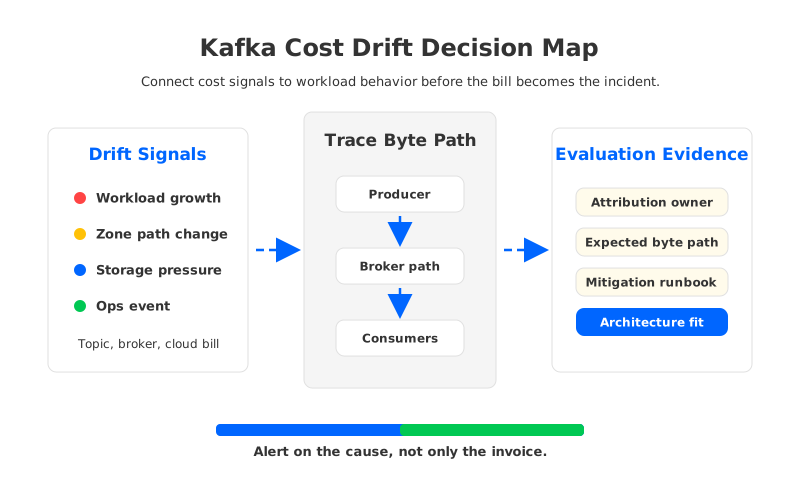
The goal is to make the cost model observable like latency, availability, and lag. If a team can trace cost drift back to a workload, architecture decision, or operational event, it can decide whether the drift is acceptable growth, a bug, or a signal that the streaming platform is carrying the wrong shape of state.
1Why Teams Search for kafka cost anomaly detection
A Kafka cost anomaly usually starts as a question that no single team can answer quickly. FinOps asks why network transfer increased. SRE checks broker health and finds no outage. Data engineering notices that one consumer group replayed history. Application owners say the traffic spike was expected. By the time teams agree on a cause, the prevention window has passed.
That pattern appears because Kafka cost is coupled to runtime behavior. A normal-looking topic configuration can become expensive when read fanout grows. A reasonable replication factor can produce a large network line item in a multi-AZ cloud deployment. A connector that retries aggressively can generate duplicate writes and downstream reads. A retention increase can change storage, recovery time, cache pressure, and backfill economics.
The most useful anomaly categories are therefore technical, not accounting-only:
- Workload drift: ingress, egress, read fanout, consumer replay, topic growth, or partition count changed faster than the forecast.
- Topology drift: clients, brokers, connectors, or private endpoints moved across zones, VPCs, accounts, or regions in a way that changed traffic paths.
- Storage drift: retention, compaction, tiering, local disk headroom, object storage requests, or replay patterns shifted the storage cost surface.
- Operational drift: rebalancing, broker replacement, migration, incident recovery, or connector retries created temporary traffic that became visible in the bill.
- Ownership drift: the team that caused the cost and the team that pays for the platform stopped sharing the same labels, dashboards, or review process.
Generic cloud cost alerts are not enough. A Kafka-aware drift system should say whether the change came from a topic, group, broker path, storage policy, or operation.
2The Production Constraint Behind the Problem
Traditional Kafka follows a shared-nothing architecture. Brokers own local log data, followers replicate from leaders, and partitions are placed on specific brokers. This design is proven and understandable, but it also means the broker is both a compute process and a storage owner. In cloud environments, that dual role turns many platform changes into cost changes.
The same byte can touch multiple billable surfaces. It is written by producers, replicated for durability, stored for retention, fetched by consumers, replayed by backfills, and moved during reassignment or recovery. Cloud billing separates compute, block storage, object storage, private connectivity, and data transfer; Kafka behavior crosses those boundaries continuously. A stable application metric can still hide cost drift if the traffic path or storage model changed underneath it.
Apache Kafka features and ecosystem tools give teams important controls. Consumer groups and offsets make read progress observable. Transactions and idempotent producers help protect correctness. KRaft removes the old ZooKeeper dependency from Kafka metadata management. Tiered Storage can move older log segments to remote storage, reducing pressure on broker-local disks for long-retention workloads. Kafka Connect and MirrorMaker 2 help with integration and movement. None of these controls remove the need to map Kafka behavior to cloud cost drivers.
The cost model becomes sensitive at platform scale. A small topic-level decision can multiply across thousands of partitions. A replay pattern can turn retained history into a bursty read workload. A broker placement change can alter cross-zone transfer. Cost drift detection needs to see these changes as platform events, not invoice deltas.
3Architecture Options and Trade-Offs
Platform teams usually have three architecture choices when Kafka cost drift becomes a recurring problem. They can keep local-disk Kafka and improve instrumentation. They can add tiered storage where retention is the dominant pressure. Or they can evaluate Kafka-compatible shared storage, where durable stream data is moved away from broker-local disks and brokers become less stateful with respect to retained data.
| Option | Cost drift it can expose or reduce | What still needs validation |
|---|---|---|
| Local-disk Kafka with better observability | Strong topic, broker, disk, and consumer-group visibility when the team owns the full stack | Reassignment, local storage headroom, cross-zone replication, and replay cost remain tied to broker placement |
| Kafka Tiered Storage | Lower local-disk pressure for older segments and long retention | Active log behavior, cache misses, remote reads, broker lifecycle, and cloud storage request patterns |
| Kafka-compatible shared storage | Less broker-local durable state, more independent compute and storage scaling, and a clearer object-storage cost model | Kafka compatibility, WAL durability, object storage latency, cache behavior, migration safety, and governance boundaries |
The table should not be read as a ranking. Local-disk Kafka can be the right answer when workload shape is stable and the team values operational familiarity. Tiered storage can be the right answer when the main issue is keeping older data without expanding broker disks. Shared storage becomes interesting when the cost anomaly is rooted in the broker owning durable state: over-provisioned disks, slow data movement, cross-zone replication paths, or scaling events that move more bytes than the business expected.
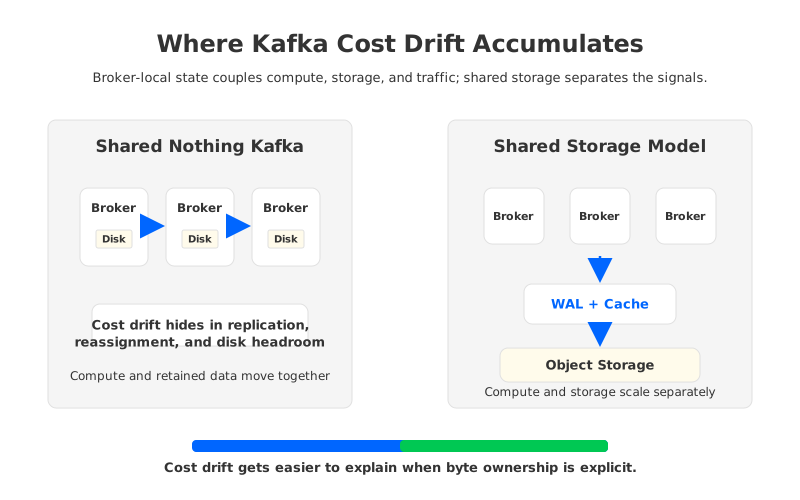
The trade-off is that shared storage moves responsibility rather than deleting it. The platform must still prove when a write is durable, how hot reads are served, how replay works, how client semantics are preserved, and how object storage policy is governed. A cost architecture that cannot explain failure behavior is not production-ready, no matter how attractive the spreadsheet looks.
4Evaluation Checklist for Platform Teams
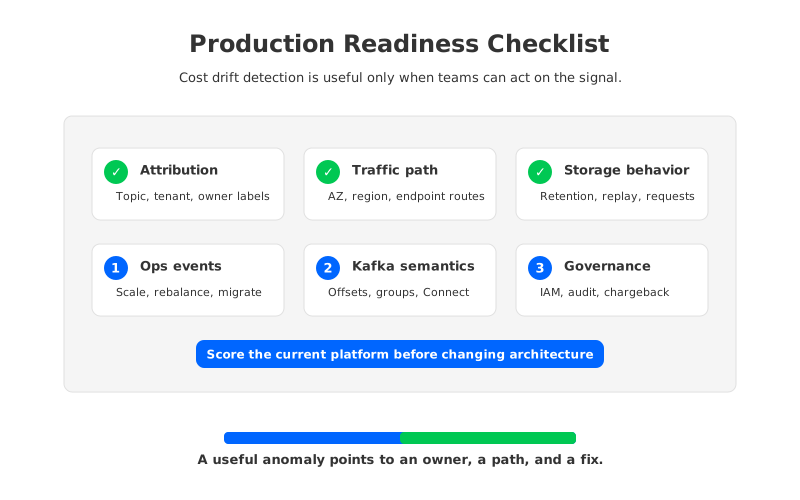
Cost drift detection should start with a measurable contract. A monthly bill is too slow and coarse. A per-topic cost estimate can become false precision if it ignores consumer fanout, retries, storage lifecycle, private connectivity, and operational events. The practical contract is a short list of signals that platform, FinOps, and application teams can all recognize.
| Review area | Evidence to collect | Decision question |
|---|---|---|
| Workload attribution | Topic, tenant, producer, consumer group, connector, and environment labels | Can the team name who owns the drift within one review cycle? |
| Traffic path | Ingress, egress, replication, cross-zone, cross-region, PrivateLink, and NAT paths | Did the bytes move through the path the architecture expected? |
| Storage behavior | Local disk, remote tier, object storage, request volume, retention, compaction, and replay reads | Is the storage cost driven by retention policy or by unexpected access patterns? |
| Operational events | Broker replacement, partition reassignment, scaling, incident recovery, migration, and backfills | Was the anomaly caused by a planned operation, an incident, or normal growth? |
| Kafka semantics | Offsets, consumer groups, transactions, idempotence, Connect jobs, and MirrorMaker or linking state | Can mitigation avoid breaking application correctness? |
| Governance | IAM, encryption, bucket policy, network ownership, tags, audit logs, and chargeback rules | Does the cost owner match the infrastructure owner and data owner? |
This checklist works best when wired into incident review. If cost drift is treated as finance-only, engineers will see it after the technical cause is gone. If it is treated as SRE-only, teams may optimize noisy symptoms while missing procurement, tagging, or ownership gaps. Kafka platform owners need both views because streaming systems are long-running shared infrastructure, not isolated batch jobs.
The first implementation can be simple. Start with one expensive cluster and map the top topics by write throughput, retained bytes, read fanout, and consumer replay. Then add cloud metrics for data transfer, storage, and private connectivity. Finally, annotate the timeline with scaling, reassignment, retention changes, connector deployments, and migration tests. The result is a drift detection loop that can distinguish expected growth from architectural waste.
5How AutoMQ Changes the Operating Model
After that neutral framework is in place, AutoMQ becomes relevant as a Kafka-compatible cloud-native streaming platform built around Shared Storage architecture. It keeps the Kafka protocol surface while changing the storage layer underneath: brokers are stateless for durable stream data, S3Stream stores persistent stream data in S3-compatible object storage, and WAL storage protects the write path before data is organized into object storage.
That architecture changes the shape of cost drift. In traditional Kafka, durable data ownership sits on brokers, so scaling and recovery can involve local disk, replication traffic, and partition data movement. In AutoMQ, durable data is externalized into shared storage, so broker capacity and storage capacity can be reasoned about more independently. Cost management still requires discipline, but the categories become clearer: broker compute, WAL, cache, object storage, object requests, and network paths.
The zero cross-AZ traffic design is particularly relevant to Kafka cost anomaly detection. Traditional multi-AZ Kafka deployments often create cross-zone transfer through replication and client placement. AutoMQ's supported cloud deployment patterns are designed to reduce that class of traffic by using stateless brokers, shared storage, and zone-aware access paths. The evaluation point is not a slogan; it is a testable question for FinOps and SRE: when workload traffic changes, does the bill show broker-to-broker cross-zone drift or a more controlled storage-backed path?
Customer-controlled deployment boundaries also matter. AutoMQ BYOC runs in the customer's cloud account and VPC, while AutoMQ Software targets private infrastructure. For regulated teams, that means the same drift review can include bucket ownership, IAM policy, encryption, network controls, telemetry scope, and chargeback labels. Cost anomaly detection is stronger when the platform architecture does not hide the infrastructure boundary that produces the bill.
AutoMQ still needs production validation like any Kafka-compatible platform. Teams should test producer and consumer compatibility, transactions if used, consumer group behavior, Kafka Connect jobs, monitoring integrations, failure recovery, replay, object storage behavior, and migration rollback. The test should focus on whether the architecture reduces the specific drift sources the team cares about: over-provisioned broker disks, expensive cross-zone paths, slow data movement, or capacity plans built around worst-case retention.
6A Readiness Scorecard for Cost Drift Detection
Before changing architecture, score the current platform honestly. Give each area a value from 0 to 2: 0 means missing, 1 means partial, and 2 means production-ready. The total is less important than the weak spots because those weak spots become proof points for any target architecture.
| Area | 0 | 1 | 2 |
|---|---|---|---|
| Attribution | Cluster-level bill only | Topic or tenant labels exist but are incomplete | Topic, tenant, environment, and owner are reliable |
| Cost path | Cloud bill is reviewed manually | Major services are separated | Kafka behavior is mapped to compute, storage, and network paths |
| Event timeline | Incidents and cost are reviewed separately | Some platform events are annotated | Scaling, replay, migration, and retention changes are correlated with cost |
| Mitigation | Engineers react after budget alerts | Runbooks exist for obvious cases | Teams can choose workload, topology, storage, or architecture mitigation |
| Migration safety | No rollback model | Mirroring or linking is tested for a subset | Offsets, clients, data, and rollback are validated with production-like traffic |
A low score does not automatically mean the team needs a replacement streaming platform. It means the team does not yet know why cost moves. Fixing attribution and event timelines may reveal that the current architecture is fine. It may also reveal that the same cost drivers recur because the architecture keeps binding durable data, compute, and network movement together.
That is the decision point. If the drift comes from poor labels or missing dashboards, improve governance first. If it comes from a few wasteful consumers, fix application behavior first. If it comes from a structural pattern in broker-local storage, cross-zone replication, or data movement during operations, evaluate whether a Kafka-compatible shared-storage model changes the operating burden.
When your next kafka cost anomaly detection review starts, do not begin with the invoice. Begin with the byte path. Identify who produced the data, where it was stored, how often it was read, which zones it crossed, and which events changed the path. If that investigation keeps ending at broker-local state and data movement, test a different operating model. To evaluate AutoMQ against that checklist, start with the AutoMQ GitHub repository and run one production-like workload through the cost drift scorecard before widening adoption.
7References
- Apache Kafka documentation: https://kafka.apache.org/documentation/
- Apache Kafka consumer documentation: https://kafka.apache.org/documentation/#consumerapi
- Apache Kafka message delivery semantics: https://kafka.apache.org/documentation/#semantics
- Apache Kafka KRaft documentation: https://kafka.apache.org/documentation/#kraft
- Apache Kafka KIP-405: Kafka Tiered Storage: https://cwiki.apache.org/confluence/display/KAFKA/KIP-405%3A+Kafka+Tiered+Storage
- AWS EC2 On-Demand pricing and data transfer: https://aws.amazon.com/ec2/pricing/on-demand/
- AWS S3 pricing: https://aws.amazon.com/s3/pricing/
- AutoMQ architecture overview: https://docs.automq.com/automq/architecture/overview?utm_source=blog&utm_medium=reference&utm_campaign=aivk-0030
- AutoMQ S3Stream Shared Streaming Storage: https://docs.automq.com/automq/architecture/s3stream-shared-streaming-storage/overview?utm_source=blog&utm_medium=reference&utm_campaign=aivk-0030
- AutoMQ migration overview: https://docs.automq.com/automq-cloud/migrate-to-automq/overview?utm_source=blog&utm_medium=reference&utm_campaign=aivk-0030
8FAQ
8.1What is Kafka cost anomaly detection?
Kafka cost anomaly detection is the practice of correlating Kafka workload behavior with cloud cost signals. It connects topics, producers, consumer groups, connectors, brokers, storage, network paths, and platform events so teams can explain why spend changed.
8.2Which Kafka metrics matter most for cost drift?
Start with bytes in, bytes out, retained bytes, consumer lag, read fanout, partition count, broker disk utilization, reassignment activity, connector retries, and client placement by zone or network boundary. Then join those metrics with cloud data transfer, storage, request, and compute costs.
8.3Does Kafka Tiered Storage solve cost anomaly detection?
Tiered Storage can reduce local-disk pressure for long retention, but it does not replace cost observability. Teams still need to track active log behavior, remote reads, cache misses, replay traffic, object storage requests, and broker operations.
8.4When should AutoMQ be evaluated?
Evaluate AutoMQ when Kafka compatibility is required and recurring cost drift comes from broker-local storage, cross-zone replication paths, over-provisioned capacity, slow data movement, or unclear customer-cloud ownership. Use production-like traffic and validate the full Kafka client and operations contract.


