
Table of Contents
Table of Contents
Teams usually search for streaming data contracts kafka after a contract has escaped the spreadsheet. A producer changed a field that looked harmless, a consumer interpreted the same value differently, or a privacy rule was applied after the event had reached too many systems. Kafka kept its promise: it stored the records, ordered them within partitions, exposed Offsets, and let Consumer groups make progress. The problem is that the business promise around the event was weaker than the streaming platform carrying it.
A streaming data contract is not only a schema. It is a production control surface around a stream: shape, meaning, ownership, compatibility, policy, observability, rollback, and the points where a platform can reject, quarantine, transform, or replay data. That sounds like governance, but it quickly becomes infrastructure. The contract only matters when it changes runtime behavior under load, during incidents, and across teams with different deployment calendars.
The practical thesis is this: streaming data contracts for Kafka-compatible platforms should be evaluated as a control framework, not as a registry feature. Schema compatibility is critical, but the platform underneath determines how expensive it is to retain evidence, replay bad periods, isolate sensitive topics, and migrate without rewriting clients.
1Why teams search for streaming data contracts kafka
The search intent is rarely academic. Platform teams already have producers, topics, Consumer groups, connectors, stream processors, and downstream lakes or applications. They need teams to move quickly without turning every event change into an incident review. The tension is familiar: streaming turns data into an operational dependency, but many organizations still review streaming data as if it were a batch table.
That mismatch shows up in three places. First, schemas prove that a record can be decoded, not that the value is safe or meaningful. Second, ownership is split: producer teams understand domain semantics, platform teams own shared enforcement points, and consumers often discover breakage first. Third, rollback is harder in streaming because a bad event may be stored, indexed, transformed, and acted on before the alert fires.
A production-ready contract therefore needs to answer questions that are more concrete than "which schema format do we use?"
- Entry control: What must be true before the record is acknowledged into a topic?
- Compatibility control: Which changes are allowed per topic, and who approves exceptions?
- Policy control: Where are privacy, residency, masking, and least-privilege rules enforced?
- Evidence control: Which metrics, logs, schema versions, rejected records, and audit trails prove the contract worked?
- Recovery control: How are Offsets, retained records, quarantine paths, and replays handled when the contract was wrong?
Those controls can be implemented with producer validation, CI checks, schema registries, Kafka Connect policies, stream processing jobs, broker-side guardrails, data catalogs, and consumer validation. The important part is assigning each control to the right layer. If every rule lives in producer code, shared policy drifts. If every rule lives in the platform, business logic bottlenecks.
2The production constraint behind the problem
Apache Kafka gives teams durable ordered logs, Consumer groups, transactions, client APIs, Kafka Connect, and a broad ecosystem. Those are strong contract building blocks because they give the organization a stable interface. The harder question is what happens when the contract program changes the workload shape of the cluster.
Contract enforcement adds patterns that look small during design review and large during incidents. You keep raw topics longer so certified streams can be rebuilt. You add quarantine topics so rejected events are not lost. You run backfills when compatibility rules change. You retain audit evidence. You may isolate sensitive topics in dedicated clusters or network boundaries. Each decision is reasonable; together they increase storage, reads, metadata, and coordination.
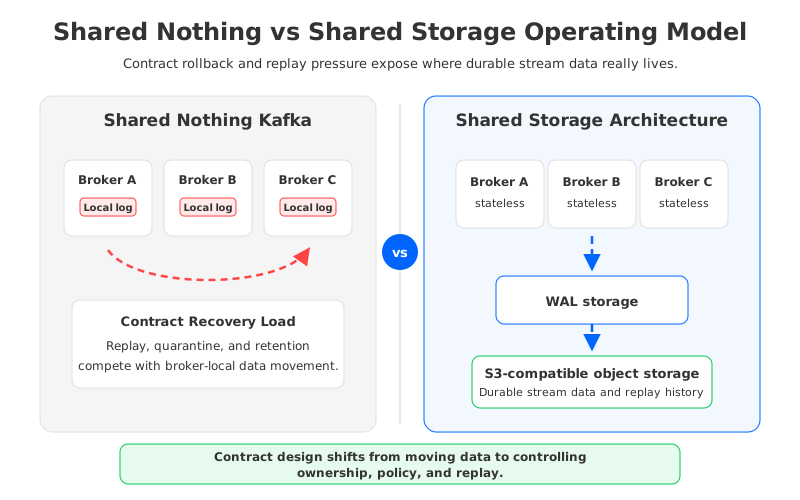
Traditional Kafka runs on a Shared Nothing architecture. Brokers own local log storage, partitions are assigned to brokers, and replication provides durability. That design is proven, but it ties governance work to broker-local capacity and data movement. Longer retention means more storage planning. Large replay jobs can compete with live traffic. Partition movement, leader changes, and broker maintenance become part of the contract risk model.
Tiered Storage helps by moving older log segments to remote storage, and it can improve retention economics for historical data. It does not make broker compute stateless or remove live-log constraints. For a contract program, that distinction matters. The platform team is not only storing events; it is keeping a recovery boundary that compliance, security, and downstream teams trust.
3Architecture options and trade-offs
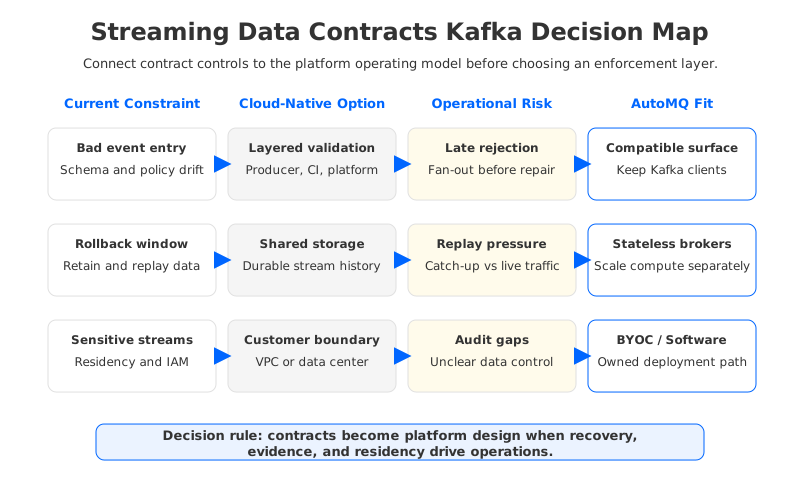
Most teams do not need to replace their streaming platform to start data contracts. They need sharper ownership and better enforcement around existing streams. But once contracts become a production control system, architecture matters because the platform must support retention, rollback, isolation, and migration without making every policy improvement a capacity project.
The evaluation should compare operating models, not vendor checkboxes. Registry-centered controls are a good foundation for structural compatibility. Stream processing is strong for stateful checks, enrichment, and remediation. Platform controls are useful for shared policy before broad fan-out. Storage architecture becomes relevant when rollback windows, replay load, and isolation requirements drive broker sizing.
| Option | Where it helps | Where it is weak | Contract risk to test |
|---|---|---|---|
| Producer and CI validation | Catches domain errors close to source ownership | Hard to keep consistent across many teams | Shared policies drift between codebases |
| Schema registry and compatibility rules | Controls record shape and version evolution | Does not prove semantic correctness or privacy safety | A valid event can still violate business intent |
| Stream processing guardrails | Handles stateful checks, enrichment, quarantine, and repair | Bad records may already exist in raw topics | Correction streams arrive after broad fan-out |
| Broker-local Kafka operations | Mature ecosystem and familiar APIs | Retention, replay, and reassignment can pressure local storage | Governance work competes with live workloads |
| Kafka-compatible Shared Storage architecture | Separates durable stream data from broker-local disks | Requires validation of WAL type, object storage, and deployment boundaries | Teams must test latency, recovery, and cloud controls |
The table should make one point uncomfortable: contracts are not isolated from platform design. A strict compatibility policy is easy to write. It is harder to operate when a failed rollout requires retained raw data, offset-aware replay, consumer coordination, and spare capacity to rebuild certified streams while normal traffic continues.
4Evaluation checklist for platform teams
A useful evaluation starts with the event lifecycle and works outward. The contract begins before the record is written, but it ends only after the organization can prove what happened and recover from a bad period. Security, compliance, SRE, FinOps, and application teams should be in the same review, even if they own different layers.
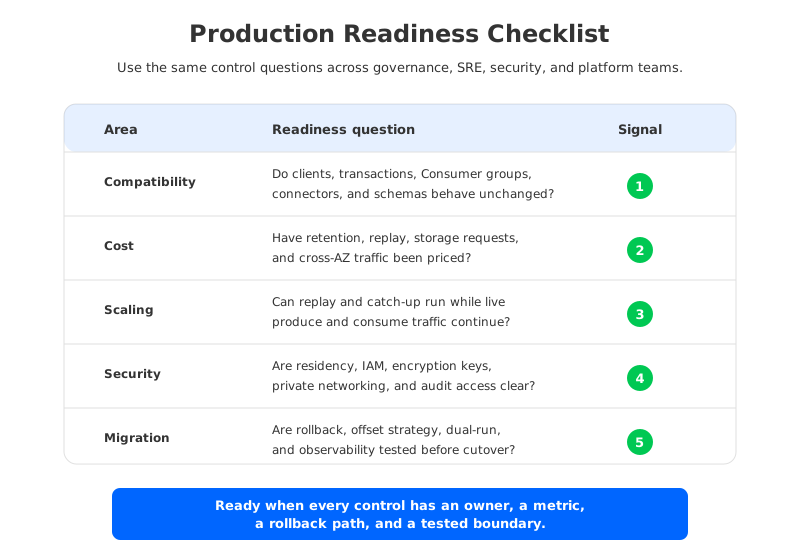
Use this checklist before you standardize a streaming data contract framework:
- Define topic classes. Separate raw, certified, sensitive, quarantine, and remediation topics. Each class should have its own compatibility, retention, access, and audit rules.
- Assign control points. Put domain invariants near producers, structural compatibility in registry or CI workflows, shared policy near platform boundaries, and stateful checks in stream processing.
- Test rollback with Offsets. A contract is incomplete until teams know which records are replayed, which consumers are reset, and how duplicate side effects are avoided.
- Measure contract health. Track rejected records, schema versions, compatibility exceptions, Consumer lag, replay throughput, quarantine age, and downstream error rates.
- Map data residency and network boundaries. Sensitive streams need clear answers for VPC placement, private connectivity, object storage ownership, IAM, encryption keys, and audit access.
- Price the recovery path. Cost review should include retention, object storage requests, cross-Availability Zone traffic, connector throughput, observability volume, and operational time.
- Plan migration and rollback together. Validate client compatibility, Kafka Connect behavior, transactions, Consumer group behavior, schema tooling, and observability before moving critical topics.
This checklist also prevents a common mistake: overloading one tool with every responsibility. A schema registry should not become the privacy program. A stream processor should not become the sole rollback plan. A broker cluster should not become the evidence system for every audit. The framework is stronger when each layer has a narrow job and a visible failure mode.
5How AutoMQ changes the operating model
After the neutral review reaches retention, replay, elasticity, and deployment boundaries, AutoMQ becomes relevant as a Kafka-compatible, cloud-native streaming platform built around Shared Storage architecture. AutoMQ keeps Kafka protocol and ecosystem compatibility while replacing broker-local log storage with S3Stream, WAL (Write-Ahead Log) storage, and S3-compatible object storage. AutoMQ Brokers process Kafka requests, manage leadership and caching, and coordinate through KRaft metadata, but durable stream data is not pinned to broker-local disks.
For streaming data contracts, that changes the operating model. Retention and replay stop being primarily a broker-local disk problem. Broker replacement and scaling can focus on compute ownership and traffic placement rather than moving large amounts of partition data between nodes. Contract programs still need schemas, producer discipline, policy definitions, and audit workflows, but the platform can reduce the operational penalty.
The deployment boundary is equally important. AutoMQ BYOC runs the control plane and data plane inside the customer's cloud account and VPC. AutoMQ Software targets private data center deployments where customers operate the environment with AutoMQ support. For regulated streams, the review can keep message data, object storage, network isolation, IAM policies, and audit evidence inside customer-controlled boundaries.
AutoMQ also gives platform teams related building blocks to include in the review. Kafka Linking can be part of a migration plan that preserves Kafka-oriented workflows. Self-Balancing can keep broker traffic distribution from becoming a manual reassignment exercise. Table Topic can be evaluated when certified streams should land in Apache Iceberg tables with less pipeline surface area. None of these features replaces data contracts; they support the operating model around them.
6Decision matrix: when the platform needs to change
The easiest contract improvements are process changes: require schema review, add producer tests, document owners, and alert on violations. The platform review becomes serious when contract controls start shaping cluster architecture. That point arrives quietly. Retention grows because auditors need evidence. Quarantine grows because producers need safer rollouts. Replays become more frequent because certified streams support AI, finance, or operational workflows.
| Signal | Interpretation | Platform action |
|---|---|---|
| Schema changes break consumers, but recovery is small | The issue is change discipline | Add CI checks, compatibility modes, and owner review |
| Sensitive fields can fan out before masking | The issue is policy placement | Move enforcement closer to ingestion or certified topics |
| Replays disrupt live workloads | The issue is recovery isolation | Test catch-up reads, storage architecture, and compute scaling |
| Broker disk planning is driven by rollback windows | The issue is durable storage ownership | Evaluate Shared Storage architecture for Kafka-compatible streams |
| Migration risk is dominated by client rewrites | The issue is interface continuity | Prefer Kafka-compatible migration paths and validate client behavior |
This matrix is conservative. A platform migration should not be the first answer to an ownership problem. But ignoring storage architecture after contracts become operationally heavy is the opposite mistake. If the framework depends on long rollback windows, repeatable replays, controlled residency, and elastic recovery, the streaming platform has become part of governance design.
7FAQ
7.1What is a streaming data contract in Kafka?
A streaming data contract is the production agreement around a Kafka topic or event type. It includes schema, meaning, ownership, compatibility rules, privacy policy, observability, and recovery behavior. The contract is strongest when those rules change runtime behavior through validation, quarantine, alerts, and replay procedures.
7.2Are schemas and streaming data contracts the same thing?
No. Schemas define structure and compatibility. Streaming data contracts define the broader promise: what the fields mean, who owns them, which policy applies, how drift is detected, and how the team recovers when the contract is wrong.
7.3Where should streaming data contracts be enforced?
Most production platforms use layered enforcement. Producer code should check domain invariants. CI and schema tooling should check compatibility. Platform controls should enforce shared policy before fan-out. Stream processing can add stateful validation and remediation. Consumers still need defensive checks.
7.4Does a contract framework require changing Kafka clients?
Not always. Many controls can be added with schemas, CI workflows, registry policy, connector configuration, certified topics, observability, and migration tooling. Client changes are usually required when producers must add fields, correct semantics, or adopt stricter validation.
7.5How does AutoMQ help with streaming data contracts?
AutoMQ helps with the platform side of contract operations. Its Kafka-compatible Shared Storage architecture can make retention, replay, broker replacement, and elastic scaling easier to reason about than broker-local storage models. Teams still need schema governance, ownership, and policy controls.
8Closing the control loop
The original search for streaming data contracts kafka usually begins with a data quality problem. It should end with a control framework. The contract must say what is allowed, where it is enforced, who owns exceptions, what evidence proves compliance, and how the platform recovers from a bad period.
If your current Kafka architecture makes that control loop depend on permanent overprovisioning, fragile replay windows, or unclear data residency boundaries, evaluate a Kafka-compatible shared-storage design with your own topics and failure drills. You can start with the AutoMQ project or discuss a BYOC architecture review with the AutoMQ team: start from AutoMQ.


