
Table of Contents
Table of Contents
Streaming data governance starts with schemas because schemas are visible. A producer publishes an additional field, a consumer breaks, and the platform team learns that "events are APIs" is not a metaphor. Schema compatibility rules and ownership metadata are the first practical defenses against chaos. They are necessary, but they are not enough.
The harder governance problems show up after a valid event enters the runtime path. A customer identifier may be legal in one topic but not another. A fraud model may depend on a field that only some teams can read. A replay job may be correct while violating a retention policy. In production, governance is not only a catalog problem. It is a control problem.
That distinction matters for Kafka-compatible streaming platforms. Kafka is often the shared system for payments, orders, telemetry, customer profiles, clickstreams, AI context, and security events. Once those streams become shared infrastructure, governance must move from "can we describe the data?" to "can we control how data behaves while it is moving?"
1The schema contract is the beginning
Schema contracts are still the right starting point. They turn loosely coupled producers and consumers into an ecosystem with explicit expectations. A schema can define required fields, data types, default values, and compatibility modes. It can stop a producer from deleting a field that downstream services still need, and it can give consumers a stable interface even as event producers evolve.
But a schema answers a narrow question: does this record fit the declared shape? It does not automatically answer who should see the record, how long it should be retained, whether replay is allowed, or whether a derived topic has the same sensitivity as its source. Those questions sit directly in the streaming runtime.
The governance surface expands as soon as the platform becomes multi-team:
- Contract governance defines who owns a topic, what compatibility policy applies, and how schema changes are reviewed.
- Access governance decides which producers, consumers, service accounts, and operators can touch each stream.
- Policy governance controls masking, tokenization, residency, retention, and purpose-specific use.
- Operational governance tracks replay, backfill, consumer lag, dead-letter events, audit trails, and incident response.
- Cost governance makes sure governance controls do not become an unlimited retention and reprocessing bill.
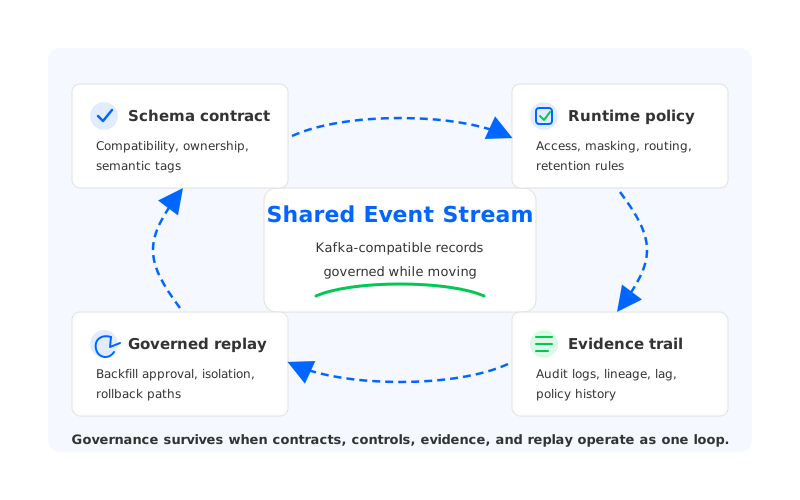
These domains are connected. If a topic contains personally identifiable information, the schema should mark it, the access policy should restrict it, the runtime should enforce it, and the audit trail should prove it. Treat any one layer as the whole governance system and the gaps move elsewhere.
2Why batch-era governance breaks at stream speed
Traditional data governance grew around warehouses, lakes, and batch pipelines. That world has an important advantage: data usually lands before it is broadly consumed. Teams can scan it, classify it, transform it, and expose curated tables later. Even when the process is imperfect, there is often a staging area where governance tools can catch up.
Streaming changes the timing. A Kafka record may be consumed by multiple services within seconds of being produced. It may feed a fraud decision, update a customer profile, trigger a workflow, or refresh an AI retrieval index before a nightly scanner has any chance to classify it. A late governance decision is still useful for audit and cleanup, but it may be too late for runtime control.
The same problem appears during replay. Replaying a topic is one of Kafka's strengths, and it is essential for rebuilding projections or recovering from application bugs. Yet replay is also a governance event. Old data may re-enter systems that were not originally authorized to receive it, under policies that changed after the data was written.
That is why streaming data governance has to combine three controls that batch systems often separate:
| Governance layer | What it controls | What breaks when it is missing |
|---|---|---|
| Design-time contract | Schema, compatibility, ownership, semantic tags | Consumers break silently or reinterpret fields differently |
| Runtime enforcement | Identity, authorization, masking, routing, retention, replay permissions | Valid events move into invalid contexts |
| Operational evidence | Audit logs, lineage, lag, dead-letter handling, policy-change history | Teams cannot prove what happened during incidents or audits |
The table is deliberately ordered. Contract comes first because a platform needs a stable language for data. Runtime enforcement comes next because a contract without control is a suggestion. Evidence closes the loop because governance that cannot be audited usually fails the moment a regulator, security team, or incident commander asks for proof.
3Runtime control changes the architecture
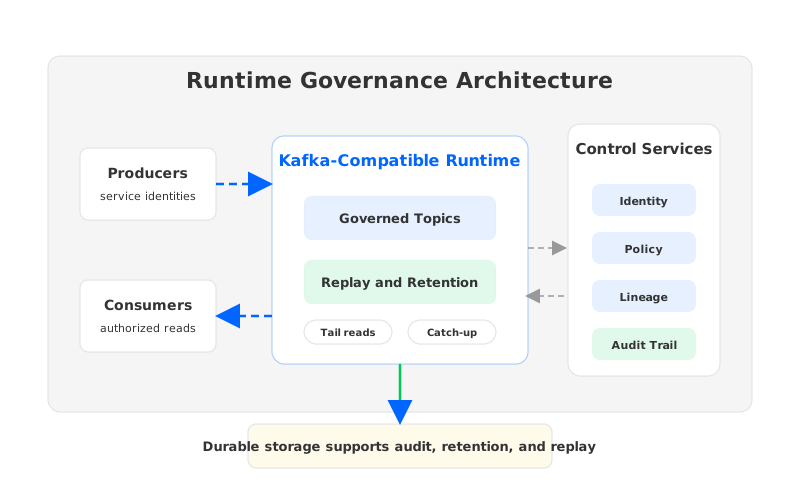
Runtime governance is not a single feature. It is an architectural posture: the streaming platform must be able to attach identity, policy, observability, and lifecycle rules to data paths that are continuously active. That posture affects topic design, client authentication, network placement, stream processing, storage, and operations.
Consider a customer-profile stream. The schema may declare customer_id, email, region, and consent_status. The platform also needs to answer whether a marketing service can consume the email field, whether a fraud service can replay 90 days of history, whether a cross-region connector is allowed to export records, and whether a derived topic that removes email but keeps customer_id is still sensitive.
A useful runtime control model has four working parts:
- Identity-bound access. Producers, consumers, connectors, stream processors, and operators should act through identities that can be audited. Service accounts matter because shared credentials destroy accountability.
- Policy-aware data paths. Routing, transformation, masking, and sink configuration should reflect data classification. Sensitive topics should not rely on downstream teams to remember policy rules.
- Replay and retention control. Retention windows, compaction strategy, backfill permissions, and replay isolation should be governed as first-class lifecycle decisions.
- Continuous evidence. Metrics, logs, lineage metadata, and policy-change history should be queryable when an incident occurs, not reconstructed from scattered tickets.
This is where many Kafka platforms discover that governance and operations are inseparable. A topic-level ACL may be correct, but if backfills share broker I/O with tail consumers, the governance-approved recovery process can still create an availability incident. A masking job may be correct, but if the raw topic has unbounded retention with broad read access, the platform has only moved the risk.
4The storage layer is part of governance
Streaming governance discussions often focus on catalogs and access control, but the storage architecture decides how disruptive good governance becomes. Retention, replay, audit, and isolation all depend on how the platform stores and serves historical data. If long retention lives on broker-local disks, governance policy can become a capacity constraint.
Traditional Apache Kafka uses a Shared Nothing architecture: each Broker manages local storage, and durability comes from replication across brokers through ISR (In-Sync Replicas). This model is proven, but it ties partition data to broker-local resources. When governance requires longer retention, more derived topics, or frequent replay, the platform has to plan for local disk, replication traffic, reassignment, and noisy catch-up behavior.
Apache Kafka Tiered Storage, defined through KIP-405, helps by moving older log segments to remote storage. It can improve long-retention economics, and it is an important direction for the Kafka ecosystem. Still, Tiered Storage does not automatically remove all broker-local operational concerns. Hot data, leadership, and replay patterns still need workload-specific testing.
For governance-heavy workloads, the question becomes more direct: can the platform keep governed history durable and replayable without making every policy decision a broker-storage decision? A platform that treats historical data as shared durable storage can make retention and replay less tightly coupled to individual Broker lifecycles. That does not remove the need for access policy, schema discipline, or stream processing governance, but it changes the operating cost of doing those things well.
5Where AutoMQ fits after the evaluation
Once a team has separated schema contracts from runtime control, AutoMQ becomes relevant as a Kafka-compatible, cloud-native streaming platform built around Shared Storage architecture. AutoMQ keeps Kafka protocol compatibility for producers, consumers, and ecosystem tools while using S3-compatible object storage as the durable storage layer through S3Stream. Its brokers are stateless, and WAL (Write-Ahead Log) storage provides the low-latency persistence path before data is uploaded to S3 storage.
That architecture matters for governance because runtime control often increases the data the platform must retain and replay. Raw topics may need to stay available for audit and rebuild. Masked or normalized topics may become shared data products. Backfills may need isolation from tailing consumers. In a Shared Storage architecture, durable data ownership shifts away from individual brokers, so scaling compute and governing retained data can be handled with cleaner separation.
AutoMQ is not a governance catalog, a policy engine, or a stream processing framework. Those responsibilities still belong to the surrounding platform: schema registry, identity provider, authorization model, stream processor, lineage system, and operational processes. The narrower point is that a Kafka-compatible shared-storage runtime can make governed retention, replay, and elasticity more practical.
The deployment boundary also matters. In AutoMQ BYOC, the control plane and data plane run in the customer's own cloud account VPC, with AutoMQ Cloud used to manage BYOC environments and obtain installation commands. That model is relevant for teams that need governance controls and customer data to remain inside their cloud boundary while still operating a cloud-native streaming platform.
6A practical governance architecture
The cleanest streaming governance architectures avoid a single central bottleneck. They use central policy where consistency matters and distributed ownership where domain context matters. Topic owners define meaning, platform teams enforce runtime controls, security teams define classification, and application teams own consumer behavior.
A practical design usually includes:
- Topic ownership metadata. Every topic needs an owner, purpose, data classification, compatibility policy, retention target, and incident contact. Ownership cannot live only in chat history.
- Schema compatibility gates. Producers should not be able to publish incompatible schemas into shared topics without review. Compatibility rules should be stricter for shared operational streams than for private experimental topics.
- Identity and authorization boundaries. Service accounts, ACLs, network boundaries, and sink permissions should match data classification. Broad read access to raw regulated topics is the fastest way to make every downstream system part of the audit scope.
- Governed transformation paths. Masking, tokenization, enrichment, and derived-topic creation should produce versioned outputs with lineage back to the raw source. Derived does not automatically mean non-sensitive.
- Replay procedures. Backfill and replay should have approval, isolation, observability, and rollback expectations. A replay is a controlled reprocessing event, not a routine consumer operation.
- Evidence collection. Audit logs, metric history, policy changes, schema changes, and operational events need a durable trail. Incident response is much easier when the platform can answer who changed what, which identity consumed which stream, and how far replay progressed.
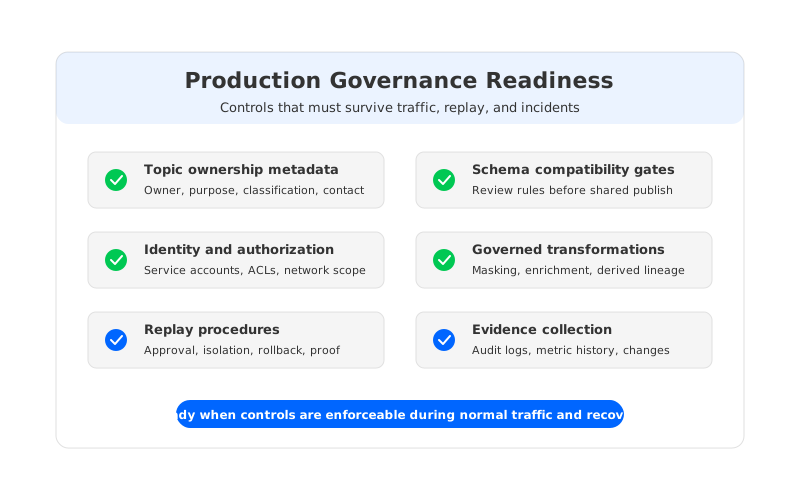
This architecture is not meant to slow every team down. It prevents the platform from paying for speed later with incidents, duplicated masking logic, or emergency topic freezes. The best governance controls are close enough to the runtime path to be enforceable and clear enough that application teams know how to work inside them.
7Evaluation checklist for production teams
Before choosing a governance stack or changing a Kafka platform architecture, test the workflow around a real stream. Pick a topic that has multiple consumers, meaningful sensitivity, and a replay requirement. The goal is to expose the messy intersections between policy, storage, replay, and ownership.
Use these questions as the first pass:
| Question | Why it matters |
|---|---|
| Can the platform identify the owner, schema, classification, retention, and consumers for the topic? | Governance starts with discoverability, but ownership makes it actionable. |
| Can policy be enforced before broad fan-out? | Sensitive data should not depend on every consumer implementing the same rules. |
| Can replay be isolated, authorized, and audited? | Backfill is where availability, cost, and compliance often collide. |
| Can derived topics be traced back to raw sources and policy changes? | Lineage is required when downstream data products inherit risk. |
| Can long retention be funded and operated without broker-local fragility? | Governance policies fail when they are too expensive to keep. |
| Can teams roll back a bad schema or transformation without losing evidence? | Recovery needs both technical replay and audit continuity. |
The most useful result is not a perfect score. It is a map of which gaps belong to metadata, policy, runtime operations, and storage architecture. Buying or building one tool rarely closes all of them.
8Governance that survives motion
Streaming data governance is harder than static data governance because the data is already doing work. It is being consumed, transformed, replayed, enriched, masked, and copied while teams are still arguing about definitions. Schema contracts give that motion structure. Runtime control makes the structure enforceable.
The platform decision follows from that reality. If Kafka is only a transport buffer for a few internal services, schema governance and ACL discipline may be enough. If Kafka is the operational data plane for regulated, multi-team, AI-adjacent, or customer-facing workflows, governance has to include storage, replay, identity, lineage, and evidence. That is a bigger design problem, and architecture choices become leverage.
Start with one high-value stream and draw the runtime path: producer identity, schema contract, topic classification, access policy, transformation points, storage retention, replay procedure, downstream sinks, and audit evidence. Then ask whether your current Kafka-compatible platform can enforce that design during normal traffic and during recovery. To evaluate a shared-storage option, review the AutoMQ architecture materials and test the model against your own retention, replay, and data-boundary constraints.
9References
- Apache Kafka documentation
- Apache Kafka KIP-405: Kafka Tiered Storage
- Apache Avro specification: schema resolution
- OpenLineage documentation
- AutoMQ documentation: compatibility with Apache Kafka
10FAQ
10.1Is streaming data governance only schema governance?
No. Schema governance defines event shape and compatibility, but production streaming governance also needs identity, authorization, masking, retention, replay control, lineage, audit evidence, and operational procedures.
10.2Where should governance enforcement happen in a Kafka architecture?
Enforcement should happen as close as possible to the point where risk appears. Schema compatibility belongs before publish, access control belongs on producer and consumer paths, masking may belong in governed transformation flows, and replay approval belongs in operational workflows.
10.3Does Tiered Storage solve governance retention requirements?
Tiered Storage can help with longer retention economics by moving older segments to remote storage, but teams still need to test hot data behavior, catch-up reads, policy enforcement, and operational procedures. Retention is one part of governance, not the whole system.
10.4How does AutoMQ relate to streaming data governance?
AutoMQ provides a Kafka-compatible Shared Storage architecture with stateless brokers and S3-compatible object storage. It does not replace governance tools, but it can make governed retention, replay, and elastic operations more practical for streaming platforms.


