
Table of Contents
Table of Contents
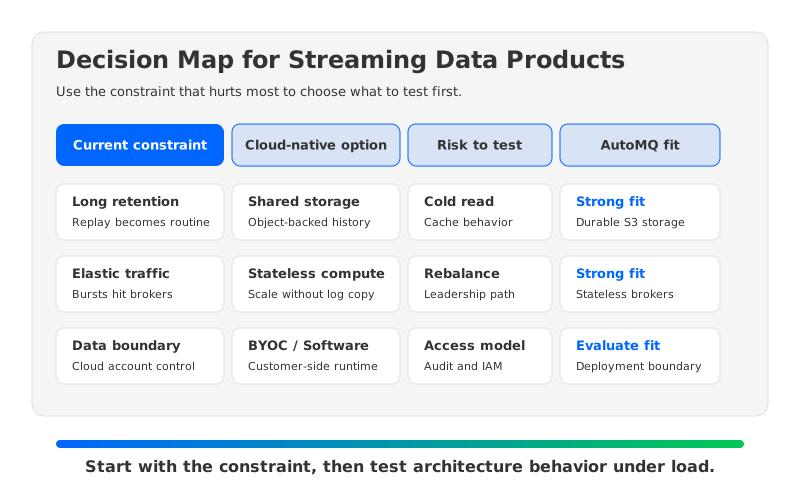
A search for streaming data product pipeline kafka usually begins after the first version of the platform has worked. The team has Kafka topics carrying product events, Flink or Kafka Streams jobs calculating derived state, downstream services depending on replay, and people asking whether the stream is trustworthy enough to become a product interface. At that point, the hard question is no longer "Can Kafka move events?" Apache Kafka has already answered that for many teams. The harder question is whether the surrounding architecture can support data products without turning every retention, scale, and governance decision into a broker storage project.
A streaming data product pipeline is different from a one-off event pipeline. A one-off pipeline can tolerate local conventions because one team owns the producer, processor, and consumer. A data product pipeline becomes a shared contract: it has owners, schema expectations, service-level objectives, replay windows, access controls, and consumers that the producing team may not know personally. Kafka gives this model useful primitives: topics, partitions, offsets, consumer groups, transactions, and a mature connector ecosystem. Those primitives are necessary, but they do not decide how painful the platform becomes when the same event history must serve operational systems, analytics jobs, and AI features.
For Kafka-based streaming data products, the platform decision should start with operating behavior, not feature checklists. Compatibility, cost, and governance matter, but the root constraint is architectural: traditional Kafka ties durable log data to broker-local storage, and that coupling shapes almost every downstream trade-off.
1Why teams search for streaming data product pipeline kafka
The phrase is awkward, which is often a good sign. Real platform searches are rarely polished. Someone is connecting the language of data products with infrastructure they already run: Kafka topics, stream processing jobs, lakehouse tables, feature pipelines, observability sinks, and operational consumers. They are not asking for a definition of Kafka. They are deciding where the durable contract should live.
That decision usually appears in three situations. The first is productization: a team wants to turn an internal event stream into a reusable interface with documented schema, retention, ownership, and quality expectations. The second is consolidation: several pipelines already exist, but each manages replay, schema evolution, and backfill differently. The third is migration pressure: an existing Kafka estate works, yet storage growth, cross-Availability Zone (AZ) traffic, broker replacement, or managed-service boundaries make the next stage harder.
These situations look different in planning meetings, but they stress the same parts of the system:
- Replay is no longer exceptional. Stream processors, debugging workflows, AI feature rebuilds, and lakehouse ingestion all need historical reads, so retention becomes part of the product contract.
- Consumers multiply independently. A single topic can feed fraud detection, search indexing, analytics, and operational alerts, each with its own lag profile and failure mode.
- Ownership becomes explicit. Data product teams need to know who controls schemas, access, lifecycle, quality, and rollback when a bad event reaches the stream.
- Infrastructure choices become visible. Broker disks, network paths, storage tiering, and migration tools determine whether the product contract is affordable to keep.
The important shift is that Kafka stops being only a transport layer. It becomes the durable boundary between teams. Once that happens, platform teams need to evaluate the architecture under production pressure: long retention, replay storms, consumer lag, processor restarts, schema changes, regional failure planning, and budget controls.
2The production constraint behind the problem
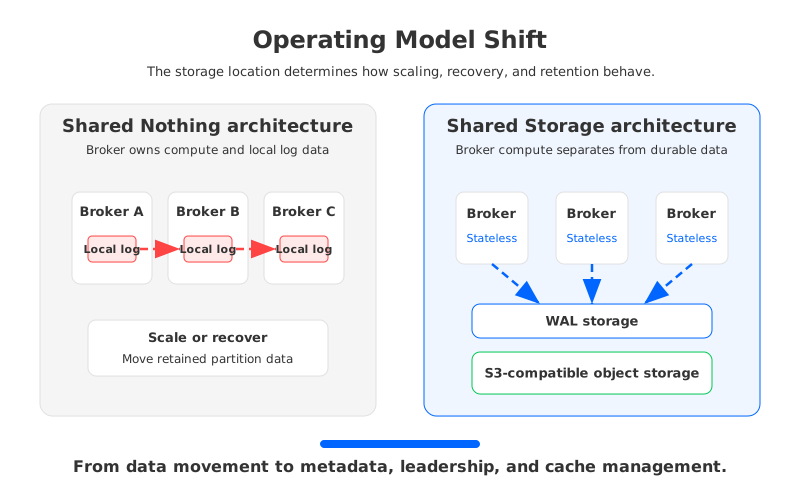
For a simple event pipeline, that trade-off may be acceptable. For a streaming data product pipeline, the coupling shows up in more places. Long retention affects how quickly a broker can be replaced and how much data sits behind reassignment. Multi-AZ deployment can create inter-zone network paths that need to be understood and budgeted against cloud provider pricing. Consumer group lag can signal that cold reads, cache behavior, or downstream processors are failing to keep up.
That distinction can disappear in a slide deck and reappear during an incident. A data product owner cares that the stream can be replayed. A platform engineer also cares what happens when the broker serving that stream is replaced during a traffic spike. If recovery depends on rebuilding substantial broker-local state, the operating model is still tied to local storage. If recovery mostly depends on metadata, leadership, write-ahead recovery, and cache warmup, the operating model changes.
3Architecture options and trade-offs
Most teams evaluating Kafka for streaming data products have four broad options. None is universally correct. The right choice depends on the contract the pipeline must provide and the failure modes the team is prepared to operate.
| Option | What it preserves | What to test before committing |
|---|---|---|
| Self-managed Kafka with local disks | Maximum operational control and full Kafka ecosystem compatibility | Reassignment time, disk sizing, multi-AZ traffic, upgrade process, and on-call load |
| Managed Kafka service | Less infrastructure ownership and familiar Kafka APIs | Network boundaries, cost model, migration path, quota behavior, and feature compatibility |
| Kafka with Tiered Storage | Kafka semantics with remote storage for older segments | Active-log storage needs, cold-read behavior, restore path, and operational maturity |
| Kafka-compatible shared-storage platform | Kafka client compatibility with a redesigned storage layer | Compatibility proof, write latency, cache behavior, governance boundary, and migration rollback |
The table is intentionally operational. A feature matrix can tell you whether transactions, Kafka Connect, or schema tooling are supported. It cannot tell you whether a retention increase will force a disk migration project, whether a processor backfill will surprise the cache layer, or whether a broker replacement will stay boring when the cluster is already hot. Those are the tests that matter once the stream becomes a product dependency.
Cost evaluation needs the same discipline. Do not compare only the most visible line item. Kafka platform cost is a stack: compute, persistent storage, object storage, inter-zone traffic, private connectivity, observability, backups, support, and engineer time. Cloud providers publish separate pricing for services such as S3 storage and EC2 data transfer, which is a reminder that architecture decides which meters turn. A design that reduces broker-local disk usage can still create other costs if replay, networking, or control-plane boundaries are poorly understood.
Governance is the other place where platform choices become concrete. A streaming data product needs an owner, but ownership without enforceable boundaries is only a wiki page. Teams should know where Kafka records live, which account or VPC contains the data plane, how service accounts or IAM roles reach the platform, how audit logs are collected, and which team can approve schema or access changes. The more the stream becomes a shared product, the less acceptable it is to answer those questions with tribal knowledge.
4Evaluation checklist for platform teams
The evaluation should produce evidence that another engineer can inspect later. A successful proof of concept is not "the demo worked." It is a record of the assumptions, workload profile, failure tests, and rollback path that made the platform acceptable for a particular data product.
Start with compatibility. Apache Kafka compatibility should cover the clients and tools you already use, not only the protocol headline. Test producers, consumers, consumer groups, offset management, transactions if you use them, Kafka Connect, stream processors, schema tooling, monitoring exporters, and security configuration. A platform can be Kafka-compatible in the common path and still fail on the one integration that matters to your migration.
Then test operating behavior under the workload that made you search in the first place:
This checklist prevents a common mistake: evaluating the stream processor and the Kafka platform separately. Flink, Kafka Streams, Spark Structured Streaming, and custom consumers all expose different pressure patterns: bursty reads after checkpoint recovery, long backfills, or lag that turns into user-visible freshness problems. The Kafka-compatible layer underneath must be tested with those behaviors, not with a synthetic happy path that only proves the broker can accept writes.
5How AutoMQ changes the operating model
After the neutral evaluation is explicit, AutoMQ fits into a specific architecture category: a Kafka-compatible streaming platform that keeps Kafka protocol and ecosystem compatibility while replacing broker-local log storage with a Shared Storage architecture. The core idea is not "Kafka plus lower-cost storage." The more important shift is that durable stream data moves to shared object storage through S3Stream, while brokers become stateless compute nodes that handle protocol processing, partition leadership, caching, and scheduling.
That storage split changes the way platform teams reason about streaming data products. In traditional Kafka, a topic with long retention is tied to broker disk planning and data movement. In AutoMQ, object storage is the primary durable layer, and WAL (Write-Ahead Log) storage provides the write durability and recovery buffer in front of it. AutoMQ Open Source uses S3 WAL, while AutoMQ commercial editions can use other WAL storage options such as Regional EBS WAL or NFS WAL depending on deployment needs. The right WAL choice still needs workload testing, especially for latency-sensitive pipelines, but the architecture separates the durability layer from broker identity.
AutoMQ also changes the boundary discussion. AutoMQ BYOC runs the control plane and data plane in the customer's cloud account and VPC, while AutoMQ Software is designed for customer-operated private environments. For teams building regulated or internally governed streaming data products, that deployment boundary can be as important as storage architecture. The data product owner can ask a concrete question: does the pipeline keep Kafka records, storage resources, and operational controls inside the environment my organization governs?
The product-level features then sit on top of that architecture. Kafka Linking can help migration planning where commercial AutoMQ capabilities are available. Self-Balancing and seconds-level partition reassignment are relevant when teams expect uneven traffic and frequent scaling. Table Topic is relevant when a streaming data product should feed Apache Iceberg tables without building a separate ETL path for every topic. These features should not be evaluated as isolated checkboxes. They are useful when they support the operating model the data product requires: compatible clients, durable replay, elastic compute, and a defensible deployment boundary.
6A practical readiness scorecard
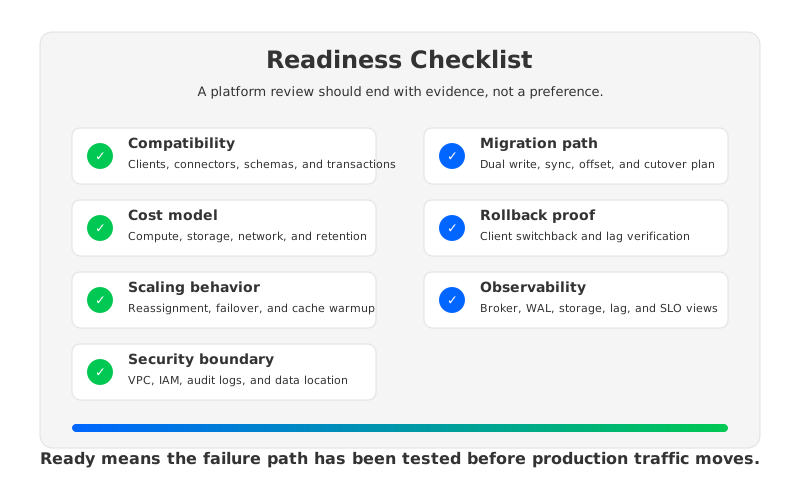
Before choosing any Kafka-compatible platform for a streaming data product pipeline, assign a score to each dimension: 0 means untested, 1 means tested in a demo, and 2 means tested with production-like workload and rollback evidence. The score is not meant to be scientific. It forces the team to name what it knows and what it is assuming.
| Dimension | Evidence to collect | Ready signal |
|---|---|---|
| Compatibility | Client, connector, transaction, schema, and monitoring tests | Existing applications run without code changes or documented exceptions |
| Cost model | Workload-based estimate across compute, storage, network, and operations | The team knows which cloud meters grow with retention and replay |
| Scaling | Capacity add/remove tests under write and read load | Scaling does not require an unplanned data movement window |
| Security | VPC, IAM, audit, encryption, and support-access review | Data and control boundaries are clear to the security team |
| Migration | Topic sync, offset validation, client cutover, and rollback rehearsal | The team can move traffic and switch back without guessing |
| Observability | Broker, storage, WAL, lag, and processor dashboards | Operators can explain a freshness or replay incident from metrics |
The uncomfortable score is often the most useful one. If compatibility is a 2 but migration rollback is a 0, the platform decision is not ready. If storage cost looks attractive but observability is a 1, the team may be moving into an architecture it cannot operate. If security boundary is a 2 and scaling is a 2, the remaining work may be a focused performance test rather than a platform debate.
Returning to the original search, streaming data product pipeline kafka is not really a request for a template. It is a request for a decision framework that treats Kafka as a product boundary, not only an event bus. Start with the contract your stream must provide, test the architecture under that contract, and make the storage model visible before it makes itself visible during an incident.
If that evaluation points toward Kafka-compatible streaming with Shared Storage architecture, test AutoMQ against one representative pipeline: a real topic, a real processor, realistic retention, a cutover plan, and a rollback rehearsal. You can start with the AutoMQ environment path here: try AutoMQ.
7FAQ
7.1Is Kafka still a good foundation for streaming data product pipelines?
Yes, when the team needs durable topics, consumer groups, offsets, replay, and broad ecosystem compatibility. The evaluation question is not whether Kafka primitives are useful. It is whether the chosen Kafka or Kafka-compatible platform can operate those primitives under the retention, governance, scaling, and recovery expectations of a data product.
7.2Does Tiered Storage solve the storage problem for Kafka data products?
Tiered Storage can help by moving older segments to remote storage, and it is worth evaluating for Kafka clusters that need longer retention. It does not fully remove broker-local storage from the operating model, so teams still need to test active-log sizing, cold-read behavior, reassignment, and recovery.
7.3When should a team evaluate AutoMQ?
Evaluate AutoMQ after you have confirmed that Kafka compatibility is required and that broker-local storage is becoming a constraint. It is especially relevant when long retention, replay, elastic capacity, customer-controlled deployment boundaries, or object-storage-backed durability are central to the platform decision.
7.4What should be included in a proof of concept?
Use a real client, a real stream processor, representative message size, realistic retention, failure injection, migration cutover, and rollback verification. A proof of concept that only writes and reads a small test topic is not enough for a streaming data product pipeline.


