
Table of Contents
Table of Contents
The phrase streaming data transfer cost kafka usually appears after a team has already done the responsible thing. The Kafka cluster is spread across availability zones, replication is enabled, producers and consumers are isolated by application boundaries, and the platform is reliable enough that nobody wants to go back to a single-zone deployment. Then the cloud bill arrives with a network line item that does not behave like ordinary infrastructure overhead.
That line item is frustrating because it is not caused by one mistake. It is the result of a correct production architecture running inside a cloud pricing model where bytes have direction, source, destination, and service boundaries. Kafka makes data durable by copying records, and consumers make data useful by reading records. Rebalances, broker replacement, replication, tiering, mirroring, and connector workloads all move records again.
The budget problem is not whether Kafka is worth running across zones. For most production systems, the answer is yes. The real problem is that Kafka traffic is easy to under-model before launch and hard to untangle after workloads depend on it.
1Why Teams Search for streaming data transfer cost kafka
Most teams do not start with a data transfer budget. They start with an availability target. A platform owner chooses multiple availability zones so a zone outage does not stop ingestion, then applies Kafka's familiar durability pattern: keep replicas of each partition on different brokers, usually spread across zones. That decision is reasonable, but the cost model must include more than producer throughput and retained bytes.
Kafka traffic has several layers. Producer writes enter the cluster once, but broker replication copies records to followers. Consumers may read from leaders in another zone when placement is not controlled. Kafka Connect workers, stream processors, monitoring systems, and mirror pipelines may read the same topic for different purposes. Broker maintenance can trigger partition movement, and scaling events can move stored data as well as live traffic.
The cloud bill sees all of those paths as network events. The platform team sees them as separate operational concerns. That mismatch is why the search query tends to appear late: the cluster is healthy, and cost is no longer theoretical.
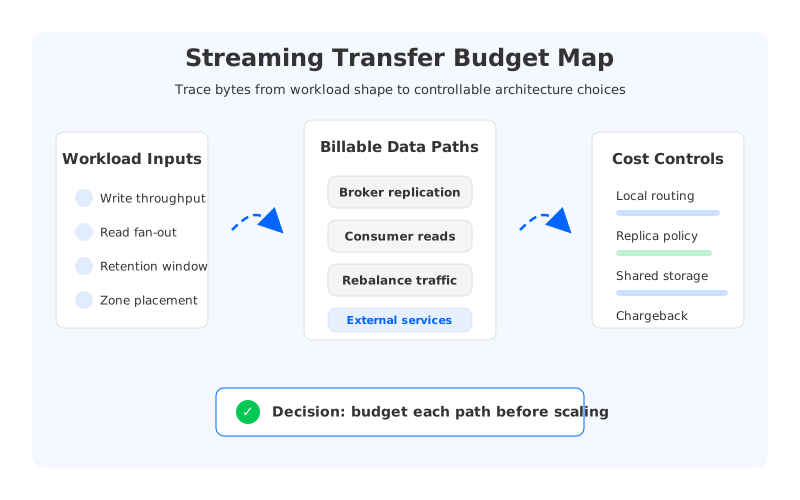
The first useful move is to stop treating "Kafka traffic" as one number. Break it into budget domains:
- Ingress from producers, including their zone and broker endpoint selection.
- Replication between brokers, especially when followers live in different availability zones.
- Consumer egress to applications, stream processors, connector workers, analytics, and observability tools.
- Operational movement from reassignment, broker replacement, expansion, and recovery.
- External paths such as object storage, private networking, managed connectors, or cross-region mirroring.
This breakdown changes the conversation. Instead of asking whether Kafka is expensive, the team can ask which data path is growing faster than the workload and how operators can control it.
2The Cloud Cost Drivers Behind the Workload
Data transfer cost sits between architecture and procurement. Engineers describe partitions, replicas, consumers, and zones. Finance receives service-level line items. A useful budget model translates the engineering design into billing-sensitive paths without pretending the bill is only an accounting artifact.
The simplest starting point is a traffic multiplication model. If an application writes a steady stream into a replicated Kafka topic, the cluster must store that stream on more than one broker for durability. If replicas are spread across zones, replication can cross zone boundaries. If multiple consumer groups read from brokers in another zone, read traffic can cross zones too. None of this is accidental; it is the result of combining high availability, fan-out, and cloud zone isolation.
Three patterns usually dominate the budget:
- Replication fan-out: higher durability and availability require additional copies of data. In a multi-AZ layout, replica placement determines whether those copies become inter-zone traffic.
- Read fan-out: Kafka is often valuable because many consumers can read the same topic independently. Each consumer group may add its own network path.
- Operational churn: replacement, expansion, rebalancing, and retention changes can move old data when the cluster layout changes.
These drivers behave differently. Replication traffic follows writes. Read fan-out depends on application behavior and can spike during replay. Operational churn is episodic, which makes it easy to miss in a steady-state benchmark. A budget that only models normal producer throughput will look clean until the first large catch-up, repartitioning project, or broker fleet change.
Cloud pricing pages matter here, but they are not enough by themselves. AWS, for example, publishes service-specific pricing for data transfer, EC2, and object storage, and those pages should be checked before any production cost estimate is approved. The architecture review still has to answer which component causes bytes to move and whether the team can place or route that component differently.
3Storage, Network, and Compute Trade-Offs
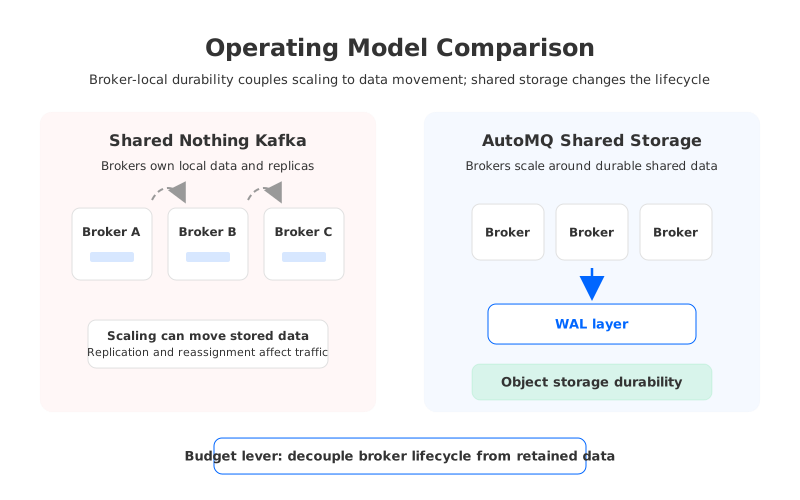
Traditional Kafka was designed around broker-local storage. A broker owns partitions, persists log segments on local or attached disks, and participates in replication with other brokers. This model is familiar and battle-tested, but it couples compute, storage, and data movement. When the cluster scales, recovers, or changes partition placement, stored data follows broker ownership.
That coupling shows up in the budget. Local storage forces the platform to provision broker capacity for retained data and recovery windows, not only active compute. Replication moves data between brokers for durability. Consumer placement influences whether reads stay local to a zone. Rebalancing may move historical data even when live write rate has not changed.
Tiered storage changes part of this equation by offloading older log segments to object storage. It can reduce local disk pressure and improve long-retention economics, especially when old data is read rarely. But tiered storage is not the same as making brokers stateless. Hot data, leader placement, replica management, and recovery behavior still matter. The team must understand which traffic stays in the broker layer and which traffic moves to object storage.
The deeper question is where long-lived durability belongs. If durability stays with broker-owned local replicas, compute scaling and storage movement remain connected. If durability moves into shared storage, brokers can become more elastic because long-lived data is not tied to a specific broker disk. That distinction is where data transfer budgets become more than a spreadsheet exercise.
4Evaluation Checklist for FinOps and Platform Teams
A serious Kafka cost review should include both FinOps and platform engineering. FinOps can identify which network and storage categories are growing, but platform engineers know which Kafka paths generate those bytes. The strongest reviews put both views in the same room and work from a shared checklist.
| Review area | Question to answer | Why it affects the budget |
|---|---|---|
| Producer placement | Are producers zone-aware, and do they connect to local-zone endpoints where possible? | Misplaced ingress can create avoidable cross-zone paths before replication even begins. |
| Replica placement | How are leaders and followers distributed across zones? | Replication can become the largest predictable traffic multiplier in a write-heavy workload. |
| Consumer locality | Do major consumer groups read from brokers in the same zone? | High fan-out workloads can make read traffic as important as writes. |
| Rebalance behavior | How much historical data moves during scaling, replacement, and partition reassignment? | Episodic movement can break a steady-state budget. |
| Retention policy | Is retention based on replay requirements or copied from defaults? | Longer retention changes storage and recovery economics. |
| Connector estate | Where do Kafka Connect, CDC, and stream processing workers run? | Connectors often read large streams continuously and can add hidden egress paths. |
| Chargeback model | Can teams see which topics, applications, and consumer groups drive transfer? | Shared clusters need accountability before optimization becomes political. |
The checklist is intentionally operational. A cost model that cannot be mapped to placement, routing, retention, and ownership will not survive production. It may produce a number, but nobody will know who can change it.
5A Budget Model That Survives Production
Start with workload shape, not instance type. For each major topic family, capture write throughput, replication policy, retention window, consumer group count, replay behavior, and zone placement. Then record which paths cross availability zones and which paths go to external services. The model needs enough structure that a production incident or traffic spike can be explained after the fact.
A practical model has four layers:
- Baseline traffic: normal writes, replication, and steady consumer reads.
- Burst traffic: producer spikes, downstream catch-up, backfills, and replay after outages.
- Operational traffic: reassignment, broker replacement, expansion, shrink, and recovery.
- External traffic: object storage, cross-region replication, private endpoints, connectors, and analytics systems.
The value of this model is not the arithmetic. It exposes fragile assumptions. If a single analytics consumer doubles read traffic across zones, the issue is not Kafka throughput; it is consumer placement and access pattern design. If broker replacement moves a large amount of historical data, the issue is not only recovery time; it is the coupling between local storage ownership and compute lifecycle.
There is also a governance angle. Shared Kafka platforms often serve many product teams, but network costs appear at the platform account level. Without topic-level and consumer-level attribution, the platform team owns every team's usage pattern. Chargeback does not need to be punitive. It needs to make fan-out, replay, and long retention visible enough that application teams can choose well.
6How AutoMQ Changes the Operating Model
Once the evaluation framework is clear, AutoMQ becomes relevant as a Kafka-compatible, cloud-native streaming platform that separates broker compute from durable storage. It keeps Kafka protocol compatibility while moving the storage architecture toward shared object storage with a write-ahead log layer. The goal is not to make network cost disappear. The goal is to change which data paths exist, which paths scale with workload, and which paths operators can control.
In a broker-local Kafka deployment, a broker is both a compute process and a long-lived data owner. That is why scaling and recovery often involve moving partition data between brokers. In AutoMQ's Shared Storage architecture, brokers are stateless relative to long-lived stream data, while durable data is stored in object storage and protected through the WAL design. That shift changes the operational budget: compute capacity can scale more independently from retained data, and broker lifecycle events do not have to mean large local-disk data migrations.
Multi-AZ traffic is also a first-class design concern. AutoMQ documents a zero cross-AZ traffic approach that combines shared storage with zone-aware routing so producer and consumer traffic can be kept aligned with local-zone access patterns. For FinOps teams, the important point is not a slogan; it is the ability to evaluate a concrete architecture where replication-style broker-to-broker data movement is not the default durability mechanism.
The migration review should still be conservative. Kafka compatibility reduces client replacement risk, but every production workload has its own mix of clients, ACLs, connectors, transactions, monitoring, topic settings, and recovery procedures. A serious pilot should test the workload's actual throughput, read fan-out, failover behavior, retention policy, and observability requirements. Architecture changes are valuable when they reduce operational coupling without creating additional blind spots.
7Production Readiness Scorecard
The final output of the review should be a scorecard that a platform team can rerun quarterly. Kafka traffic patterns change when additional applications subscribe, teams add stream processing jobs, retention expands for compliance, or analytics teams replay historical events. A one-time spreadsheet will drift. A scorecard becomes part of platform operations.
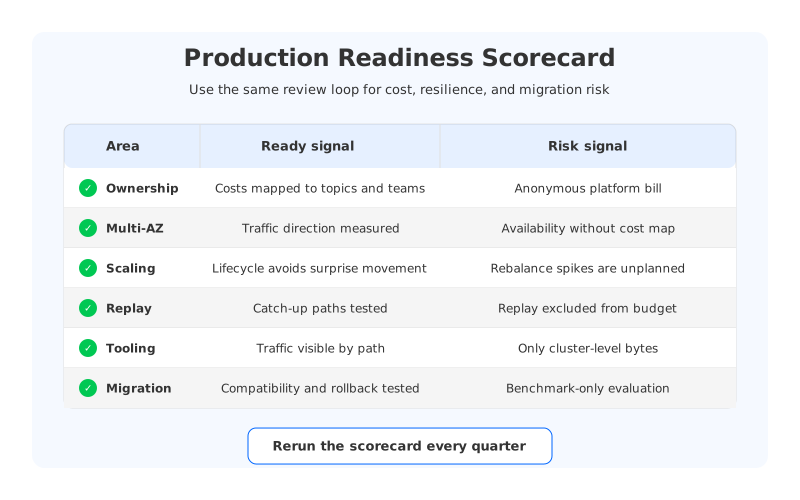
| Area | Ready signal | Risk signal |
|---|---|---|
| Budget ownership | Network, storage, and compute drivers are mapped to topics and teams | The platform account receives the bill, but usage is anonymous |
| Multi-AZ design | Producer, broker, and consumer placement is tested under real workload shape | Availability is configured, but traffic direction is not measured |
| Scaling model | Expansion and recovery do not require surprise historical data movement | Broker lifecycle events create large transfer spikes |
| Replay policy | Retention and catch-up paths are based on incident scenarios | Replay is treated as rare and excluded from the model |
| Tooling | Dashboards show traffic by path, topic, and consumer class | Operators only see cluster-level bytes in and out |
| Migration plan | Compatibility, rollback, and performance are validated with production-like clients | The evaluation stops at benchmark throughput |
This is where the original search query turns into operating practice. The team is no longer asking "what does Kafka data transfer cost?" in the abstract. It is asking which architecture makes cost understandable, which controls exist before the bill grows, and which migration path reduces risk.
If your team is building that review, test the budget model against producer placement, read fan-out, replay windows, and broker lifecycle events. AutoMQ's Shared Storage architecture and zero cross-AZ traffic design are worth evaluating when the Kafka cost model is dominated by replication, local storage coupling, or multi-AZ movement. Start here: explore AutoMQ for Kafka-compatible streaming infrastructure.
8References
- Apache Kafka documentation
- Apache Kafka design documentation
- Apache Kafka KRaft documentation
- Apache Kafka tiered storage documentation
- AWS EC2 on-demand pricing and data transfer reference
- AWS S3 pricing
- AutoMQ Shared Storage architecture
- AutoMQ Kafka compatibility
- AutoMQ inter-zone traffic overview
9FAQ
9.1Why does multi-AZ Kafka create data transfer budget risk?
Multi-AZ Kafka creates budget risk because the same record may move through producer ingress, broker replication, consumer reads, connectors, and rebalancing. When those paths cross zones or service boundaries, transfer charges can grow faster than headline write throughput suggests.
9.2Is cross-AZ traffic always avoidable in Kafka?
No. Production availability often needs data or clients distributed across zones. The goal is to identify which cross-zone paths are required and which come from placement, routing, or architecture choices.
9.3Does tiered storage remove Kafka data transfer cost?
Tiered storage can reduce broker-local disk pressure by moving older log segments to object storage. It does not automatically make brokers stateless or remove replication, read, and operational data movement. Teams should model which traffic remains in the broker layer and which traffic moves to object storage.
9.4How should FinOps teams model Kafka transfer cost?
Start with write throughput, replication policy, consumer fan-out, retention, replay behavior, and zone placement. Then separate baseline traffic from burst, operational, and external-service traffic. Map costs to topics and teams so optimization has an owner.
9.5Where does AutoMQ fit in a Kafka cost review?
AutoMQ fits after the team has defined compatibility, availability, retention, and traffic requirements. Its Kafka-compatible Shared Storage architecture and zero cross-AZ traffic design are relevant when broker-local storage coupling, replication traffic, or multi-AZ transfer cost are material parts of the operating model.


