
Table of Contents
Table of Contents
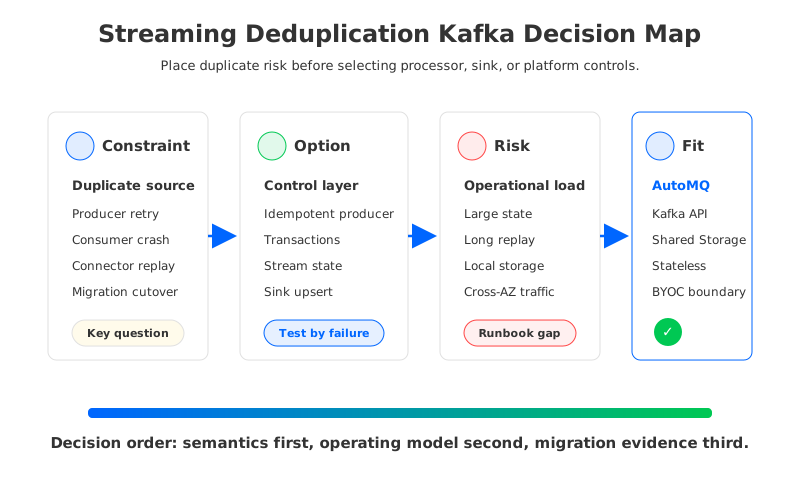
Searches for streaming deduplication kafka usually come from a specific production moment: a pipeline is replaying, a sink is seeing duplicate writes, or a platform team is being asked why "exactly once" did not make every downstream system exactly-once. Kafka is a durable log with partition ordering, consumer groups, offsets, idempotent producer support, and transactions. Those capabilities matter. They still do not decide where duplicates can appear, which system owns the deduplication key, or how replay should behave after the business action has happened.
The hard part is that deduplication is not one feature. It is a boundary decision. A payment authorization, a click event, a CDC update, and an audit log all tolerate different kinds of replay, latency, and correction. The architecture that works for one can be dangerous for another. The useful question is not "Can Kafka deduplicate streams?" but "Which layer should absorb duplicate risk without turning recovery, cost, and governance into a permanent tax?"
1Why teams search for streaming deduplication kafka
Most duplicate problems start before the stream processor sees a record. Producers retry after timeouts. Source connectors restart from a checkpoint. Consumers process a record, write to a database, and crash before committing the offset. Cross-region replication or migration can intentionally replay data. A stateful job may restore from a checkpoint that is behind the latest sink write. None of these events are rare enough to ignore in production.
Kafka gives teams several building blocks. Consumer groups distribute partitions and track progress through committed offsets. The idempotent producer helps avoid retry duplicates within a session. Transactions let a producer write to multiple partitions and commit consumed offsets atomically in supported read-process-write workflows. Kafka Connect provides source and sink integration, KRaft removes the ZooKeeper dependency for metadata, and Tiered Storage can offload older log segments while keeping Kafka's local-log model for active data.
Those primitives are necessary, but they are not a full deduplication policy. Offsets describe how far a consumer has read; they do not prove that an external database, search index, feature store, or compliance archive accepted the side effect exactly once. A sink that upserts by business key has a different model than one that appends every record. Teams need an architecture map, not another checklist of client configs.
2The production constraint behind the problem
Deduplication state grows in two directions at once. The application needs enough memory of past records to recognize a duplicate, while Kafka needs enough retained history for replay, reprocessing, and recovery. A 24-hour deduplication window may require a keyed state store or external index. A 30-day replay requirement still lands as Kafka retention pressure even when deduplication logic lives elsewhere.
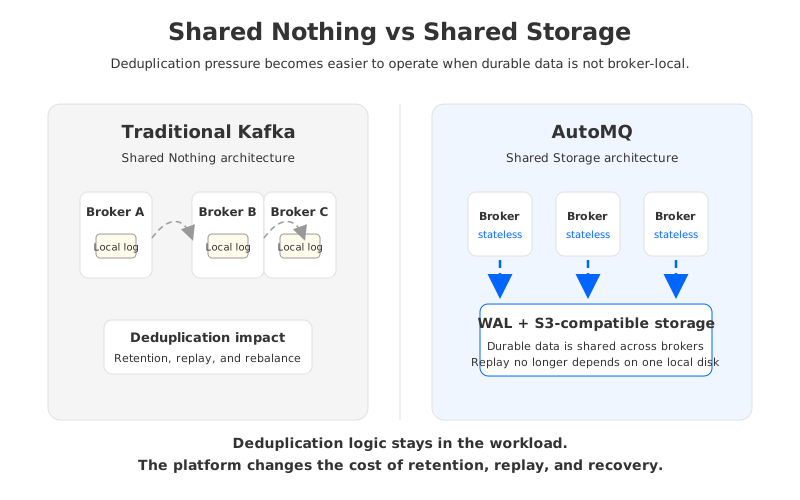
Traditional Kafka clusters make this pressure operationally visible because durable data is tied to broker-local storage. More retention means more local disk or attached block storage. More partitions and changelog traffic mean more broker load. Rebalancing a storage-heavy cluster can become data movement, not only metadata movement. In multi-Availability Zone deployments, replication and client placement can also create network paths that show up as cloud data-transfer cost.
That matters for deduplication because replay is part of the safety plan. When a team cannot afford to reprocess a stream quickly, it may shorten retention or narrow the deduplication window. When expanding a cluster requires moving a large amount of broker-local data, it may overprovision capacity before peak periods. When cross-AZ traffic becomes material, it may place producers, brokers, consumers, and sinks in ways that optimize the bill rather than the failure model. The correctness problem has become an infrastructure problem.
3Architecture options and trade-offs
A production deduplication design usually combines several patterns. The right choice depends on duplicate source, business key quality, ordering requirements, and what happens during replay.
| Pattern | Where it lives | Strong fit | Main risk |
|---|---|---|---|
| Producer idempotency | Kafka producer and broker | Retry duplicates from transient producer failures | Does not deduplicate business events emitted twice by the application |
| Kafka transactions | Kafka read-process-write path | Atomic writes and offset commits inside supported Kafka workflows | Does not make every external sink transactional |
| Stream processor state | Flink, Kafka Streams, Spark, or similar | Windowed deduplication, CDC normalization, enrichment, and joins | State size, checkpoint behavior, and restart time become platform concerns |
| Sink-side idempotency | Database, warehouse, index, object store, or API | Upserts, compare-and-set writes, stable event IDs, and business-key conflict handling | Sink semantics vary; append-only sinks need careful modeling |
| Compacted topic or index topic | Kafka topic keyed by entity or event ID | Last-known-state and lookup-style deduplication | Compaction is not a time-bounded processing guarantee |
No single row owns the whole problem. Producer idempotency is a good default, but it does not detect that two services produced the same business event with different sessions. A stream processor can maintain a deduplication index, but that state needs checkpointing and recovery testing. Sink-side idempotency is often the strongest protection against duplicate side effects, yet it can make a "simple" consumer depend on database transaction behavior.
A useful design starts with event identity. If the record has a stable event ID generated at the business boundary, deduplication can be deterministic. If the system invents a key later from timestamp, payload hash, and source partition, the design may work for analytics but fail for regulated workflows. CDC streams add another wrinkle: the duplicate key may be a database primary key plus commit sequence, not a producer-generated event ID.
Event-time windows are another common trap. A five-minute deduplication window may look reasonable until a source connector is down for 30 minutes and then catches up. Increasing the window increases state. Reducing the window shifts risk to the sink. The platform team can tune RocksDB, checkpoints, changelog topics, and retention settings, but the application team still needs to define whether a late duplicate should be dropped, corrected, or emitted as a compensating event.
4Evaluation checklist for platform teams
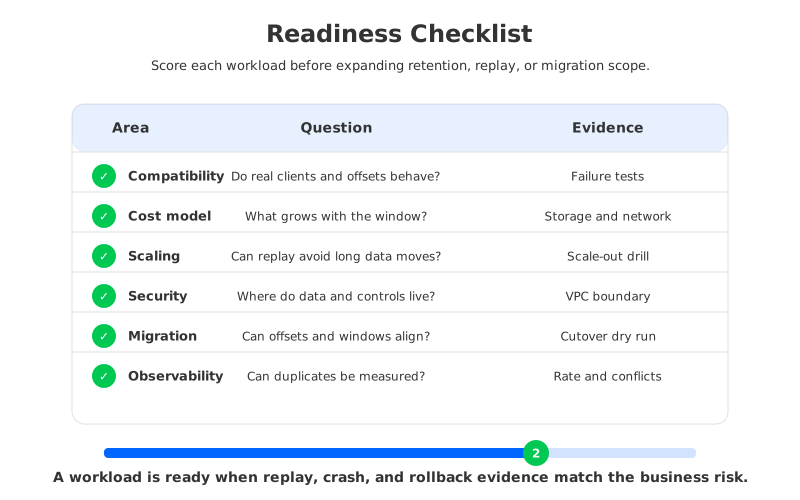
The most productive evaluation is not "Which vendor says exactly-once?" It is a set of workload-specific questions that force the team to place duplicate risk, operational cost, and rollback behavior in the same room.
| Evaluation area | Question to answer | Evidence to collect |
|---|---|---|
| Compatibility | Do existing clients, consumer groups, offsets, transactions, connectors, and stream processors behave as expected? | Integration tests with real client versions and failure injection |
| Cost model | Which parts of deduplication increase retained data, changelog traffic, state size, network movement, or storage requests? | Retention profile, cloud storage pricing, network pricing, and replay volume |
| Elasticity | Can the platform absorb replay, catch-up reads, and traffic spikes without long data movement? | Scale-out tests, partition reassignment timing, and consumer lag recovery |
| Governance | Who owns event IDs, schemas, PII handling, replay approvals, and deduplication exceptions? | Data contracts, schema rules, runbooks, and audit requirements |
| Failure recovery | What happens if the job writes to the sink and crashes before committing the offset? | Controlled crash tests and sink idempotency validation |
| Migration | Can source and target offsets, ordering assumptions, and duplicate windows be reconciled? | Migration dry run with representative consumer groups |
| Rollback | Can consumers safely replay from a known offset or timestamp without corrupting downstream state? | Rollback drill and business approval boundaries |
Apply this checklist per workload, not per cluster. A fraud-feature pipeline, an audit-log archive, and an OLAP ingestion path may share Kafka infrastructure while requiring different duplicate guarantees. The platform can provide durable transport, replay, and observability. It should not pretend that every consumer has the same tolerance for side effects.
Cost belongs in the same checklist because deduplication decisions change infrastructure shape. A larger window may require more stream-processor state. A longer replay horizon may require more Kafka retention. More changelog partitions may increase broker load. A migration plan that relies on replay may temporarily double reads and writes. Cloud pricing pages for storage, inter-AZ transfer, and private connectivity are not side documents in this discussion; they are part of the architecture review.
5How AutoMQ changes the operating model
After the workload requirements are clear, Kafka-compatible platforms with Shared Storage architecture become easier to evaluate. AutoMQ is one option in this category: it keeps Kafka protocol compatibility while changing the storage model under the brokers. AutoMQ uses a Shared Storage architecture built around S3Stream, WAL storage, data caching, and S3-compatible object storage. Durable data is no longer bound to broker-local disks, and brokers can operate as stateless brokers.
That shift does not remove application-level deduplication. It changes the operational constraints around it. If a deduplication-heavy workload needs longer retention, the primary storage layer is object storage rather than broker-local disk. If the cluster needs to scale, partition reassignment is less about copying retained log data and more about changing ownership, leadership, metadata, and traffic placement.
This distinction is important for teams comparing Tiered Storage with a Shared Storage architecture. Tiered Storage can offload older segments, which is useful for retention economics, but the active log and broker-local storage model still matter. AutoMQ's design treats S3-compatible object storage as the main durable storage layer, with WAL storage used as a write and recovery path. That is a different operating model, especially for workloads where deduplication, replay, and long retention are all part of the same correctness story.
The deployment boundary also affects governance. AutoMQ BYOC runs the control plane and data plane in the customer's cloud environment, while AutoMQ Software targets private data center deployments. For regulated deduplication use cases, event IDs, PII-bearing payloads, audit logs, object storage, private endpoints, and telemetry may all be subject to internal controls. Kafka compatibility helps reduce rewrite risk, but deployment ownership decides where data and control paths can live.
AutoMQ also becomes relevant when deduplication feeds table-oriented analytics. Some pipelines should still use a stream processor because they need joins, late-event logic, CDC merge handling, or stateful deduplication before the output is trustworthy. Other streams are already table-shaped and benefit from simpler topic-to-table paths. AutoMQ Table Topic is designed for streaming data into Apache Iceberg tables, which can reduce pipeline surface area when transformation logic is not the main problem. The decision remains semantic: remove pipeline layers only when they are unnecessary, not when they are hiding correctness work.
6A practical readiness scorecard
Before selecting a platform or rewriting a pipeline, score each workload from 0 to 2 in seven areas. A score of 0 means unknown or untested. A score of 1 means designed but lightly tested. A score of 2 means tested through a replay, crash, or migration drill with production-like data.
| Area | 0 | 1 | 2 |
|---|---|---|---|
| Event identity | No stable event ID | Key exists but is not governed | Stable business key with schema contract |
| Offset strategy | Reset behavior unclear | Timestamp or latest-start plan documented | Offset, replay, and rollback tested |
| Sink idempotency | Append-only side effects | Upsert or dedup table planned | Crash-after-write scenario tested |
| State recovery | Checkpoints not validated | Job restore tested in staging | Restore tested with catch-up and late data |
| Retention | Set by habit | Set by replay requirement | Tied to business recovery objective |
| Observability | Only lag dashboards | Lag plus job and sink metrics | Duplicate rate, replay rate, and sink conflicts tracked |
| Migration | Generic replication plan | Dry run on non-critical topics | Consumer-group cutover and rollback tested |
Low scores do not always mean the platform is wrong. They usually mean the duplicate boundary is still implicit. Raising the score may require a schema rule, a sink-side idempotency table, a longer retention period, a stream-processor state change, or a different migration method. The architecture decision becomes much clearer once those gaps are visible.
For teams evaluating a Kafka-compatible foundation with Shared Storage architecture, the next step is to test the workload that creates pressure: long retention plus replay, stateful deduplication plus crash recovery, or migration plus offset continuity. If broker-local storage, slow scaling, or cloud data-transfer patterns make that test harder than the application logic, AutoMQ is worth evaluating as the streaming foundation. You can start from the AutoMQ BYOC path here: talk to AutoMQ about a Kafka-compatible deduplication architecture.
7FAQ
7.1Does Kafka deduplicate messages automatically?
Kafka can reduce some duplicates through idempotent producer behavior and transactions, but it does not automatically deduplicate every business event or every downstream side effect. Application keys, stream-processor state, and sink idempotency still matter.
7.2Is exactly-once semantics enough for streaming deduplication kafka workloads?
Exactly-once semantics helps in supported Kafka workflows, especially read-process-write pipelines that use transactions. It does not guarantee that an external database, API, or object store will handle duplicate side effects correctly.
7.3Should deduplication happen in Kafka, Flink, Kafka Streams, or the sink?
Use Kafka primitives for transport and offset safety, stream processing for stateful or windowed deduplication, and sink-side idempotency for irreversible side effects. Critical systems usually need more than one layer.
7.4How does shared storage help deduplication-heavy workloads?
Shared Storage architecture does not replace deduplication logic. It can make the surrounding operations easier by reducing dependence on broker-local retained data, improving elasticity, and making replay or long retention less tied to local disk capacity.
7.5When should a team consider AutoMQ?
Consider AutoMQ when the Kafka API is still the right application contract, but broker-local storage, scaling, retention, replay, or cloud network cost is limiting the platform. Test it against the exact clients, processors, connectors, and failure cases that carry duplicate risk.


