
Table of Contents
Table of Contents
A streaming feature pipeline starts as a freshness problem and quickly becomes a platform problem. The model team asks for lower feature latency. The data engineering team wires CDC, clickstream, transaction, or telemetry events into a stream processor. The SRE team then inherits a Kafka estate that must retain enough history for replay, serve multiple online and offline consumers, survive failures, and keep costs predictable while traffic arrives in bursts.
That is why the hard part is not producing a real-time feature. It is building a pipeline whose freshness, replay, governance, and operating model still hold after the first model reaches production. A useful architecture conversation begins with the workload contract: which events are authoritative, how fresh the feature must be, how far back teams need to replay, and who owns the infrastructure boundary when the pipeline becomes business-critical.
1Why Streaming Feature Pipelines Matter Now
Machine learning systems have moved closer to operational workflows. Fraud scoring, logistics ETA prediction, real-time personalization, anomaly detection, and AI-assisted operations all depend on features that can become stale while a batch job is still waiting for its next schedule. For these systems, a feature pipeline is not a side channel for analytics. It is part of the serving path.
Kafka is a natural backbone for this pattern because it gives producers and consumers a durable event log. Producers publish events into topics, consumers read at their own pace, and consumer groups track progress through offsets. That contract lets the same event stream feed online feature computation, offline training data generation, monitoring, lakehouse sinks, and backfill jobs without coupling every consumer to the source application.
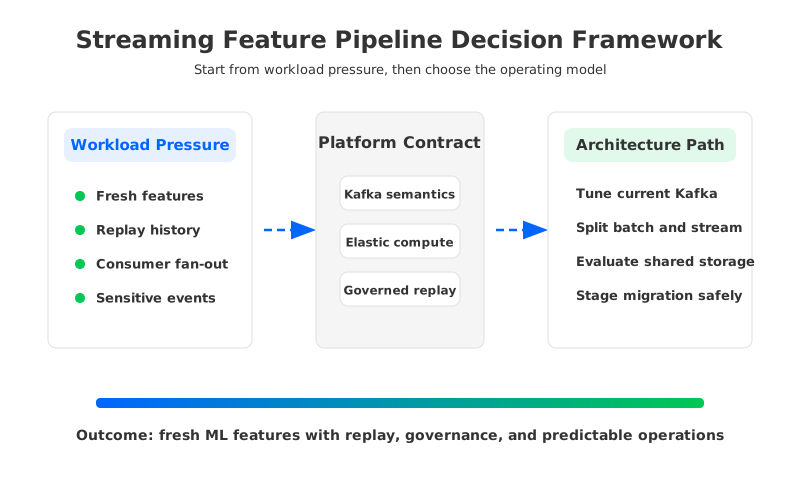
The pressure appears when feature pipelines start sharing a Kafka platform with other workloads:
- Freshness pressure. Online features may need second-level or sub-minute updates, while training datasets need complete, replayable history.
- Fan-out pressure. A stream that began with one feature service may later feed experiments, dashboards, compliance exports, and model monitoring jobs.
- Replay pressure. Feature bugs are often fixed by recomputing from historical events, which turns retention from a safety margin into a product requirement.
- Governance pressure. Feature values can contain customer behavior, payment signals, device identifiers, or operational state that must be controlled across teams.
- Cost pressure. Storage, replication, backfill traffic, and reserved broker headroom grow as the pipeline becomes more valuable.
These pressures are not signs that Kafka is the wrong primitive. They are signs that the streaming platform underneath the feature pipeline must be evaluated as production infrastructure, not as a temporary integration bus.
2The Production Constraints Behind the Search
The common feature pipeline diagram is deceptively clean: source systems emit events, a stream processor computes features, an online store serves low-latency reads, and an offline store keeps history for training. That diagram is useful, but it hides the infrastructure decisions that determine whether the pipeline remains operable.
The first decision is the event contract. Feature pipelines should prefer immutable business events or CDC records that can be replayed deterministically. If a producer sends precomputed feature values with hidden application state, replay becomes fragile because the stream no longer contains enough information to rebuild the feature. If the stream carries raw events with clear schemas and timestamps, the feature computation can evolve while the event log stays stable.
The second decision is the serving split. Online features and offline training data usually need different storage systems, but they should not be computed from unrelated logic. Teams often solve this with a stream processor that writes to an online feature store and a durable offline sink. Feast, for example, documents Kafka as a streaming data source for feature ingestion, which reflects the common pattern of using streams as the bridge between operational events and feature infrastructure.
The third decision is replay scope. A feature pipeline that only retains a few hours of data may be fine for transient scoring, but it is weak for model debugging, backfills, or training set reconstruction. Longer retention gives teams more room to repair mistakes, but traditional Kafka deployments often make retention expensive because broker-local disks, replication, and rebalancing all grow with retained bytes.
This is where architecture matters more than tuning. You can increase partitions, add brokers, change retention, and isolate workloads, but each change still runs inside the same operating model: brokers own local storage, partitions have leaders and followers, and capacity planning must account for both compute and storage at the broker layer.
3Architecture Patterns Teams Usually Compare
Most teams evaluate streaming feature pipelines through three patterns. None is universally right; each one optimizes a different operating constraint.
| Pattern | Where it fits | Main risk |
|---|---|---|
| Batch-first feature pipeline with streaming patches | Teams with strong warehouse or lakehouse workflows and modest freshness needs | Online and offline logic can drift when streaming patches become permanent |
| Traditional Kafka-centered streaming pipeline | Teams that already operate Kafka and need durable event replay for many consumers | Broker-local storage can make retention, fan-out, scaling, and recovery operationally heavy |
| Kafka-compatible shared-storage streaming platform | Teams that want Kafka APIs while separating broker compute from durable storage | Requires evaluation of WAL design, object storage behavior, and migration boundaries |
The batch-first pattern is often the safest starting point for analytics-heavy organizations. It keeps the warehouse or lakehouse as the system of record and adds streaming updates for the subset of features that need freshness. The cost is semantic drift: if the streaming path and batch path are implemented separately, feature definitions can diverge under incident pressure.
The traditional Kafka-centered pattern is the most familiar for platform teams. It uses Kafka topics as the durable source of events, stream processing to compute feature values, and downstream sinks for online and offline stores. Apache Kafka's core model of topics, partitions, producers, consumers, and offsets makes this pattern predictable for teams that already understand consumer groups and replay.
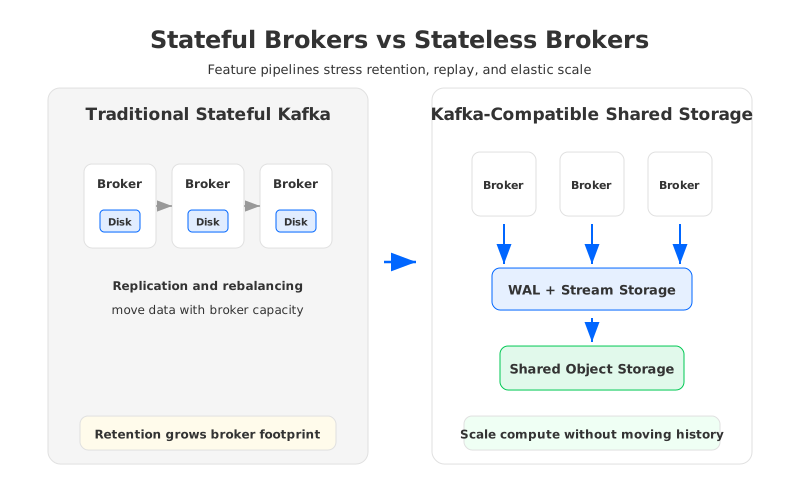
The shared-storage pattern keeps the Kafka-compatible surface but changes the infrastructure contract. Instead of treating every broker as both compute and durable storage, it moves the long-lived stream data into shared storage and makes brokers closer to stateless compute. That matters for feature pipelines because feature workloads are bursty: a backfill, model launch, or experiment can create temporary pressure that should not force a permanent broker-local disk footprint.
4Evaluation Checklist for Platform Teams
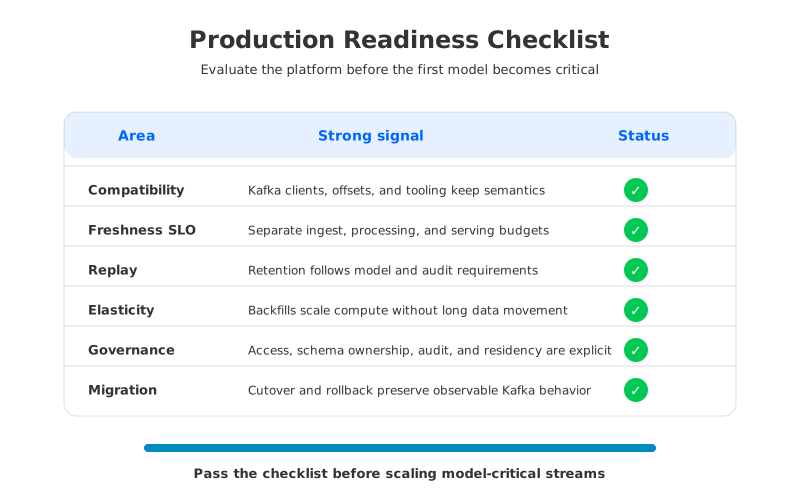
A good streaming feature pipeline review should be less about product names and more about failure modes. The platform must give model teams fresh data, but it must also give operators a way to reason about recovery, governance, and cost when workloads scale.
Use this checklist before committing to a design:
| Area | Question to ask | What a strong answer looks like |
|---|---|---|
| Kafka compatibility | Can existing producers, consumers, stream processors, and connectors keep their semantics? | The platform supports Kafka protocol expectations, consumer group behavior, offsets, and operational tooling with minimal application change |
| Freshness SLO | What latency budget belongs to ingestion, processing, storage, and serving? | The pipeline has separate SLOs for event arrival, feature computation, online serving, and backfill recovery |
| Replay and retention | How far back can teams recompute features after a bug or schema change? | Retention is sized from model and governance requirements, not only from broker disk availability |
| Elasticity | What happens during backfills, experiments, or traffic bursts? | Compute can scale without large partition movement or long storage rebalancing windows |
| Governance | Who can publish, consume, replay, or export sensitive feature events? | Access control, schema ownership, audit paths, and data residency boundaries are explicit |
| Migration and rollback | Can the team move pipeline stages without rewriting every client? | The migration plan preserves Kafka APIs where possible and keeps rollback paths observable |
The checklist exposes a pattern: feature pipelines need both data semantics and infrastructure elasticity. A platform that handles only one side will eventually push complexity into another team. If the streaming layer has strong semantics but weak elasticity, SREs pay the bill during backfills. If it scales easily but changes client behavior, data engineers pay the migration tax.
5Where AutoMQ Changes the Operating Model
Once the evaluation reaches that tension, AutoMQ becomes relevant as an architecture option rather than an opening advertisement. AutoMQ is a Kafka-compatible cloud-native streaming system that separates broker compute from shared storage while preserving the Kafka API surface for existing clients and tools. In practical terms, the design target is familiar Kafka semantics with a storage layer built for cloud object storage economics and elastic operations.
For streaming feature pipelines, the key difference is the decoupling of retained data from broker-local disks. Traditional Kafka brokers must be sized around partitions, replication, local storage, and recovery behavior. When retained feature events grow, the broker fleet carries that storage footprint. When a backfill increases read pressure, operators often need to think about broker capacity and data movement at the same time.
AutoMQ's shared storage architecture changes that relationship. Brokers can be treated more like stateless compute nodes, while durable stream data is persisted in object storage through AutoMQ's storage layer and write-ahead-log design. This does not remove the need to engineer latency, durability, or governance. It changes where those trade-offs are made. Storage durability and retained history move closer to cloud storage primitives, while broker scaling becomes less tied to moving partition data across local disks.
That operating model is especially useful when a feature pipeline has uneven demand:
- A model launch causes a short-lived spike in feature reads and monitoring consumers.
- A feature bug requires replaying historical events into a corrected transformation.
- A training refresh needs a wide scan of retained streams while online features keep serving.
- A regional deployment needs data control without turning every cluster change into a storage migration.
AutoMQ also offers deployment choices that matter for enterprise AI infrastructure. BYOC and software deployment models can keep the data plane within a customer-controlled cloud boundary, while Kafka compatibility reduces the amount of client-side migration required. For teams already standardizing on Kafka tooling, that combination can be more important than a marginal feature-store integration because it protects the operational contract around the stream itself.
6Decision Table: What Should You Do Next?
The right next step depends on which constraint is already painful. A team with an experimental feature pipeline does not need the same answer as a team whose fraud model depends on replaying weeks of payment events.
| Situation | Practical next step |
|---|---|
| Freshness is the primary urgent issue | Add streaming computation around the highest-value features, but keep feature definitions aligned with offline training logic |
| Replay is becoming a bottleneck | Review retention requirements, backfill paths, schema evolution, and topic design before adding more consumers |
| Kafka cost is rising with retained feature history | Separate write throughput, consumer fan-out, cross-zone traffic, broker-local storage, and object storage assumptions in the cost model |
| Broker scaling is slowing experiments | Evaluate whether compute and storage are too tightly coupled for the workload's burst pattern |
| Governance is blocking production launch | Define ownership for schemas, access control, audit, regional boundaries, and feature export paths before scaling the pipeline |
| Migration risk is the main concern | Prefer Kafka-compatible interfaces and staged cutovers so producers, consumers, and rollback plans stay understandable |
The architectural trap is treating a streaming feature pipeline as a single project. It is a contract between source applications, model teams, stream processors, storage systems, and operators. If that contract is vague, every model launch turns into another infrastructure exception. If the contract is explicit, teams can decide when to tune existing Kafka, when to redesign the pipeline, and when to evaluate a Kafka-compatible shared-storage platform such as AutoMQ.
For teams exploring that last path, the useful next step is a workload review rather than a generic demo. Map producer throughput, consumer fan-out, retention windows, backfill behavior, online serving SLOs, and data control requirements. Then compare the current Kafka operating model with a shared-storage design using the same workload assumptions. AutoMQ's documentation and deployment guides are a good starting point for that evaluation.
7References
- Apache Kafka Documentation
- Apache Kafka Design Documentation
- Apache Kafka KIP-405: Kafka Tiered Storage
- AutoMQ Architecture Overview
- AutoMQ: Difference with Apache Kafka
- AutoMQ WAL Storage Documentation
- Feast Documentation: Kafka Data Source
8FAQ
8.1Is a streaming feature pipeline the same as a feature store?
No. A streaming feature pipeline moves and transforms real-time events into feature values. A feature store manages feature definitions, serving, discovery, and often online/offline consistency. Many production systems use Kafka or Kafka-compatible streams to feed a feature store, but the stream and the store solve different parts of the architecture.
8.2When does Kafka become difficult for ML feature pipelines?
Kafka becomes difficult when retention, replay, fan-out, and bursty backfills grow faster than the broker operating model. Broker-local storage is workable for many pipelines, but long history and frequent recomputation can make disk sizing, partition movement, and recovery planning more complex.
8.3Do feature pipelines always need exactly-once processing?
Not always. Some features tolerate idempotent updates, deduplication, or periodic correction. Features tied to payments, risk, or compliance often need stronger processing guarantees and clearer replay behavior. The requirement should come from the feature's business impact, not from a generic platform slogan.
8.4Where does AutoMQ fit in a machine learning feature architecture?
AutoMQ fits at the Kafka-compatible streaming layer. It can receive events from applications or CDC pipelines, serve stream processors and feature infrastructure, and retain replayable history through a shared-storage architecture. It does not replace model training, online serving, or feature governance; it gives those systems a more elastic streaming foundation.


