
Table of Contents
Table of Contents
Teams search for streaming integration backlog when the integration queue has stopped being a project list and started becoming a platform risk. The CDC team is waiting for database approvals. Product engineering wants API events online for personalization. Analytics wants fresher lakehouse tables. Meanwhile the Kafka platform team is asked to absorb every source, replay, and schema surprise.
That backlog is not only a prioritization problem. It signals more real-time data demand than the current operating model can handle. A queue of integrations hides pressure around freshness, recovery time, storage cost, governance, connector ownership, and capacity headroom. Treating every request as "add another connector" makes the backlog longer because it ignores why the queue exists.
The better question is which integrations deserve streaming treatment first, and which platform constraints must be fixed before the team adds more load. CDC, APIs, and lakehouse pipelines have different failure modes and economics. A useful prioritization model should expose those differences before any vendor, framework, or managed service enters the conversation.
1Why Streaming Integration Backlogs Matter
A streaming integration backlog usually forms after the first wave of Kafka adoption succeeds. The platform already carries operational events, application logs, or a few high-value event streams. Then other teams notice that database changes can feed search indexes, SaaS events can update customer health scores, and lakehouse tables can be refreshed closer to business time.
The backlog grows because these requests are not equivalent. A CDC pipeline from a payment database has tight correctness and rollback requirements. API ingestion may be limited by rate limits, authentication flows, and vendor error semantics. A lakehouse pipeline may care less about millisecond latency and more about file layout, table format, replay, and schema evolution.
Platform teams get into trouble when they prioritize by whoever shouts loudest or whichever connector looks easiest. An easy source can become expensive if it creates heavy retention and replay requirements.
Review each request across five dimensions:
- Business freshness. How quickly does the consuming system need the data, and what breaks when it is late?
- State and correctness. Does the pipeline need ordered changes, idempotent writes, transactional boundaries, or exact replay semantics?
- Recovery weight. How much data must be retained and replayed after a source outage, sink outage, or schema repair?
- Governance scope. Which teams own credentials, schemas, data contracts, lineage, retention, and sensitive fields?
- Platform friction. Does the request expose broker capacity, local storage, cross-AZ traffic, partition movement, or operational scaling limits?
Those dimensions turn a backlog into an architecture conversation. The most urgent item is often the one where delayed integration creates business risk and where the platform can support recovery without inventing a special runbook.
2CDC, APIs, and Lakehouse Pipelines Stress Kafka Differently
CDC pipelines are usually the most demanding from a correctness perspective. They capture database changes and turn them into ordered event streams for search indexing, analytics, cache updates, and service decoupling. They also inherit database realities: snapshots, log positions, schema changes, tombstones, source failover, and privileges.
API pipelines often integrate SaaS services, partner systems, or internal HTTP services that were not designed for continuous high-throughput extraction. Rate limits, pagination, retry policies, token rotation, and partial failures matter more than partition count at the beginning.
Lakehouse pipelines translate streaming data into table-oriented storage such as Apache Iceberg, Delta Lake, or Apache Hudi. The hard part is maintaining table metadata, schema evolution, partition layout, compaction, late-arriving records, and replayable history. A backlog full of "Kafka to lakehouse" requests often means the organization wants real-time data products with analytics-grade governance.
| Integration type | Typical priority signal | Main production risk | Platform implication |
|---|---|---|---|
| CDC from operational databases | Business systems need current state outside the database | Incorrect ordering, duplicate updates, snapshot pressure, source log retention | Needs strong offset handling, replay, DLQ policy, and write-burst capacity |
| API and SaaS ingestion | Teams need external events or partner data faster than batch polling | Rate limits, partial failures, authentication drift, inconsistent payloads | Needs throttling, retry isolation, schema validation, and clear ownership |
| Lakehouse pipelines | Analytics, AI, and governance teams need fresher tables | Table metadata churn, file layout problems, replay cost, schema evolution | Needs long retention, catch-up reads, predictable storage cost, and table-format discipline |
The table makes one point clear: a single "stream everything" policy is not a prioritization model. CDC should be evaluated early when operational correctness and business freshness are tied together. API ingestion should move when the external dependency is stable and the use case has clear value. Lakehouse pipelines deserve early investment when many teams need the same governed data product.
3The Hidden Constraint Is Often the Kafka Operating Model
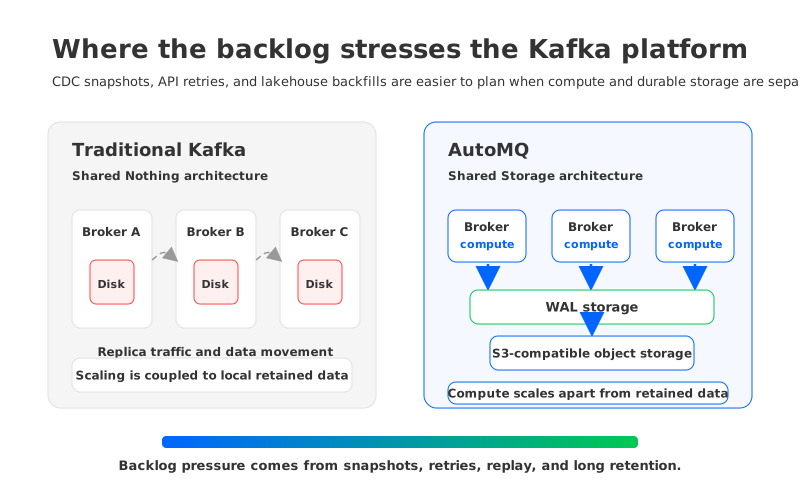
Once the backlog is visible, teams often focus on connector tooling. Tooling explains part of the delay, but many backlogs persist because the platform underneath each integration has become heavy to change. Traditional Kafka uses a Shared Nothing architecture: each broker owns local partition data, and durability is maintained through replicas. This ties scaling, recovery, retention, and broker replacement to data placement.
Integration workloads amplify that coupling. CDC snapshots can produce write bursts, API retry storms can create uneven ingress, and lakehouse backfills can trigger long consumer catch-up windows. When every retained byte is part of a broker-local capacity plan, adding integrations may require adding brokers, moving partitions, expanding disks, tuning replication, and waiting for data movement.
Tiered Storage helps when the pain is long historical retention. It offloads older segments to remote storage while keeping recent data local to brokers. That can reduce local disk pressure, but it does not make brokers stateless. For a backlog dominated by replays, backfills, and elastic integration demand, the question becomes whether offloading old segments is enough or whether the durable stream storage model itself needs to change.
Separate three layers that are often collapsed into one purchasing decision:
- Integration runtime. Connector workers, CDC agents, API pollers, stream processors, table writers, and their deployment model.
- Kafka-compatible platform. Topics, partitions, offsets, consumer groups, security, retention, replication, and client compatibility.
- Storage and scaling model. How durable stream data is stored, how brokers are replaced, how capacity is added, and how replay traffic is handled.
If the backlog is blocked by missing ownership, weak schemas, or unreliable sources, changing the Kafka platform will not fix it. If it is blocked by broker-local storage, slow partition movement, or expensive retained data, connector tuning will not be enough.
4A Prioritization Framework for Platform Teams
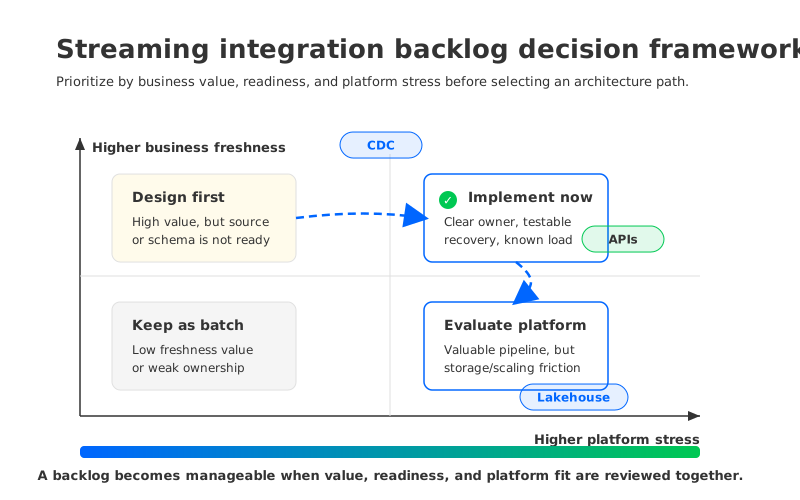
A streaming integration backlog should be triaged like production risk, not like a feature queue. Score each request against value, readiness, and platform stress. The score does not need to be perfect; it needs to force the right conversation before implementation starts.
High-priority integrations usually have three traits: delayed data hurts the consuming workflow, ownership boundaries are clear enough to operate, and the platform can recover without manual heroics. If one trait is missing, the request may still matter, but it is a design problem rather than a connector ticket.
| Question | CDC lens | API lens | Lakehouse lens |
|---|---|---|---|
| What proves value? | Downstream system needs current entity state or change history | Product, support, or partner workflow needs fresher external events | Shared analytics or AI data product needs governed freshness |
| What blocks readiness? | Database privileges, log retention, schema change ownership | Rate limits, API contracts, token ownership, retry semantics | Table format, schema evolution, compaction, partition strategy |
| What stresses Kafka? | Snapshots, high write bursts, ordered replay, tombstones | Uneven ingress, retries, DLQs, payload variability | Long retention, catch-up reads, backfills, many consumers |
| What should be tested first? | Snapshot plus failover plus duplicate handling | Throttling plus partial outage plus replay window | Backfill plus schema evolution plus table repair |
This framework also prevents the common mistake of optimizing for the first successful ingest. A pipeline is production-ready when it can restart, replay, reject bad records, preserve ownership, and be audited under load. The backlog should shrink only when those conditions are met.
Classify each request into one of four actions:
- Implement now. High value, clear ownership, known source behavior, and validated platform capacity.
- Design before implementation. High value, but unresolved schema, security, replay, or rollback questions.
- Batch remains acceptable. Fresher data is useful, but the business impact does not justify streaming complexity yet.
- Platform evaluation required. The request is valuable, but scaling, retention, recovery, or cross-AZ cost concerns show that the Kafka operating model is the blocker.
That last category is where the team stops debating a single connector and asks whether the streaming platform can become a shared foundation for many integrations with different recovery and governance needs.
5Where AutoMQ Changes the Operating Model
AutoMQ should enter the conversation after the team has identified platform friction. The architectural question is straightforward: can the organization keep Kafka-facing contracts while reducing the operational weight of broker-local durable state? That matters because CDC snapshots, API retries, and lakehouse backfills punish platforms that scale by moving retained data around.
AutoMQ is a Kafka-compatible streaming platform that keeps Apache Kafka protocol and ecosystem semantics while replacing Kafka's broker-local log storage with S3Stream, WAL storage, and S3-compatible object storage. Durable stream data is stored in shared object storage, while AutoMQ Brokers are designed as stateless brokers.
For integration backlog strategy, that changes several questions:
- Capacity becomes less tied to retained local data. Compute scaling can be evaluated separately from durable stream storage.
- Replay-heavy workloads become easier to reason about. CDC repair, API reprocessing, and lakehouse backfill still need discipline, but the storage layer is built around object storage and Catch-up Read behavior.
- Broker lifecycle becomes less intrusive. Stateless brokers reduce the penalty of replacing or scaling compute nodes.
- Deployment boundaries stay explicit. AutoMQ BYOC and AutoMQ Software are designed for customer-controlled environments where data, credentials, network paths, and governance evidence must remain inspectable.
This does not remove connector testing. A bad CDC configuration can still duplicate records, an API connector can still leak credentials, and a lakehouse writer can still create small-file or schema problems. AutoMQ changes the platform layer so that the backlog is less likely to be blocked by storage coupling, slow scaling, or retained-data movement.
It also gives teams a cleaner migration path when Kafka compatibility is non-negotiable. Existing producers, consumers, topics, offsets, and ecosystem tools can be evaluated against a compatible interface while the storage architecture changes underneath. For lakehouse-oriented requests, Table Topic can be evaluated where direct streaming-to-Iceberg output fits the data product design.
6Production Readiness Checklist
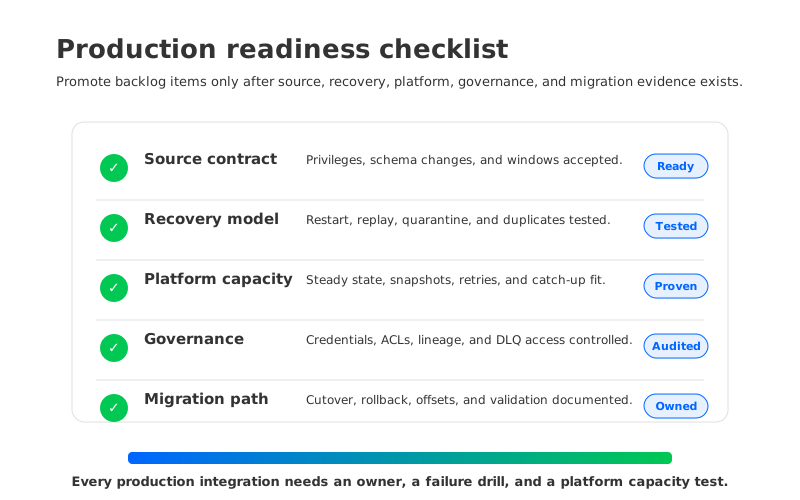
The backlog is ready to move when each integration has an owner, a failure plan, and a platform test. The checklist below works best as a gate before a pipeline is promoted to production.
| Gate | What to prove | Evidence |
|---|---|---|
| Source contract | The source owner accepts extraction method, privileges, schema changes, and maintenance windows. | Data contract, connector config, schema review. |
| Recovery model | The pipeline can restart, replay, quarantine bad records, and avoid unsafe duplicates. | Failure drill with outages and malformed records. |
| Platform capacity | Storage, compute, partitions, and consumers can handle steady state plus backfill. | Snapshot, retry, and catch-up read load test. |
| Governance | Credentials, ACLs, classification, lineage, retention, and DLQ access are controlled. | Security review, ACL export, secret scan. |
| Migration path | Cutover, rollback, offset continuity, and validation are explicit. | Runbook, dry run, rollback trigger. |
| Backlog symptom | Best next move |
|---|---|
| Many requests lack source owners or schemas | Fix governance before adding more streaming infrastructure. |
| CDC requests are high value but snapshot and replay tests fail | Prioritize CDC design work and capacity tests before broad rollout. |
| API ingestion is blocked by external rate limits | Build throttling, retry isolation, and DLQ policy before platform changes. |
| Lakehouse requests need the same governed stream history | Invest in shared topics, retention strategy, and table-format architecture. |
| Valuable integrations repeatedly hit broker storage or scaling limits | Evaluate a Kafka-compatible Shared Storage architecture such as AutoMQ. |
Backlogs shrink when teams stop treating integration as isolated tickets. CDC, APIs, and lakehouse pipelines all ask the same platform to provide durable, replayable, governed streams. The right priority is where business value, operational readiness, and platform fit line up.
If your queue keeps growing because the current Kafka platform makes every integration feel like a storage, scaling, or recovery project, use the hardest item as the proof point. Test a CDC snapshot, an API retry storm, or a lakehouse backfill against the architecture you want for the next 50 integrations. AutoMQ is worth evaluating when that test needs Kafka compatibility, shared object storage, stateless brokers, and a customer-controlled deployment boundary. Start from the AutoMQ documentation.
7References
- Apache Kafka documentation: Introduction
- Apache Kafka documentation: Consumer groups and offsets
- Debezium documentation: What is change data capture?
- Apache Iceberg documentation: Apache Iceberg table specification
- AutoMQ documentation: Architecture overview
- AutoMQ documentation: S3Stream shared streaming storage
- AutoMQ documentation: Table Topic overview
8FAQ
8.1What is a streaming integration backlog?
A streaming integration backlog is the queue of CDC, API, SaaS, lakehouse, and application-event pipelines waiting to move onto a real-time or Kafka-compatible streaming platform. It reflects demand for fresher data and limits in governance, source readiness, connector ownership, and platform capacity.
8.2How should teams prioritize CDC, API, and lakehouse pipelines?
Prioritize by business freshness, correctness requirements, recovery weight, governance readiness, and platform friction. CDC moves early when operational systems need current state. APIs move when rate limits and ownership are clear. Lakehouse pipelines move when many teams need the same governed, replayable data product.
8.3When is batch still the better choice?
Batch remains appropriate when fresher data has low business value, the source cannot support continuous extraction, governance is unresolved, or the workflow does not need replayable event history.
8.4What makes integration backlogs hard for traditional Kafka clusters?
Traditional Kafka ties durable partition data to broker-local storage. CDC snapshots, API retries, long retention, and lakehouse backfills can increase broker capacity pressure, partition movement, and recovery time.
8.5Where does AutoMQ fit in streaming integration backlog strategy?
AutoMQ fits when the backlog exposes Kafka platform constraints rather than connector gaps. It keeps Kafka compatibility while using Shared Storage architecture, object storage, and stateless brokers for elastic integration infrastructure.


