
Table of Contents
Table of Contents
Streaming joins become expensive when the join is treated as a query feature rather than an operating contract. The SQL or stream-processing code may be short: join orders with payments, enrich clicks with customer attributes, correlate telemetry with deployment metadata, or match device events with the latest entitlement table. The platform work behind that short expression is less tidy. Kafka topics must retain enough history, stream processors must hold state, brokers must serve replay and tail traffic, and SREs must keep recovery paths inside the same budget envelope as normal traffic.
That is the real search intent behind streaming joins kafka cost. Teams are not asking whether a join operator exists. Apache Kafka Streams and Apache Flink both support join patterns over streams and tables, with semantics that depend on keys, windows, changelog streams, time attributes, state, and materialization. The hard question is whether the event backbone can support those joins without turning every new enrichment use case into more broker storage, more cross-zone traffic, more replay pressure, and more operational risk.
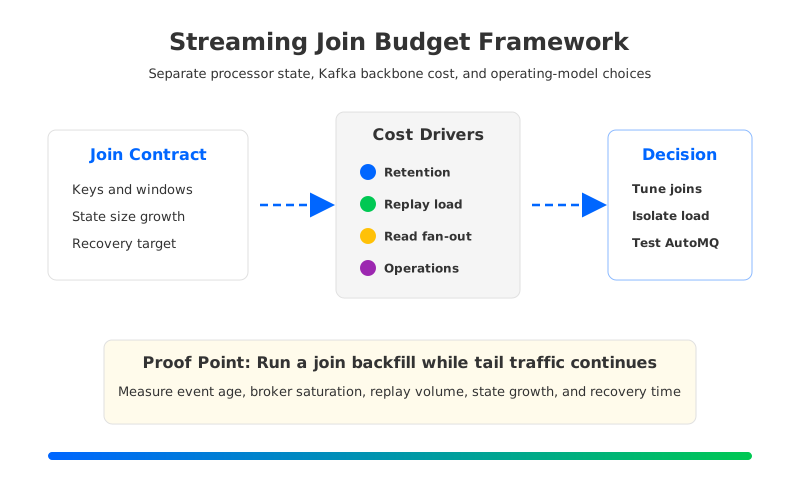
The budget issue usually appears after the first success. A team proves that joining real-time orders with customer state removes minutes of batch delay. Then fraud wants another stream, support wants richer context, observability wants deployment metadata, and AI teams want fresh features. Each request looks reasonable in isolation. Together they change the workload from "move events" to "keep enough event and state history available for many continuously updating relationships."
1Why Streaming Joins Change the Cost Shape
A streaming join combines two or more changing inputs while preserving useful time semantics. A stream-stream join usually needs a window because both sides are moving. A stream-table join uses a changing reference view. A table-table join maintains results as either side updates. In Flink SQL, streaming joins operate over dynamic tables; in Kafka Streams, KStream and KTable APIs expose different join forms and materialization options. Those semantics are powerful because they let teams express real-time relationships without waiting for a warehouse job.
The same semantics create four budget drivers that are easy to hide in a design review:
- State size: Join windows, lookup tables, changelogs, and materialized views all require state. Longer windows and higher-cardinality keys increase memory, local disk, checkpoint, and changelog pressure.
- Replay volume: Backfills, bug fixes, schema corrections, and new derived features often reread historical topics. The join may be real time, but recovery is usually historical.
- Fan-out: A topic used by one join becomes an input to many joins. Broker fetch load and cache behavior change when every team treats the same stream as a shared feature substrate.
- Availability topology: Production joins need high availability. Multi-zone placement, broker replication, checkpoint storage, and processor failover all affect the bill.
The important point is not that streaming joins are bad. They are often the correct architecture. The point is that join cost is a system property, not a line item in the stream processor alone. If Kafka is the durable event backbone, Kafka storage, broker fetch paths, partition placement, and recovery behavior become part of the join budget.
2The Production Constraints Behind the Query
Most teams first optimize the processing job: tune RocksDB state, adjust checkpoint intervals, fix skewed keys, increase task parallelism, or shorten a window. That work matters, but it does not remove pressure from the event backbone. A join job with lower processor cost can still make the platform more expensive if it requires longer Kafka retention, high-volume replay, or many consumers reading the same hot topics.
The cost model becomes clearer if the team separates processing cost from backbone cost:
| Cost area | What drives it | Common blind spot |
|---|---|---|
| Stream processor state | Window length, key cardinality, table size, checkpoint policy | Treating state tuning as the whole cost problem. |
| Kafka storage | Retention, replication factor, changelog topics, compacted tables | Keeping more history on broker-local disks than the join really needs hot. |
| Broker and network load | Read fan-out, replay, cross-zone consumers, partition movement | Measuring produce throughput but ignoring catch-up reads. |
| Operations | Rebalancing, broker replacement, disk expansion, incident replay | Counting infrastructure spend but not operator time and recovery risk. |
This split prevents a common mistake: blaming the join engine for every cost increase. Sometimes the stream processor is the right place to optimize. Sometimes the data model is wrong and the join should be precomputed, denormalized, or moved to a lookup service. But when the recurring pain is retention growth, broker scaling, partition reassignment, or replay interference, the event backbone has become the limiting architecture.
3Architecture Patterns Teams Usually Compare
The first pattern is conservative Kafka optimization. Keep the existing Kafka estate, improve partition keys, reduce unnecessary fan-out, use compacted topics for reference data, set retention by use case, and enforce quotas on replay-heavy consumers. This is often the best first move because it preserves known behavior and avoids migration work. It is also honest: a bad join key will remain bad on any platform.
The second pattern is workload isolation. Teams split high-volume join workloads into dedicated topics, clusters, or processor pools. Isolation can protect tail traffic from replay and make chargeback easier. The downside is duplication. More clusters and topic copies can reduce blast radius while increasing operational surfaces, data governance work, and cross-system reconciliation.
The third pattern is managed Kafka. Delegating broker lifecycle operations can help when the team lacks Kafka operations capacity. The evaluation still needs detail. Managed does not automatically mean low join cost; retention, network placement, read fan-out, private connectivity, tiered storage behavior, and replay characteristics still shape the final bill.
The fourth pattern is a Kafka-compatible shared-storage architecture. In this model, durable stream data is no longer pinned to broker-local disks in the same way as traditional shared-nothing Kafka. Brokers focus more on Kafka protocol handling, scheduling, cache, and compute responsibilities, while object storage or cloud storage carries the durable data layer. This changes the cost conversation because retention and broker compute can be scaled with less coupling.
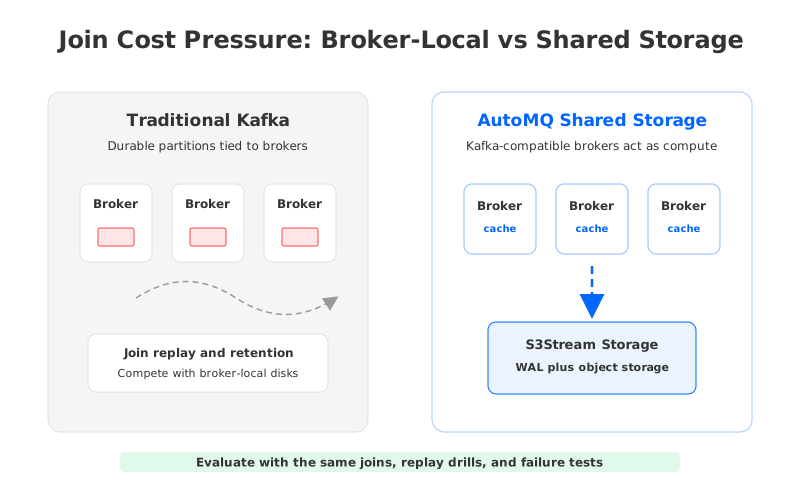
This is where AutoMQ belongs in the evaluation, after the neutral framework is already visible. AutoMQ is a Kafka-compatible streaming platform that replaces Kafka's broker-local log storage with S3Stream, a shared storage layer using WAL storage and S3-compatible object storage. Brokers become stateless in the durable-data sense, so scaling and broker replacement do not require the same kind of partition data movement that dominates many traditional Kafka operations. For streaming joins, that matters when the budget pressure is caused by retained history, replay, and elasticity rather than by the join expression itself.
4A Practical Cost Worksheet for Streaming Joins
A useful worksheet starts with the join contract. Write down what the join must prove in production: input streams, reference tables, keys, window length, update frequency, expected lateness, recovery target, and failure behavior. Then model the cost of keeping that contract alive during normal traffic and correction traffic. Correction traffic is the painful part because backfills and incident reprocessing often arrive exactly when the platform is already under scrutiny.
At minimum, capture these inputs:
- Written bytes and retained bytes for every source, changelog, and derived topic used by the join.
- Read fan-out across stream processors, debugging tools, downstream consumers, replay jobs, and AI feature builders.
- State and checkpoint size for each join operator, including compacted tables and windowed stores.
- Cross-zone and private-network paths for producers, brokers, processors, object storage, checkpoints, and sinks.
- Recovery drills that measure catch-up time while normal tail traffic continues.
- Operational work required for broker scaling, partition reassignment, disk expansion, processor failover, and rollback.
The worksheet should produce more than a monthly cost estimate. It should show which dimension dominates under stress. If processor state dominates, optimize the join or state backend. If read fan-out dominates, use topic design, caching, or consumer placement. If retained bytes and broker data movement dominate, test whether shared storage changes the operating curve.
5Where AutoMQ Changes the Operating Model
Traditional Kafka couples durable partition data with broker-local storage. That model has served the industry well, but it makes some join-heavy workloads awkward in the cloud. Long retention grows broker storage. Replays compete with broker resources. Scaling compute can trigger data movement. Multi-zone durability often means the platform pays for replication and topology complexity while join jobs continue to multiply.
AutoMQ changes the coupling point. It preserves Kafka protocol compatibility, but durable stream storage is implemented through S3Stream, with WAL storage used for write acceleration and recovery and object storage serving as the primary data repository. The result is not "joins become free." Nothing makes state, reads, and recovery free. The useful change is that retained stream history is no longer naturally tied to long-lived broker disks, and broker capacity can be reasoned about more like compute and cache.
For a platform team, that translates into several evaluation questions:
- Can join-heavy replay run without forcing large broker-local disk expansion?
- Can broker capacity be added or replaced without copying large retained partitions between brokers?
- Can long retention be modeled against object storage, request, cache, and network behavior rather than only local disk capacity?
- Can the deployment boundary meet governance requirements when data-plane resources need to stay in a customer-controlled cloud or private environment?
Those questions are concrete enough for a proof of concept. Mirror representative topics, run the same Kafka clients and stream processors, execute a backfill, fail a node, scale capacity, and compare event age, catch-up time, broker saturation, object storage behavior, and cost counters. The goal is not to crown a universal architecture. The goal is to find out whether your join budget is limited by processing logic, data modeling, or the storage model under the event backbone.
6Production Readiness Checklist
The best review for streaming joins is intentionally boring. It asks whether the team can explain the bill and the recovery path before the use case becomes critical.
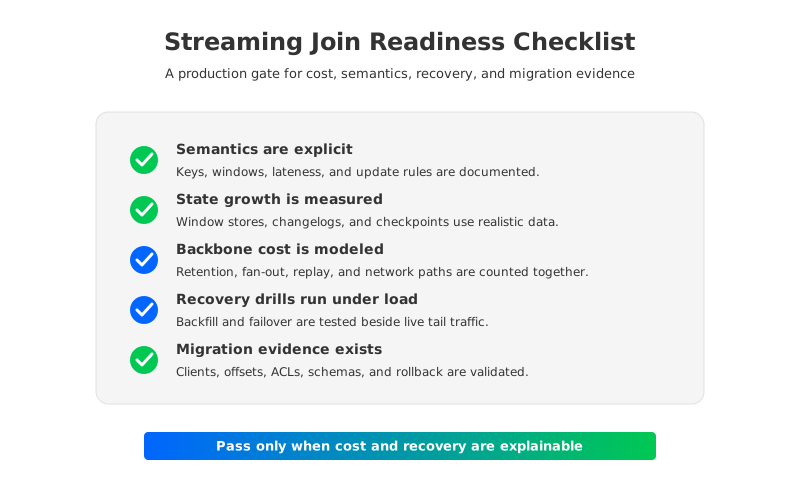
Use the checklist as a gate before scaling a join pattern across teams:
| Review area | Pass signal | Red flag |
|---|---|---|
| Semantics | Join keys, windows, late data, and update rules are documented. | The job "works" but no one can explain wrong or late matches. |
| State | State size and checkpoint growth are measured under realistic data. | Capacity is estimated from a short demo run. |
| Backbone cost | Retention, replication, fan-out, and replay are modeled together. | The estimate covers processor compute only. |
| Recovery | Backfill and failover drills run beside live tail traffic. | Recovery is tested during quiet periods only. |
| Migration | Clients, offsets, ACLs, schemas, and rollback are verified. | Kafka compatibility is assumed from a hello-world producer. |
The first decision is usually not "replace Kafka." It is "make the join contract measurable." Once the contract is measurable, architecture choices become less emotional. Some workloads need only query and state tuning. Some need isolation. Some need managed operations. Some deserve a shared-storage Kafka-compatible design because the budget problem is the coupling of durable data, broker disks, and operational movement.
If your streaming joins keep expanding the Kafka budget faster than the business value expands, redraw the architecture around the cost drivers: state, retention, replay, fan-out, and recovery. For teams that want Kafka compatibility while testing a shared-storage operating model, AutoMQ is worth evaluating with the same join workload, processor code, and failure drills you use for your current platform.
7References
- Apache Kafka Documentation
- Apache Kafka Streams KStream API
- Apache Kafka Streams KTable API
- Apache Flink Documentation: Joins
- AutoMQ Documentation: Architecture Overview
- AutoMQ Documentation: S3Stream Shared Streaming Storage
- AutoMQ Documentation: Stateless Broker
- AWS S3 Pricing
8FAQ
8.1What makes streaming joins expensive on Kafka?
Streaming joins can increase cost through retained source topics, changelog topics, materialized state, replay reads, cross-zone traffic, and operational work around broker scaling or recovery. The join operator may be efficient, but the surrounding event backbone still has to store, serve, and recover the data required by the join contract.
8.2Should teams optimize the stream processor before changing Kafka architecture?
Yes. Start with join keys, windows, state size, checkpoint policy, consumer parallelism, and data modeling. A shared-storage Kafka-compatible platform will not fix skewed keys or unnecessary state. Architecture evaluation becomes relevant when the recurring cost driver is broker-local retention, replay pressure, partition data movement, or slow elasticity.
8.3How should platform teams model streaming joins Kafka cost?
Model written bytes, retained bytes, read fan-out, state size, checkpoint size, cross-zone paths, replay volume, recovery time, and operator work. Run at least one recovery drill while live traffic continues. A spreadsheet based only on steady-state processor compute will miss the most expensive failure and replay paths.
8.4Where does AutoMQ fit for join-heavy workloads?
AutoMQ fits when teams want Kafka compatibility but need to test whether shared storage and stateless brokers change the cost curve for retention, replay, scaling, and recovery. It should be evaluated with the same Kafka clients, stream processors, topics, and failure drills as the current platform.
8.5Do shared-storage Kafka-compatible systems remove the need for join state management?
No. Join state still has to be designed, sized, checkpointed, and recovered. Shared storage changes the event-backbone operating model; it does not remove the need to manage stream-processing state, key distribution, time semantics, and downstream consistency.


