
Table of Contents
Table of Contents
Teams do not search for streaming microservice boundaries kafka because they need another definition of microservices. They search for it when a topic has stopped being "some messages we publish" and has become a contract that several teams depend on. A payment service emits an event, fraud scoring consumes it, customer support reads it later, finance reconciles it, and analytics builds retained history from the same stream. The boundary is no longer a REST endpoint owned by one team. It is an event stream whose schema, ordering, retention, replay behavior, security rules, and operational limits affect every downstream consumer.
Kafka is a natural place for these boundaries because it gives teams durable logs, consumer groups, offsets, ordering within partitions, and a protocol ecosystem that most data engineers already understand. That strength is also why the boundary can become difficult to operate. When an event becomes a contract, the platform team inherits questions that application teams rarely model in the first design review: how long must the log remain replayable, who can change the schema, how much fan-out is acceptable, what happens during a broker failure, and who pays for cross-zone traffic when the consumer base grows.
The architectural mistake is treating those questions as separate operational tickets. They are one system design problem: a streaming microservice boundary is healthy only when the application contract and the Kafka operating model are aligned.
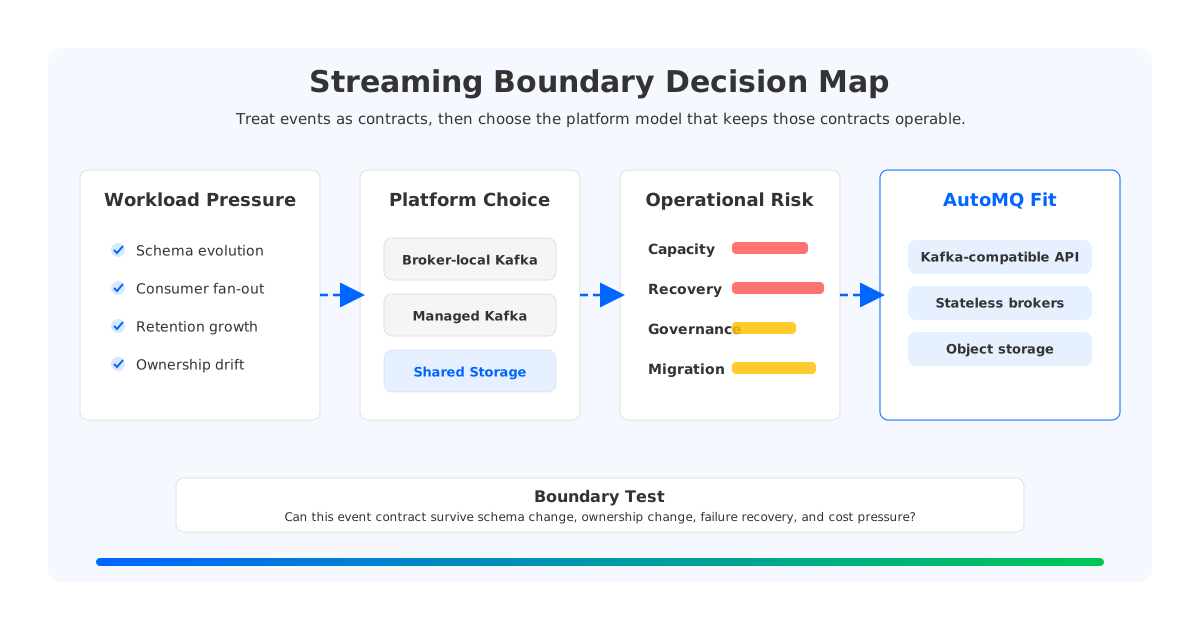
1Why teams search for streaming microservice boundaries kafka
Most microservice boundary discussions start with ownership. One team owns an order service, another owns inventory, another owns fulfillment. A synchronous API makes that boundary visible because a caller must know the endpoint, request shape, response shape, and failure behavior. With Kafka, the boundary can look less formal: a team creates a topic, publishes records, and lets consumers subscribe.
That informality is useful early. It lets teams decouple release schedules and add consumers without changing the producer. Over time, the same flexibility creates hidden coupling. Consumers depend on field names, event timing, retention windows, keying strategy, and ordering behavior. A schema change that looks backward compatible to one team may break a stream processing job that treats null values differently.
The practical boundary is larger than the event payload:
- The schema and compatibility policy that tell consumers how data can change.
- The partition key and ordering expectations that determine whether a downstream service can reason about state.
- The retention and replay window that define how far back consumers can recover.
- The offset and consumer group model that controls independent progress.
- The security, ownership, and cost model that determines who can change the topic and whether it remains affordable.
These are the conditions under which independent teams can safely share a stream. A topic without them is not a stable boundary; it is a queue that happens to have multiple readers.
2The production constraint behind the problem
Traditional Kafka was designed around a shared-nothing model. Each broker owns local log segments, replicas are placed across brokers for durability, and partition movement involves moving data between brokers. This model is robust, but it makes storage placement part of the operating model. When a microservice boundary becomes popular, storage and replication behavior start to matter as much as the event schema.
Consider a topic that begins as a simple order event stream with one producer team and two consumers. Six months later, it feeds fraud detection, fulfillment routing, customer support search, data lake ingestion, dashboards, and backfills. The application architecture improved because teams avoided point-to-point integrations. The Kafka platform, however, now carries more retention, fan-out, offset state, ACLs, schema review, and capacity planning.
In broker-local architectures, four operational pressures show up repeatedly:
- Broker-local storage becomes a scaling constraint. Adding compute capacity does not automatically rebalance durable data, so partition movement must be planned and monitored.
- Retention turns into capacity reservation. A topic that needs longer replay windows consumes broker-attached storage even when most reads are tail reads.
- Multi-AZ durability can amplify network cost. Replication, client placement, and consumer fan-out may move data across availability zones.
- Connectors and stream processors widen the blast radius. Kafka Connect, Flink, Spark, and custom consumers depend on stable offsets, schema behavior, and backpressure handling.
Kafka has mature concepts for consumer groups, offsets, producer acknowledgments, transactions, and connectors. The issue is that microservice boundaries convert those mechanisms into long-lived team contracts. Once that happens, every infrastructure decision becomes part of the contract surface.
3Architecture options and trade-offs
There are several reasonable ways to run Kafka-compatible streaming infrastructure for microservice boundaries. The right answer depends on control requirements, operational capacity, and workload volatility.
| Option | Where it fits | Main risk to model |
|---|---|---|
| Self-managed Apache Kafka | Teams with deep Kafka operations skills and strong control requirements | Capacity planning, partition reassignment, broker failure recovery, and operational labor |
| Managed Kafka service | Teams that want less infrastructure ownership and accept provider-specific boundaries | Cost visibility, scaling limits, network placement, and migration path |
| Kafka-compatible shared storage architecture | Teams that want Kafka semantics while separating compute scaling from durable storage growth | Compatibility validation, deployment model, and migration discipline |
The trade-off is not "managed versus self-managed" in the abstract. The deeper question is where the log lives and how expensive it is to change the compute layer around it. If durable data is bound to broker-local disks, scaling and recovery involve data placement work. If durable data lives in shared storage, the platform has more freedom to scale, replace, and rebalance brokers without treating every change as a storage migration.
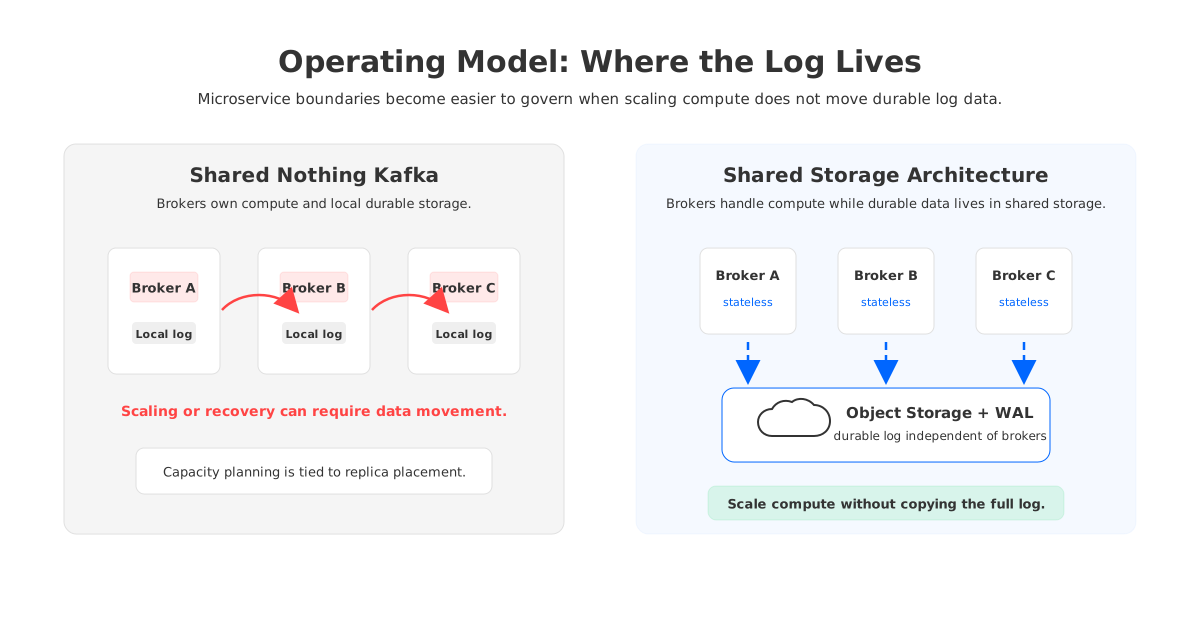
This distinction also changes governance. In a broker-local model, platform teams often use stricter quotas because a poorly planned topic can consume scarce broker resources. In a shared storage model, storage growth still matters, but retained history is less tightly coupled to broker compute. That gives teams room to evaluate boundaries by contract value rather than only by local disk pressure.
4Evaluation checklist for platform teams
A streaming microservice boundary should pass a platform review before it becomes a shared production contract.
Start with compatibility. Kafka compatibility is not a slogan; it is a test plan. Confirm client libraries, producer acknowledgments, transactions if used, consumer group behavior, offset reset policies, ACLs, quotas, and operational tooling. If a platform claims Kafka compatibility, the proof should include the actual clients and frameworks your teams run, not only a console producer and consumer.
Then model cost as behavior, not as a monthly estimate. A boundary that looks inexpensive at launch can become costly when read fan-out grows, retention extends, or consumers move across network boundaries. Cost review should separate compute, storage, retained history, replication traffic, cross-zone transfer, connector infrastructure, and operational labor.
Governance needs the same concreteness. Topic ownership should identify who can approve schema changes, retention changes, partition changes, and deletion. Security review should cover producer and consumer identity, ACL scope, network path, encryption, and audit evidence. A team cannot own a boundary it cannot observe.
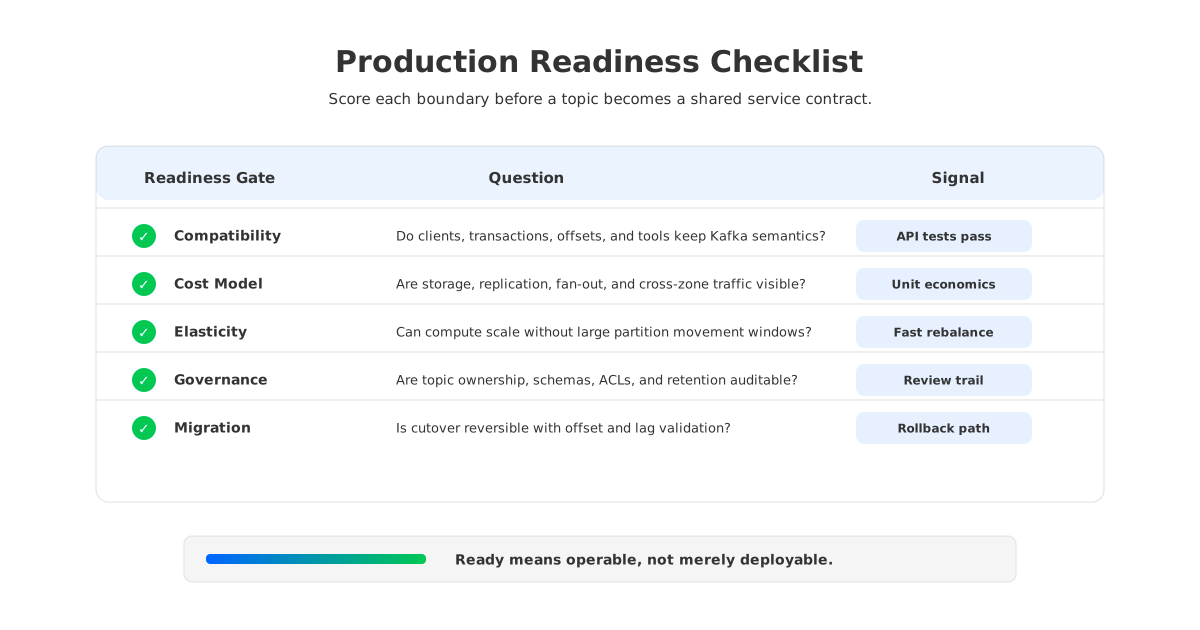
For migration and rollback, use a scorecard:
| Gate | Production question | Evidence to collect |
|---|---|---|
| Client compatibility | Do existing producers and consumers preserve expected behavior? | Integration tests using real client versions and configs |
| Offset continuity | Can consumers resume without duplicate processing surprises? | Offset mapping, lag comparison, and replay validation |
| Schema safety | Are compatibility rules enforced before deployment? | Schema registry checks or equivalent CI policy |
| Cost control | Can the team see storage, fan-out, and network drivers? | Cost allocation tags, network metrics, retention reports |
| Failure recovery | What happens if a broker, AZ, connector, or downstream service fails? | Runbook tests and recovery time observations |
| Rollback | Can traffic return to the previous path without data loss? | Dual-write, mirroring, or cutover plan with stop criteria |
This checklist prevents a common failure mode: choosing a streaming platform from a feature matrix, then discovering later that it cannot support the boundary model.
5How AutoMQ changes the operating model
If the root pressure is the coupling between broker compute and durable log storage, the architecture worth evaluating is a Kafka-compatible shared storage design. AutoMQ fits in this category: it preserves Kafka protocol compatibility while moving the storage model toward object-storage-backed durability and stateless brokers.
The important shift is not a cosmetic "cloud-native" label. AutoMQ's Shared Storage architecture separates broker compute from the durable stream storage layer. Brokers can focus on Kafka protocol requests, while S3-compatible object storage and a write-ahead log layer provide persistence.
First, scaling becomes less dominated by data movement. In traditional Kafka, adding brokers is only the beginning; the hard work is moving partitions and replicas so the capacity is useful. With shared storage, brokers do not need to own the full historical log locally.
Second, retained history stops competing so directly with broker-local disks. Long replay windows still have cost, and object storage is not free. But capacity can grow in the object storage layer rather than requiring the same broker disk provisioning. For microservice boundaries, this matters because replay is part of the contract.
Third, multi-AZ traffic deserves architectural attention. AutoMQ documents patterns for eliminating inter-zone traffic by using S3-based storage architecture and zone-aware client behavior. A topic that starts with two local consumers can later serve analytics, search, ML, and operational workflows across several zones.
Fourth, customer-controlled deployment boundaries matter for regulated teams. AutoMQ offers BYOC and self-managed deployment options, which let organizations keep the data plane in their own cloud or private environment while using Kafka-compatible interfaces. For teams evaluating private connectivity, regional control, data residency, or marketplace procurement, deployment is part of the architecture decision.
Shared storage changes the shape of the operating problem; it does not excuse teams from defining the contract. A Kafka-compatible platform still requires schema governance, client testing, offset validation, observability, and rollback planning.
6A practical boundary design pattern
The cleanest way to design streaming microservice boundaries is to treat each high-value topic as a product interface. That means making the invisible contract explicit enough that teams can change it safely.
Use a short boundary record for every shared topic:
- Purpose: The business event or state transition represented by the topic.
- Owner: The team accountable for schema, retention, and producer behavior.
- Consumers: Known consumer groups, criticality, and replay needs.
- Compatibility policy: Which schema changes are allowed and tested.
- Keying and ordering: What the partition key means.
- Retention and replay: How long data remains available and why.
- Operations and cost: Freshness, lag thresholds, incident ownership, fan-out, storage growth, and network placement.
This record gives platform teams a way to review boundaries without blocking every release. It also gives application teams a better vocabulary: "I need a replay window after failed deployments" is a contract requirement; "make retention longer" is only an implementation request.
7Migration guidance for existing Kafka estates
Most organizations already have topics, consumers, connectors, schemas, and operational habits. Migration should begin with classification, not tooling: start with low-risk topics, prove procedures on well-understood streams, and move contract-heavy topics only after earlier waves produce evidence.
For each candidate, validate client behavior before moving production traffic. Kafka client settings for acknowledgments, idempotence, batching, timeouts, offset resets, and transactions can affect outcomes. Cutover should also have stop criteria for lag divergence, duplicate processing, schema failure, or cost signals outside the expected band.
8The contract is the architecture
The most useful mental model is simple: a streaming microservice boundary is not the topic name. It is the set of promises that surround the topic. Kafka gives you the mechanics to publish, store, consume, replay, and process events. Platform architecture determines whether those mechanics remain affordable and recoverable as the boundary becomes more important.
When evaluating Kafka-compatible infrastructure, resist the temptation to start with a vendor feature list. Start with the contract. Ask what consumers may depend on, how far back they must replay, how ownership changes are approved, what failure modes are acceptable, and how cost changes when the boundary succeeds.
AutoMQ is worth evaluating when the answers point toward Kafka compatibility, object-storage-backed durability, elastic compute, customer-controlled deployment boundaries, and reduced operational coupling between brokers and retained log data. For a deeper product view, see the verified AutoMQ BYOC page: explore AutoMQ for cloud-native Kafka streaming.
9References
- Apache Kafka documentation for Kafka consumer groups, offsets, producer configuration, transactions, Kafka Connect, and KRaft.
- AutoMQ Shared Storage architecture for stateless brokers and shared storage design.
- AutoMQ Kafka compatibility for Kafka protocol and semantics compatibility.
- AutoMQ WAL storage for the write-ahead log layer used with object storage.
- AutoMQ inter-zone traffic documentation for zone-aware traffic design.
- AutoMQ migration overview for Kafka migration planning.
- AWS Amazon S3 user guide for object storage concepts and durability documentation.
- AWS EC2 On-Demand pricing for cloud data transfer pricing references.
- AWS PrivateLink documentation for private connectivity concepts.
10FAQ
10.1What are streaming microservice boundaries in Kafka?
They are event streams that act as contracts between services and teams. In Kafka, the boundary includes the topic, schema, partition key, ordering assumptions, retention window, replay behavior, consumer group model, security rules, and operational ownership.
10.2Is a Kafka topic enough to define a microservice boundary?
No. A topic is the transport and storage primitive. The boundary is the contract around that topic. Without schema rules, ownership, retention policy, observability, and rollback expectations, consumers may depend on behavior that the producer or platform team never intended to guarantee.
10.3How should teams choose partition keys for event boundaries?
Choose a key that matches the state and ordering requirement consumers need. For entity-centric workflows, keys often follow the entity whose state must be processed in order, such as order_id or account_id.
10.4Why does storage architecture matter for microservice boundaries?
Storage architecture determines how expensive it is to retain, replay, scale, and recover the event log. Broker-local storage ties durable data placement to brokers. Shared storage separates durable log storage from broker compute.
10.5Where does AutoMQ fit in a Kafka boundary strategy?
AutoMQ fits when teams want Kafka-compatible APIs and semantics while changing the operating model behind the brokers. Its shared storage architecture, stateless brokers, object-storage-backed durability, and customer-controlled deployment options are relevant for teams that need elastic scaling, long retention, and clearer cloud cost boundaries.


