
Table of Contents
Table of Contents
Searches for streaming platform adoption metrics often start with a dashboard that looks healthier than the platform feels. The number of Kafka clusters has grown. Topic count is up. More teams are producing events, more applications are consuming them, and more pipelines are labeled "real time" in architecture reviews. On paper, adoption is moving in the right direction.
The production reality is less tidy. A cluster can have many topics but no clear application owner. A platform can onboard dozens of teams while every retention change still turns into a manual capacity review. A developer portal can create topics in minutes while SREs spend their week managing broker-local disk, cross-zone traffic, connector failures, and unclear rollback paths. Cluster count measures footprint; it does not measure whether the streaming platform is becoming a usable internal product.
Adoption metrics need to answer a harder question: are more teams using streaming because the platform is healthy, governed, cost-aware, and operable, or are they using it because Kafka became the default place to put integration pressure? The distinction matters. The first case creates durable platform leverage. The second case creates a larger incident surface with better-looking charts.
1Why Teams Search for streaming platform adoption metrics
Platform teams usually outgrow cluster-count reporting after the first wave of Kafka adoption. Early metrics are infrastructure-centric because infrastructure is the visible work: clusters deployed, brokers provisioned, topics created, and clients connected. Those numbers help explain footprint, but they do not explain whether application teams can use the platform without hidden operational drag.
The search intent behind streaming platform adoption metrics is therefore practical. Platform leaders need a way to report adoption to engineering executives, but SREs and data engineers need the same metrics to make daily decisions. They want to know which applications depend on streaming, where operational risk is concentrated, which teams create cost pressure, which services are ready for migration, and which workloads still require platform intervention for routine changes.
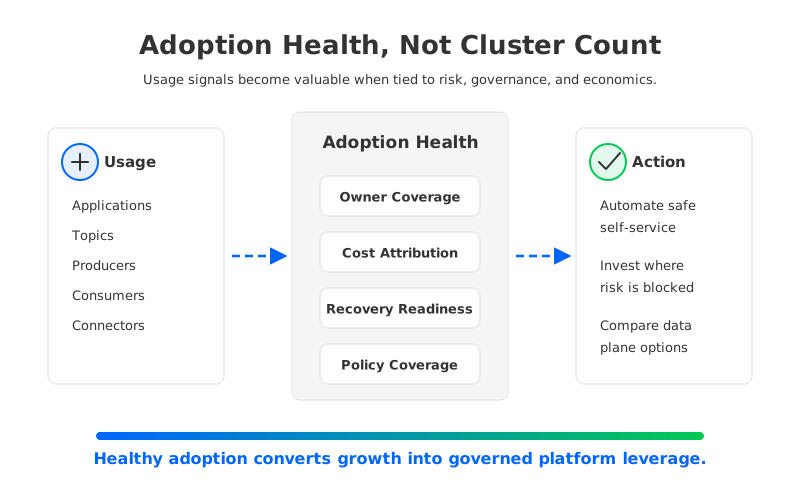
A useful adoption model separates visible usage from healthy usage:
- Usage metrics show how much of the organization touches the platform: active applications, topics, producer clients, consumer groups, connectors, schemas, and environments.
- Operational metrics show whether the platform absorbs that usage safely: incident rate, consumer lag response, broker saturation, failed connector runs, partition movement, and recovery time.
- Governance metrics show whether the platform can scale across teams: owner coverage, policy compliance, auditability, access-review freshness, and data classification coverage.
- Economic metrics show whether adoption is financially legible: storage growth, network transfer, compute utilization, replay demand, and cost attribution by application or business unit.
A strong adoption dashboard is not a single score. It is a layered view that lets platform teams distinguish a popular platform from a platform that is ready for more responsibility. A team with high cluster count and low owner coverage is not mature. A team with steady application growth, clear cost attribution, and stable recovery behavior is much closer.
2The Production Constraint Behind the Problem
Kafka adoption tends to expand through success. One product team builds an event-driven workflow, another team consumes the same topic for analytics, and a third team adds a connector to feed a warehouse. The platform becomes more useful precisely because more teams depend on the same shared streams. That shared value also means every unclear boundary becomes a production concern.
Traditional Kafka is built around a shared-nothing broker model. Topics are split into partitions, partitions are replicated across brokers, and durable log data lives on broker-attached storage. This model gives Kafka strong performance and a mature operational ecosystem, but it also couples adoption growth to broker-local capacity. More retention means more disk. More replicas mean more data placement. More traffic can mean more inter-broker and cross-zone movement. More consumers can turn retained data into active read pressure.
That coupling changes what adoption metrics should measure. Counting active topics is not enough if every high-retention topic creates a storage reservation problem. Counting consumer groups is not enough if the platform cannot tell which application owns lag or replay demand. Counting clusters is not enough if capacity is fragmented across environments, each with its own utilization floor and failure domain.
The issue becomes sharper in cloud deployments. Cloud providers charge separately for compute, storage, object storage requests, network transfer, and sometimes cross-zone or private connectivity traffic. A streaming platform that looks efficient at the broker level may still create cost surprises when replication, consumer fan-out, or migration traffic crosses availability-zone boundaries. Adoption metrics need to follow those cost paths rather than stop at Kafka resource counts.
This is where many platform reports lose decision value. They show growth without showing the work required to support that growth. An executive sees more teams onboarded. The SRE team sees more retained data, more manual tuning, more client exceptions, more connector runbooks, and a larger migration backlog. Both views are true, but only one explains whether the platform is ready for the next wave of applications.
3Architecture Options and Trade-offs
The first architecture option is to keep the current Kafka estate and improve the measurement layer around it. This is often the right first step. Add consistent owner metadata, classify topics by workload type, export Kafka metrics with application labels, and connect alert routes to service ownership. A platform team that lacks these basics should not expect an architecture migration to fix reporting discipline.
The second option is to turn adoption reporting into a platform workflow. Instead of collecting metrics after the fact, make ownership, retention class, access scope, schema policy, and cost center part of topic and connector provisioning. GitOps, Terraform modules, internal developer portals, and service catalogs can make the desired state reviewable. They also let teams compare what was requested, what was approved, and what is actually running in the cluster.
The third option is to evaluate whether the data plane itself is limiting adoption. If the hardest problems are broker-local storage, capacity buffers, cross-zone transfer, and manual balancing, reporting improvements can expose the pain but cannot remove it. A Kafka-compatible platform with shared storage changes the operating model by separating broker compute from durable log storage. That does not remove the need for governance, but it can change the physical cost of growth.
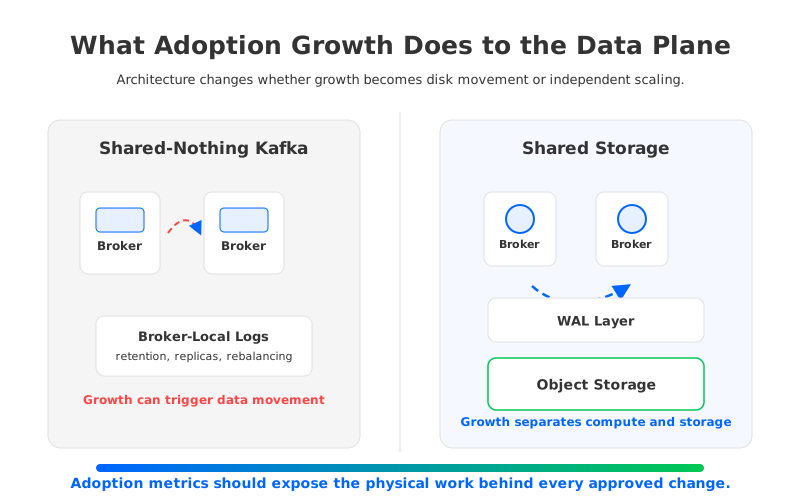
Each option has a different adoption signal. A metadata program improves accountability. A platform workflow improves repeatability. A shared-storage architecture improves the elasticity of the data plane that sits underneath those workflows. Mature teams usually need all three, but they should not confuse them.
| Decision area | What to measure | Why it matters |
|---|---|---|
| Compatibility | Client API coverage, connector compatibility, schema workflow fit, and migration impact. | Adoption stalls when application teams must rewrite clients or retool routine operations. |
| Cost model | Compute utilization, retained storage, network transfer, replay traffic, and cost attribution. | Growth is not healthy if finance cannot see which workloads create demand. |
| Elasticity | Time and risk required to add capacity, replace brokers, rebalance partitions, and absorb traffic spikes. | A platform with high adoption but low elasticity creates slow operations during peak demand. |
| Governance | Owner coverage, access review status, data classification, and policy exception rate. | Self-service only works when the platform knows who owns each decision. |
| Recovery | Failure-domain behavior, consumer catch-up risk, connector restart paths, and rollback readiness. | Adoption increases the blast radius of unclear recovery assumptions. |
The point is not to crown one architecture category in the abstract. The point is to make the trade-off visible. If adoption pressure is mostly about workflow clarity, start with ownership and platform automation. If adoption pressure is mostly about storage-coupled operations, the architecture layer deserves direct evaluation.
4Evaluation Checklist for Platform Teams
The most useful adoption checklist starts from application behavior rather than cluster inventory. Pick a representative set of workloads: one latency-sensitive producer, one high-volume analytics stream, one regulated data flow, one connector-heavy pipeline, and one service that requires replay during incident recovery. Then ask whether the platform can explain and operate each workload without tribal knowledge.
The checklist should include seven dimensions. Compatibility asks whether existing Kafka producers, consumers, admin tools, and connectors work without rewriting the application path. Ownership asks whether every topic, client identity, consumer group, connector, and alert has an accountable team. Cost asks whether the platform can attribute storage, compute, network, and replay demand to an application boundary. Elasticity asks how much operator work is required when traffic or retention changes. Governance asks whether policy checks happen before production changes. Observability asks whether platform and application teams see the same symptoms. Migration asks whether cutover and rollback can happen by workload, not only by cluster.
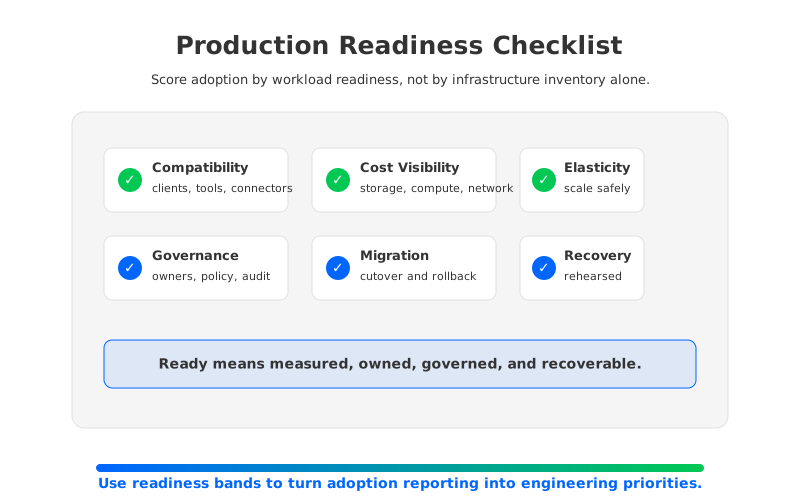
This checklist is intentionally stricter than a standard adoption report. It asks whether the platform can sustain adoption under change. A stream that works during steady state but cannot be migrated safely is not fully adopted. A topic that has traffic but no owner is not fully adopted. A cluster that is highly utilized but requires manual disk management for routine growth is not fully adopted either.
One practical way to score the checklist is to use readiness bands instead of fake precision. For each workload, mark the dimension as "ready," "watch," or "blocked." Ready means the platform has a documented workflow, current metadata, working alerts, and a rehearsed recovery path. Watch means the workflow exists but depends on manual review or incomplete labels. Blocked means the team cannot safely automate or report the dimension.
The scorecard gives executives a cleaner story than cluster count. It can say: adoption is growing, but regulated workloads are blocked on access review automation; analytics workloads are ready except for cost attribution; connector-heavy pipelines need better restart and rollback runbooks. That level of detail helps platform teams win investment because it connects adoption to specific engineering work.
5How AutoMQ Changes the Operating Model
Once the evaluation reaches the data-plane layer, the architecture target becomes more concrete. A platform team wants Kafka-compatible APIs and client behavior, but it also wants scaling, recovery, and cost boundaries that do not depend as heavily on broker-local storage. AutoMQ fits this category as a Kafka-compatible, shared-storage streaming platform: it keeps the Kafka protocol surface while moving durable stream storage toward object storage and stateless broker operation.
AutoMQ's shared-storage architecture separates compute from storage. Brokers serve Kafka-compatible traffic, while durable data is backed by object storage through the S3Stream layer and protected by a WAL design. In operational terms, the broker is no longer the long-term home of retained log data. That distinction changes adoption metrics because platform growth can be evaluated through independent compute, storage, and network dimensions instead of treating broker count as the main proxy for capacity.
For platform engineering teams, this matters in several adoption workflows. When application teams request more retention, the platform can reason about durable storage without assuming every retained byte must sit on broker-local disks. When broker capacity changes, the operation is less defined by historical log movement. When cost attribution matters, storage, compute, and network placement can be discussed as separate levers. When availability-zone traffic matters, AutoMQ's design for reducing cross-AZ Kafka data replication gives platform teams another dimension to evaluate against cloud network costs.
This does not make adoption governance disappear. AutoMQ still needs the same operating scaffolding any serious streaming platform needs: service ownership, access control, schema policy, observability, migration planning, and incident response. The difference is that the data plane is less likely to turn every approved growth request into a broker storage project. That is the architectural change a metadata dashboard cannot produce by itself.
The right sequence is therefore conservative: measure adoption by application readiness, classify where the platform is blocked, and only then compare architectures. If the scorecard shows that broker-local storage and capacity operations are the recurring blockers, evaluate AutoMQ Cloud with the workloads that create the most adoption pressure.
6References
- Apache Kafka Documentation
- Apache Kafka KRaft Documentation
- Apache Kafka Consumer Configuration
- Apache Kafka Connect Documentation
- AutoMQ Architecture Overview
- AutoMQ Native Compatibility with Apache Kafka
- AutoMQ WAL Storage
- AutoMQ Stateless Broker
- AWS Amazon S3 Pricing
- AWS Data Transfer Pricing
7FAQ
7.1What are streaming platform adoption metrics?
Streaming platform adoption metrics measure whether application teams are using a streaming platform in a healthy, governed, cost-aware, and operable way. They include usage metrics such as applications, topics, producers, consumers, and connectors, but they also include ownership, cost attribution, recovery readiness, policy coverage, and operational risk.
7.2Why is cluster count a weak adoption metric?
Cluster count measures infrastructure footprint, not platform maturity. A team can run many clusters while still lacking owner metadata, cost visibility, migration safety, and self-service workflows. Cluster count becomes useful only when it is paired with application readiness and operating-risk metrics.
7.3Which Kafka adoption metrics should platform teams track first?
Start with active applications, owner coverage, topic and consumer group inventory, connector inventory, alert route coverage, retention classes, cost attribution, and recovery readiness. These metrics connect Kafka resources to the teams that own applications and incidents.
7.4How do cloud costs affect streaming platform adoption?
Cloud deployments separate costs across compute, storage, object storage requests, private connectivity, and network transfer. A platform can appear healthy at the cluster level while specific workloads create cost pressure through retention, replication, consumer fan-out, or replay traffic.
7.5Where does AutoMQ fit in a streaming platform adoption strategy?
AutoMQ is relevant when platform teams want Kafka-compatible APIs but need a more elastic operating model than broker-local storage provides. Its shared-storage architecture and stateless broker design help teams evaluate adoption through compute, storage, and network dimensions rather than using broker count as the main capacity proxy.


