
Table of Contents
Table of Contents
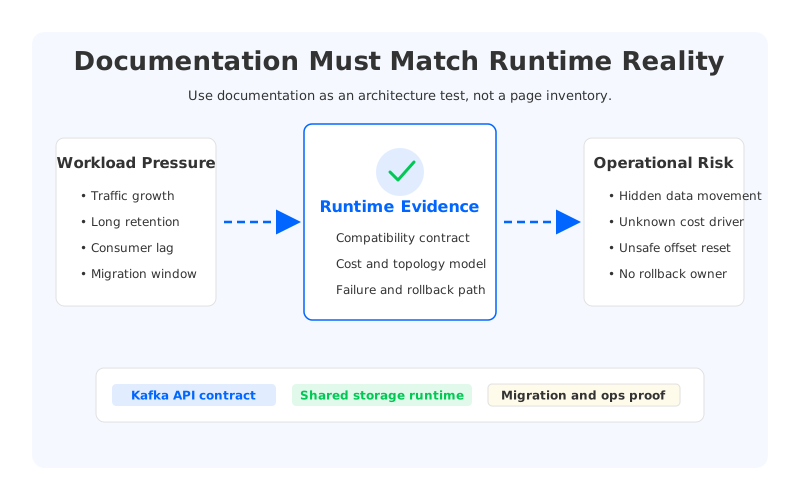
A platform team usually starts searching for streaming platform documentation kafka when the written version of the platform has drifted away from production. The runbook says a topic has three replicas, but it does not explain where replicas land across availability zones. The architecture page says the service is "Kafka-compatible," but it does not say which client features and operational behaviors have been tested. The migration guide lists commands, yet the rollback path depends on offset ownership, producer cutover, and network routing that nobody has written down.
This is not a documentation hygiene problem. It is a runtime reality problem. Event streaming platforms sit between application teams, data teams, security, FinOps, and SREs, so every undocumented assumption eventually becomes a production question: who owns lag, why did the cloud bill change, and whether a migration can be reversed without replaying a week of traffic.
Good documentation for a Kafka-compatible streaming platform therefore has to do more than explain features. It has to preserve the relationship between architecture, operations, cost, and team boundaries. If those pieces are documented separately, engineers can still follow every page and end up with a platform nobody can reason about under pressure.
1Why Teams Search For Streaming Platform Documentation Kafka
The keyword sounds narrow, but the search intent is broad. Some readers want Apache Kafka documentation because they are tuning producers and consumers. Others are evaluating a managed or Kafka-compatible platform and need to know whether existing clients, topics, ACLs, observability workflows, and migration tools still apply. A third group is turning tribal knowledge into self-service guidance.
Those readers share the same underlying concern: documentation is the interface between platform promises and production accountability. A streaming platform can claim compatibility, elasticity, governance, and lower operating cost, but buyers need to see which commands are familiar, which metrics matter, which cloud resources are created, and which failure modes change.
Useful documentation answers five questions before it dives into syntax:
- What is compatible? Teams need a clear statement of Kafka protocol, client, topic, consumer group, transaction, security, and tooling compatibility. "Kafka-compatible" is not enough when an application depends on a particular client library behavior or offset workflow.
- What changes operationally? A platform may keep Kafka APIs while changing storage, scaling, failover, or balancing behavior. Documentation should name those changes so SREs do not debug the target platform with old mental models.
- Where does cost come from? Kafka documentation that ignores broker-local storage, cross-zone traffic, retention, and catch-up reads leaves FinOps teams guessing.
- Who owns each control? Topic creation, connector lifecycle, IAM or RBAC, cluster scaling, schema governance, and incident response often span teams. Documentation should make ownership explicit.
- How does migration reverse? A credible migration guide documents prechecks, data movement, cutover, validation, and rollback. The rollback path is what proves the plan understands production.
This is why a documentation project becomes an architecture project. Writers cannot fill gaps with better prose when the platform team has not decided the runtime contract.
2The Production Constraint Behind The Problem
Traditional Kafka was designed around broker-local logs. A broker owns partitions, writes records to local disks, replicates those records to other brokers, and serves consumers from the same local storage path. That design is coherent and battle-tested, but it binds compute capacity, storage capacity, and data placement together. Documentation has to explain all three because an operational change to one can affect the other two.
When traffic grows, platform teams do not only add throughput. They also add partitions, replicas, disk, network movement, and rebalance work. When a broker fails, recovery is not only a process restart; the platform must decide where leadership moves, how followers catch up, and whether placement creates hot spots. When retention grows, storage pressure changes how much local disk must be reserved and how long catch-up reads can compete with tail reads.
The cloud makes those trade-offs visible. Availability zones, object storage, block storage, private networking, and managed Kubernetes all have separate pricing and operational boundaries. A Kafka runbook that was sufficient in a data center can become incomplete in cloud infrastructure because cost and failure domains are no longer implicit.
| Documentation Area | Runtime Reality It Must Capture | What Goes Wrong When It Is Missing |
|---|---|---|
| Topic and partition design | Throughput, ordering, partition count, key distribution, and retention | Teams over-partition early or create hot partitions nobody can explain |
| Broker and storage model | Where durable data lives and how scaling changes placement | Scaling plans hide data movement and recovery time |
| Network topology | AZ placement, client routing, replication, and private access | Cross-zone traffic appears as an unexplained bill item |
| Consumer group operations | Offset ownership, reset policy, lag, and replay safety | Teams reset offsets during incidents without understanding blast radius |
| Migration workflow | Data sync, producer cutover, validation, and rollback | A reversible migration becomes a one-way production gamble |
The table is deliberately operational. Documentation usually fails because a feature was described outside the system behavior it changes, not because a page forgot one more field.
3Architecture Options And Trade-Offs
A Kafka-compatible platform can preserve the application interface while changing the infrastructure behind it. Application teams care about clients, topics, partitions, offsets, and security semantics. Platform teams care about storage durability, failover, cost, scaling speed, and observability. Documentation should keep those two views connected without pretending they are the same thing.
The first architecture pattern is classic shared-nothing Kafka. Each broker stores its own partition replicas, and durability comes from replication across brokers. The documentation burden is familiar: explain replication factor, ISR behavior, partition reassignment, disk sizing, rack awareness, retention, and consumer lag. The model is transparent, but it can turn scaling and recovery into data movement exercises.
The second pattern is Kafka with tiered storage. Tiered storage can offload older log segments to remote storage while brokers continue serving as the active local write path. This can reduce pressure from long retention, but it does not automatically make brokers stateless. Documentation has to be precise here because teams often confuse "remote historical data" with "compute and storage are fully separated."
The third pattern is shared storage for the streaming log. In this model, durable stream data is backed by shared cloud storage, while brokers become closer to stateless compute nodes that serve the Kafka protocol and coordinate access to the storage layer. The operational question changes from "how do we move local replicas between brokers?" to "how do compute nodes attach to durable shared state safely and quickly?"
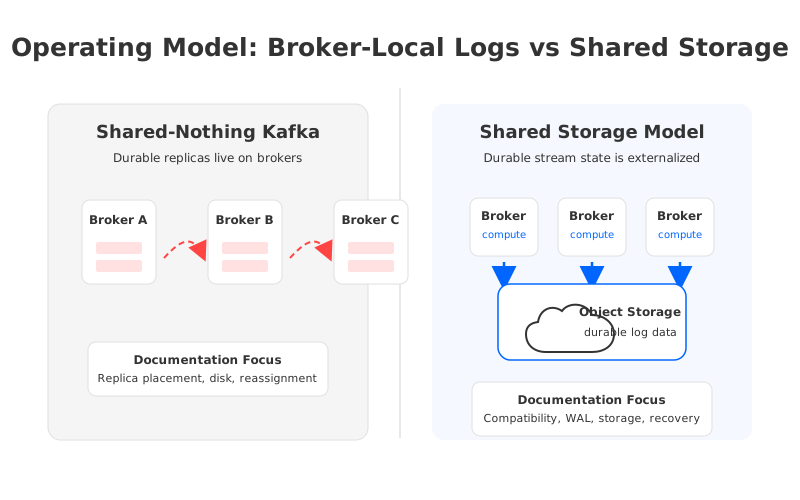
That change is the point where AutoMQ becomes relevant, after the evaluation framework rather than before it. AutoMQ is a Kafka-compatible, cloud-native streaming platform that uses shared storage with object-storage-backed durability and stateless brokers. Its documentation should be read through that lens: compatibility keeps application integration familiar, while the storage model changes scaling, balancing, recovery, and cloud cost mechanics.
The trade-off is not "old Kafka bad, replacement architecture good." The useful question is narrower: which runtime constraints dominate your platform? If local disk placement, partition reassignment, cross-zone replication traffic, and capacity preallocation are the recurring sources of work, shared storage deserves serious evaluation. If your workload is small, static, and already well operated, the documentation gap may be less urgent than the migration work required to change platforms.
4Evaluation Checklist For Platform Teams
Documentation quality is easiest to judge as an operational test. Pick a workload, an incident, a scaling event, and a migration window. Then ask whether the docs let an engineer reason from first principles instead of copying commands.
The checklist below works across vendors and deployment models.
| Evaluation Dimension | What Strong Documentation Shows | Evidence To Look For |
|---|---|---|
| Kafka compatibility | Supported clients, APIs, security modes, offsets, transactions, and tooling expectations | Compatibility page, tested client guidance, known restrictions |
| Cost model | Storage, compute, network, retention, replication, and catch-up read drivers | Cloud resource list, pricing assumptions, traffic diagrams |
| Elasticity | How scale-out, scale-in, balancing, and partition movement behave | Scaling docs, self-balancing explanation, operational limits |
| Governance | Topic ownership, ACLs, RBAC, service accounts, audit boundaries | Security docs, account model, access-control examples |
| Failure recovery | Broker loss, zone disruption, delayed consumers, and restore behavior | Runbooks, metrics, alert guidance, validation steps |
| Migration safety | Prechecks, data sync, producer and consumer cutover, rollback | Migration guide, offset handling, acceptance criteria |
A weak documentation set often fails in the second column. It may have pages, but the pages describe UI actions or configuration fields without explaining the runtime behavior those actions modify. Strong documentation gives readers enough context to predict consequences.
This is where documentation and platform engineering meet. A self-service portal can make topic creation faster, but it cannot make a bad topic policy safe. A Terraform module can standardize cluster setup, but it cannot replace documentation that explains cloud resources, deployment boundaries, and credential scope. Better developer experience means fewer hidden assumptions.
5How AutoMQ Changes The Operating Model
Once the documentation review has separated application compatibility from infrastructure behavior, AutoMQ's architecture becomes easier to evaluate. The platform keeps Kafka protocol compatibility as the application-facing contract, while its shared storage design moves durable stream data away from broker-local disks. Brokers become closer to compute nodes because durable state is no longer trapped inside the machine serving a partition.
That shift changes what documentation should emphasize. Instead of centering every operational page on broker disk ownership and partition replica movement, AutoMQ documentation can explain shared storage, WAL options, object storage configuration, self-balancing, cross-zone traffic reduction, migration, and observability. Object storage is not magic; the docs still need to explain write paths, WAL choices, recovery behavior, and cloud resource dependencies.
For platform teams, the practical documentation difference shows up in four areas:
- Scaling language becomes more direct. If brokers are stateless, a scale event can be documented as a compute-capacity operation rather than a long data relocation plan. Readers still need limits, prerequisites, and metrics, but the mental model is different.
- Cost documentation becomes more cloud-native. Storage durability, retention, and cross-zone traffic can be discussed in terms of object storage, network paths, and client routing rather than only broker disk and replica placement.
- Migration docs can focus on runtime validation. Kafka compatibility helps preserve clients and application semantics, but migration still needs explicit checks for topic configuration, offset continuity, producer cutover, consumer lag, and rollback.
- Operations docs can separate symptoms from causes. Lag, throughput, storage growth, and node health should map to metrics that reflect the shared-storage architecture, not only the classic broker-local assumptions.
The benefit is not shorter documentation. A platform that changes the operating model owes readers a clear explanation of what changed, what stayed compatible, and how to verify both in production.
6A Production Readiness Scorecard
Before a team publishes or adopts streaming platform documentation, it should run a scorecard that mirrors real operating pressure. The goal is not a perfect wiki. The goal is documentation that can carry a team through routine change and abnormal events.
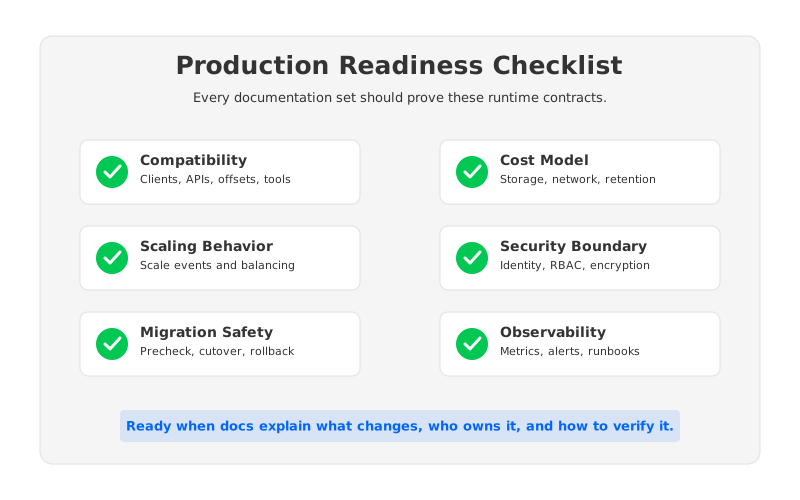
Start with the application contract. Can a developer identify which Kafka clients, authentication methods, topic operations, consumer group operations, and delivery guarantees are supported? Then move to the infrastructure contract. Can an SRE explain where data is durable, how nodes scale, how balancing works, and which metrics prove health? Finally, test the organizational contract. Can security, FinOps, and platform engineering find their responsibilities without reading every internal Slack thread?
This scorecard works because it forces documentation to stay close to runtime reality:
- Compatibility: Document supported Kafka semantics, client guidance, tested tools, and known limits.
- Cost: Document the cloud resources, storage paths, network paths, and retention assumptions that drive the bill.
- Scaling: Document what changes during scale-out, scale-in, balancing, and partition growth.
- Security: Document identity, authentication, authorization, encryption, and deployment boundaries.
- Migration: Document prechecks, synchronization, cutover, validation, and rollback.
- Observability: Document metrics, dashboards, alerts, and the operational meaning of each signal.
If your documentation cannot answer those questions, the fix is not a bigger table of contents. The fix is to bring architecture, operations, and ownership into the same documentation loop.
For teams evaluating a Kafka-compatible shared-storage model, AutoMQ's public documentation is a useful place to start because it separates compatibility, architecture, migration, cross-zone traffic, and observability into specific operational topics. Review the getting started guide and architecture docs with your own workload in mind: which parts preserve your existing Kafka contract, and which parts change the operating model your team documents today? Start with the AutoMQ Cloud overview here: Explore AutoMQ Cloud.
7References
- Apache Kafka Documentation
- Apache Kafka Consumer Configuration
- Apache Kafka KRaft Documentation
- AWS S3 Storage Classes
- AutoMQ Kafka Compatibility
- AutoMQ Shared Storage Architecture
- AutoMQ Cross-Zone Traffic Overview
- Migrating From Apache Kafka To AutoMQ
- AutoMQ Observability Overview
8FAQ
8.1What should streaming platform documentation include for Kafka-compatible systems?
It should include the application contract, the infrastructure contract, and the operating contract. The application contract covers clients, topics, partitions, offsets, security, and compatibility. The infrastructure contract covers storage, networking, scaling, durability, and cloud resources. The operating contract covers ownership, observability, incident response, migration, and rollback.
8.2Is Kafka compatibility enough for migration planning?
No. Kafka compatibility can reduce application change, but migration planning still has to document topic configuration, ACLs, network access, offset continuity, producer cutover, consumer lag, validation, and rollback. Compatibility answers whether applications can keep using Kafka semantics; migration documentation answers whether production can move safely.
8.3How does shared storage change Kafka documentation?
Shared storage changes the operating model behind the Kafka API. Documentation should explain where durable data lives, how brokers scale, how recovery works, which cloud resources are required, and which metrics reflect the shared-storage architecture. It should also be clear about what remains compatible with existing Kafka clients and tools.
8.4Why should cost be part of platform documentation?
Cost is part of runtime behavior in cloud infrastructure. Retention, replication, cross-zone traffic, object storage, block storage, compute, and catch-up reads can all change the bill. When documentation ignores cost drivers, teams cannot connect an architectural choice to its operational consequence.
8.5Where should AutoMQ appear in an evaluation process?
AutoMQ should appear after the team has defined its Kafka compatibility requirements, cloud cost constraints, scaling expectations, governance model, and migration risk. At that point, AutoMQ can be evaluated as a Kafka-compatible shared-storage platform whose architecture changes how brokers, storage, scaling, and cross-zone traffic are documented and operated.


