
Table of Contents
Table of Contents
Teams searching for confluent alternatives are usually not looking for a casual ranking exercise. They already know that Confluent is a serious Kafka ecosystem vendor, and they may already run part of their estate on Confluent Cloud, Apache Kafka, Amazon MSK, or a mix of managed and self-managed clusters. The search starts when a business constraint turns a familiar streaming platform into a procurement question: renewal exposure, cloud-networking cost, data-plane control, migration timing, data residency, or the need to standardize Kafka across teams.
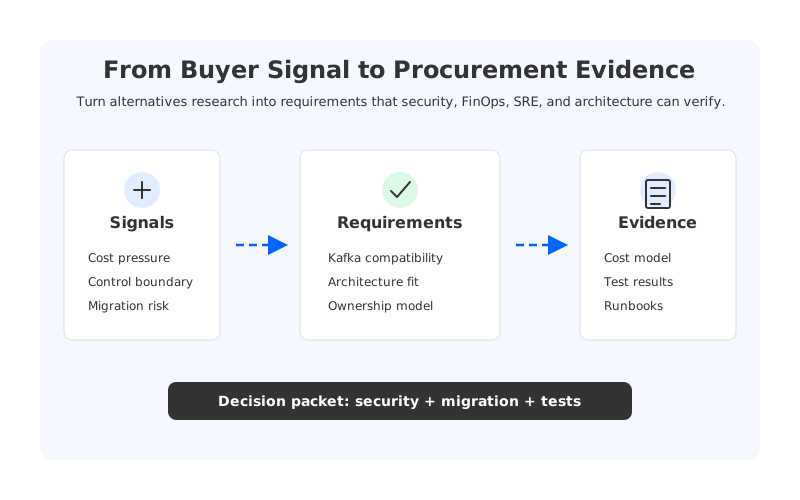
Review pages can help at this stage because they surface buyer language. They reveal what practitioners complain about, praise, and compare when the sales deck is gone. But a review page is not an architecture decision record. Procurement teams need criteria that can survive a security review, a FinOps model, a migration rehearsal, and a production incident. The useful output is not a longer vendor list; it is a defensible evaluation packet.
1Why Teams Search for confluent alternatives
The phrase confluent alternatives compresses several different problems into one query. One team may want a lower operational burden than self-managed Kafka but more control than a fully vendor-operated service. Another may want Kafka protocol compatibility while changing the storage model underneath. A third may be comparing Confluent Cloud with Amazon MSK, Redpanda, Aiven, self-managed Apache Kafka, or Kafka-compatible systems because procurement wants evidence before the next contract cycle.
Those motivations should be separated before any vendor conversation starts. Otherwise the evaluation becomes a set of product names with no stable weighting. A governance team will care about identity, auditability, network boundaries, and support process. A platform team will care about partition movement, broker failure, scaling, upgrade safety, and client compatibility. A FinOps team will care about retained data, cross-AZ traffic, egress, connector cost, and idle capacity. A CTO will ask whether the chosen platform reduces strategic risk or merely shifts it to a different contract.
The first procurement move is to turn the search query into a problem statement:
- Commercial pressure means the current platform may be technically acceptable, but the cost model is hard to defend under expected growth.
- Architecture pressure means the platform's data path, storage model, or scaling behavior no longer matches the workload.
- Control pressure means security, residency, cloud-account ownership, or operational access has become more important than outsourcing every part of the stack.
- Migration pressure means the team needs a path that preserves Kafka application behavior while changing the backend platform.
This framing treats Confluent, MSK, Redpanda, Aiven, AutoMQ, and self-managed Kafka respectfully: each represents a different split of responsibility between application teams, platform engineering, the cloud provider, and the streaming vendor. The question is which split fits the buyer's constraints.
2From Reviews to Requirements
Review sites tend to emphasize experience: support quality, ease of use, setup friction, perceived pricing, feature coverage, and whether teams would recommend a product. Those signals are useful, but they are not procurement criteria until they are converted into measurable requirements. "Cost is high" becomes a cost model with traffic, storage, network, support, and migration assumptions. "Setup is complex" becomes a deployment and operations runbook review. "Performance is good" becomes workload-specific latency, throughput, and replay tests.
The conversion matters because Kafka platforms fail evaluations in different places. A managed service may reduce broker operations but limit the data-plane controls a regulated buyer expects. A self-managed deployment may offer maximum control but reintroduce patching, capacity planning, and on-call ownership. A Kafka-compatible engine may improve storage economics but needs proof that client behavior, consumer groups, transactions, ACLs, and observability remain acceptable for the workload.
| Buyer signal | Procurement requirement | Evidence to request |
|---|---|---|
| Pricing concerns | Full cost model across compute, storage, network, and support | Bill-of-materials, pricing assumptions, and sensitivity analysis |
| Migration anxiety | Compatibility and rollback plan | Client matrix, MirrorMaker or migration design, cutover rehearsal |
| Operations burden | Day-2 ownership boundary | Upgrade, scaling, incident, and support runbooks |
| Governance review | Identity, network, encryption, and audit controls | IAM/RBAC design, private connectivity, audit trail, compliance mapping |
| Performance claims | Workload-specific acceptance tests | Produce, consume, replay, rebalance, and failure recovery results |
This table is deliberately vendor-neutral. It also avoids the trap of scoring every platform on the same superficial checklist. A fully managed platform, a cloud-provider managed Kafka service, a self-managed cluster, and a shared-storage Kafka-compatible system are not the same category of product. Procurement has to compare outcomes, not labels.
3Architecture Criteria Behind the Shortlist
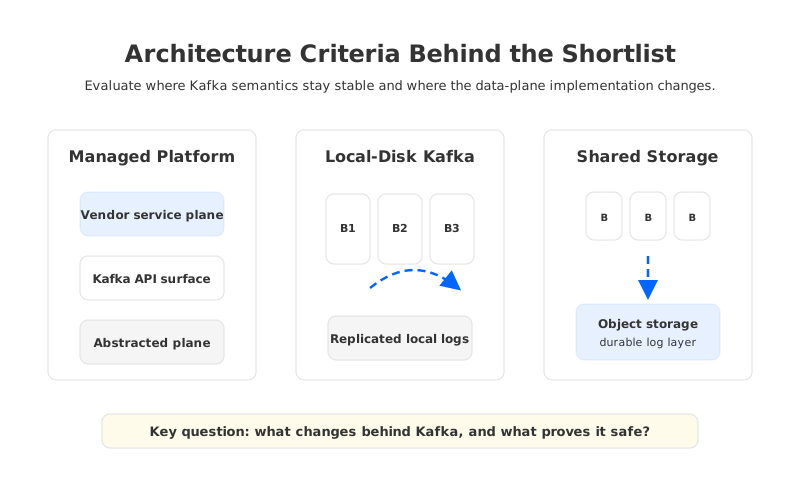
Kafka buyers often start with feature coverage, but serious alternatives work begins at the architecture boundary. Apache Kafka defines the client-facing concepts that applications depend on: topics, partitions, producers, consumers, consumer groups, offsets, transactions, ACLs, and retention behavior. The procurement question is which parts of that contract must remain unchanged and which parts of the underlying implementation are allowed to change.
That distinction is important because many expensive Kafka decisions are not visible in the API. Traditional Kafka couples broker compute with local durable storage. Replication gives availability, but it also creates data movement across brokers and often across availability zones. Tiered storage changes the retention path for older segments, but the active log and operational model may still depend on broker-local storage. Shared-storage Kafka-compatible systems take a different approach: brokers become more stateless, while durable log data is placed in object storage or another shared durable layer.
The shortlist should therefore be organized around architecture questions:
- Protocol and semantic compatibility. Which Kafka clients, APIs, delivery guarantees, security mechanisms, and operational behaviors are required? Claims of compatibility should be checked against real clients and existing application patterns.
- Storage ownership. Does durable data live primarily on broker-attached disks, remote tiers, object storage, or a vendor-controlled service layer? The answer affects recovery, scaling, retention economics, and data residency.
- Network boundary. Where does data cross availability zones, VPCs, cloud accounts, or regions? Kafka cost surprises often come from movement, not only from storage.
- Scaling behavior. Does adding capacity require partition reassignment and data movement, or can compute scale more independently from retained data?
- Failure recovery. When a broker, zone, disk, or network path fails, how much data must move before the platform returns to a healthy state?
These criteria keep the conversation concrete. Confluent Cloud may be attractive when the team wants a broad managed streaming platform with a mature ecosystem. Amazon MSK may fit teams that prefer AWS-managed Kafka primitives inside AWS operational boundaries. Self-managed Apache Kafka may remain the right answer for teams with strong Kafka operations and strict customization needs. Kafka-compatible shared-storage platforms become interesting when the buyer wants to preserve Kafka-facing behavior while changing the cost and recovery profile of the data plane.
4Cost Criteria That Survive FinOps Review
Cost comparisons around Kafka often collapse into a single monthly estimate, which is the least useful number in the packet. A streaming platform has several cost drivers that scale differently: broker or service capacity, retained data, replicated data, cross-zone traffic, internet or inter-region egress, private connectivity, connector runtime, observability, and support. A platform that looks cost-effective for a short-retention workload may look very different for a replay-heavy audit log or CDC backbone.
The cost model should be built from workload primitives rather than vendor bill names. Start with logical ingress per day, consumer fan-out, retention period, compression ratio, replication or durability model, expected replay volume, peak-to-average traffic ratio, and network topology. Then map those primitives to each candidate's billing and infrastructure model. AWS publishes separate pricing pages for Amazon MSK, S3, PrivateLink, and data transfer because those are separate economic surfaces. A buyer should preserve that separation in the evaluation instead of hiding it under one total.
Cost review should also include a sensitivity table. What happens when retention doubles? What happens when another consumer group reads every topic? What happens when traffic shifts across zones or regions? What happens when a migration period runs two platforms in parallel? These questions are not pessimistic; they are how Kafka platforms are actually used.
A procurement-ready cost model explains which line items grow with data volume, which grow with availability design, and which grow because humans need time to migrate safely.
That last part is easy to miss. Migration is a real cost driver. Running source and target clusters side by side, synchronizing topics, validating offsets, changing producers, moving consumers, and preparing rollback windows all create temporary capacity and labor costs. A proposal that ignores this period is not complete, even if the steady-state platform looks attractive.
5Migration and Ownership Questions for Platform Teams
The hardest part of a streaming platform change is not deploying the target cluster. It is preserving application expectations while changing the system underneath them. Kafka clients encode assumptions about bootstrap addresses, authentication, ACLs, topic configuration, partition counts, offset behavior, consumer group coordination, transaction settings, connector semantics, monitoring, and error handling. A credible alternative has to meet the existing estate where it is.
Platform teams should ask for a migration plan that names the control points:
- Inventory. Which topics, producers, consumers, connectors, schemas, ACLs, quotas, and operational dashboards are in scope?
- Synchronization. How will data move from the existing platform to the target, and how will lag be measured?
- Cutover. Which applications move first, what is the freeze window, and who owns client configuration changes?
- Rollback. What condition triggers rollback, and can the source platform still serve as the recovery point?
- Acceptance. Which workload tests must pass before procurement signs the production order?
Ownership needs the same precision. If the buyer chooses a fully managed service, the vendor owns more of the platform operations but the buyer may own less of the data-plane envelope. If the buyer chooses self-managed Kafka, the platform team owns more operational work but gains direct control. If the buyer chooses a BYOC or software deployment, responsibility may be split: the data runs in the buyer's cloud account or Kubernetes environment while vendor tooling handles parts of lifecycle management. None of these models is universally superior. The procurement packet should state which ownership model the organization wants.
6How AutoMQ Fits the Evaluation
After the neutral criteria are clear, AutoMQ belongs in the evaluation as a Kafka-compatible, cloud-native streaming platform that changes the storage architecture rather than asking applications to abandon Kafka APIs. AutoMQ's documented design uses S3Stream shared storage, stateless brokers, and object storage as the durable foundation, with WAL and cache paths to preserve low-latency Kafka-facing behavior. That makes it relevant when the buyer's pain is tied to local-disk coupling, slow data movement during scaling, long-retention economics, or cross-zone traffic patterns.
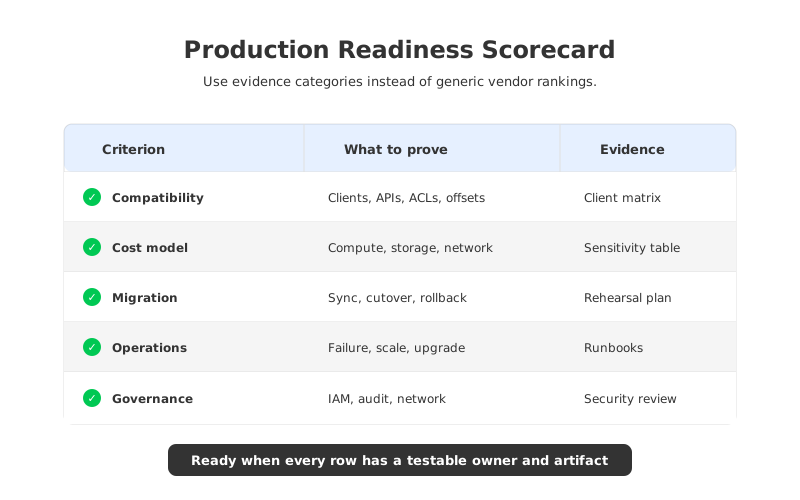
AutoMQ should still be evaluated with the same evidence standard as any other candidate. Validate Kafka client compatibility against the applications you actually run. Test produce latency, tailing reads, catch-up reads, broker failure recovery, scaling, partition movement, ACL behavior, and observability integration. Review the BYOC or software deployment boundary with security and cloud architecture teams. Then compare the result against managed Kafka and self-managed Kafka on the same workload assumptions.
The useful distinction is architectural, not promotional. If a workload depends on the broader Confluent ecosystem, integrated governance, and vendor-operated service scope, Confluent may remain the right fit. If a workload needs AWS-managed Kafka inside familiar AWS operations, MSK may be appropriate. If a team wants to preserve Kafka semantics while reducing the operational drag of broker-local storage, AutoMQ is worth testing because its Shared Storage architecture changes the failure, scaling, and cost model behind the Kafka interface.
Procurement teams should leave the evaluation with artifacts, not opinions: a cost model, a migration plan, an operations boundary, a security review, and acceptance-test results. That is the difference between "we found alternatives" and "we can defend this platform decision."
If your team is turning a confluent alternatives search into a production evaluation, start with the architecture and cost evidence before vendor scoring. AutoMQ's team can help map Kafka workload assumptions to a Shared Storage architecture evaluation plan: talk to AutoMQ.
7References
- Apache Kafka Documentation
- Amazon MSK Developer Guide: What is Amazon MSK?
- Amazon MSK Pricing
- Amazon S3 Pricing
- AWS PrivateLink Documentation
- AutoMQ: Compatibility with Apache Kafka
- AutoMQ: S3Stream Shared Streaming Storage
- AutoMQ: Eliminate Inter-Zone Traffic
- AutoMQ: Migrating from Apache Kafka to AutoMQ
8FAQ
8.1Are review sites useful when evaluating Confluent alternatives?
They are useful as input, especially for discovering recurring buyer concerns, but they should not be the final decision method. Convert review themes into procurement requirements such as cost model, migration proof, security controls, operational ownership, and workload-specific tests.
8.2Should every Confluent alternative preserve Kafka compatibility?
Not always. If the goal is to replace Kafka with a different streaming model, compatibility may be less important. If existing applications already depend on Kafka clients, consumer groups, offsets, ACLs, transactions, or connector behavior, compatibility becomes a primary procurement criterion.
8.3What is the most overlooked cost driver in Kafka procurement?
Network movement is often underestimated. Cross-zone, cross-region, PrivateLink, egress, replay, and migration traffic can all affect the bill. Storage and compute matter, but data movement determines whether the architecture remains economical as usage grows.
8.4Where does AutoMQ fit among Confluent alternatives?
AutoMQ fits evaluations where teams want Kafka-compatible behavior with a cloud-native Shared Storage architecture. It is especially relevant when the pain point is broker-local storage, scaling movement, retention cost, or cross-zone traffic, and it should be tested against the same acceptance criteria as other candidates.


