
Table of Contents
Table of Contents
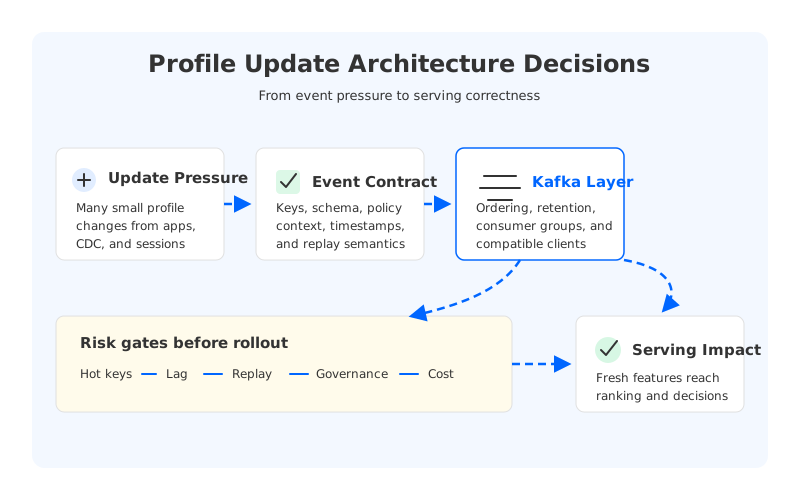
Teams search for streaming profile updates kafka when personalization stops being a nightly feature pipeline and becomes a production dependency. A user changes location, opens a product page, abandons a cart, updates consent, watches a video, or triggers a fraud signal, and the serving system needs that context while the session is still alive. The hard part is not publishing one event. The hard part is keeping profile state current, governed, replayable, and cost-controlled while many applications are reading and writing at the same time.
Kafka is often the right backbone because it gives the profile system an ordered event log, independent producers and consumers, replay, retention, offsets, and broad ecosystem compatibility. It also exposes every weakness in the platform boundary. If profile updates feed search ranking, recommendations, dynamic pricing, notification timing, or risk scoring, the streaming layer is no longer a passive transport. It becomes the control surface for how user context moves across the company.
That changes the design question. The useful question is not "Can Kafka carry profile update events?" It can. The better question is: can the Kafka-compatible platform absorb profile update pressure without turning storage growth, consumer lag, cross-zone traffic, governance, and migration into separate incidents?
1Why teams search for streaming profile updates kafka
The search intent usually appears after a batch profile system has hit its limit. Batch pipelines are still valuable for training features, long-window aggregates, offline attribution, and backfills. They struggle when product teams need profile corrections to reach online serving paths in minutes or seconds. A personalization stack that waits for the next warehouse job may serve the wrong offer, miss a churn signal, or keep using stale consent state after the user has changed it.
Streaming profile updates solve a different class of problem. They let teams treat profile changes as an event stream rather than a table overwrite. Each update can be validated, enriched, compacted, joined, replayed, and materialized into serving stores. Kafka consumers can feed feature stores, cache layers, search indexes, graph stores, lakehouse tables, and model-serving systems without forcing every team to poll the same source database.
The pressure comes from the shape of the data:
- High write concurrency: Many upstream services emit small profile changes. Identity, activity, preference, billing, consent, risk, and support systems all want to write facts about the same user.
- Mixed read patterns: Online serving wants low-latency updates, analytics wants durable history, and data science wants clean replay for feature reconstruction.
- Strict semantics: Some events are append-only behavioral signals, while others are corrections or deletes that affect privacy, policy, and model eligibility.
- Long operational tail: The system has to survive client bugs, late events, schema changes, replay storms, topic growth, and migration cutovers.
These properties make the streaming platform part of personalization architecture, not plumbing hidden underneath it. Once the profile stream is central, platform teams need a way to evaluate Kafka-compatible infrastructure with the same discipline they apply to databases and serving stores.
2The production constraint behind the problem
A profile update stream looks simple in a diagram: producers write events, Kafka stores them, consumers update serving systems. Production adds friction at every arrow. Producers may emit duplicate or out-of-order updates. Consumers may need idempotent writes to a feature store. A stream processor may join the update with session context. A governance service may need to enforce deletion or consent changes ahead of other attributes.
Kafka gives useful primitives for this work, but it does not remove the design burden. Partitioning by profile ID can preserve per-user ordering, but it can also create hot partitions for large accounts, shared devices, household identities, or popular creators. Log compaction can keep the latest value for a key, but teams still decide which topics are compacted, which retain history, and how tombstones are handled. Consumer groups provide independent progress tracking, but lag in a serving consumer has direct product impact.
Traditional Kafka architecture also ties durable data to brokers through local replicas. That shared-nothing model has served many workloads well, and it remains a valid foundation when teams can plan capacity conservatively. The cloud version of the problem is less forgiving. When broker-local storage grows with retained profile history, scaling and recovery can require moving data between brokers. In a multi-AZ deployment, replication, reassignment, and recovery paths may also create cross-zone network cost and longer operational windows.
For personalization, this matters because the workload rarely stays flat. A product launch can multiply profile reads. A campaign can change write distribution. A backfill can create replay pressure. A privacy workflow can force deletion propagation across materialized stores. The Kafka platform has to handle these events without asking application teams to redesign the profile event contract whenever infrastructure changes.
3Architecture options and trade-offs
There are several workable patterns for streaming profile updates. The wrong choice is treating them as interchangeable because each pattern moves risk to a different team.
The first pattern is a self-managed Kafka cluster with profile topics, stream processors, and downstream materialized views. This gives strong control over client settings, partitioning, retention, compaction, access control, and upgrade timing. It also puts broker sizing, disk growth, partition reassignment, failover practice, certificate rotation, connector operations, and incident response on the internal platform team. That may be acceptable for organizations with deep Kafka operations capacity. It becomes fragile when personalization teams expect database-like elasticity from an event log that is still managed as broker-local infrastructure.
The second pattern is a managed Kafka-compatible service. It can reduce operational load and speed up adoption, especially when teams are less interested in broker internals than in delivery semantics and ecosystem support. The trade-off is architectural visibility. Platform teams still need to inspect compatibility, network paths, data residency, private connectivity, service quotas, connector placement, observability, and rollback options. A profile update stream touches sensitive user state, so "managed" cannot mean "unexamined."
The third pattern is a Kafka-compatible cloud-native streaming platform built around shared storage. In this model, brokers process requests and serve hot data, but durable retained data is backed by shared cloud storage rather than being permanently owned by local broker disks. This changes the operating model for scaling and recovery. It does not remove the need for partition design, schema governance, stream processing discipline, or latency testing. It does reduce the amount of operational risk tied to broker-local storage movement.
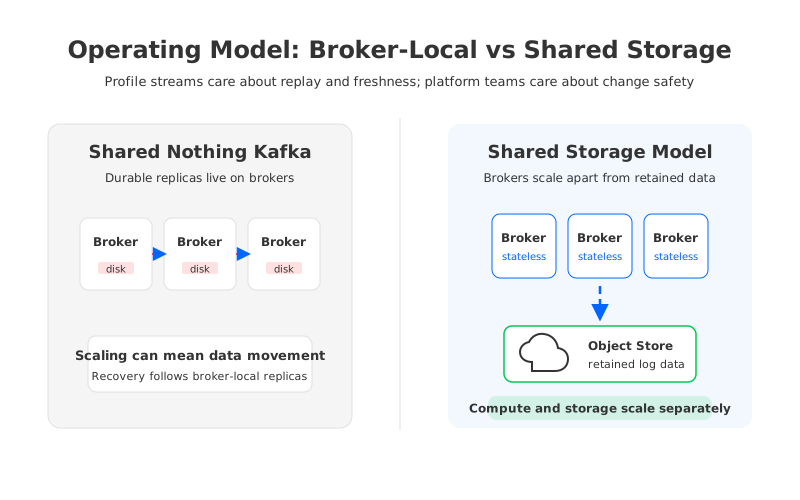
The important distinction is between the event model and the storage model. Personalization teams care about keys, ordering, compaction, replay, and consumer progress. Platform teams care about the storage model because it determines what happens when the cluster grows, shrinks, fails, or retains more data. A strong architecture lets those two concerns evolve at different speeds.
4Evaluation checklist for platform teams
Before choosing an implementation, define the profile update contract. A profile event should carry identity, versioning, source, timestamp, schema, and policy context for downstream systems. That contract should be independent of any single serving store. Otherwise the stream becomes a queue for one application rather than a durable profile change log.
The platform evaluation can then focus on the operational questions that decide whether the architecture will survive growth.
| Evaluation area | What to verify | Failure mode |
|---|---|---|
| Key and ordering model | Profile ID, account ID, device ID, or composite key produces the right ordering and partition distribution | Hot partitions or out-of-order profile corrections |
| Compatibility | Existing Kafka producers, consumers, transactions, offsets, Connect workers, and stream processors work with expected client versions | Migration requires application rewrites before platform risk is understood |
| Retention and compaction | History topics, compacted latest-state topics, tombstones, and replay windows are explicit | Serving stores disagree after backfill or delete workflows |
| Elasticity | Scaling, broker replacement, and retention growth do not depend on long storage relocation windows | A launch or backfill turns into a cluster operations event |
| Governance | ACLs, encryption, consent state, deletion paths, audit logs, and schema controls match the sensitivity of profile data | Personalization uses stale or unauthorized attributes |
| Cost model | Cross-AZ traffic, storage, replay reads, connector traffic, and validation workloads are modeled under expected peaks | The profile stream looks efficient in steady state and expensive during change |
| Migration and rollback | Topic mirroring, dual reads, consumer offset handling, data validation, and rollback are rehearsed | Cutover succeeds for writes but breaks serving correctness |
This checklist prevents a common mistake: optimizing the streaming layer for ingestion while ignoring serving consequences. A profile update stream is judged by whether the right profile reaches the right serving system at the right time. Broker throughput is necessary, but it is not sufficient.
The most useful validation is a production-shaped slice. Pick a profile domain with real sensitivity, such as preference updates, entitlement changes, or consent state. Run the planned producer, topic, stream processor, serving consumer, replay path, and rollback path under the same network and identity model used in production. Then fail a consumer, replay a window, rotate a credential, change a schema, and scale the cluster. The findings from that exercise are more valuable than a generic benchmark.
5How AutoMQ changes the operating model
Once the neutral requirements are clear, AutoMQ becomes relevant as an architecture option rather than a pitch. AutoMQ is a Kafka-compatible cloud-native streaming platform that separates compute from storage through a Shared Storage architecture. Brokers remain compatible with Kafka clients and ecosystem tools, while durable stream data is stored in shared object storage with a WAL path for write durability.
For streaming profile updates, the value is not that shared storage changes the application event model. Producers still need a sane key strategy. Consumers still need idempotent writes. Stream processors still need state management. The value is that infrastructure teams can reason about retained profile history separately from broker compute capacity. When the retained log is not treated as local broker property, broker replacement and scaling can be evaluated more like compute lifecycle operations and less like storage relocation projects.
That distinction matters during personalization spikes. If a campaign creates more profile reads, the team may need more broker capacity and cache throughput. If retention grows because data science wants a longer replay window, the team may need more durable storage. Those are different scaling axes. A shared-storage Kafka-compatible design gives platform teams a cleaner way to discuss them without forcing every capacity decision through broker disk ownership.
AutoMQ's cloud deployment model also matters for governance. In BYOC-style deployments, the streaming data plane can run in the customer's cloud environment, which lets security teams inspect VPC boundaries, object storage policies, IAM roles, private connectivity, observability, and operational access. That does not replace a security review. It gives reviewers concrete cloud resources and network paths to examine.
Cost should be validated with the same discipline. Profile systems generate overlooked background traffic: compaction, replay, CDC catch-up, connector writes, feature store rebuilds, cache warmup, and dual-run migration. AutoMQ's architecture is designed to reduce the operational burden created by broker-local storage and cross-AZ data movement, but each buyer should test that claim against its own topology and workload. The right proof is a traffic matrix and a replay rehearsal, not a slide.
6A practical readiness scorecard
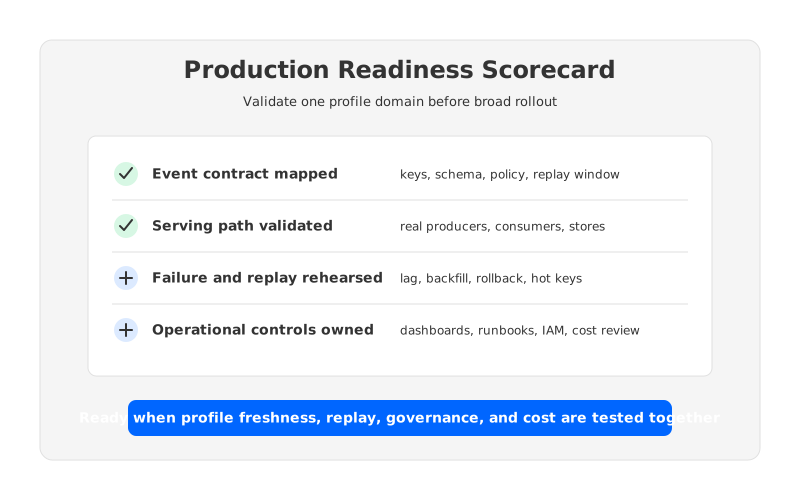
The final readiness score should be assigned per profile domain. Consent updates, recommendation preferences, fraud features, entitlement state, and anonymous browsing signals carry different correctness requirements. A missed preference update may be annoying; a stale consent update may be a policy violation; a delayed fraud signal may be a financial loss.
Use four levels. Mapped means every producer, topic, processor, consumer, serving store, replay path, and governance path is drawn. Validated means representative traffic has run through those paths with real clients and schemas. Rehearsed means failures, replay, schema change, credential rotation, scaling, migration, and rollback have been tested. Operationalized means the checks are part of normal runbooks, dashboards, cost reviews, release gates, and incident response.
The jump from validated to rehearsed is where personalization systems usually reveal their hidden coupling. A consumer can be idempotent during normal writes and still fail during replay. A compacted topic can represent latest profile state and still lose useful audit context. A stream processor can keep state correctly but emit updates too late for a serving SLA. A cluster can pass throughput tests and still create operational risk when retained data has to move during broker replacement.
Return to the original search: streaming profile updates kafka. The durable answer is not a reference architecture with three boxes. It is an operating model that keeps profile events ordered, replayable, governed, and cost-aware while the business changes around them. If your evaluation points toward Kafka-compatible shared storage with independent compute and storage scaling, test AutoMQ against one production-shaped profile domain before broad rollout: try AutoMQ.
7References
- Apache Kafka documentation
- Apache Kafka consumer documentation
- Apache Kafka message delivery semantics
- Apache Kafka Connect documentation
- Apache Kafka log compaction documentation
- Apache Kafka Streams documentation
- AWS data transfer pricing
- AutoMQ architecture overview
- AutoMQ S3Stream shared storage overview
- AutoMQ WAL storage documentation
- AutoMQ Cloud overview
- AutoMQ migration overview
8FAQ
8.1What are streaming profile updates?
Streaming profile updates are profile changes published as events so downstream systems can react continuously. They can include preferences, consent, entitlements, identity links, behavioral signals, risk features, and account state.
8.2Why use Kafka for profile update streams?
Kafka gives teams a durable event log, partitioned ordering, replay, consumer groups, retention, compaction, and broad ecosystem support. Those features make it a practical backbone for feeding feature stores, search indexes, caches, analytics systems, and model-serving paths.
8.3Should profile update topics use log compaction?
Some should, but not all. Compacted topics work well for latest-state views keyed by profile ID. History topics, audit workflows, replay pipelines, and behavioral event streams often need time-based retention or an append-only model.
8.4How should teams partition profile update events?
Most teams start with a stable profile or account identifier to preserve per-profile ordering. The design needs hot-key analysis, composite identity handling, and a plan for high-volume entities so one partition does not become a bottleneck.
8.5Where does AutoMQ fit in this architecture?
AutoMQ fits after the team has defined neutral requirements for compatibility, ordering, replay, governance, elasticity, cost, and migration. It is relevant when those requirements point toward Kafka-compatible shared storage, stateless brokers, customer-controlled cloud boundaries, and independent compute/storage scaling.


