
Table of Contents
Table of Contents
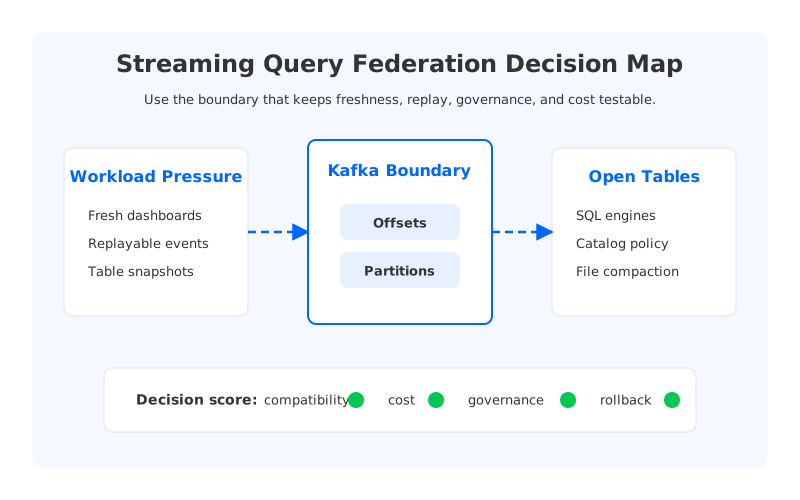
Teams rarely search for streaming query federation kafka because they want a cleaner architecture diagram. They search for it when the boundary between events and analytics has started to leak into production work. Product dashboards need fresher numbers, fraud systems need replayable decisions, data scientists want table scans, and application teams still want Kafka semantics that do not change every time the lakehouse team changes a table layout.
The phrase is awkward because the boundary is awkward. Kafka gives teams ordered event streams, partition-level parallelism, consumer group coordination, offsets, and a mature ecosystem of clients and connectors. Open table formats such as Apache Iceberg give teams table snapshots, schema evolution, catalogs, and SQL access across engines. Query federation tries to let both worlds meet without forcing every workload through one interface.
The useful question is where the production boundary should sit so that freshness, cost, governance, and recovery remain testable.
1Why teams search for streaming query federation kafka
Search intent around streaming query federation usually starts with an operational mismatch. The business wants real-time analytics, but the infrastructure grew from separate decisions: Kafka for event-driven services, a lakehouse for analytical history, stream processors for transformations, connectors for ingestion, and a catalog for table governance. The pain appears when the same event must behave like a durable message, an analytical row, a replay source, and a governed data product at the same time.
That mismatch is easy to hide at first. A connector writes events into object storage every few minutes. A Flink job commits files. A dashboard queries a table that is "fresh enough." Then another team asks whether the table can be reconstructed from a known Kafka offset after a bad deploy. At that point, the federation design becomes a platform contract.
Several symptoms usually show up together:
- Freshness is defined in different languages. Kafka consumers talk about offsets, lag, and committed positions. Table consumers talk about snapshots, manifests, files, and catalog commits. A query federation layer has to translate between these concepts without hiding failure modes.
- Replay has two meanings. Event systems replay from offsets. Lakehouse systems often scan snapshots or rewrite partitions. Both are valid, but they produce different operational plans.
- Governance moves from metadata to behavior. Schema compatibility, catalog permissions, data retention, and deletion policy are no longer documentation topics. They decide whether a failed writer can be recovered and whether downstream queries see a consistent result.
- Cost appears in the space between systems. Storage can be inexpensive while cross-AZ traffic, connector workers, table compaction, and duplicate retention still drive the bill. Federation can reduce duplication, but only when the boundary is designed deliberately.
Kafka remains a strong backbone for this class of problem because its protocol and consumer model are already the shared interface for many operational systems. Those semantics matter because query federation is not a loose file export. It is a production path from ordered events to queryable state.
2The lakehouse freshness constraint behind the workload
Lakehouse freshness is not the same as low broker latency. A producer can receive a Kafka acknowledgement quickly while the analytical table still waits for a writer, file layout, metadata commit, catalog visibility, and query engine refresh behavior. Shortening one part of the path does not automatically shorten the whole path.
That is why freshness needs a workload-specific definition before any architecture choice. A security monitoring table may tolerate minute-level commits if replay is reliable and audit history is complete, while a customer-facing operational dashboard may need tighter freshness for a subset of fields.
Table freshness has a cost curve. Faster commits generally increase coordination, metadata, and maintenance pressure. Query federation succeeds when the gap between the latest Kafka offset and the latest table snapshot is visible and controllable.
| Workload question | Kafka-side signal | Table-side signal | Design implication |
|---|---|---|---|
| How fresh must queries be? | Consumer lag and committed offsets | Snapshot age and catalog commit time | Define freshness as an end-to-end SLO, not a broker metric. |
| Can the result be rebuilt? | Offset range, key ordering, transaction boundaries | Snapshot lineage and partition rewrite history | Keep a recovery map between event positions and table states. |
| Who owns schema change? | Producer schema and compatibility policy | Table schema evolution and catalog rules | Treat schema as a cross-boundary contract. |
| What drives cost? | Retention, fanout, broker storage, network traffic | File count, compaction, object storage requests | Model the full path before optimizing one layer. |
Platform teams get into trouble when they select an ingestion tool before they decide what correctness means. Kafka and open tables can support several patterns, but the operating model is not the same.
3Stream-to-table architecture options
Most teams have four broad options for connecting Kafka-compatible streams with queryable tables. The right option is the one whose failure modes the team can explain during an incident.
The first option is a conventional Kafka-to-lakehouse sink. Kafka remains the event backbone, and a connector or stream processing job writes selected records into object storage and an open table format. This is familiar, but workers, checkpoints, dead-letter handling, schema mapping, file sizing, compaction, and catalog commits all become production responsibilities.
The second option is query federation above separate systems. A query engine can read from tables and sometimes from streaming sources, giving analysts a more unified interface. It is weaker as a production correctness boundary because the query layer does not automatically solve offset management, writer recovery, table maintenance, or stream retention economics.
The third option is longer-retention Kafka plus selective table materialization. Kafka stays close to operational replay, while curated topics are materialized into open tables for analytical access. This admits that event replay and table analytics are different access paths.
The fourth option is a Kafka-compatible shared storage architecture with a built-in stream-to-table path. The streaming layer preserves Kafka protocol semantics while moving durable stream storage onto object storage, and selected topics can be written into open tables closer to the platform boundary. Object storage is no longer only a downstream sink.
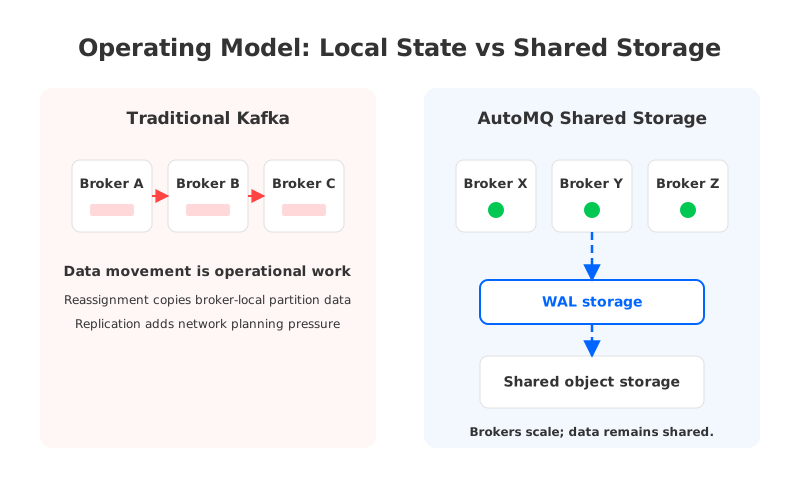
Traditional Kafka's Shared Nothing architecture makes each broker responsible for local partition data. That design is proven, but it couples compute placement with durable storage placement. Scaling brokers, replacing nodes, or rebalancing hot partitions can involve broker-local data movement. In a lakehouse-heavy environment, retained event history is no longer a passive buffer; it is part of the analytical recovery path.
Tiered storage helps by offloading older segments, but it does not fully erase the primary-storage operating model. A shared storage design changes the premise more deeply: brokers handle Kafka protocol and compute responsibilities, while durable data is stored in shared object storage with a WAL layer for write efficiency and recovery.
4Evaluation checklist for platform teams
An evaluation framework should start with compatibility because Kafka compatibility is not a marketing detail in this workload. Existing producers, consumers, serializers, ACL models, transactions, Connect jobs, and operational tooling define the migration surface. If an architecture breaks offset behavior or requires application rewrites, the cost will show up in every downstream team, not only in the platform budget.
Cost comes next, but it should be modeled as a system cost. Broker storage, object storage, cross-AZ traffic, connector workers, query engine scans, table maintenance, and operational labor all matter. "Data is in object storage" is not a cost model by itself.
Governance is the third axis. Query federation touches identity, catalog permissions, schema compatibility, retention, encryption, and deletion policy. The platform team should know whether the source of truth for a field is the event schema, the table schema, or a derived contract.
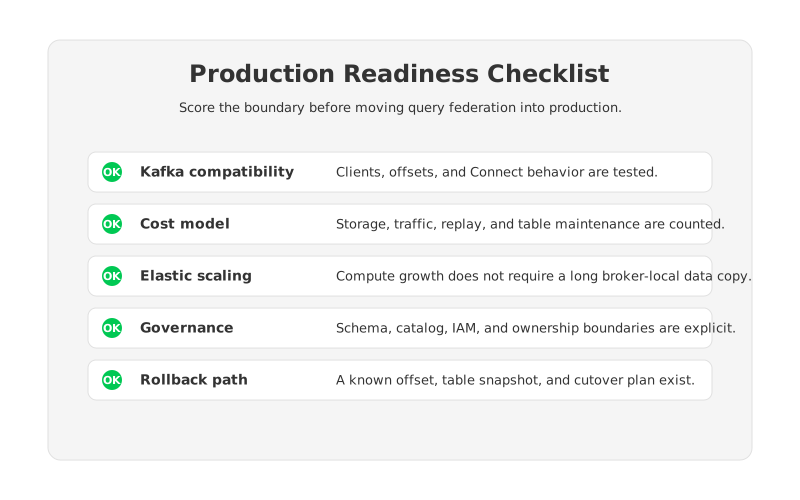
The readiness checklist below is a useful review before the architecture is treated as production:
- Compatibility: Can existing clients, offsets, consumer groups, transactions, and Connect jobs be tested without rewriting applications?
- Freshness: Is there one end-to-end definition that connects producer acknowledgement, writer commit, catalog visibility, and query result age?
- Cost: Does the model include storage, cross-AZ traffic, worker compute, replay, table compaction, object storage requests, and duplicate retention?
- Scaling: Can the platform add or remove streaming compute without turning every change into broker-local data movement?
- Governance: Are schema evolution, catalog ownership, IAM boundaries, retention, and deletion policy explicit?
- Migration and rollback: Can the team cut over gradually, compare results, preserve offsets, and return to a known good state?
- Observability: Can operators see lag, writer health, catalog commit failures, object storage behavior, and query freshness in one incident view?
A team with stable traffic and modest freshness needs may choose a conventional connector path because it is familiar and sufficient. A team with heavy replay, long retention, cloud cost pressure, and frequent scaling events should look harder at the storage architecture under the Kafka-compatible layer.
5How AutoMQ changes the operating model
Once the evaluation framework is clear, AutoMQ fits as a specific architectural answer rather than a generic streaming pitch. AutoMQ is a Kafka-compatible streaming platform that replaces Kafka's broker-local log storage with S3Stream, a shared storage layer backed by object storage and WAL storage. Persistent stream data is no longer tied to broker-local disks.
That distinction matters for streaming query federation. If the platform needs Kafka semantics on one side and object-storage-backed table workflows on the other, the traditional architecture makes object storage feel like a downstream destination. AutoMQ moves object storage into the streaming foundation itself, so durable event history, replay economics, and table materialization can be evaluated on a common cloud storage substrate.
AutoMQ Table Topic is the most direct feature for this article's boundary. It is designed to write streaming data into Apache Iceberg tables using external catalog services such as AWS Glue Catalog, Hive Catalog, and AWS S3 Table Catalog. It gives platform teams another option for selected streams where table freshness and query access are first-class requirements.
The storage model also changes operations around scale and recovery. AutoMQ's Shared Storage architecture makes brokers stateless in the sense that durable partition data is stored in shared object storage. Partition reassignment and broker replacement no longer require the same broker-local data copy pattern as Shared Nothing Kafka.
Engineering judgment still matters. AutoMQ Open Source uses S3 WAL, which is simpler to deploy and better suited to latency-tolerant scenarios. AutoMQ commercial editions, including AutoMQ BYOC and AutoMQ Software, support additional WAL options for lower-latency workloads.
AutoMQ BYOC is relevant when governance and cloud-account boundaries are part of the decision. In BYOC, the control plane and data plane run in the customer's own cloud account or VPC, and the data path remains within that customer-controlled environment.
Zero cross-AZ traffic is another operating-model consideration. Traditional Kafka replication can create cross-AZ data movement when brokers are distributed across availability zones. AutoMQ's documentation describes an S3-based shared storage approach and related routing capabilities to eliminate cross-AZ data transfer costs. For query federation, locality affects producer traffic, replica traffic, connector reads, table writes, and analytical scans.
The balanced way to evaluate AutoMQ is to treat it as a Kafka-compatible shared storage layer with optional stream-to-table integration, not as a replacement for every lakehouse component. You still need a catalog, table design, and schema discipline. The difference is that the streaming backbone no longer has to carry broker-local storage assumptions into a world where durable data and analytical tables already live in object storage.
6Decision matrix
The following matrix is a compact way to compare architecture choices:
| Architecture choice | Good fit | Watch for | Typical decision signal |
|---|---|---|---|
| Kafka sink to open tables | Familiar ingestion, explicit transformation logic, mature connector operations | Worker failures, small files, schema mapping, checkpoint recovery | The team already operates Connect or Flink well and freshness targets are moderate. |
| Query engine federation | Exploration across live and historical data | Weak ownership of offsets, writer recovery, and commit semantics | Analysts need flexible access, but the path is not the primary recovery boundary. |
| Long-retention Kafka plus selective tables | Operational replay with curated analytical tables | Broker storage economics and replay impact on live traffic | Some streams need event-native recovery while selected domains need SQL access. |
| Kafka-compatible shared storage with Table Topic | Object-storage-backed durability and elastic brokers | WAL type choice, catalog readiness, table design discipline | Retention, replay, and freshness are platform-level concerns. |
The last row is where AutoMQ deserves evaluation. It is not automatically the right answer for every Kafka estate, but it addresses a specific cloud-native mismatch: the event backbone is expected to serve long-retention, replay-heavy, lakehouse-facing workloads while still operating like broker-local storage is the center of gravity.
7References
- Apache Kafka Documentation for Kafka consumer groups, offsets, transactions, replication, KRaft, Tiered Storage, and Kafka Connect concepts.
- Apache Iceberg Documentation for open table format concepts, snapshots, schemas, catalogs, and table operations.
- Amazon S3 User Guide for object storage concepts.
- AutoMQ Shared Storage Architecture for AutoMQ's Shared Storage architecture, S3Stream, WAL storage, and stateless broker model.
- AutoMQ Compatibility with Apache Kafka for Kafka protocol and ecosystem compatibility.
- AutoMQ Table Topic Overview for AutoMQ's built-in stream-to-Iceberg table feature and catalog requirements.
- AutoMQ Zero Cross-AZ Traffic Overview for AutoMQ's cross-AZ traffic optimization model.
8FAQ
8.1What does streaming query federation mean for Kafka teams?
It means designing a boundary where Kafka-compatible streams can support queryable analytical access without losing offsets, ordering, consumer group behavior, and replay. The hard part is making freshness, recovery, and ownership explicit.
8.2Is Kafka a replacement for a lakehouse?
No. Kafka is strong for event-driven systems, ordered replay, consumer coordination, and operational integration. A lakehouse is strong for SQL analytics, table snapshots, schema evolution, and cross-engine access. Many production architectures need both.
8.3When should a team use a connector instead of Table Topic?
A connector or Flink job is a good fit when transformations are substantial or the table layout requires custom logic. Table Topic is worth evaluating when selected streams should be materialized into Apache Iceberg tables with less ingestion surface area.
8.4How does shared storage affect query federation cost?
Shared storage can reduce broker-local capacity planning and data movement tied to durable stream retention. The final cost still depends on workload details: WAL type, retention, fanout, table commit frequency, object storage requests, query scans, and cross-AZ traffic all need to be counted.
8.5How should teams evaluate AutoMQ for this workload?
Start with one production stream that already feeds both Kafka consumers and analytical queries. Test compatibility, freshness, replay from known offsets, catalog integration, rollback, and cloud cost under the same traffic shape.
If your team is evaluating where Kafka-compatible streaming should meet open tables, start with one stream and test it against your own freshness and rollback requirements: AutoMQ Table Topic overview.


