
Table of Contents
Table of Contents
Searching for streaming reverse etl loop kafka usually means a team has outgrown one-way data activation. The warehouse or lakehouse still shapes customer scores, eligibility rules, inventory state, fraud features, and account signals, but the systems that act on those facts are operational applications with uptime, rollback, and audit requirements. A nightly sync can update a field. A production loop has to publish a fact, let services consume it, prove which version they saw, and recover when the model or target application is wrong.
That is why the word "loop" matters. Reverse ETL moves modeled data back into operational tools, but a streaming loop adds feedback and failure control. A campaign service may consume an updated segment, emit delivery events, and feed outcomes back into analytics. A support console may read entitlement changes while billing uses the same topic to enforce access. Once the path influences user-visible behavior, the platform team is no longer choosing a connector. It is defining the operating contract for activated data.
The useful thesis is simple: a streaming reverse ETL loop should be judged by how it behaves under change. Schemas evolve, consumers lag, target systems reject writes, and teams need replay windows long enough to rebuild state. Kafka-compatible streaming is a strong foundation because it gives applications offsets, Consumer group isolation, retention, replay, and ecosystem tooling. The harder question is whether the platform can keep those semantics without turning growth into broker-local storage pressure, data movement, and migration risk.
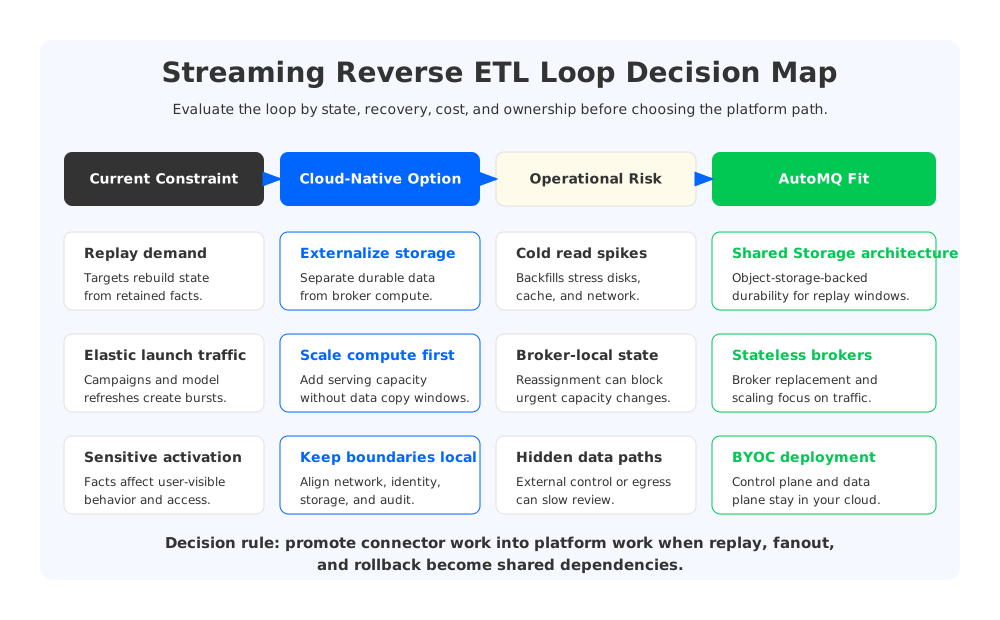
1Why teams search for streaming reverse etl loop kafka
The first search is rarely about Kafka internals. It starts with a product or operations problem: "Can this customer see a feature yet?", "Should this order trigger a fraud review?", "Is this lead ready for sales?", or "Which model feature did the recommendation service use?" Analytics teams can often produce the answer, but operational systems need that answer in a form they can depend on. Polling a table every few minutes works until the answer affects a live workflow.
Kafka changes the shape of the problem because it turns analytics-derived changes into durable records. Producers write keyed events into topics, consumers process them at their own pace, and offsets make recovery observable. Kafka Connect can standardize integrations, while transactions and idempotent producer behavior help teams reason about write consistency. Those primitives do not remove application design work, but they give the platform team a common language for delivery, replay, and ownership.
Reverse ETL loops expose four production boundaries earlier than teams expect:
- Contract boundary: The event should represent an operational fact, not a leaked analytics table. Consumers need stable keys, schema compatibility, and clear semantics for nulls, deletions, and late updates.
- Recovery boundary: Offsets, retries, and dead-letter handling must show whether a target system is behind, corrupted, or safely caught up after a fix.
- Cost boundary: Retention, fanout, backfills, and long replay windows increase storage and read pressure even when producer throughput is modest.
- Ownership boundary: Analytics may own the model, application teams own the behavior, and platform engineers own the transport, observability, and rollback path.
The loop becomes fragile when those boundaries are hidden inside connector settings. A connector can move data, but it cannot decide whether a downstream service should replay a time window, quarantine a bad segment, or tolerate out-of-order corrections. Those are platform decisions, and Kafka-compatible streaming makes them explicit.
2The production constraint behind the problem
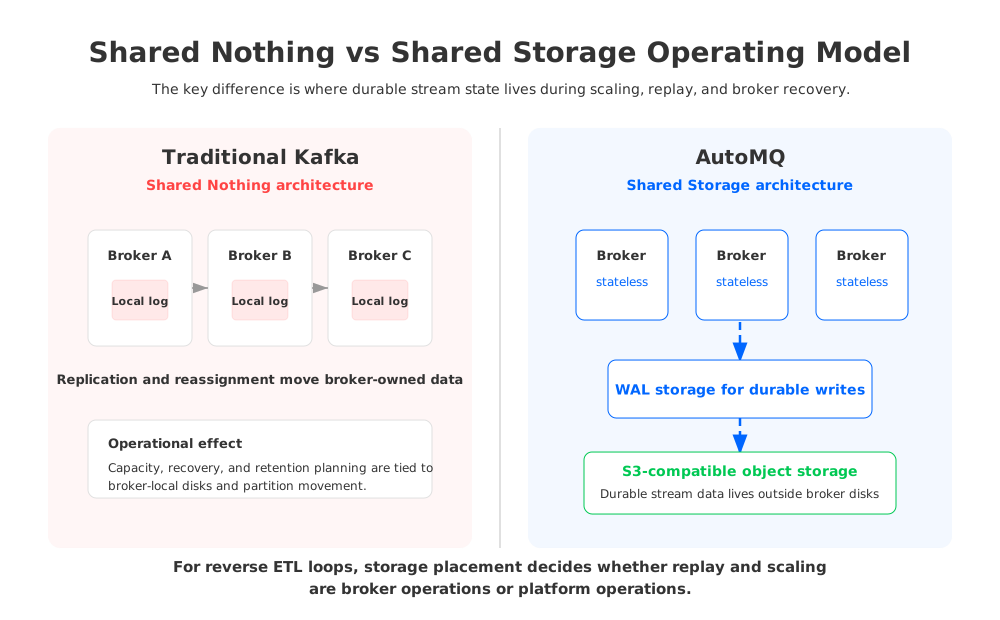
Traditional Kafka runs on a Shared Nothing architecture: each broker owns local persistent data, partitions are replicated across brokers, and scaling or replacing brokers can require reassignment work. That architecture is familiar and proven, but it couples compute, storage, and data movement. In a reverse ETL loop, the coupling shows up when retained history grows for audit, many targets consume the same fact, or a model change requires a controlled backfill.
Reverse ETL traffic is often asymmetric. Writes from analytics may be small and predictable, while reads are bursty and operationally sensitive. A target rebuild, application launch, or compliance investigation can turn a quiet topic into a replay-heavy workload. If broker storage is the durable state boundary, the team may add capacity for storage even when CPU is not constrained, or delay scaling because moving partition data creates risk.
Tiered Storage can reduce pressure from older segments by moving historical data to remote storage. It does not erase the need to understand what remains on broker-local storage, how catch-up reads behave, and whether scaling still depends on broker-owned state. For streaming reverse ETL loops, the core question is whether replay, recovery, and elasticity stay predictable when activated data becomes a shared dependency.
Cross-team operations also become expensive. A schema change may require analytics, platform, and application owners to agree on compatibility rules. A failed target write may require SREs to separate connector failure from consumer bug. A migration may require preserving offsets so consumers do not rebuild from the wrong position. Those tasks are solved by designing the loop around state, ownership, and recovery.
3Architecture options and trade-offs
A practical architecture review should separate the data movement pattern from the streaming platform underneath it. Batch reverse ETL, CDC into Kafka, streaming transformations, and application-owned consumers can all be valid. The right answer depends on freshness, write criticality, recovery needs, and how many systems depend on the same fact.
| Option | Where it fits | Main trade-off |
|---|---|---|
| Scheduled reverse ETL sync | Low-risk enrichment, CRM fields, periodic lifecycle updates | Simple operations, but weak replay and limited failure isolation |
| CDC or table-change publishing | Row changes need to leave a source or modeled table quickly | Easier automation, but row shape can leak implementation details |
| Domain event publishing | Applications need stable facts such as entitlement_changed or risk_score_updated | More design work, but clearer contracts and safer consumers |
| Kafka-compatible platform layer | Multiple teams need offsets, replay, retention, and independent consumers | Strong operating model, but requires platform ownership |
The table is a pressure test. If the use case is a low-risk SaaS enrichment job, a scheduled tool may be enough. If the same data drives authorization, customer experience, fraud decisions, or AI feature serving, the team needs a durable loop with observable state transitions.
Event design deserves attention before platform choice. A row-level event such as customer_profile_row_updated is easy to generate, but every consumer must understand warehouse modeling choices. A domain event such as account_support_tier_changed is harder to design, but it tells consumers what changed in operational language. This matters during rollback: replaying a row export may repeat an implementation detail, while replaying a domain fact can restore intended state.
The storage model underneath Kafka-compatible streaming is the second decision. With broker-local storage, the team plans disk, replication, reassignment windows, and hot partition movement. With shared object storage, the team evaluates object-store durability, WAL behavior, cache efficiency, and network boundaries. The difference is where durable state lives and how much broker replacement or scaling is tied to copying data.
4Evaluation checklist for platform teams
The most useful checklist prevents late-stage surprise. It should force teams to answer how the loop behaves when a model is wrong, a target is unavailable, or the streaming layer scales during a backfill.
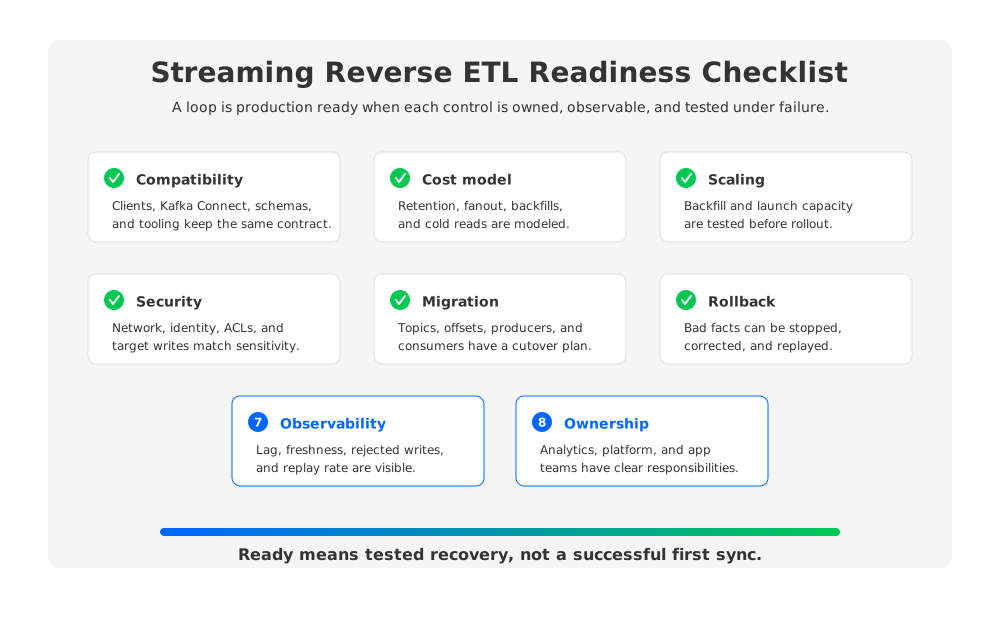
Use these checks before treating the loop as production ready:
- Compatibility: Existing producers, consumers, Kafka Connect jobs, client libraries, and schema tooling should work without changing the application contract.
- Offset and replay design: Every target should have a documented replay range, idempotency strategy, and Consumer group ownership model.
- Schema governance: Backward compatibility, required fields, tombstones, null semantics, and version rollout rules should be decided before the first high-risk topic goes live.
- Storage and cost model: Retention, fanout, backfills, and cold reads should be modeled separately from steady-state writes.
- Security boundary: Credentials, network paths, topic ACLs, and target write permissions should match the data sensitivity of the activated fact.
- Migration and rollback: The team should know how topics, offsets, consumer state, and producer cutover behave if the platform changes later.
- Observability: Lag, connector task state, rejected writes, replay rate, and end-to-end freshness should be visible from one operating view.
These checks keep the conversation grounded. A team that can answer them is building a data product boundary, not merely wiring systems together. A team that cannot answer them may ship the first sync, but later consumers will inherit the missing decisions.
5How AutoMQ changes the operating model
After neutral evaluation, the architectural requirement becomes clearer: keep Kafka-facing semantics stable while reducing operational work tied to broker-local durable state. AutoMQ fits that category as a Kafka-compatible, cloud-native streaming platform built around Shared Storage architecture and stateless brokers.
AutoMQ keeps the Kafka protocol and ecosystem model that reverse ETL loops rely on, including producers, consumers, topics, offsets, Consumer groups, and Kafka Connect compatibility. The architectural change is below that interface. Instead of treating broker-local disks as the long-term data boundary, AutoMQ uses S3Stream with WAL storage and S3-compatible object storage so durable stream data is externalized from broker compute. Brokers can focus on request handling, caching, leadership, and scheduling rather than owning local persistent data.
For streaming reverse ETL loops, that shift changes three operating questions. Retention planning is less entangled with broker disk reservations, which matters for replay, audit, and target rebuilds. Scaling focuses more on compute and traffic shape, because broker replacement does not have to mean large local data movement. Recovery planning can treat activated data as durable platform state rather than state attached to a specific broker.
AutoMQ BYOC also matters when reverse ETL touches regulated or customer-sensitive data. In BYOC deployments, the control plane and data plane run inside the customer's cloud environment, and business data remains within that cloud boundary. That lets platform teams align Kafka-compatible streaming, object storage, identity, network policy, and connector operations with the same account or VPC controls used by the rest of the data platform.
Connector operations remain engineering work. AutoMQ Managed Connector can reduce deployment and operations friction for Kafka Connect-style integrations, but the team still has to define event contracts, target idempotency, and rollback behavior. AutoMQ Linking is relevant when teams migrate existing Kafka workloads while preserving topic and consumer progress semantics. Table Topic can support analytical feedback by landing stream data in Apache Iceberg tables, although it should not replace careful event design for operational consumers.
The practical advantage is that the platform discussion moves away from "How many disks do we need to survive the next backfill?" and toward "What contract, replay window, and ownership model should this loop expose?" The business cares whether activated facts are fresh, correct, recoverable, and governed; the platform should make those properties easier to operate.
6A migration path that avoids hidden coupling
Teams rarely replace an activation path in one step. A safer approach is to build the loop beside the existing sync, publish a narrow domain event, and let one or two consumers prove offset handling, schema evolution, and target idempotency. The first topic should reveal real constraints without forcing every team to change at once.
A workable migration sequence looks like this:
- Define the operational fact and the owning team before choosing the connector path.
- Publish into a Kafka-compatible topic with stable keys, schema checks, and a documented replay window.
- Add one target consumer and measure freshness, lag, rejected writes, and recovery time after a forced failure.
- Run the batch or legacy path in parallel until downstream state can be compared.
- Move additional consumers only after rollback, offset reset, and schema rollout procedures are written down.
This sequence is conservative. Reverse ETL loops fail in places that are hard to see in a demo: a consumer commits too early, a target API accepts partial writes, a backfill overloads a broker, or a model changes field meaning. A migration plan that exercises those failure modes before broad adoption will look slower at first and more cost-effective after the first incident.
7FAQ
7.1Is streaming reverse ETL the same as CDC?
No. CDC usually captures changes from a source database or table. Streaming reverse ETL publishes analytics-derived or transformed facts back into operational systems. CDC may feed the analytics layer, but the reverse ETL loop is judged by target behavior, event contracts, replay, and rollback.
7.2Why use Kafka-compatible streaming for a reverse ETL loop?
Kafka-compatible streaming gives teams durable topics, Consumer group isolation, offsets, retention, replay, Kafka Connect integration, and a mature client ecosystem. Those mechanics are useful when multiple applications need to consume the same activated facts at different speeds.
7.3When is batch reverse ETL still enough?
Batch reverse ETL is often enough for low-risk enrichment, scheduled marketing audiences, or internal fields where delay and replay are not operationally critical. Streaming is more appropriate when data freshness, ordering, failure isolation, or multi-consumer fanout affects production behavior.
7.4How should teams evaluate AutoMQ for this workload?
Evaluate AutoMQ when Kafka compatibility is required but the workload is expected to create pressure around retention, replay, broker-local storage, elastic scaling, BYOC boundaries, or migration. Test with a real activation loop rather than a synthetic connector-only path.
7.5Does a shared-storage streaming platform remove the need for governance?
No. Shared Storage architecture changes the operating model for storage and broker state, but governance still belongs to the data contract. Teams still need schema review, ownership, access control, target idempotency, observability, and documented rollback procedures.
The original search phrase, streaming reverse etl loop kafka, points to a production question rather than a connector question. Closing the loop means choosing which facts deserve to become events, deciding who owns recovery, and selecting a Kafka-compatible platform whose storage model can support replay and elasticity without making broker disks the center of every operating decision. To evaluate the shared-storage path in your own environment, start with the AutoMQ console and test one activation loop end to end.


