
Table of Contents
Table of Contents
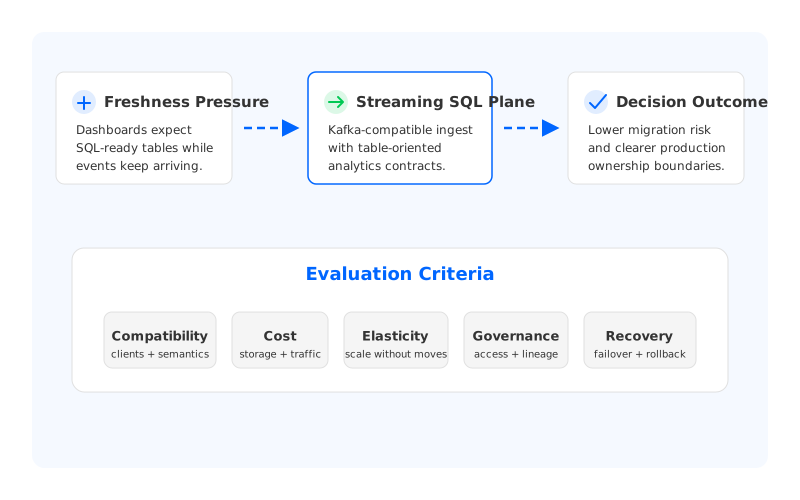
The search phrase streaming sql data plane kafka sounds awkward because it sits at the boundary between two teams that usually speak different languages. Data engineers want SQL over fresh operational events. Platform teams are responsible for Kafka clusters, retention, replication, connector uptime, network boundaries, and recovery drills. When those two worlds meet, the question is no longer whether Kafka can move events fast enough; it is whether the streaming layer can behave like a production data plane for analytics workloads that expect table-like contracts.
That distinction matters. A dashboard that refreshes every few minutes, a fraud model that reads recent account activity, and a lakehouse job that incrementally consumes events all depend on the same chain of assumptions: producers keep writing, consumers keep making progress, data remains queryable, and schema or partition changes do not break downstream jobs. If the streaming layer is treated as a transport pipe, the hard parts are pushed into ad hoc connectors, replay jobs, and operational runbooks. If it is treated as a data plane, the architecture has to own freshness, durability, cost, governance, and recovery as first-class design constraints.
1Why Teams Search for streaming sql data plane kafka
Most teams arrive at this topic after they have already built a workable event pipeline. Producers publish to Kafka topics, stream processors derive features or aggregates, and analytics systems consume the result through Flink, Spark, Trino, ClickHouse, Snowflake, BigQuery, or an Iceberg-based lakehouse. The first version usually works because the workload is narrow and ownership is clear.
The architecture becomes harder when the pipeline turns into shared infrastructure. Freshness expectations get tighter, more teams ask for the same data, and replay is no longer a rare maintenance action. At that point, the Kafka cluster is not serving one pipeline; it is serving an analytics substrate. The failure mode also changes. A short lag spike can become a stale executive dashboard. A broker expansion can become a delayed backfill. A connector restart can become a broken table snapshot.
The phrase "streaming SQL data plane" is useful because it forces the platform team to evaluate the whole path, not a single component. SQL engines do not care that an event was durably written to a topic if the table view is stale. Kafka operators do not care that a lakehouse query is elegant if the connector fan-out creates uncontrolled egress or replay pressure. A production design has to make those concerns visible in one operating model.
2The Lakehouse Freshness Constraint Behind the Workload
Fresh analytics workloads sit between batch lakehouse assumptions and event-streaming assumptions. A batch table can tolerate scheduled compaction, delayed partition discovery, and hourly freshness windows. A streaming topic can tolerate consumer-specific offsets, continuous appends, and replay from retained logs. A streaming SQL workload wants both: table-shaped access with event-time freshness and operational continuity.
That combination changes the meaning of retention. In a classic Kafka pipeline, retention is often discussed as a replay window for consumers. In a lakehouse-oriented workload, retention also supports table repair, late data handling, audit trails, and backfills into additional datasets. The platform has to answer a practical question: when a downstream table is wrong, can the team reconstruct the correct state without turning the Kafka cluster into a special-purpose recovery system?
Freshness also changes the cost model. Keeping more data close to compute can reduce read latency, but it increases broker-local storage pressure and makes capacity planning less forgiving. Pushing data into object storage improves durability economics and aligns with lakehouse storage patterns, but the streaming layer still needs a write path that can absorb bursts and preserve Kafka semantics. The wrong design pays twice: once for streaming durability and again for analytical storage, with fragile glue between them.
The useful mental model is to separate three contracts:
- The event contract defines ordering, keys, offsets, transactions, and consumer group behavior.
- The table contract defines schema evolution, discoverability, partitioning, snapshot consistency, and query access.
- The operations contract defines scaling, recovery, observability, security, and cost ownership.
The data plane succeeds when those contracts reinforce each other. It fails when each team optimizes its own layer and leaves the integration risks to whoever is on call.
3Stream-to-Table Architecture Options
There are several ways to connect Kafka-compatible streaming infrastructure to SQL analytics. The right choice depends on freshness windows, write volume, governance requirements, cloud boundary, and team maturity. The important part is to understand which trade-off each pattern moves into production operations.
The most common pattern is Kafka plus a stream processing job that writes to an analytics sink. Flink, Spark Structured Streaming, Kafka Connect, and purpose-built sink connectors can all play this role. This pattern is flexible because the processing layer can transform, enrich, deduplicate, and route data before it lands in a table. Its risk is that the stream-to-table contract lives in job configuration and operational discipline.
A second pattern is Kafka plus a lakehouse table format such as Apache Iceberg. The table format gives analytics teams a stronger abstraction for snapshots, schema evolution, partition metadata, and query engine interoperability. The streaming platform still has to feed that table format reliably. The harder the workload pushes toward low-latency updates, the more the team has to care about small files, commit cadence, compaction, and exactly how failures are replayed.
A third pattern is to treat the streaming platform itself as part of the table delivery path. Instead of making Kafka a passive source and pushing all table responsibility into downstream jobs, the platform exposes a clearer bridge between topics and object-storage-backed table data. The platform team can reason about event durability, table delivery, and storage layout as one data-plane concern rather than a chain of unrelated tickets.
The pattern choice should follow the workload, not vendor preference:
| Workload signal | Architectural implication | Operational question |
|---|---|---|
| Many independent SQL consumers need the same fresh data | Avoid duplicating sink pipelines per consumer | Who owns fan-out, replay, and freshness SLOs? |
| Retention is used for repair and audit, not only replay | Storage design becomes a governance concern | Can old data be recovered without broker-local pressure? |
| Cloud cost is scrutinized by FinOps | Network and storage movement must be modeled | Which actions create cross-zone or cross-service traffic? |
| Teams need Kafka client compatibility | Semantics matter more than API shape | Are offsets, consumer groups, and transactions preserved? |
| The lakehouse is the analytical system of record | Table delivery is part of production reliability | How are schema changes, commits, and failures observed? |
Streaming SQL is attractive because it promises faster decisions, but production teams buy architecture by failure mode. The design that looks clean in a whiteboard diagram has to survive bursts, restarts, rebalances, schema changes, and month-end cost reviews.
4Evaluation Checklist for Platform Teams
A streaming SQL data plane should be evaluated with the same seriousness as a database, not the casualness of a connector. The workload may enter through Kafka topics, but the consumers make business decisions from the resulting tables and queries.
Start with compatibility. If applications already use Kafka producers, consumers, transactions, offsets, ACLs, and Kafka Connect, a migration that breaks those assumptions creates hidden rewrite cost. Compatibility is not a checkbox that says "has a Kafka API." It is an operations question: can existing clients keep their behavior, can consumer groups recover cleanly, and can teams test cutover without changing every application at once?
Then examine cost and elasticity together. Traditional Kafka capacity planning ties broker count, local disk, replication, and partition placement into one operational unit. That coupling is manageable for stable workloads, but analytics freshness workloads are often bursty. Backfills, table repairs, and consumer fan-out can all create read and write patterns that diverge from the steady-state ingest rate.
Security and governance deserve the same attention. The data plane must live inside the organization's cloud boundary, identity model, encryption policy, network policy, and audit process. That boundary affects architecture as much as compliance, because it determines who can inspect logs, control private networking, manage keys, and respond during an incident.
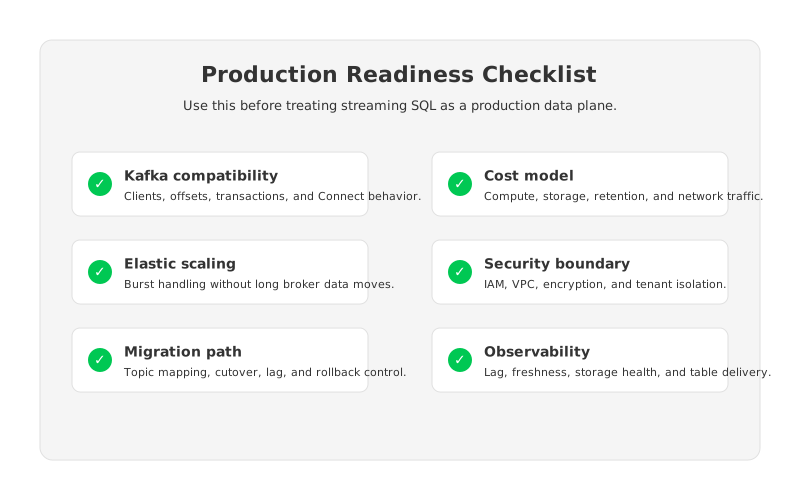
The final checklist should be concrete enough for an architecture review:
- Compatibility: existing Kafka clients, consumer groups, transactions, Kafka Connect jobs, and tooling continue to work or have a tested migration path.
- Freshness: lag, table commit delay, and query-visible freshness are measured.
- Cost: compute, storage, retention, network paths, fan-out, and backfill behavior are modeled before rollout.
- Elasticity: scaling does not require disruptive data movement for routine workload changes.
- Governance: identity, encryption, network isolation, metadata, and audit requirements have named owners.
- Recovery: failover, replay, rollback, and table repair are tested with real workload shape.
- Observability: operators can connect topic health, consumer progress, storage health, and table delivery in one incident timeline.
The goal is to prevent a familiar failure: a streaming platform passes a throughput test, then fails the first time an analytics team asks for freshness, lineage, cost predictability, and recovery at the same time.
5How AutoMQ Changes the Operating Model
Once the evaluation framework is clear, the architecture requirement becomes sharper. A Kafka-compatible streaming SQL data plane benefits from Kafka semantics, but it does not benefit from binding durable data to broker-local disks. The storage model that worked for an on-premises cluster can become the source of cloud operational friction when retention grows, backfills spike, or brokers need to scale independently from stored data.
This is where AutoMQ, a Kafka-compatible cloud-native streaming platform, changes the operating model. AutoMQ separates compute from storage by using shared object storage for durable data and keeping brokers more stateless than a traditional shared-nothing Kafka deployment. The point is to keep the Kafka protocol and client ecosystem while moving the storage responsibility into a cloud-native layer aligned with elastic infrastructure and long-lived data.
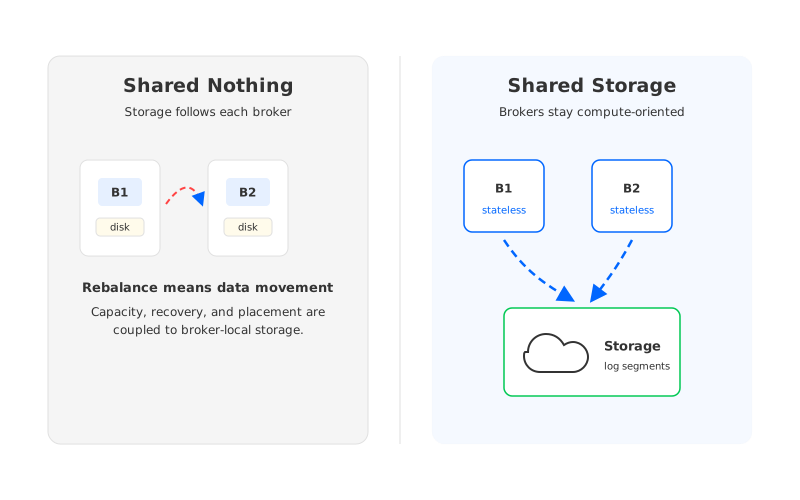
That difference matters for streaming SQL workloads because the bottleneck is often operational coupling, not raw ingest. In a broker-local design, adding capacity or recovering from placement changes can involve moving stored log data between brokers. In a shared-storage design, the broker fleet can focus more on serving reads and writes while durable log segments live in object storage. The practical outcome is a cleaner separation between compute scaling, retention policy, and data durability.
AutoMQ's Table Topic direction is relevant for the same reason. Analytics teams do not want every fresh dataset to become a bespoke connector project. They want a dependable path from Kafka-compatible topics to table-shaped data in object storage, where lakehouse engines can participate without forcing the streaming team to reinvent table delivery for each use case.
There is also a cloud cost angle, but it should be framed carefully. Cost reduction is not magic; it comes from removing unnecessary coupling and making expensive actions visible. When durable data sits in shared object storage, operators can reason differently about retention, broker replacement, and cross-zone data movement. When brokers are less tied to local disks, elastic scaling becomes a capacity-management decision rather than a data relocation project.
6Migration and Readiness Scorecard
The safest migration plan treats streaming SQL as a staged operating-model change. The first stage is inventory. List the topics that feed analytical workloads, their retention windows, consumer groups, connector jobs, schema dependencies, peak write rates, replay behavior, and freshness expectations. Teams often discover that the hardest workloads are topics with many downstream consumers, unclear ownership, or frequent repair needs.
The second stage is compatibility testing. Run representative producers and consumers against the target Kafka-compatible platform, including the failure cases that matter in production: consumer restart, rebalance, transaction handling, connector recovery, permission changes, and backfill. A test that only proves a producer can write and a consumer can read is too thin.
The third stage is table delivery validation. If the target architecture includes object-storage-backed table output, test commit cadence, schema evolution, late data handling, compaction workflow, and query-visible freshness. A topic can be healthy while a table is stale, and a table can be queryable while the replay path is broken.
Use a compact scorecard before production cutover:
| Readiness area | Pass condition |
|---|---|
| Client behavior | Existing applications run with tested configuration changes only |
| Freshness SLO | Topic lag and table freshness are measured with agreed thresholds |
| Cost model | Retention, storage growth, network paths, and replay bursts are estimated |
| Failure handling | Broker failure, connector restart, and table repair are rehearsed |
| Governance | Access control, encryption, metadata ownership, and audit trails are documented |
| Rollback | Cutover can be reversed without losing offsets or corrupting table state |
The scorecard is intentionally blunt. A streaming SQL data plane is shared infrastructure. If no team owns rollback, rollback will be improvised. If no team owns table freshness, every lag incident becomes a negotiation. If no team owns cost modeling, the architecture review happens after the bill arrives.
7References
- Apache Kafka documentation
- Apache Kafka Connect documentation
- Apache Kafka consumer configuration documentation
- Apache Kafka tiered storage documentation
- Apache Iceberg documentation
- Amazon S3 data durability documentation
- AutoMQ architecture overview
- AutoMQ Kafka compatibility documentation
- AutoMQ Table Topic documentation
8FAQ
8.1Is streaming SQL the same thing as Kafka Streams or Flink SQL?
No. Kafka Streams and Flink SQL are processing technologies that can be part of the design. A streaming SQL data plane is the broader production architecture that connects Kafka-compatible ingestion, processing, table delivery, governance, cost control, and recovery.
8.2Do teams need to replace Kafka to support fresh analytics?
Not necessarily. Many teams can keep Kafka-compatible producers, consumers, and tools while changing the storage and operating model underneath. The migration question is whether the platform can support freshness, retention, replay, and table delivery without creating more operational coupling.
8.3Where does a lakehouse table format fit?
A table format such as Apache Iceberg gives analytics engines a consistent way to read snapshots, schemas, partitions, and metadata. It does not remove the need for a reliable streaming write path with clear ownership for freshness, failures, and repair.
8.4When should AutoMQ be evaluated for this workload?
Evaluate AutoMQ when the team wants Kafka compatibility but is constrained by broker-local storage, elastic scaling limits, long retention pressure, or cloud cost visibility. A good next step is to map one high-value analytics topic through the checklist above, then test client behavior, freshness measurement, and recovery workflow. To discuss that evaluation with the AutoMQ team, use the verified contact path at go.automq.com/contact.


