
Table of Contents
Table of Contents
Teams search for streaming transformations kafka when the transformation layer starts to feel heavier than the data product it supports. A fraud feature needs enriched events before they reach an online model. A pricing service wants normalized inventory updates instead of raw CDC payloads. Kafka can move all of those events, but the harder problem is deciding where transformation logic should live without creating a maze of one-off processors, duplicated topics, and unclear ownership.
The first version of a streaming transformation is usually harmless. One consumer reads a topic, rewrites a few fields, and publishes a cleaner topic for downstream teams. The fifth version is different: the same source event may be transformed for analytics, customer notifications, AI retrieval, compliance audit, and feature generation. The platform team then owns not only Kafka availability, but also the operational consequences of transformation sprawl.
The useful question is what architectural contract prevents each added use case from becoming a separate pipeline with separate durability, scaling, governance, and recovery rules.
1Why streaming transformations kafka Matters Now
Streaming transformations used to be a narrow stream processing concern. A data engineering team would enrich records, aggregate sessions, or reshape events before a warehouse sink. That pattern still exists, but the same transformed streams now feed operational APIs, real-time ML features, AI assistants, observability products, and security workflows. The transformed topic can become a production contract between teams.
That shift changes the failure model. If a transformation is wrong, the issue may propagate to several consumers before anyone notices. If a transformation lags, downstream systems may see stale or inconsistent state. If it cannot be replayed deterministically, schema fixes and policy changes turn into manual recovery work.
Apache Kafka gives teams durable topics, partitions, consumer groups, offsets, and transactions that can support serious transformation workflows. Apache Flink, Kafka Streams, Kafka Connect single message transforms, and custom consumers all build on that foundation. The challenge is choosing the right transformation boundary for each workload and making sure the platform can survive the consequences of that choice.
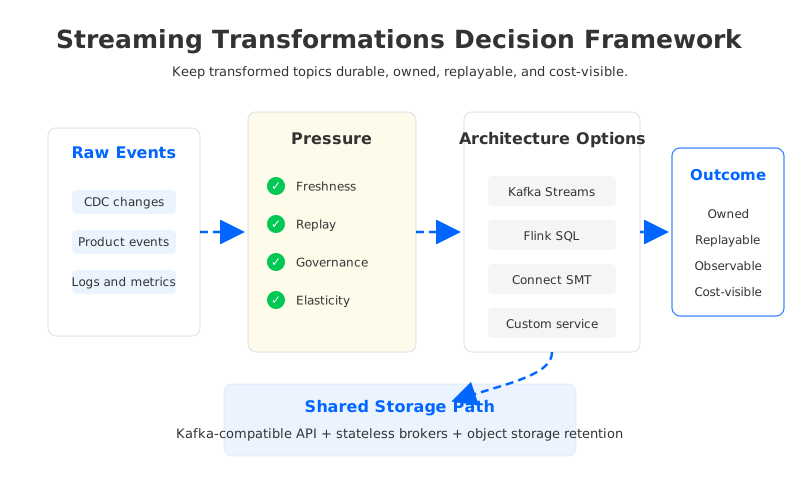
The pressure usually arrives from four directions:
- Freshness pressure from operational products that cannot wait for batch cleanup.
- Replay pressure from schema changes, enrichment bugs, model updates, and historical backfills. A pipeline that cannot replay safely is hard to trust.
- Governance pressure from derived data. Once a field is enriched, masked, joined, or aggregated, teams need to know which rule produced it.
- Elasticity pressure from uneven traffic during imports, incident recovery, or downstream catch-up.
These pressures are why the transformation layer deserves platform-level design.
2The Production Constraints Behind the Search
The cleanest transformation architecture is the one that makes ownership obvious. Raw topics represent source truth. Transformed topics represent a deliberate contract. Processing jobs are versioned, observable, and replayable. Consumers know whether they are reading raw events, normalized events, enriched events, or serving-ready projections.
Streaming transformation choices should be evaluated across the whole lifecycle, not only by developer convenience:
| Evaluation area | Why it matters | Architecture question |
|---|---|---|
| State | Joins, deduplication, and windows need recoverable state. | Does the engine checkpoint state and replay input cleanly? |
| Schema | Transformed streams become contracts for consumers. | Are schema versions, compatibility rules, and ownership explicit? |
| Replay | Bugs and policy changes require correction. | Can the platform replay from offsets without rebuilding producers? |
| Cost | Long retention and fan-out multiply storage and network demand. | Does retained history live on broker-local disks or cloud object storage? |
| Scaling | Backfills stress processors and brokers. | Can compute scale without large partition data movement windows? |
| Governance | Derived data must be auditable. | Can teams trace output fields to transformation logic and source offsets? |
This table also prevents a common mistake: selecting a transformation tool before defining the contract. Kafka Streams may fit application-local transformations with tight service ownership. Flink may be better for stateful SQL, complex event-time processing, and larger shared jobs. Kafka Connect transformations are useful for light field-level adjustments around source and sink integration. None of those options removes the need for durable input, clear output contracts, and a recovery plan.
3Why Traditional Kafka Can Amplify Pipeline Sprawl
Traditional Kafka remains a strong foundation for event-driven systems because it makes data movement explicit and durable. Producers write to topics, consumers track offsets, and multiple downstream systems can process the same source stream independently. That is why weak platform rules show up quickly: every added transformed topic increases retention, replication, schema, monitoring, and access-control work.
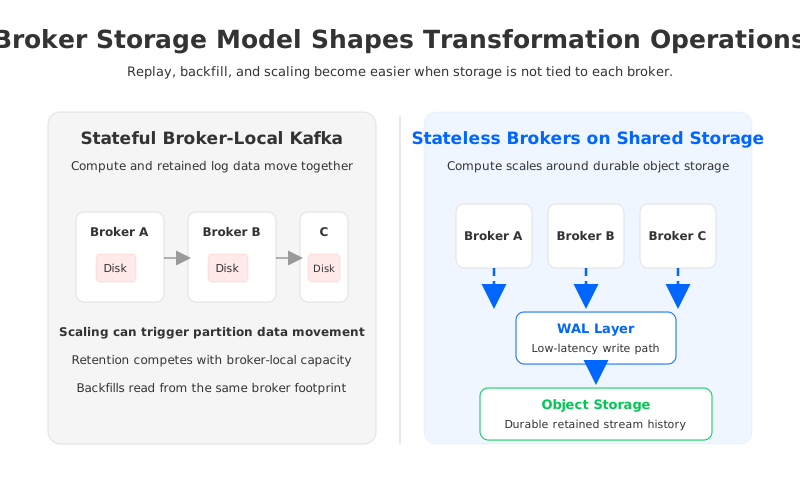
The deeper friction comes from Kafka's shared-nothing storage model. Brokers own local log data, partitions are replicated across brokers, and capacity planning binds compute and storage together. Transformation workloads stress it in specific ways: long replay windows require more retained history, multiple derived topics increase fan-out, and backfills create read spikes. Broker changes can involve partition reassignment and data movement at the same time the transformation layer is trying to catch up.
Tiered storage can help by moving older segments to object storage, especially when teams need longer retention. It does not fully remove the coupling between active broker capacity and the hot transformation path. Platform teams still need to reason about local broker storage, partition placement, cross-zone replication traffic, and the timing of scaling events.
That is how pipeline sprawl becomes infrastructure sprawl. A team creates a special enrichment job because the shared transformation job is too slow to change. Another team creates a private replay topic because the canonical one has short retention. Each decision is rational in isolation, but the platform becomes harder to operate with every exception.
4Architecture Patterns Teams Usually Compare
Most production teams compare four transformation patterns. Application-local transformation gives product teams control, but it can duplicate logic if several services need similar enrichment. Centralized stream processing with Flink or a similar engine improves reuse and state management, but it requires strong job ownership and release discipline. Connector-edge transformation is efficient for simple field operations, but too limited for complex stateful logic. Batch-plus-stream hybrid processing appears when historical correction and live traffic have different requirements.
The right answer is rarely one pattern for everything. A practical platform defines which transformations belong where:
- Light normalization near ingestion, when the rule is stable and source-specific.
- Stateful enrichment in a stream processing engine, when the job needs joins, windows, event-time logic, or exactly-once-oriented workflows.
- Domain projections close to product services, when logic expresses application-specific meaning.
- Historical rebuilds through a replay path, when model, schema, or policy changes require recomputing derived streams.
The architectural goal is to keep these patterns interoperable. Raw topics should remain available for replay. Transformed topics should have stable naming and schema ownership. Processing jobs should expose lag, checkpoint, failure, and output metrics.
This is where AutoMQ becomes relevant after the neutral evaluation. AutoMQ is a Kafka-compatible cloud-native streaming platform built on Shared Storage architecture. It keeps Kafka protocol compatibility while moving durable stream storage to object storage and using stateless brokers with a write-ahead log path for low-latency writes.
For transformation-heavy platforms, that changes the operating model. Retention can align with object storage economics rather than broker-local disk planning. Broker scaling can focus on active traffic instead of moving large amounts of partition data. Replay-heavy jobs, such as backfills or recomputing derived topics after a logic change, can be planned as reads from durable streams instead of emergency exercises around fragile historical copies.
5Evaluation Checklist for Platform Teams
An architecture review should start from the transformed stream as a product. Who owns it? Which consumers depend on it? What source records and transformation rules produced it? How far back can it be replayed? These questions separate a reusable platform from a collection of pipelines.
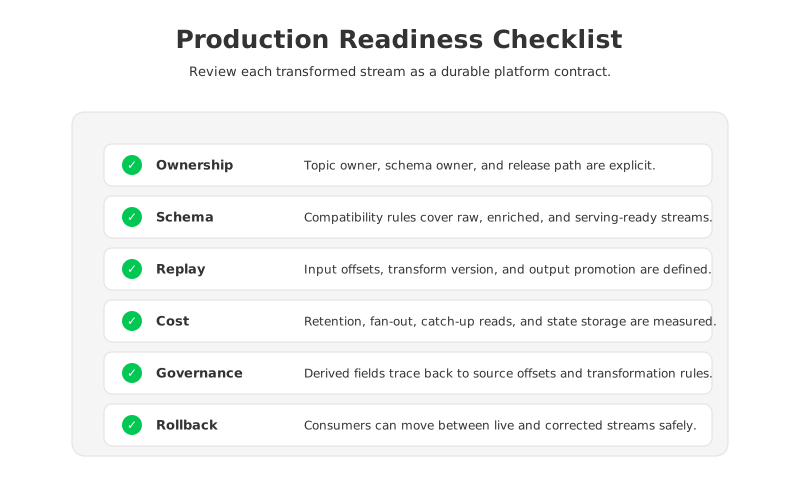
The first checkpoint is semantic ownership. A transformed topic should represent a business or platform contract, with schema rules and compatibility expectations. If the transformation masks personal data, enriches with account state, or changes event meaning, the output topic needs its own documentation and review path.
The second checkpoint is replay design. A replay should answer three questions before the job starts: which input offsets are included, which transformation version is used, and how the output will be separated from or merged into the live stream. Kafka offsets and consumer groups provide the mechanical basis, but the platform still needs conventions for versioning, idempotency, and rollback.
The third checkpoint is cost visibility. Transformation sprawl often hides cost because every job looks small. Retained raw topics, retained derived topics, multi-AZ replication, catch-up reads, processor state, and sink retries all compound. Platform teams should measure cost per source domain and per transformed contract, not only per cluster.
The fourth checkpoint is operational symmetry. Live processing and backfill processing should use the same contracts whenever possible. If a backfill requires a separate code path, separate credentials, and separate output naming, it will be used less often and trusted less when it matters.
6Where AutoMQ Changes the Operating Model
AutoMQ should not be evaluated as a transformation engine. Flink, Kafka Streams, Kafka Connect, and application services still perform the transformation logic. AutoMQ sits underneath them as the Kafka-compatible streaming layer that stores, serves, and scales the event history those systems depend on.
In an AutoMQ-based design, source systems publish raw events to Kafka-compatible topics. Transformation jobs consume those topics, maintain state in their chosen processing framework, and publish derived topics for downstream consumers. The application contract still uses topics, partitions, offsets, consumer groups, and Kafka-compatible clients. The difference is the storage model: durable stream data is placed on shared object storage, and stateless brokers use WAL storage for the low-latency write path before data is flushed to object storage.
This design is valuable when the transformation platform has to support both steady traffic and correction traffic. A schema fix may require replaying a week of source events. An AI feature launch may need a derived topic built from historical data before live serving begins. In a broker-local model, those activities compete with disk, partition placement, and cluster scaling decisions. In a shared-storage model, the platform team can reason more directly about read throughput, processor capacity, cache behavior, and object storage lifecycle policy.
The decision is not automatic. If a team runs a small Kafka cluster with short retention, predictable traffic, and few derived streams, improving topic conventions and processing ownership may be enough. AutoMQ becomes more compelling when the organization needs Kafka compatibility, long replay windows, elastic capacity, cloud object storage economics, and a customer-controlled deployment boundary.
7Decision Table
Use this table before adding another transformation pipeline:
| If your transformation need looks like this | Architecture direction |
|---|---|
| One service needs a small domain-specific projection | Keep it application-local, but publish schema and replay rules. |
| Several teams need the same normalized or enriched stream | Create a shared transformed topic with explicit ownership. |
| The logic needs joins, windows, event-time handling, or large state | Use a stream processing engine such as Flink and design checkpoint/replay from the start. |
| Historical correction and backfill are frequent | Prioritize long retention, idempotent output, and a storage model that makes replay affordable. |
| Derived streams are multiplying across business domains | Establish a transformation platform standard and evaluate Kafka-compatible Shared Storage architecture such as AutoMQ. |
Streaming transformations are supposed to reduce downstream complexity, not move it into a less visible layer. When each transformation has a clear contract, replay path, cost model, and owner, Kafka becomes a durable platform for change rather than a collection of pipes. If your team is trying to keep Kafka compatibility while making retention, replay, and scaling easier to operate, review the AutoMQ Shared Storage architecture or start from the AutoMQ product overview.
8References
- Apache Kafka documentation
- Apache Kafka consumer design
- Apache Kafka transactions
- Apache Kafka Streams documentation
- Apache Flink SQL documentation
- AutoMQ Shared Storage architecture
- AutoMQ S3Stream shared streaming storage
- AutoMQ WAL storage documentation
- AWS S3 user guide
9FAQ
9.1What are streaming transformations in Kafka?
Streaming transformations consume Kafka records, change or enrich them, and publish results to another topic or external system. They can include filtering, masking, joining, aggregation, format conversion, feature generation, and domain projection. The important production question is whether the transformed output is treated as a durable contract with schema, ownership, replay, and monitoring.
9.2Should transformations run in Kafka Streams, Flink, Kafka Connect, or custom services?
It depends on the shape of the logic. Kafka Streams fits application-owned transformations that stay close to a service. Flink is stronger for stateful SQL, event-time processing, large shared jobs, and complex joins. Kafka Connect transformations are useful for simple integration-edge changes. Custom services work when domain logic is specialized and the operational surface remains small.
9.3How do teams prevent transformation pipeline sprawl?
Separate raw source topics from transformed contract topics. Assign ownership, publish schema rules, define replay procedures, and measure cost by transformed stream rather than only by cluster. A shared platform standard matters more than the individual processing tool.
9.4Does AutoMQ replace Flink or Kafka Streams?
No. AutoMQ is the Kafka-compatible streaming platform underneath transformation engines and services. Flink, Kafka Streams, Kafka Connect, and custom consumers still perform the transformation logic. AutoMQ changes the storage and broker operating model so retention, replay, and scaling can be handled with Shared Storage architecture and stateless brokers.
9.5When should a team evaluate AutoMQ for streaming transformations?
Evaluate AutoMQ when transformed streams are becoming shared infrastructure, replay windows are getting longer, backfills are common, and broker-local storage planning is slowing down platform work. It is especially relevant when the team wants Kafka compatibility, object-storage-backed retention, elastic broker capacity, and deployment inside its own cloud boundary.


